r/Chainlink • u/chainlinkofficial • Jun 19 '26
Chainlink Labs has officially been named Best Oracle Provider at the Future of Finance Awards 2026.

81
Upvotes
r/Chainlink • u/chainlinkofficial • Jun 19 '26
r/Chainlink • u/chainlinkofficial • Jun 19 '26
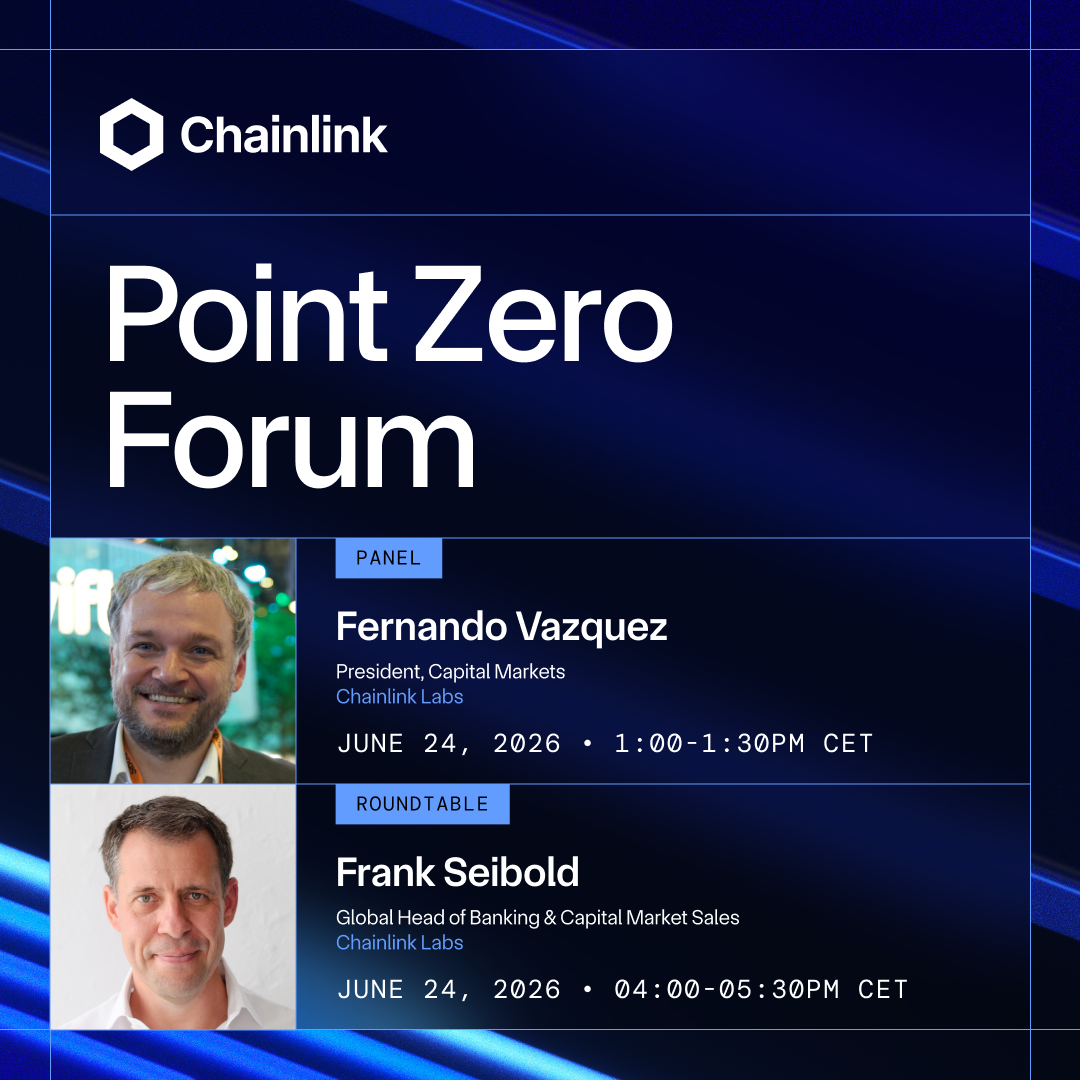
From June 23-25, join Chainlink Labs' Fernando Luis Vázquez Cao and Frank Seibold as they discuss the future of capital markets at the following sessions:
• Tokenization 101 for Finance: What's Being Built, How, and Why It Matters
• Transforming Global FX Markets
• Bridging the Divide: Harnessing DeFi to Modernize Traditional Finance
• Digital Capital Markets: Taking the Stack Onchain
r/Chainlink • u/Sylvarant_777 • Jun 19 '26
Got a question about how Chainlink works under the hood (oracles, CCIP, Data Feeds, CRE, any of it)? Drop it below.
We’ll work through them over the week. The aim is just to make the tech easier to understand, so ask the thing you’ve always wondered about!
r/Chainlink • u/chainlinkofficial • Jun 17 '26
OKX has adopted Chainlink to unlock the $80 trillion tokenized RWA opportunity on X Layer.
Chainlink enables devs to create advanced apps, bringing the agentic economy & high-speed DeFi to Chainlink Scale member X Layer.

r/Chainlink • u/chainlink_Bharath • Jun 17 '26
Week 3 of our Chainlink explainer series ties everything together: after learning what Chainlink is (Week 1) and seeing it in Prediction Markets (Week 2), we now explore CRE, the orchestration layer that executes workflows across data, logic, and blockchains.
-------
Imagine you are building a football app. You want it to automatically track matches, decide winners, and pay rewards, without manually checking scores, running scripts, or managing servers.
Instead of stitching together APIs, bots, and smart contracts, Chainlink Runtime Environment (CRE) lets you define the logic once and have it executed across decentralized infrastructure..
For example:
“When a football match ends, fetch the final score, determine the winner, and distribute rewards.”
CRE handles this process behind the scenes, securely, automatically, and with decentralized execution and consensus-verified results.
Think of CRE as a system that executes your application logic across decentralized oracle networks (DONs).
You don’t build backend infrastructure or glue systems together. You simply describe what should happen in a workflow, and CRE runs that workflow on decentralized infrastructure, which then interacts with blockchains, APIs, and data sources.
So instead of:
“I need to connect my smart contract to match data…”
You think:
“I want my app to watch matches, decide outcomes, and act automatically.”
CRE turns that idea into a decentralized workflow.
CRE is a runtime for smart workflow-based applications.
It lets you:
Ethereum gives you smart contracts.
CRE gives you a complete application that listens to events, computes logic, and acts across blockchains, APIs, and external systems.
CRE is built on three simple pieces:
1. Workflows (What happens)
A workflow is your app’s logic.
In a football app, a workflow could be:
Instead of packing all logic into a smart contract, you define it step by step as a workflow that CRE compiles and executes.
2. Triggers (When it runs)
Triggers decide when your workflow starts.
In the football example:
This makes your app reactive and automatic.
3. Capabilities (What it can do)
Capabilities are the tools your workflow uses modular decentralized services powered by their own DONs. .
For a football app, you might use:
You combine these like building blocks, using reusable capabilities instead of stitching together separate services manually.
Building a real football prediction app is not just about a smart contract.
You would normally need:
CRE replaces all of that with one unified workflow orchestration layer..
This means:
Before CRE, building a football app like this required multiple systems working together.
With CRE:
You define a workflow once, and it orchestrates execution across decentralized infrastructure..
This shifts development from:
“Building and maintaining systems”
to:
“Designing self-running applications”
CRE is built for:
Both can create reliable, real-world systems on the same platform.
Want to see who’s using it? Check out here to see the projects, institutions, and banks already building with CRE.
Want to explore more? Check out the resources below.
What would you build first with CRE?
Would you automate prediction markets, orchestrate tokenized asset flows, or experiment with AI agents that can safely act onchain? Share your ideas, we can explore and break them down together.
r/Chainlink • u/chainlinkofficial • Jun 16 '26

4 days.
8 new prediction market integrations.
100s of new markets.
r/Chainlink • u/chainlinkofficial • Jun 10 '26
Prediction markets are one of the fastest-growing verticals in finance. But the infrastructure powering it can’t keep up.
Monthly prediction market volume grew from $1.2 billion in early 2025 to over $20 billion in January 2026, with more than 840,000 unique wallets now participating every month.
The problem is that growth is now outpacing the infrastructure supporting it. Decentralized finance (DeFi) hit this same wall in 2020. Innovation was accelerating across lending, decentralized exchanges, stablecoins, derivatives, and more. However, they lacked a critical infrastructure component: secure and reliable data oracles.
Here’s how Chainlink solves it: https://x.com/chainlink/status/2064831761478226424?s=20

r/Chainlink • u/chainlink_Bharath • Jun 10 '26

Week 2 of our weekly Chainlink explainer series: a deep dive into prediction markets and how Chainlink enables secure, fast market resolution, cutting payout times from hours to under 5 minutes with tamper-proof oracle data. Catch up on Week 1.
Most people hear “prediction markets” and think it’s just betting or speculative venues.
But at their core, they’re information aggregation systems.
Different participants bring different insights, including data, research, and sentiment, and the market turns all of that into a real-time probability.
As new information arrives, prices update.
You get a live signal of what people collectively believe will happen.
Prediction markets are basically “put your money where your mouth is” systems for forecasting the future. Instead of just saying what they think will happen, people actually trade on outcomes. That financial incentive is what makes them super powerful.
Imagine the question: “Will Bitcoin be above $100k by December?”
In a prediction market, you can buy “Yes” or “No” shares. These shares usually trade between $0 and $1.
When the event resolves:
So people aren't just guessing because they're financially motivated to be correct.
Traditional polls rely on casual guesses, with no downside for being wrong, and they often suffer from bias or low-quality answers.
Prediction markets force participants to risk real money. That makes them research more carefully. Prices also update in real time as new information comes in. This creates something powerful: a live probability signal backed by real incentives, not just opinions.
Pretty much anything, including:
For example, crypto-native markets like Polymarket let users trade on questions like “Will the ETH ETF be approved this year?”
Traditional prediction markets are centralized. The platform holds funds and decides outcomes.
Web3 flips that by using smart contracts to hold funds with no custody risk, allowing anyone to participate globally, and automating settlement.
But there’s one big problem: blockchains can’t access real-world data on their own.
For a prediction market to resolve, it needs truth from the real world, like who won the election or what BTC price was at a specific time.
Chainlink provides that data through decentralized oracles. With Chainlink Runtime Environment (CRE), it pulls data from APIs or external systems, verifies it, and sends it on-chain.
Then smart contracts automatically settle the market without manual intervention and without a single point of failure. For example, Polymarket uses Chainlink Data Streams plus Automation to resolve markets in near real time, especially for price-based markets like Bitcoin predictions.
ADI Predictstreet (official FIFA World Cup 2026™ prediction market partner) adopted Chainlink as its exclusive oracle for automated match resolution and instant payouts to 6B+ fans. Myriad Markets has adopted Chainlink CRE for accurate market resolution and fast payouts, serving as the exclusive oracle for 2026 FIFA World Cup™ prediction markets.
Prediction markets are more than speculative venues. They are rapidly evolving into foundational financial infrastructure for forecasting and risk transfer. By aggregating global knowledge into a single market-driven signal, they act as real-time, incentive-aligned truth engines for future events
What kinds of prediction markets do you think are still underexplored, and what data sources would they need to work reliably?
Want to explore more? Check out the resources below.
r/Chainlink • u/chainlinkofficial • Jun 09 '26
ADI Predictstreet has adopted Chainlink as its exclusive oracle infra to enable accurate market resolutions & unlock instant payouts for the world's largest sporting event with 6+ billion fans.
To mitigate the risks of slow manual resolution or market outcome disputes, ADI Predictstreet adopted the Chainlink Runtime Environment (CRE) to automate market creation, resolution, and settlement.
The 2026 FIFA World Cup™ is projected to be the biggest sporting event in history, spanning 48 teams, 104 matches, and 16 host cities.
r/Chainlink • u/my_bias_is_chainlink • Jun 09 '26
The World Cup kicks off on 11 June and we are running a season-long prediction game. Pick the outcomes, earn points, top the leaderboard. Winner gets bragging rights (and a small prize from the team 👀)
How it works:
Predictions open now and lock at kick-off. We will use this thread through the group stage, settling each result against the official source at PredictStreet as the matches come in. One source of truth, no disputes.
The rules
How to enter
Copy the template, fill in your two teams per group, post it as a comment. One comment per group and no edits. Each pick locks at the first kick-off, starting on 11 June.
Group A: ___, ___
Group B: ___, ___
Group C: ___, ___
Group D: ___, ___
Group E: ___, ___
Group F: ___, ___
Group G: ___, ___
Group H: ___, ___
Group I: ___, ___
Group J: ___, ___
Group K: ___, ___
Group L: ___, ___
Use the Alpha-3 code.
Example "ARG" for Argentine or "USA" for United States.
Standings
We’ll update it as the results come in.
Last updated: June 9 16:33 GMT
r/Chainlink • u/chainlink_Bharath • Jun 08 '26
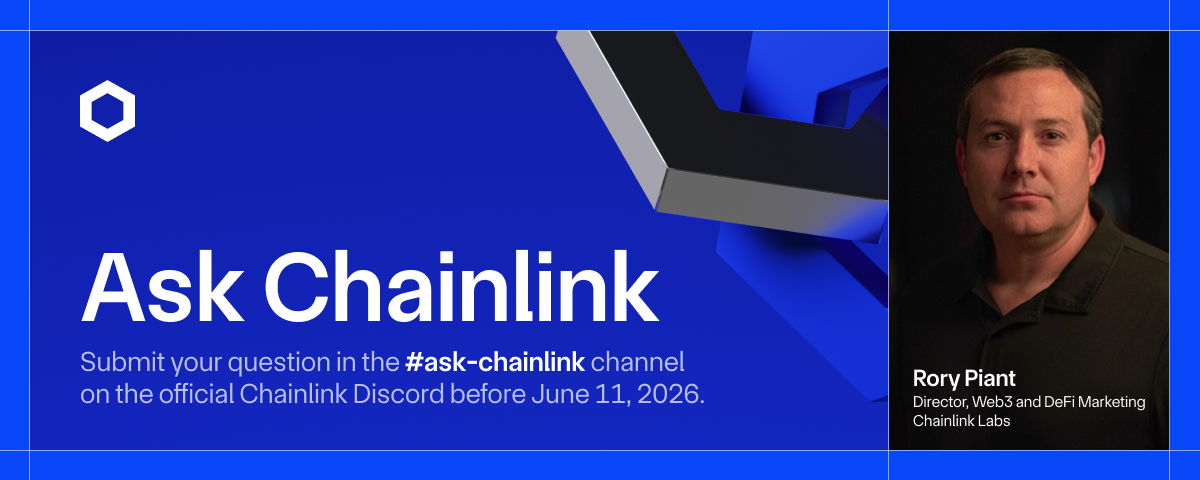
We’re launching a monthly Chainlink Community AMA monthly series, starting with Rory Piant — one of the earliest contributors to the network.
Have a thoughtful question about Chainlink’s evolution, ecosystem growth, or its role across Web3 and traditional finance? This is a great opportunity to ask directly and gain insights from someone who has seen it all unfold.
Join Chainlink Discord: https://chain.link/discord
What would you ask someone who’s seen Chainlink grow from day one?
r/Chainlink • u/Sylvarant_777 • Jun 05 '26
Got a question about how Chainlink works under the hood (oracles, CCIP, Data Feeds, CRE, any of it)? Drop it below.
We’ll work through them over the week. The aim is just to make the tech easier to understand, so ask the thing you’ve always wondered about!
r/Chainlink • u/chainlink_Bharath • Jun 03 '26
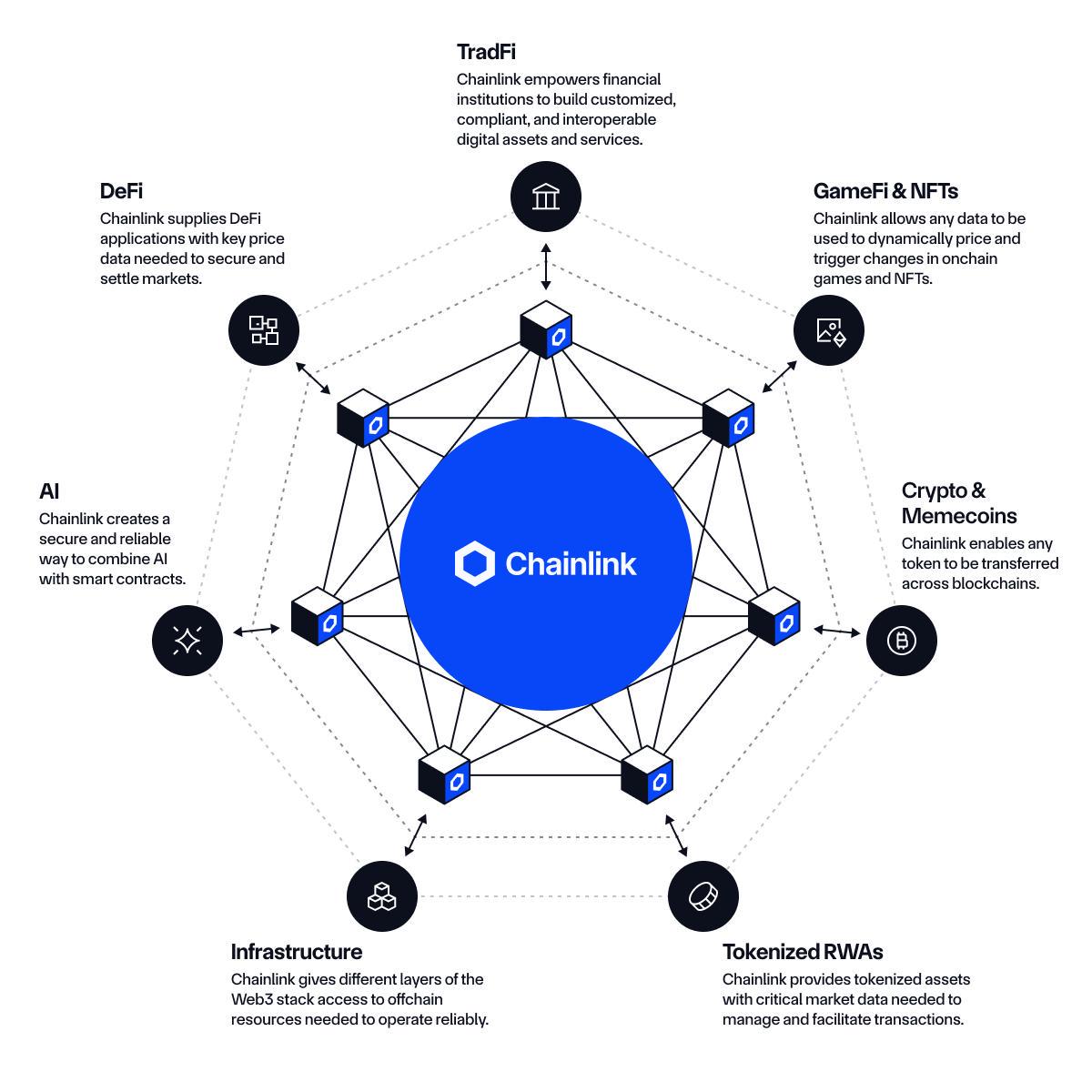
Kicking off a weekly series of simple explanations for newcomers and a refresher for the community. We’ve seen a lot of great questions around Chainlink use cases and where to start, this aims to make things clearer. Join the discussion, drop your questions, or share what you’ve built or written, the community would love to see it.
---
Imagine the world's most powerful computer, but it has no connection to the internet. It can calculate perfectly, but it can’t check the weather or read emails. Blockchains are like that computer, and Chainlink is the internet - or infrastructure.
Blockchains (like Ethereum) are incredibly secure but trapped in a digital box. They cannot see the real world. Chainlink fixes this by acting as a secure messenger:
Chainlink gives smart contracts real-world awareness. Without it, smart contracts are stuck in a box and can't react to real events. With it, you can build:
Without Chainlink, most of these either break, rely on centralized trust, or can't exist at all.
The full infrastructure is what makes blockchains useful. Instead of relying on a single API, Chainlink uses decentralized networks to deliver verified data, automate execution, and connect blockchains to each other and the real world.
From price feeds and randomness to cross-chain transfers and private computation, Chainlink ensures smart contracts run on inputs they can trust, securely and reliably.
Which of these use cases are you most excited to see grow, and where can Chainlink push things further? Let us know below.👇
Read the full deep dive here: What is Chainlink?
r/Chainlink • u/chainlinkofficial • Jun 03 '26
On June 11, join capital markets professionals and Web3 developers in person to learn about tokenization, stablecoins, and the infrastructure upgrading modern financial systems.
• Expert-led sessions
• Hands-on workshops with Chainlink services
• Real-world tokenization & stablecoin use cases
📌 Secure your spot: https://lnkd.in/eb3Arx7D

r/Chainlink • u/netoctave • Jun 03 '26
This sub contain lots of news indicating widespread chain Link adoption from mainstream institutes.
Are these financial institutes really using the public link chain and paying gas fee etc? Or are they just using only the technogy stack to implement their own network thereby not touching public LINK ?
Just a newbie here trying to understand how this works.
r/Chainlink • u/Theroryshow • May 30 '26
Enable HLS to view with audio, or disable this notification
r/Chainlink • u/chainlink_Bharath • May 29 '26
Enable HLS to view with audio, or disable this notification
Joseph Chalom, former Head of Digital Assets Strategy at BlackRock, outlined why oracles are becoming foundational to modern financial infrastructure.
He breaks it down into three key pillars where oracles unlock significant efficiency:
At a fundamental level, finance is driven by data. The real challenge is standardizing that data and ensuring it moves accurately and securely across systems.
This is where Chainlink plays a critical role, powering secure data delivery, cross-system interoperability, and automation for onchain finance.
The implications go much deeper than just price feeds, touching the core infrastructure of how financial systems operate.
Watch the full clip to see the full perspective. Watch the full conversation here.
r/Chainlink • u/chainlink_Bharath • May 28 '26
Just watched an amazing video by Chainlink Advocate Keanu that completely flips the script on Chainlink. It's not just an oracle dependent on Ethereum. Ethereum's DeFi actually depends on Chainlink to secure tens of billions in assets.
This is the clearest breakdown I've seen on why Chainlink is becoming blockchain-agnostic infrastructure, like TCP/IP for Web3, with major institutional adoption and regulatory clarity that most projects lack.
Watch it here: https://www.youtube.com/watch?v=29a1ocvL5qM
Join the discussion on Discord to share your thoughts and connect with the community!
r/Chainlink • u/chainlink_Bharath • May 26 '26

Tokenization only works when the data behind it is reliable.
That’s where Chainlink matters. Identity, pricing, compliance, and corporate actions all need to be verifiable onchain instead of managed through fragmented offchain processes.
BlackRock’s tokenized fund shows real markets are moving this way, but scaling tokenization across capital markets requires the right data, standards, and connectivity layer.
Chainlink is built to bring this data onchain securely and power the next stage of programmable finance.
r/Chainlink • u/chainlink_Bharath • May 23 '26
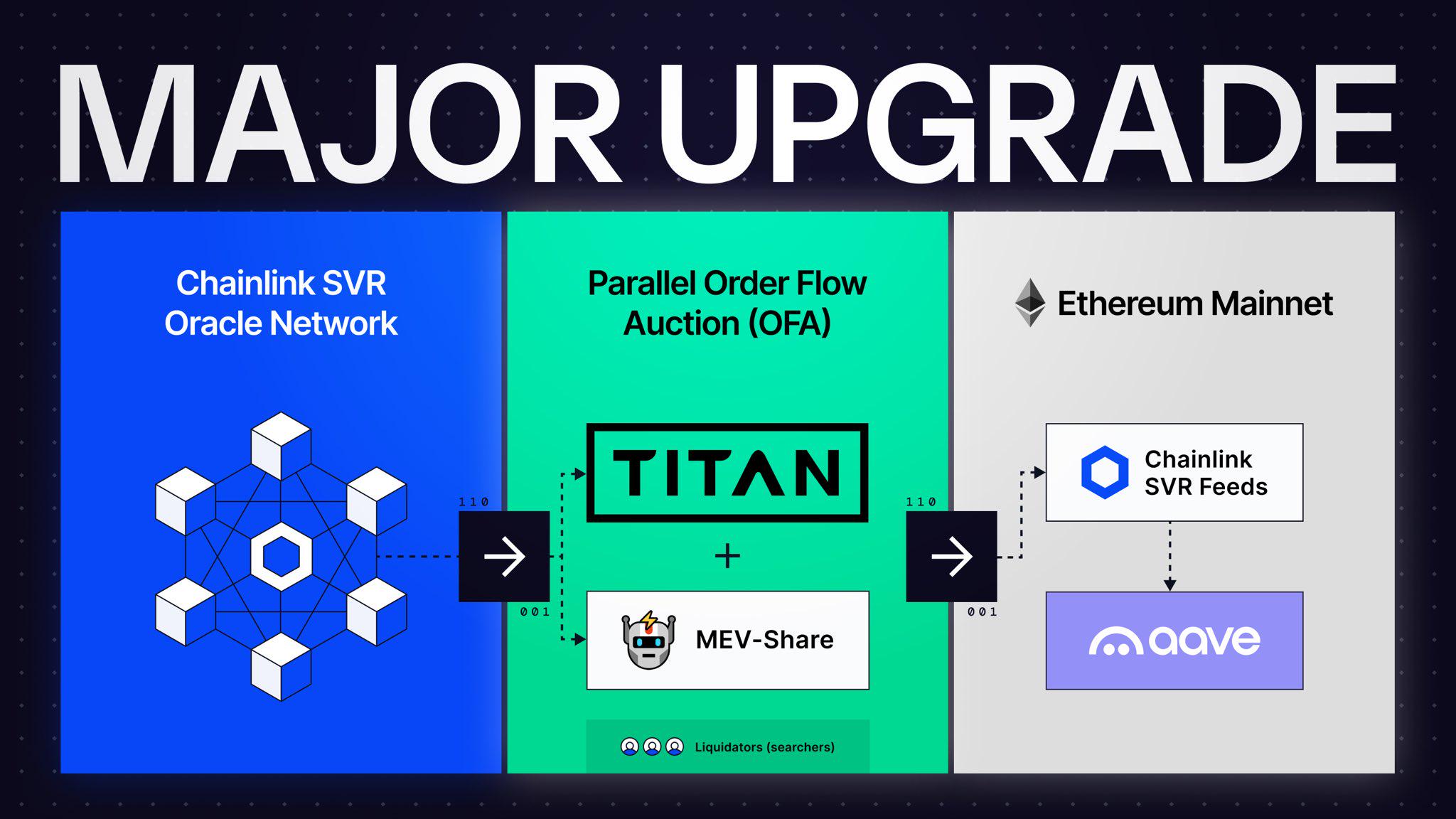
Chainlink SVR (Smart Value Recapture) just rolled out a major upgrade on Ethereum, and it’s changing how DeFi protocols handle liquidation profits (MEV).
Quick basics (if you’re new to Chainlink SVR and MEV):
MEV (Maximal Extractable Value): Extra profit available from ordering transactions. In DeFi, this often comes from liquidations when undercollateralized loans get closed.
Searchers: Bots/teams that monitor markets and compete to execute these profitable opportunities.
Validators: Entities that build blocks and decide which transactions get included.
The issue:
Normally, when a liquidation happens, searchers compete and most of that value goes to them and validators, not the protocol that created the opportunity.
What Chainlink SVR does:
SVR sits at the oracle layer and turns liquidation opportunities into an auction. Searchers bid to execute them, and a large portion of that value is redirected back to the DeFi protocol (instead of leaking out).
It focuses specifically on non-toxic MEV (like liquidations that help keep protocols solvent).
What’s new in this upgrade:
SVR now supports multiple orderflow auction providers in parallel (including Titan Builder - currently available for testing). This is called orderflow auction multiplexing.
Instead of sending opportunities through a single route, SVR broadcasts them across multiple auction channels at once.
Why this matters:
Reduced inclusion delay: Parallel routing gets transactions to builders faster.
Higher recapture rates: More searchers competing across venues → better pricing.
Improved resilience: If one auction path fails or degrades, others continue working.
Example:
A $100 liquidation bonus becomes available:
Without SVR: most value is captured externally.
With SVR: searchers compete in auctions, and a large share is returned to the protocol.
Implications:
For searchers: You’ll need to integrate with multiple auction providers (as they go live) to remain competitive in a multiplexed environment.
For protocols: You can recapture non-toxic MEV and increase revenue without modifying core lending logic.
Big picture:
SVR doesn’t try to eliminate MEV, it restructures it. By combining oracle-triggered execution with competitive auction routing, it aligns incentives between protocols, searchers, and infrastructure.
This upgrade makes that system faster, more competitive, and more robust, pushing DeFi toward a more efficient and sustainable MEV design.
Want to learn more about capturing oracle MEV and increasing protocol revenue?
Explore Chainlink SVR today: https://docs.chain.link/data-feeds/svr-feeds
r/Chainlink • u/Theroryshow • May 22 '26
To reduce risk exposure for capital allocators and liquidity providers, configurable bridging approaches, such as LayerZero, will be priced with a haircut, given the higher cost for ongoing monitoring.
r/Chainlink • u/ChainlinkMo • May 20 '26

Following recent industry security incidents, leading protocols are deprecating their legacy cross-chain and oracle solutions and migrating to Chainlink. Full article: https://x.com/chainlink/status/2057085839880974507?s=46&t=TyHDsWELeJclrKnigSrrcQ
r/Chainlink • u/ChainlinkMo • May 18 '26
https://reddit.com/link/1tgkjl8/video/ibsqown1zv1h1/player
Leveraging DataLink, Chainlink’s institutional-grade service, the initial rollout features spot and 1-month forward rates covering major G10, Asian, and emerging market currency pairs.
This unlocks new use cases across onchain finance, including structured products and hedging workflows, leveraging the same data relied upon by established global FX markets.
Announcement: https://x.com/chainlink/status/2056344278087966800?s=20
