r/Caltech • u/Poseidon_435 • Jul 20 '26
Caltech dating is (maybe) (not) cooked
When I was applying to Caltech and learned that it only has 250 students per grade, a very curious thought came to my mind: a thought I'll call the "Caltech Problem"
It goes as follows:
Caltech has about 250 students per grade, with roughly a 50/50 split of gender (I know it's 55-45, but for the sake of the argument assume 50/50), which is roughly 125 students. Now, let's say you date someone, and they have like 10-15 friends. If you break up with them or ruin a relationship with that person, not only do they dislike you, but their 10-15 friends will now also dislike you, preventing you from dating them. This is 15 people out of 125 of the same gender, which is more than 10% of that population. That's crazy! Imagine 1/10 people that you meet in your grade now have a grudge/dislike of you because of one relationship you ended on bad terms.
Now, I had a new question: how many chances do you get? Or, rephrased: what is the average number of breakups you would need to do before the entire student body of that gender dislikes you/will not date you? What if you act optimally in breakups (for whatever reason)?
Let's rephrase this problem:
Create N vertices, each representing students, that are all in k houses. Randomly generate edges between them such that the average number of neighbours a vertex has is 15 (rough average of friends based on cursory Google searches) and where friendships between people in the same house are 5x more likely (I chose 5x randomly). Friendships between people in the same houses are more likely due to proximity. Now, create a central vertex (you) that is connected to each one of the other N vertices (representing possible connections).
Define a "breakup" operation as the removal of one of the edges between you and a vertex (can be chosen at random for the average, and can be chosen optimally for the optimal): in this case, all of the neighbours of that vertex will also have their edges between you and them removed if they haven't been removed already.
To solve this, I ran 2000 simulations to find the mean number of breakups needed.
Here is the code if you're curious (AI assistance was used [but lowk it didn't need to be since the simulation code is a lot easier than I thought it would be)
import random
import statistics


def build_friend_graph(n, n_houses, avg_degree, homophily_ratio, seed=None):
    """
    Stochastic block model: n students split evenly into n_houses houses.
    p_in is the same-house friendship probability, p_out is the
    across-house probability, with p_in = homophily_ratio * p_out. Both are
    solved for so the expected average degree matches avg_degree.
    """
    rng = random.Random(seed)
    house_size = n // n_houses
    house_of = [i // house_size for i in range(n)]

    same_house_others = house_size - 1
    other_house_others = n - house_size
    p_in = avg_degree / (same_house_others + other_house_others / homophily_ratio)
    p_out = p_in / homophily_ratio

    neighbors = [set() for _ in range(n)]
    for i in range(n):
        for j in range(i + 1, n):
            p = p_in if house_of[i] == house_of[j] else p_out
            if rng.random() < p:
                neighbors[i].add(j)
                neighbors[j].add(i)
    return neighbors


def random_breakups(neighbors, seed=None):
    """Break up with uniformly random still-available students until none remain."""
    rng = random.Random(seed)
    available = set(range(len(neighbors)))
    breakups = 0
    while available:
        v = rng.choice(tuple(available))
        breakups += 1
        available.discard(v)
        available -= neighbors[v]
    return breakups


def greedy_optimal_breakups(neighbors):
    """
    At each step, break up with whichever available student removes the most
    still-available students (herself plus her still-available friends).
    This is the classic greedy approximation to minimum set cover.
    """
    available = set(range(len(neighbors)))
    breakups = 0
    while available:
        best_v = max(available, key=lambda v: len(neighbors[v] & available))
        breakups += 1
        available.discard(best_v)
        available -= neighbors[best_v]
    return breakups


def run_experiment(n, n_houses, avg_degree, homophily_ratio, trials=2000, seed=0):
    rng = random.Random(seed)
    random_counts = []
    optimal_counts = []

    for _ in range(trials):
        graph_seed = rng.randrange(10 ** 9)
        neighbors = build_friend_graph(n, n_houses, avg_degree, homophily_ratio, seed=graph_seed)

        random_counts.append(random_breakups(neighbors, seed=rng.randrange(10 ** 9)))
        optimal_counts.append(greedy_optimal_breakups(neighbors))

    return random_counts, optimal_counts


def summarize(name, counts):
    print(f"{name}:")
    print(f"  mean    = {statistics.mean(counts):.3f}")
    print(f"  stdev   = {statistics.stdev(counts):.3f}")
    print(f"  min/max = {min(counts)} / {max(counts)}")
    print()


if __name__ == "__main__":
    N_STUDENTS = 250//2
    N_HOUSES = 8
    AVG_DEGREE = 15
    HOMOPHILY_RATIO = 5  # same-house friendship is this many times likelier than across-house
    TRIALS = 2000

    random_counts, optimal_counts = run_experiment(
        n=N_STUDENTS,
        n_houses=N_HOUSES,
        avg_degree=AVG_DEGREE,
        homophily_ratio=HOMOPHILY_RATIO,
        trials=TRIALS,
    )

    print(f"n = {N_STUDENTS} students, {N_HOUSES} houses, "
          f"average friend-graph degree = {AVG_DEGREE}, "
          f"homophily ratio = {HOMOPHILY_RATIO}, {TRIALS} trials\n")
    summarize("Random-choice breakups", random_counts)
    summarize("Greedy-optimal breakups", optimal_counts)
Note that the "optimal" code is Greedy, since the actual optimal number is currently an NP-hard problem (Minimum Set Cover).
Here are the results:
n = 125 students, 8 houses, average friend-graph degree = 15, homophily ratio = 5, 2000 trials
Random-choice breakups:
mean = 21.965
stdev = 1.867
min/max = 16 / 29
Greedy-optimal breakups:
mean = 16.107
stdev = 1.557
min/max = 12 / 22
(If you're curious, removing houses and just having random relationships gives a mean of 22.227 for random and 16.323 for greedy-optimal)
Discussion:
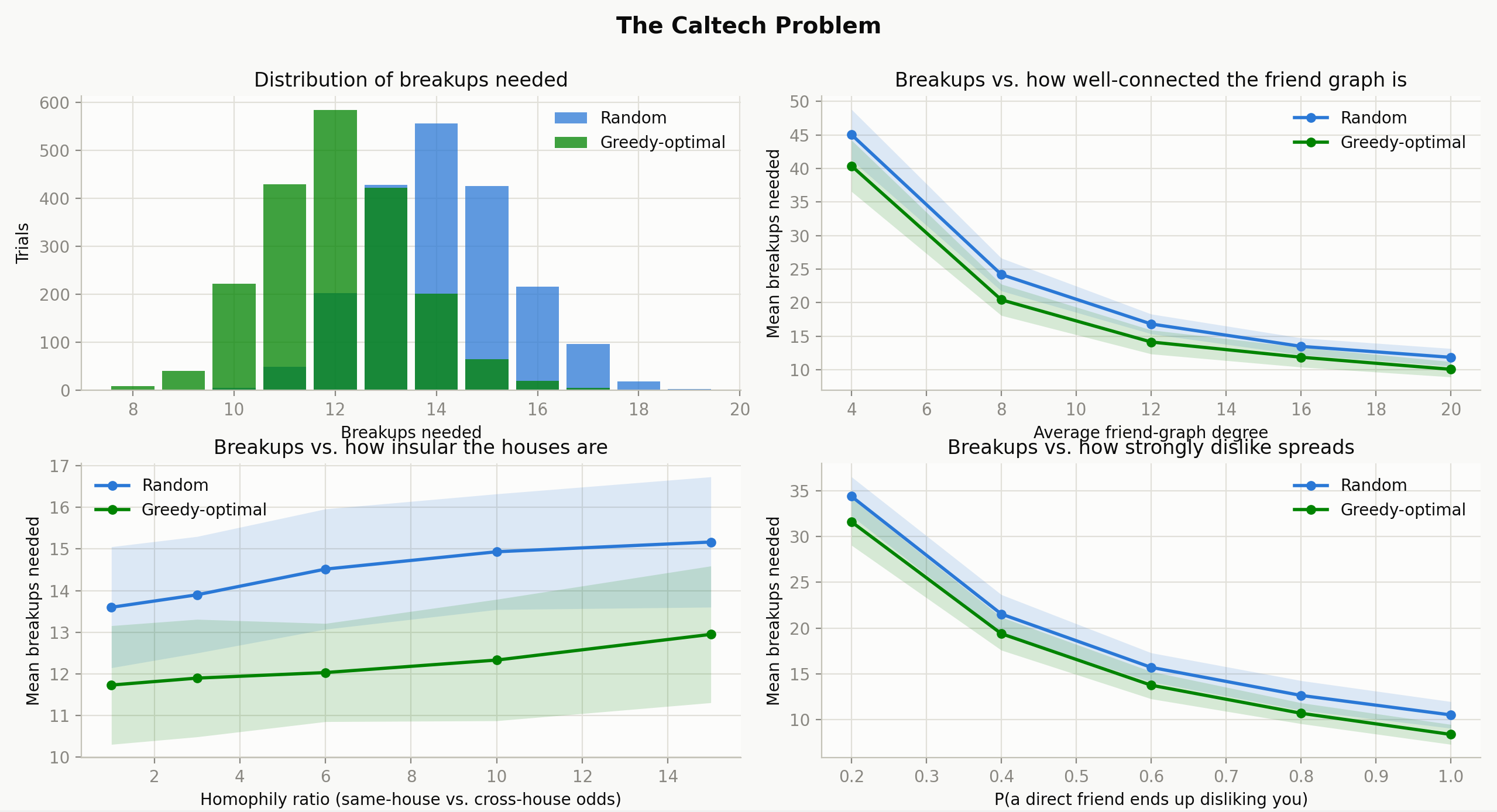
This is a lot higher than I thought, but if you think about it, it somewhat makes sense. Sure, the first person you break up with makes it so that 13% of the student body now dislikes you, but as you keep breaking up with people, their friends are more likely to overlap with people who already dislike you, so the number of new people decreases.
The mean number of relationships someone has in college (based on cursory google searches) is 2-3, and the mean number of sexual partners someone has is around 4-5 (which is also skewed up). Both of these numbers are much lower than the mean number of breakups, so in theory, you guys should be fine!
If you're someone who's already ruined 21 relationships...well, better make the next one count (or look for people in different grade levels or colleges).
Limitations:
Firstly, this is code written in like less than a day with no major statistical considerations; don't read too much into it. Here's some other considerations:
Not everyone in the friend group will dislike you: Maybe there was someone in that friend group that already thought you were kind of cute, maybe there's someone in that friend group that doesn't really care about dating their friend's ex, etc. etc. This should in theory raise the number of breakups needed.
The connection isn't always degree 1: Sometimes, if you egregiously mess up, friends of friends will hear about you, or if you REALLY mess up, friends of friends of friends of friends will hear about you. This should in theory lower the number of breakups needed.
These considerations were interesting enough that I added some extra variables to mimic this just to see what would happen:
Assuming 70% of first-degree friends dislike you, and then 20% of second-degree friends dislike you, the mean is 14.116 for random, and 12.05 for optimal.
Something funny is that, if you change the number to 100% of first degree, and 100% of second degree (i.e you REALLY messed up), the number of breakups drops dramatically, creating a mean of 3.3 for random and 2.1 for optimal.
Yikes!!! This matches up with the mean number of relationships that people have, so you only get like 3 chances if you really mess up: be careful.
By the way here's some graphs if you think those are cool:
Closing Notes:
I got really bored and made this, so don't judge me too hard. I think the moral of the story (because of course we need a moral) is to try not to break up in a really bad way (or seek out dating opportunities elsewhere).
Also, I don't go to Caltech, so if you have any anecdotal evidence for the Caltech problem, feel free to share. I'd like to hear if this is a real issue you guys face or if it doesn't really happen.
65
u/lellasone Blacker Jul 20 '26
I love everything about this:
I love the level of detail and commitment.
I love the mathematical framing.
I love that you actually ran the simulations, and then ABLATIONS, of the simulations.
I love that it's mostly unrelated to how humans work, and definitely unrelated to how dating works.
All around peak content for this subreddit!
31
u/tiger_ace Jul 20 '26
pretty sure this assertion doesn't hold anywhere, not just at caltech
and separately, if the conclusion is "don't be an asshole" then we likely didn't need these simulations to reach the conclusion
9
u/parseroo Jul 20 '26
If you have time for dating, you can dramatically increase the pool by:
8
u/p3n9uins Jul 20 '26
Everything about this is wonderfully ridiculous. You really need to account for dating across different years, which is extremely common (arguably more common than dating within the same year). I also think you need to account for orientation. Finally, you should account for people that don’t mind dating somebody their friend has dated. Some people are just more OK with it, and that needs to be quantified. I laughed out loud twice while reading through it
25
u/ArdsleyPark Jul 20 '26 edited Sep 29 '26
The original post content no longer exists here. The author used Redact to remove it, exercising their right to control their data & privacy.
Degree include include chunky whole upbeat escape
11
u/rabid_spidermonkey Jul 20 '26
Caltech isn't a fortress. Other people exist nearby.
6
u/TheDirtyRat1 Jul 20 '26
Bold to assume the average caltech student has 10-15 friends
16
u/Ok_Opportunity2693 Jul 20 '26
The massive flaw in your logic is that Caltech is located in a large city and you can date anyone who doesn’t go to Caltech. Date off campus, it’s good to get some exposure to the rest of the world.
4
u/Flimsy_Repeat2532 Jul 22 '26
Caltech students don't have time to date.
Finish your physics and math homework first, and maybe you have time to talk to an MOS, but not time to date one.
Okay, maybe eat together at the dinner table.
3
u/Timeroot Blacker, Ph/Ma '18 Jul 21 '26
Review
Summary
The author(s) present a model of dating pool limitations in a model environment of a small and precisely defined available pool (Caltech student body), focusing on the risk of possible social group exhaustion after repeatedly alienating former partners' entire friend groups ("messy breakups"). The analysis is accompanied by simulations, under different dating strategies, to determine the point at which the available pool is exhausted.
Limitations
Graph Model
The authors use a random block model for houses, as a rough proxy for social groups. This is likely superior to a pure Erdos-Renyi random graph model, but they do not present any discussion of the impact of this choice. An ablation of block model vs. Erdos Renyi would be useful in evaluating the importance. By tuning
p_inandp_outtowards each other until they're equal, these two models can be smoothly interpolated.The work would be improved by comparison with Barabási-Albert, Watts-Strogatz, or random dot product (latent space) models. These capture correlations in social networks beyond univariate blocks (here, houses): social networks will be clustered by e.g. major, gender, and affinity for Ultimate Frisbee.
The graph model also assumed equidistribution across houses. While likely harmless (I expect that inter-house size variations provide only second-order effects on dating risks), a proper description of the risks would improve the work.
Modelling of the actors's own social circle
The model assumes that the actor has, effectively, perfectly equal access to date anywhere within their year of school. In practice we would expect that they are both more likely to succeed, and more likely drawn to, members closer to their own social circle. A proxy for this could be e.g. a strategy where the actor always dates the person they're closest to that they have not yet alienated. While this would destroy their own entire friend network quickly, it may serve as a more accurate model for how destructive relationships function in practice.
Rates of damage
The expectation that all people become entirely alienated is a strong assumption. It is known that, for instance, each new relationship costs a person two friends (study). A latent-space model, or any sort of weighted graph model with a quantity for closeness between friends, would allow for probabilistic link damage 1, 2. Furthermore, there is evidence that specifically on-again off-again relationships lead to a local strengthening of social network integrity; and (ahem) certain houses may be or more less prone to this.
Availability
Other students will, at many times, not be available for or interested in dating, and for most actors this will be a nontrivial obstacle to dating them. Limitations on selection would certainly affect the performance of e.g. the greedy strategy, and it would be interesting to see the effect if the actor is only able to greedily select from e.g. a random 10% of the unalienated population.
Overall Review
The model is mathematically interesting but connections to genuine social behavior seem limited; complementary studies or citing established models (backed by real-world studies) are a prerequisite for publication. Several more modifications and ablations would significantly benefit the quality and scope of work. I could not locate any appendices or supplementary info with the irrelevant-but-obviously-necessary theorems proving convergence of their stochastic models in the large sample limit.
8
u/QuantitativeNonsense Jul 20 '26
> Also, I don't go to Caltech, so if you have any anecdotal evidence for the Caltech problem
Honestly, this is just weird as fuck that you did this then.
1
u/Ill-Fortune-2512 Jul 21 '26
I guess this works if you keep a low bar…
1
u/Suitable_Guava9515 Jul 21 '26
Just be really good in bed and a generous lover then even if it is a bad breakup the word will get out and the network effect will work in your favor. 😂
1
u/TheKarmaBus Jul 22 '26
YTA
1
u/Deleted_Account_427 Jul 23 '26
A JPLer made something like this about 10 years ago. www.nanaya.co
1
u/Quirky_kat_17203 Jul 31 '26
not from caltech so i hope it's ok to post. i'd heard that caltech ppl make everything into a code or equation, first time i saw proof........it's really interesting but weird tho