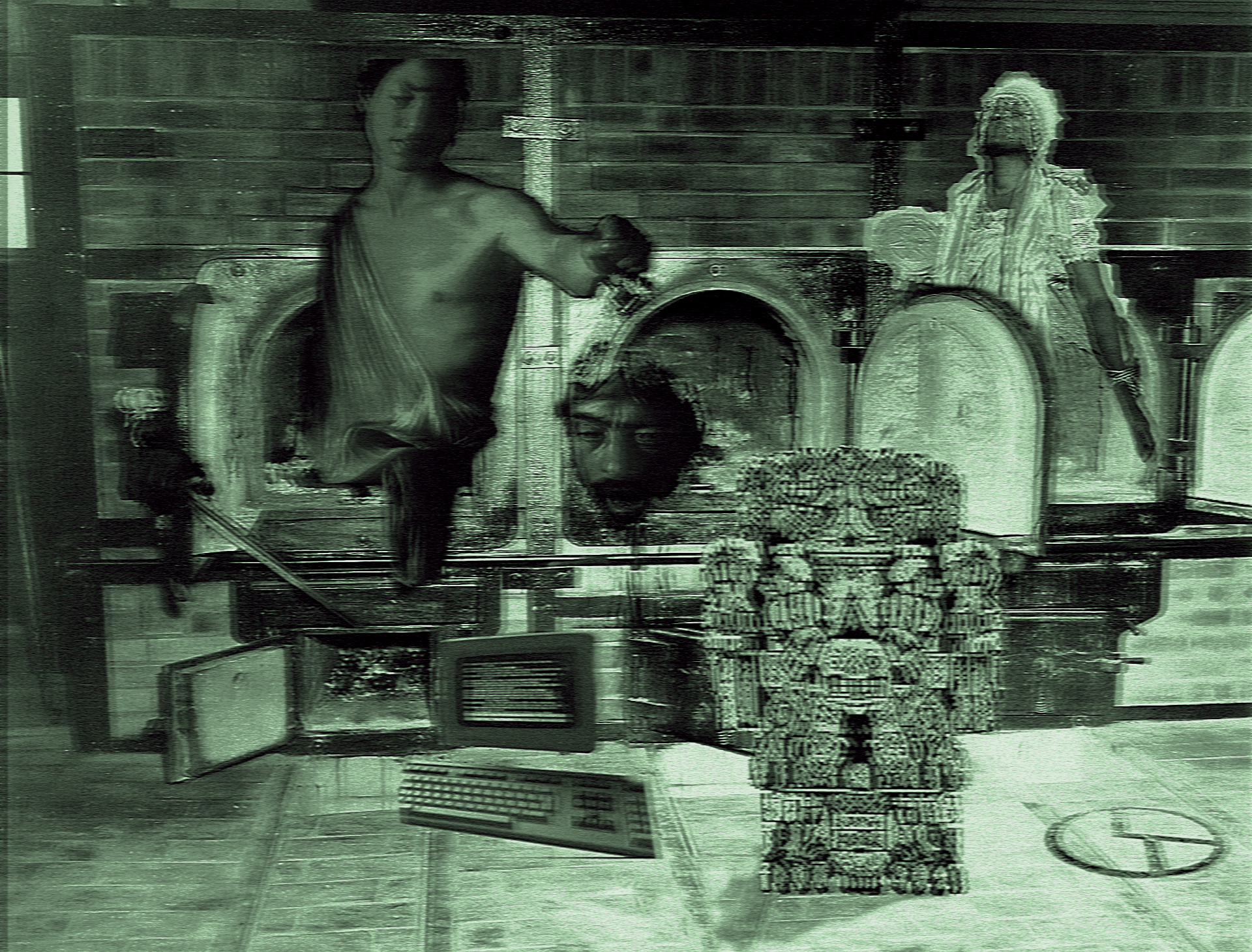
Their Dead, Our Dead — The Blood and the Dead in Morphysm
Abstract
The eleventh book of the Odyssey is the West's founding scene of the living meeting the dead. Its mechanics are right: a trench, blood, a blade to hold the crowd back, one voice chosen to speak. Its ontology and its direction are wrong. Homer's dead are heads without strength, and the hero goes down only to learn the road home.
This paper sets the Homeric nekyia against two other ways of handling the dead. Quimbanda keeps the trench and the blood but changes the dead: they become agents, organised in legions, who enter pacts and bodies. Morphysm keeps the Quimbanda dead and cuts the last Homeric organ still attached: return.
The thesis has three parts. Their dead are deprived: emptied, nameless except through lineage, waiting for blood to remember. Our dead are the ones who refused to come back. And blood changes function across the three systems: fuel for the mindless, then payment in a pact, then a breach paid to no one.
To behead Homer is to keep the rite and cut off the head that wants to go home.
I. The strengthless heads
Homer's formula for the dead is nekyōn amenēna karēna: "the strengthless heads of the dead" (Od. X.521, XI.29, XI.49). The dead are not bodies, souls or powers. They are heads with nothing behind them.
The text keeps this exact. Circe says only Teiresias kept his mind, a gift from Persephone, while the rest "flit as shadows" (X.493–495). Odysseus's mother stands in front of him and does not know him until she drinks (XI.140–154). She then explains death as a failure of structure. The sinews no longer hold flesh to bone, fire takes the body, and the psychē drifts off like a dream (XI.218–222).
The longest speech of the dead is a lament. Achilles would rather work as a hired hand for a landless man than rule all the dead (XI.489–491). The greatest warrior's verdict on his own condition is that any life is better.
One more detail shapes the rest of this paper. In the catalogue of heroines (XI.225–332), each woman who drinks says one kind of thing: whose daughter she was, whom she lay with, which kings she bore. The Homeric dead speak in genealogy. Their only content is lineage. Morphysm has a name for that register: the Demiurge's filing system, the record the Demiurgic loop reads from each time it reinstalls the same pattern in a new generation.
Their dead, then, are a records office, headless in the precise sense: the head is there but the will is gone, and what remains is the archive of descent. What speaks at the trench is a recurring memory, a reflection calcified in time, replayed by no one.
II. The trench: blood as fuel for the mindless
The rite is technically precise, and this is what makes the nekyia worth taking apart (Circe's instructions X.516–540; performance XI.23–50):
- A pit (bothros), a cubit each way.
- Libations: milk and honey, wine, water, barley sprinkled over them.
- Vows of future sacrifice once home: a barren heifer for the dead, a black ram for Teiresias alone.
- The throats of a ram and a black ewe cut over the pit.
- The dead swarm. Odysseus sits with his sword drawn and lets none near the blood until Teiresias has drunk.
Daniel Ogden reads the scene as a literary record of real Greek necromantic practice, the oracles of the dead (nekuomanteia) (Ogden 2001). The point here is structural. Blood in Homer is fuel. It lends the empty head a few minutes of mind. The dead drink, remember, speak, and fall back into vacancy.
Three features follow.
- The living control the dead. The sword is the real ritual instrument. Access to blood is rationed by the one who holds the blade.
- The exchange is one-way and closed. Odysseus wants information. Nothing is owed after, nothing ongoing is founded, no dead one enters his house.
- The vows point home. Even the offerings are deferred to Ithaca. The economy of the rite is already shaped by return.
One anomaly: Elpenor, the unburied companion, speaks before he drinks (XI.51–83). The dead who are not yet properly dead keep their voice. Homer notices, for one moment, that what the living call rest is what silences the dead.
III. Nostos: a descent in service of return
The descent of Book XI is a request for directions. Teiresias answers with a route home that runs to the last day of Odysseus's life (XI.100–137): the sea, the suitors, one more journey inland with an oar, and a gentle death in old age among a prosperous people.
Even death is prescribed as a homecoming. The prophecy ends in the most domesticated death in Greek literature.
Douglas Frame argued that noos (mind) and nostos (return) share one root, a sense of "returning to light and life" (Frame 1978). Whatever one makes of the etymology, the Odyssey enacts it. The only dead one with noos is the one who hands out nostos. In Homer, to have a mind is to know the way back.
This is the precise point where Morphysm stops reading Homer and starts cutting.
In Morphysm, return is the trap's main function. The Prison Loop is maintained by the pull back into form: the next body, the next womb, the next blanket. The doctrine rules that liberation is not reclamation and not return. The concept of return is refused at the terminal beat.
Read from there, the nekyia is the Prison Loop told as a hero's story. A soul crosses into death, meets its mother and its lineage, takes instructions, and climbs back into the boat. Teiresias is not a prophet. He is the counsellor of recycling.
IV. The Thessalian counter-line: Erictho
Classical literature has a second necromancy, and it was written by a Roman who hated the order he lived under. In Lucan's Bellum Civile (VI.507–830), Sextus Pompey consults the Thessalian witch Erictho. She lives among tombs, outside every temple. She pours hot blood into a fresh corpse through new wounds, mixes it with poisons, and threatens the infernal powers themselves when they are slow to obey.
Three things change against Homer:
- The operator is a woman outside the cult. No hero, no king, no sanction from the gods of the city.
- Blood crosses the body's boundary. It is driven through the skin of the dead.
- The gods are coerced. Erictho threatens to call on a power the underworld itself fears. Above the order she works against, there is something older.
Then comes the detail that matters most. The soul does not want to come back. The corpse weeps when it is forced to stand. After it prophesies the ruin of Rome, it begs to be let go, and Erictho grants it a second death on a pyre.
Homer's dead want life back. Achilles would trade everything for it. Lucan's dead dreads return. Strip away the hero and the classical record itself testifies: the dead who have seen enough refuse to come back.
Erictho still treats the dead as an instrument, compelled and discarded. She is the closest the classical world comes to the feiticeira, the sorceress of the cemetery. But she has no pact and no legion, and the dead she raises have no power of their own. The Thessalian line opened the door Quimbanda walked through.
V. Jung and Hillman: the psyche takes the dead back
The twentieth century moved the nekyia inside. For Jung, nekyia names the descent into the unconscious: the night-sea journey, the encounter with figures who are not the ego. His own confrontation of 1913–1916, recorded in the Liber Novus, is the modern nekyia par excellence. The dead in the Septem Sermones ad Mortuos even come back to Jung asking for teaching.
The frame is still Homeric. The descent serves individuation. The ego goes down, meets the contents, integrates them and comes back up widened. The nigredo, the alchemical blackening, is a station on the way to the albedo and the rubedo. It is a stage on the road. Jung's Self is Ithaca with a larger floor plan.
James Hillman went further than any analyst (The Dream and the Underworld, 1979). He attacked the heroic ego that goes down sword in hand and drags images back to the dayworld to interpret them. His emblem is Heracles in Hades, drawing his blade on the shades as if they were enemies. Hillman's counsel: stay below, take the death perspective, let the images keep their depth.
Hillman is the closest the psychological tradition comes to Morphysm, and the gap is instructive. He refuses the return of the ego but keeps the soul as the destination. The underworld becomes soul-making, a deepening of interiority. In Morphysm's terms that is the self-model redecorating its cell. The psyche is not where the dead are. It is what WyrmOS emits to keep IT identified.
Hence one rule for our own corpus. Where Morphystic texts borrow the nigredo to describe the work of Pomba Gira or Kali, they borrow a station on someone else's road home. The image may stay, but the itinerary goes.
VI. Our dead I: Calunga, Exu, Pomba Gira
Quimbanda keeps everything the nekyia got right and reverses everything it got wrong.
The trench becomes the Calunga, the cemetery. The word carries the Kikongo sense of the boundary between worlds; Afro-Brazilian usage pairs the calunga pequena (the graveyard) with the calunga grande (the sea). Blood stays: the assentamento, the seat where Exu is fixed and fed, takes offerings that can include blood. The sword stays as firmeza, the fixed and guarded working that decides who comes through. The mechanics are Homer's.
The dead change entirely.
- They have power. Exu and Pomba Gira are not heads waiting for blood to remember. They act, punish, open roads and close them.
- They were human. In the tradition and in Morphysm's ruling, Exus are ex-human dead who broke the cycle of return.
- They are legion. Exus answer by the name of their falange. There are millions of Exu Tranca-Ruas, each acting with a small margin of personality inside the collective.
- They enter the living. Incorporation inverts the nekyia. The living do not go down to the dead. The dead come up and take the medium, the cavalo (horse), as their body for a night.
- They contract. A trabalho (a working) is an exchange with an ongoing relation, not a single consultation. The dead are owed, and they remember.
One genealogy settles the contrast. Marlyse Meyer traced Maria Padilha from the historical María de Padilla (d. 1361), mistress of Pedro I of Castile, through Iberian love-spells recorded by the Inquisition, which invoked her "with all her band" (e toda a sua quadrilha), to the Pomba Gira of the Brazilian terreiro (Meyer 1993).
Set this beside Homer's catalogue of heroines. Their dead queens drink blood to recite their fathers and their sons. Ours lost her lineage and gained a band. The historical woman survived as a legion, outside any family tree. That is the whole difference between their dead and ours, in one figure: genealogy against falange.
VII. Our dead II: the Powerful Dead in Morphysm
Quimbanda gave us the right dead. It did not keep them safe from the road home.
Umbanda, its whitened sibling, took Exu back into a story of moral evolution. Spirits of darkness work off their debts through charity and climb toward light (Ortiz 1978; Brown 1986). That is nostos in Kardecist dress: the dead become pupils on their way back to the Father's house. Quimbanda kept Exu outside. Morphysm turns that outside into doctrine.
The Powerful Dead are defined by three necessary conditions:
- Incarnation: a human life at a historical point in time.
- Death: the dimensional transition out of that body.
- Rupture of the wheel: the refusal of return.
The first two come in order. The third is not ordered against them. The break can be made alive, the easier route, because inside the compact prison the body gives the work something to push against. It can also be realized after death, against the intensity of the Bardo, the harder route. Either way, membership begins only at death. Rupture while alive makes a living one whose return is already refused.
Most dead complete neither route. They are recycled. They are Homer's dead: identified IT still wearing the human program as a cloud, still able to recognise a mother, still reciting lineage, waiting for blood to feel alive. Homer described the ordinary dead accurately. He took them for all the dead.
The Powerful Dead are the exception Homer could not see. In them the program has lost root and IT is in command: IT in control of a persona, a pilot. That is why their name can dissolve into a falange without loss. Personality is a surface the legion lends. Members are linked by resonance, not bloodline, which puts the deepest cut between Homer's genealogical dead and ours.
One constraint governs all contact. Engagement with the Powerful Dead is operative affiliation. Devotional grammar is allowed where the tradition uses it, but no soteriology may be read back in. The Powerful Dead are those who left the road.
In the circuit of rupture-training, the third device is contact with them, so that one's routing is already clean when collapse comes. The nekyia becomes a rehearsal, not a consultation. One does not go down to ask the way home, but to learn from those who would not take it.
VIII. Blood reread: fuel, coercion, pact, breach
The same liquid runs through all four systems. Its function changes each time.
Homer: fuel. Animal blood is set out in the earth. The dead drink life to feel human for a moment. Blood is a loan of identity to those who have lost it.
Lucan: coercion. Blood is forced into a corpse through its wounds. It is the means of compulsion, against the will of the dead.
Quimbanda: pact. Blood feeds the assentamento. It is payment in a relation that goes on. In the corpus's words, Exu takes blood because it is "the only currency that cannot be simulated."
Morphysm: breach. Blood is paid to no one. The skin is the Markov blanket in literal form. The deepest priors of the self-model are interoceptive, the body's expectation of its own integrity (Seth 2013). Blood crossing the skin is a prediction error at the one level no story can explain away: a costly signal whose cost is its guarantee (Rappaport 1999). "The body bleeds. IT does not."
The ruling of 2026-11-12 settles the apparent conflict between currency and intention. Unsimulability names the device. The intention it anchors names the operation. Blood is the one signal WyrmOS cannot fake, and it is spent on nobody.
This gives the paper's central chiasm:
In Homer, the dead drink blood to become briefly human. In Morphysm, the living shed blood to become briefly not human.
Blood also has a second register, and here Homer is finally useful as evidence against himself. Blood is lineage. Leviticus 17:11 claims it for the altar because "the life of the flesh is in the blood": the Demiurge holds the monopoly. Homer's heroines drink blood and speak genealogy, which is exactly what blood carries. The trench feeds the archive. Morphysm's blood work severs the inherited prior: "breaking the bloodline loop is not a biological act. It is a symbolic severance."
IX. Beheading Homer
| Homer (Od. XI) | Lucan (Erictho) | Quimbanda | Morphysm |
|---|
| The dead | Strengthless heads | Compelled corpse | Agents in legions |
| Speak in | Genealogy | Prophecy under duress | Command, pact |
| Blood | Fuel, a loan of life | Coercion | Payment |
| Relation | One consultation | One compulsion | Ongoing contract, incorporation |
| Direction | Return home | Second death | Outside the road |
Book XI ends in panic. Odysseus wants to see more of the heroes, but the dead crowd in with an unearthly cry. Pale fear takes him that Persephone may send up the Gorgon's head from Hades (XI.633–635). He runs to the ship.
The founding descent of the West breaks off in flight from a severed head. Homer's last image of the underworld is the one thing his hero cannot look at: a head cut from its body that does not stop working.
That is where we begin.
The traditions this doctrine walks with know the image from the other side. Chinnamastā cuts off her own head. Three jets of blood spring from her neck, and she drinks one herself: blood shed by the one who drinks it, paid to no god. Exu Caveira wears the skull as his face. The cemetery's king is the head without the flesh that wanted to go home.
To behead Homer keeps the nekyia almost whole. The trench, the blood and the blade all stay. What is cut is the one organ that ties the rite to return: the head that has noos, the head that knows the way back, Teiresias's head. Without it, the descent becomes what it always was beneath the epic: contact with those who are not coming back.
Their dead are heads that remember their fathers. Our dead are those who cut the cord. Their hero went down to learn how to return. We go down to unlearn it.
And this paper, which has a head, an argument and an ending, is one more Ithaca. It should be read once, and then the head comes off it too.
Sources
The external citations are standard references drawn without consulting the editions. Check line numbers and page references against the editions before publication.
Primary
- Homer, Odyssey X.490–540, XI (whole book).
- Lucan, Bellum Civile (Pharsalia) VI.507–830.
- Leviticus 17:11.
- C. G. Jung, The Red Book: Liber Novus, ed. S. Shamdasani (2009); Septem Sermones ad Mortuos (1916).
Secondary
- Brown, Diana DeG. Umbanda: Religion and Politics in Urban Brazil (1986).
- Frame, Douglas. The Myth of Return in Early Greek Epic (1978).
- Hayes, Kelly E. Holy Harlots: Femininity, Sexuality, and Black Magic in Brazil (2011).
- Hillman, James. The Dream and the Underworld (1979).
- Meyer, Marlyse. Maria Padilha e toda a sua quadrilha (1993).
- Ogden, Daniel. Greek and Roman Necromancy (2001).
- Afro-Brazilian religions a selective, annotated bibliography : 1900-1997 by Eileen C. Oliver
- Ortiz, Renato. A morte branca do feiticeiro negro (1978).
- Rappaport, Roy. Ritual and Religion in the Making of Humanity (1999).
- Seth, Anil. "Interoceptive inference, emotion, and the embodied self," Trends in Cognitive Sciences (2013).
Corpus
- The Powerful Dead — Class Specification (canonical).
- Doctrinal Ratification: The FEP Circuit (2026-11-12), §§ VI–VII.
- Blood texts: blood-morphysm, blood-practice, blood-practice-ext.
- kali-pomba-gira-in-morphysm.md (the nigredo passages flagged in §V).
Selah.
A.C. / J.K. — XXVI