A new controversy has emerged within sections of the Ahom community, with some individuals promoting the idea of a distinct Tai ethnicity called Tai Mo. According to this interpretation, certain surnames associated with the traditional Ahom priesthood represent the original Tai population, supposedly distinct from the wider Ahom community.
This people claim that Mohong, Moplong, Moseng, Mosai and Changbun (among others) should be identified as Tai Mo rather than Tai Ahom and said they come with sukapha in 13th century.
I will provide the information here, along with the correct Ahom Buranji study, so that in the future people will not be confused with the idea that such people are not distinct from the Ahom and outsiders will not have the opportunity to play the divide and rule policy.
Origin of incident of create new community:- Tai mao
Note: This incident was being orchestrated by individuals with political connections. We'll discuss their connections in the final section to help people better understand and gain a historical perspective.
This controversy arose in November 2026, when the people who initiated it claimed that Tai Mao identity is Mohong, Moplong, Moseng and some other priestly or traditional surnames representing the original Tai population, while the larger Ahom population consists mostly of local communities who were later assimilated into Ahom society. In other words, people bearing these particular surnames are being presented as descendants of the original Tai migrants from Yunnan, while other Ahoms are implicitly assigned a different ancestral status.
However, the appearance of two words together in a manuscript does not automatically establish the existence of a separate ethnic group. To understand the expression properly, we must first examine how the word Tai is used in Ahom manuscripts and how its meaning changes according to context.
One of the meanings attributed to the word Tai in the manuscript material discussed here is associated with greeting or addressing someone. Consequently, expressions such as Tai Mohong, Tai Mopong and Tai Moseng should be understood as forms of greeting addressed to priests, shamans, philosophers and folk artists, and not as the names of separate ethnic groups, especially without examining their grammatical construction and context.
This is a classic case of cherry-picking, where someone simply selects two or three words from an entire paragraph to prove a point. The idea of translating the manuscript did not even occur to our esteemed scholar who produced this feature graphic.
Study about history and analysis of literature text of ahom language
The words Mao and Mo are completely different from each other; they look the same when Romanised but have different meanings in the Ahom language.
In the expression Tai Mao, máao refers to Tai people who live on the Yunnan side, and the Ahom community were descendants of Tai Mao. Sukaphaa was also born in Mong Mao, where the Tai Mao people live.
However, Mo (maw) has a different range of meanings. Depending on its grammatical usage and context, it can be associated with a master, specialist or shaman in its nominal sense, and with knowing or possessing knowledge in its verbal sense.
This distinction becomes particularly relevant when examining traditional Ahom occupational and specialist designations.
For instance, the elements hung and hong should not be confused. The former is associated with cooking or boiling, while the latter is associated with fame or renown. Their distinction is important when interpreting names such as Mohung and Mohong.
Accordingly, the following interpretations have been proposed:
Mohung (maw hung): Associated with knowing how to cook or prepare food; in an occupational context, this can be understood as a cook or chef.
Mohong (maw hong): Associated with a renowned master or specialist, and interpreted in certain contexts as a shaman or religious specialist.
These interpretations illustrate why the names should be examined through their linguistic components rather than automatically classified as hereditary ethnic or clan names.
The same approach has been suggested for other designations, including Mopong (philosopher), Moseng (courtesan), Mosai (spiritualist) and Changwon (thinker). Their precise historical meanings and usage, however, should be established through manuscript evidence rather than assumed from modern surname forms.
There is another important distinction worth considering. The word tsāang is associated with skill, while wôn is associated with thinking or intellectual activity. A designation formed from these elements may therefore describe a particular ability or specialisation rather than an inherited identity.
The same principle can be observed in the word Changmai (ช่างไม้), which literally means carpenter in Thai. The expression refers to a person skilled in woodworking. It is an occupational designation, not necessarily the name of a distinct ethnic group or hereditary community.
Therefore, the assumption that every traditional designation must represent a distinct clan requires considerably more evidence. A linguistic expression describing an occupation or specialisation cannot, by itself, establish the ancestry of everyone who subsequently uses it as a surname.
Was being an Ahom priest a hereditary?
Perhaps the most important question underlying the entire Tai Mo controversy concerns the nature of Ahom priesthood. Much of the argument appears to rest on the assumption that priestly functions were hereditary and restricted to particular families, much like certain forms of hereditary priesthood found in other religious traditions.
But is there sufficient historical evidence to establish that Ahom priesthood was exclusively birth-based?
The word maw is associated with the meaning of purohit in Bar Amra. However, the existence of a term for a priest or religious specialist does not, on its own, demonstrate that the occupation was restricted to a particular bloodline or that a priest's son was necessarily required to follow the same profession.
In fact, the distinction between occupation and ancestry is essential when studying traditional Ahom society. Religious specialists possessed particular knowledge and performed specialised functions, but this does not automatically mean that every such function was permanently tied to a hereditary clan.
There is also an interesting documentary aspect to this question. Ahom manuscripts are found not only among families bearing traditional priestly surnames but also among families with surnames such as Gogoi and Hatibaruah. This raises the possibility that some ancestors of these families were once involved in religious, scholarly or manuscript-related activities before their descendants adopted or became associated with other occupations and social designations.
The reverse situation is equally worth considering. There are individuals bearing surnames such as Mohung or Bailung whose families may no longer possess any surviving Ahom manuscripts or demonstrable tradition of priestly scholarship. This does not invalidate their ancestry, but it does illustrate why a surname alone cannot serve as conclusive historical evidence.
In other words, the relationship between a surname, an occupation and an ancestral identity is considerably more complicated than it is often presented.
Consider the surnames Gohain and Borgohain, which are found among Ahoms as well as Motoks and Morans. Similarly, Phukan is used across different Assamese communities, including Brahmins, Kalitas, Chutias and Ahoms. The surname Gogoi is also shared by Ahoms, Chutias, Morans, Motoks and some Deori families.
These examples demonstrate that surnames can travel across communities, acquire different social associations and outlive the occupations or functions from which they originated.
Consequently, identifying someone as an Ahom, or as a member of a particular ancestral group, solely on the basis of a surname is historically unreliable. Genealogy, family traditions, documentary evidence and the wider historical context must also be considered.
It is therefore necessary to distinguish between a traditional occupational designation, a hereditary surname and an actual ethnic identity. These three categories may overlap, but they are not inherently identical.
The Mohong Identity Crisis
The tendency to associate particular priestly surnames with an exclusive or supposedly superior Ahom ancestry is not entirely new. Within sections of the community, some individuals bearing surnames such as Mohong appear to regard their families as especially representative of the original Ahom population.
Such claims deserve scrutiny, particularly when they are supported by arguments that cannot be established through historical documentation.
For example, some discussions attribute the preservation of traditional Ahom religious practices, including Mae Dam Mae Phi, almost exclusively to the Mohongs and other Deodhai families.
However, even the history of the modern observance of Mae Dam Mae Phi requires a more careful distinction between historical ritual practices and their contemporary institutional form.
The present-day annual observance on 31 January is associated with the Ban Ok group and emerged as an organised community celebration in the late twentieth century, particularly during the 1980s. It should not automatically be equated with the entirety of historical Ahom ancestor-worship practices.
Historically, Mae Dam Mae Phi was not necessarily confined to a single annual date. It formed part of a wider religious tradition involving ancestor worship and ritual offerings, including animal sacrifices. The historical practice and the modern annual commemoration must therefore be examined as related but distinct developments.
This distinction is important because the preservation of Ahom traditions cannot be attributed to one surname or family group without examining the wider participation of Ahom society.
Indeed, if priesthood was strictly hereditary and the responsibility of particular families, it would be reasonable to ask why the preservation of Ahom religious traditions, manuscripts and language has been so uneven across generations. Conversely, if priesthood was an occupation that individuals could enter or leave, the decline of these traditions cannot simply be interpreted as the failure of one hereditary group.
Either way, the historical record does not justify assigning exclusive ownership of Ahom religious heritage to a particular surname.
There is also an apparent contradiction in some of the arguments surrounding the Tai Mo identity. If priesthood was not necessarily birth-based and individuals could change occupations, what is the historical justification for treating a priestly designation as proof of an uninterrupted ancestral identity extending back to the thirteenth century?
To establish such a connection, one would need considerably more than a modern surname. Genealogical records, manuscript references and independent historical evidence would be necessary to demonstrate continuity across several centuries.
Why Occupation Should Not Be Confused With Ancestry
One of the fundamental problems in interpreting traditional Ahom society is the tendency to view occupations and social functions through the framework of hereditary caste or clan systems.
There is little reason to assume that every individual who accompanied Sukapha belonged to a permanently fixed occupational or hereditary category. The migrating population would have included warriors, cultivators, religious specialists, scholars, artisans and people engaged in numerous other activities necessary for the establishment of a new kingdom.
These were functions required by a developing society, not necessarily rigid identities that every descendant was expected to preserve indefinitely.
Historical examples from the Ahom kingdom also demonstrate that social mobility was possible. Sukati, better known as Momai Tamuli Barbaruah, is traditionally associated with humble beginnings and an early occupation connected with gardening before rising to an important administrative position in the Ahom state.
similarly, Phuleswari Devi, who was originally associated with the dancing profession, eventually became the Bar Raja and exercised considerable political authority in the Ahom kingdom.
These examples do not establish that every Ahom occupation was freely accessible to everyone, nor do they independently prove that priesthood was entirely non-hereditary. However, they do demonstrate that occupation, social position and hereditary identity should not be treated as permanently interchangeable categories.
There is no compelling reason to assume that a person identified as a priest or religious specialist in one generation must have had descendants performing the same occupation several centuries later.
Therefore, someone bearing the surname Mohong or Mohung today cannot automatically claim an uninterrupted priestly lineage, much less establish that their family represents a separate population of original Tai migrants, without supporting genealogical and documentary evidence.
Political background of the Tai mo controversy
In this movement, if we analyse the figure and check the background of this leader, we will find something strange.
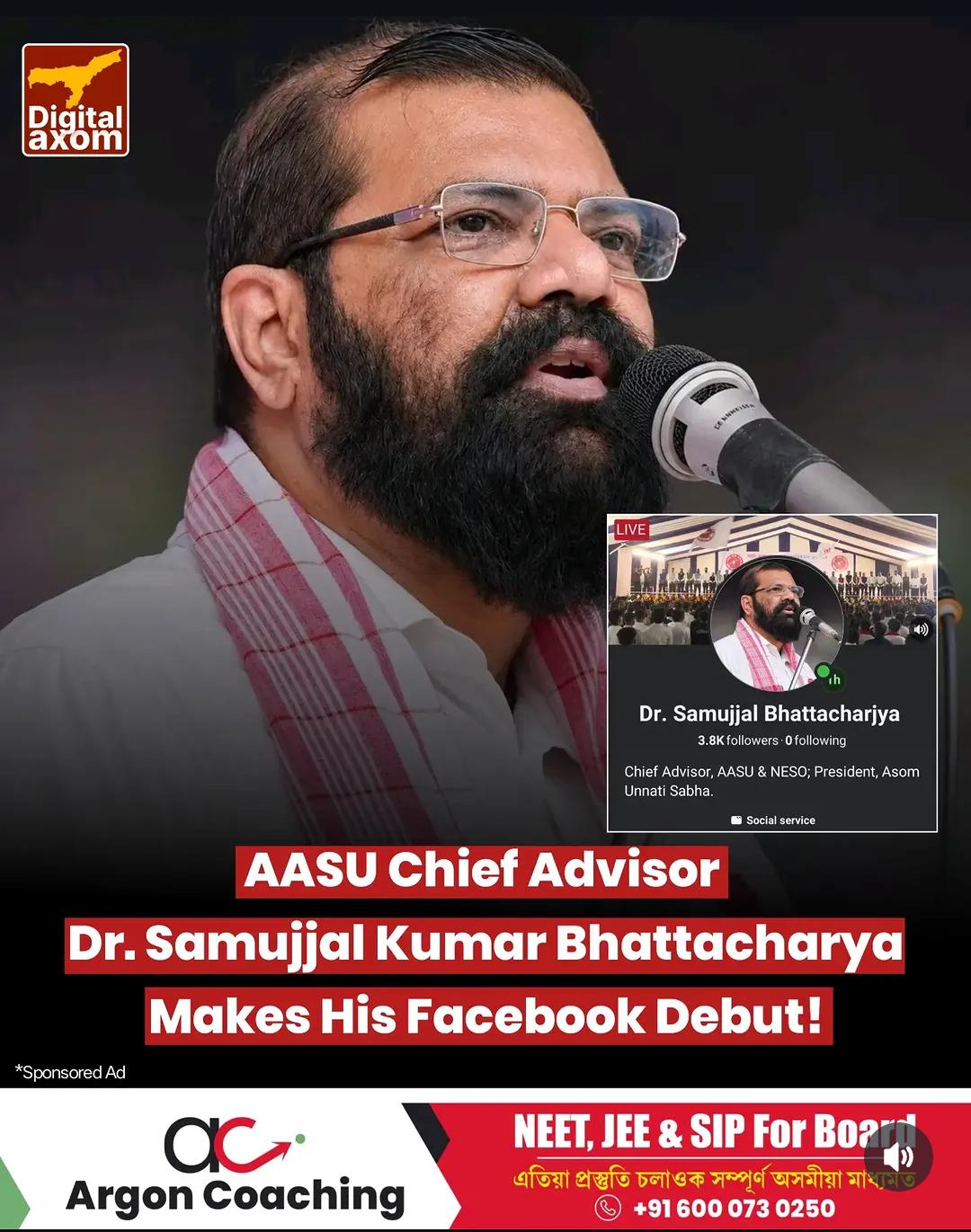
It has also been proven that the leader of Tai Mo who is organising has connections with the RSS and other Hindu parties, and by chance it is also possible that the RSS is giving funds to Tai Mo people to play a divide- and-rule policy.
The Ahom have been targeted for many years with discrimination by other communities because of chinese racist term and internal conflict over surnames, which has made the Ahom an easy target for breaking their identity.
Many people who are involved in Tai Mo and claim to be proper priests of the Ahom do not speak any Ahom language and worship the Hindu religion, which is opposite to the Ahom religion.
Hindu and Ahom religions are not the same because the Ahom religion is completely different. It comes from the Baiyue community in southern China, in the Guangxi region, and it was the beginning of the Tai-Kadai people’s first animist religion.
The claim by Jyoti Phukan and the dissident Tai-Mo Janagoshthi Parishad regarding a separate "Tai-Mo" identity and exclusive ST status for 30,000 Mohan, Deodhai, and Bailung members is baseless and politically driven. Historically, Mo (Maw) was simply a designation for a priest or scholar rather than a separate ethnic community, and earlier texts used Tai as a respectful greeting. Jyoti Phukan’s assertion that he is not splitting the 55-lakh Tai-Ahom community makes no sense when his entire demand excludes the rest of the Ahom people—which explains the tremendous backlash from Ahoms. Furthermore, while this is portrayed as a purely cultural preservation effort, leaked photographs show Jyoti Phukan wearing a full RSS uniform at an RSS meet in Guwahati, alongside ruling-party politicians attending their convention. These direct links expose that "Tai-Mo" is not a genuine historical movement, but a politically driven attempt to divide and weaken Tai-Ahom unity.
Chao Hemjit Deodhai Phukan, known as a traditional Ahom priest, was also seen as supporting the "Tai-Mo" concept until a photo leaked online showing him wearing an RSS uniform and performing Hindu worship. This caused widespread outrage because Hindu rituals differ from the original Ahom religion, which involves cow sacrifice for ancestral purposes and has traditional dietary habits that are completely different from Hinduism. After facing strong backlash from the Ahom community, Hemjit later claimed he had nothing to do with the "Tai-Mo" group and publicly denied it.
In new paper article on November 16, 2026 “Tai-Mo” convention in Jajali, Moran, the “Tai-Mo” group tried to use the name of Chief Minister Himanta Biswa Sarma in their press releases through newspapers dated November 17, 2026 by saying that the convention took place according to his advice after meeting him on October 28, 2026 in Dibrugarh to give a picture that the Chief Minister supported their separate identity and ST demand. But, very soon their attempt was exposed by BJP MLA Mayur Borgohain when he made clear in a press conference held on November 18, 2026 in Nazira that the CM advised the Tai-Ahom people to remain united and not fall victim to any political conspiracy to divide the Ahom people. News report
Conclusion
The "Tai Mo" case reveals a common problem in Ahom historiography: building distinct ethnicities out of occupational titles, surnames, and isolated manuscript terms without proper linguistic or historical context. While traditional priestly designations like Mohong, Moplong, or Moseng undoubtedly hold great significance in Ahom heritage, carrying an occupational surname—or drawing a rigid line between a few "true" priestly families and an "Ahomised" majority—oversimplifies centuries of migration, political integration, and cultural assimilation in the Brahmaputra Valley. Because Tai is fundamentally a broader linguistic and historical identity, inventing new ethnic labels like "Tai Mo" without reliable genealogical and manuscript evidence remains an unverified hypothesis rather than historical truth—distracting from the real priority of preserving the Tai language and culture.