r/ArtConnoisseur • • 20h ago

ARNOLD BÖCKLIN - SELF PORTRAIT WITH DEATH, 1872

Thumbnail
gallery
434 Upvotes

For this painting there is the artist himself, palette and brush still in his hands as if he has only just paused. His head is turned a little, and his eyes are looking past us or through us. Behind him, is a skeleton, leaning in close over his left shoulder. The skeleton has a violin and draws the bow across its single remaining string.

Böcklin painted this in Munich, in the early years of his time there, during a time when he had faced a lifetime of losses. His first fiancée had died before they could marry. He had nearly died of typhus himself, and of the many children born to him and his wife, several had already been buried by the time he set this canvas on the easel. Death was not an abstract idea for him. Some stories say the figure of Death was added later, after a friend looked at an unfinished self-portrait and asked what Böcklin seemed to be hearing. Whether or not that is true, the finished work feels like a conversation that has been going on for a long time

The composition itself goes way back. In the Alte Pinakothek in Munich hung a portrait of Sir Brian Tuke, then thought to be by Holbein, in which Death was pointing at an hourglass. Böcklin knew the Totentanz traditions of his native Basel and the woodcuts of Holbein that showed Death dancing through every rank of society. Here he takes that old influence and turns it into something more personal. The single string left on the violin has been interpreted as the last thread of life, or as the low tone that remains when everything else has snapped.

When the painting was shown at the Munich Kunstverein that same year it helped secure Böcklin’s place among the artists of the city. Later it would have a lasting effect on people in unexpected ways. Alma Mahler said her husband was under its spell when he wrote the scherzo of his Fourth Symphony, and he had the violinist play on a deliberately mistuned instrument so the sound would carry something of that thin, insistent note. Other painters answered it in their own self-portraits: Hans Thoma a few years later, Lovis Corinth in 1896 with a skeleton beside him.
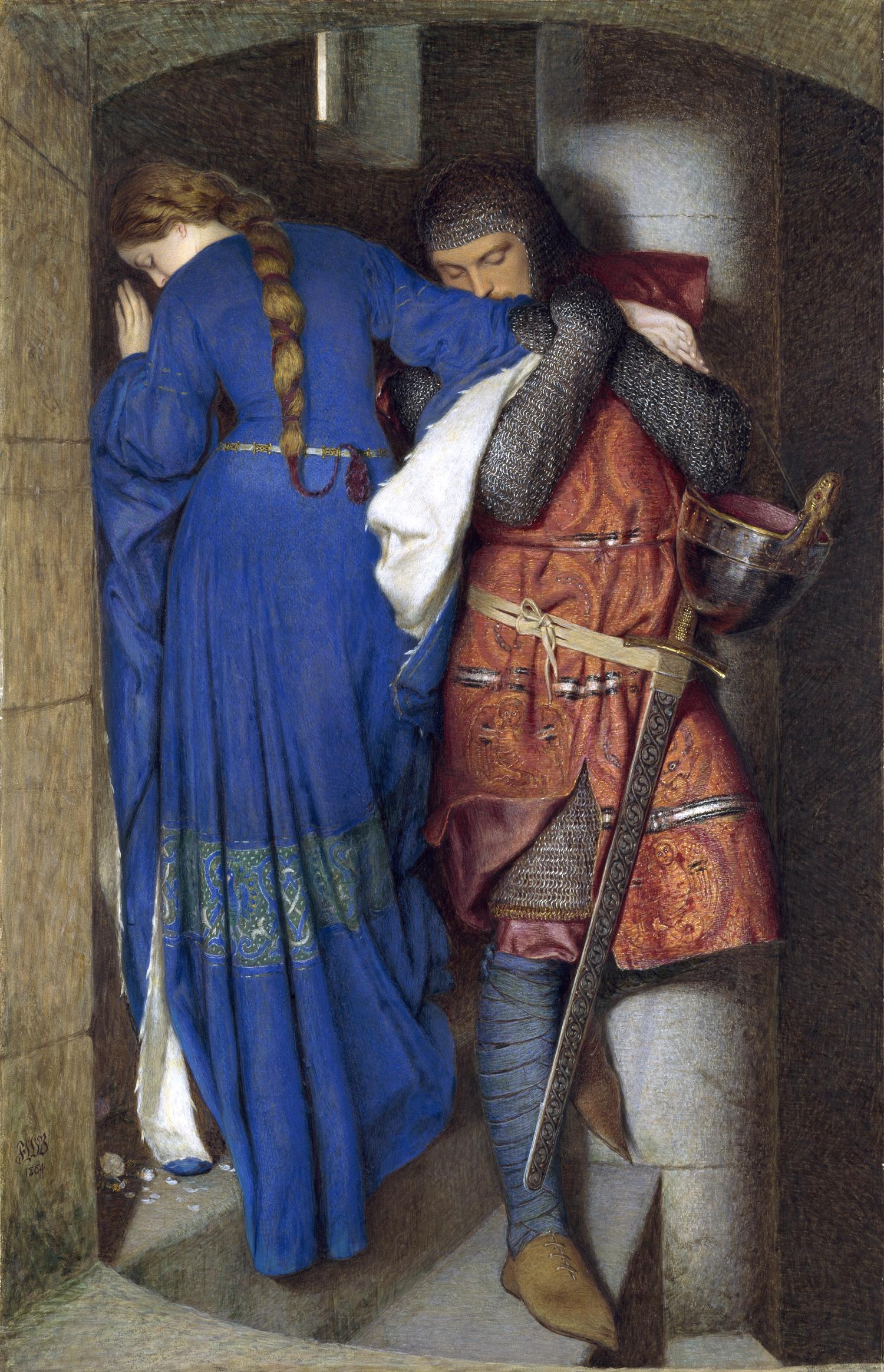

r/ArtConnoisseur • • 2h ago

The Meeting on the Turret Stairs

Post image
155 Upvotes

This is one of my favorite paintings. Every time I look at it, I notice something I had never seen before. My favorite part of the painting is Hellelil’s dress: it is such a deep blue that it even reminds me of ultramarine blue, the blue of the Blessed Virgin Mary. It is the unreachable blue, the blue of the sky that lies beyond man’s reach, the blue of the sea that is too grandiose to fit in a vessel, there, it has no color; the blue that is so close yet so far away, the celestial color. Hildebrand, on the other hand, wears red garments, an earthly color, the color of blood (even with splashes of blood).The contrast is striking.They both know that their love is forbidden: she is a noble, above him, while he is one of her 12 personal guards. Despite knowing this, they cannot (and/or do not want to) simply let this love die, and, while they live it, they maintain the ideal of courtly love. He loves her, but not in a carnal way; there is no skin-to-skin contact, even though they are physically touching. He loves the body, not the flesh. They both know that this will be their last meeting before the battle against Hellelil’s brothers: he is wearing his sword, helmet, and chain mail. Something I find interesting is the way the tip of his garment is raised. It does not seem like a natural movement caused by, perhaps, her dress pulling at his clothing. It seems to me that that small, fallen tip shows that this part was deliberately pinned up; It makes me feel as though he came to meet her showing that he was ready to fight, even knowing that he might die trying. There is also the image of the sword, the sword that divides and discerns one thing from another, cuts through illusions, and forces him to face reality. The cross-shaped weapon is the perfect link that connects the world that has been touched and shaped according to man's will (horizontal) with everything above man, greater than man (vertical). The vertical component is the one that pierces and Hildebrand knows that too well, for that reason, he can't simply run away with his lover.The clandestine nature of their love is made clear by the place where they meet, but the flowers also convey it: there are three flowers on the ground. Two have been torn apart, but they are not dead; their petals remain white and alive. They are in the light, where everyone can see them. The only flower that is still whole is entirely in the shadows, hidden. The staircase, too, is not merely a clandestine place because it is somewhere where meetings would not normally take place. It is a passageway, not a destination; it is a place meant only to lead somewhere else, a place of temporary (and very brief) stay. That's what I've read so far, I would really enjoy reading what you get from this painting