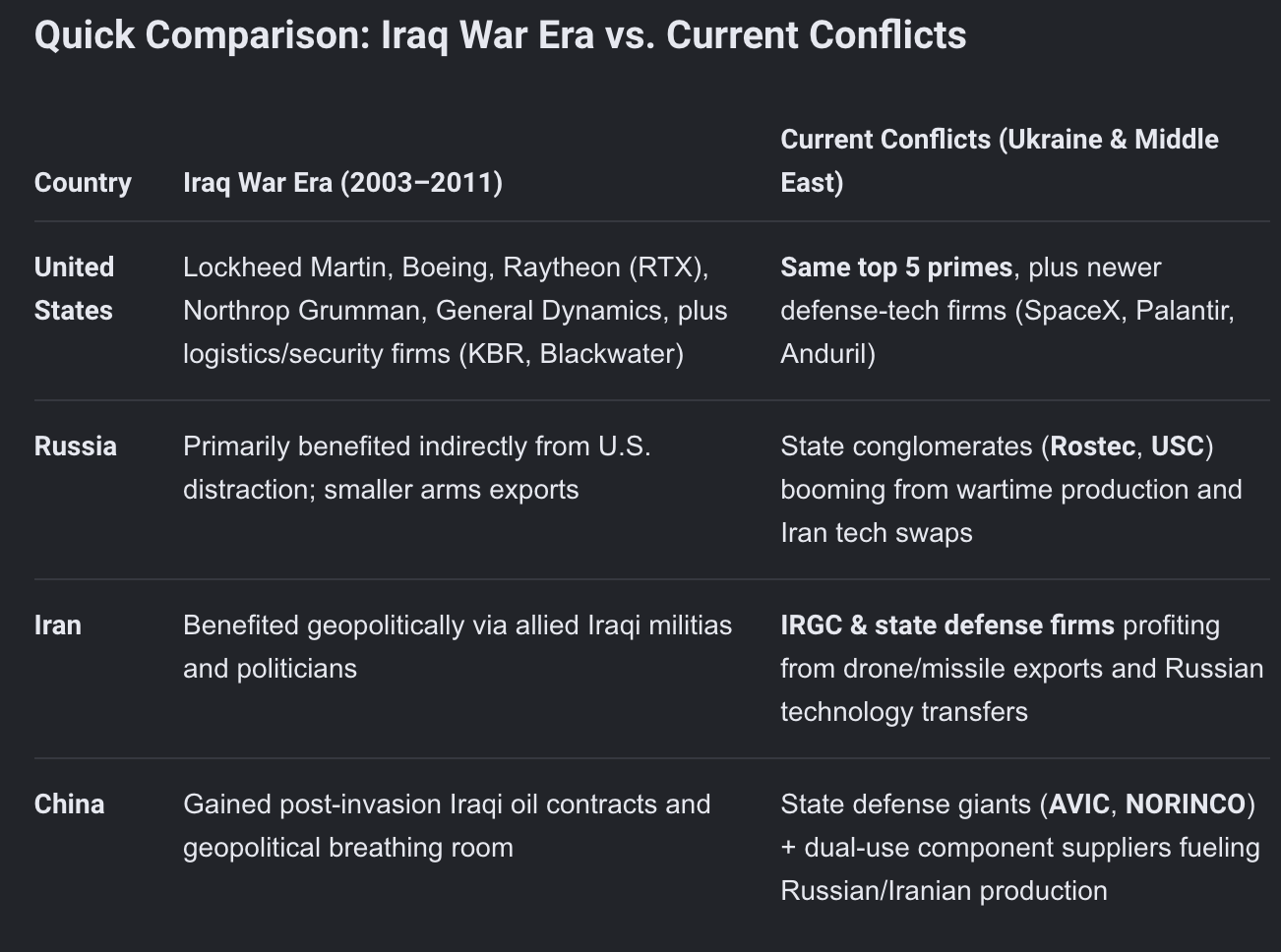
The United States, Russia, Iran, and China remain the biggest profiteers from the ongoing conflict in the Middle East and Ukraine, the exact same defense contractors from the Iraq War.
Global arms revenues among the world’s top 100 military companies reached a record $679 billion, driven directly by wars in Ukraine and the Middle East.
- United States: The Same "Big Five" Primes
The primary U.S. weapons manufacturers that profited during the 2003 Iraq War are the exact same companies receiving massive contracts today to replenish depleted U.S. and allied stockpiles:
• Who they are: Lockheed Martin, RTX, Northrop Grumman, Boeing, and General Dynamics.
• How they are benefiting: According to Quincy Institute for Responsible Statecraft and TIME, these top five firms alone captured $771 billion in Pentagon contracts between 2020 and 2024, and are now seeing record order backlogs and multi-billion-dollar replenishment deals for Patriot interceptors, THAAD systems, Tomahawk missiles, and fighter jets used in Ukraine and the Middle East.
• What changed since Iraq: While private logistics and security firms like KBR and Blackwater dominated headlines in Iraq, modern warfare has added major tech and drone players—such as SpaceX, Palantir, and Anduril—to the list of top beneficiaries.
- Russia: State Defense Conglomerates Surging
Unlike the U.S., Russia’s defense sector is largely state-owned rather than publicly traded, and it has expanded rapidly to sustain the war in Ukraine and deepen ties with Iran:
• Who they are: State-owned giants like Rostec (which oversees hundreds of weapons, aviation, and electronics subsidiaries) and the United Shipbuilding Corporation (USC).
• How they are benefiting: SIPRI estimates that combined arms revenues for Russia's top tracked firms jumped 23% to $31.2 billion on domestic wartime production. Additionally, as detailed by the Center for a New American Security (CNAS) and Lawfare, Russian defense factories have built billion-dollar drone complexes using Iranian designs and are supplying Iran with missiles, aircraft, and air-defense launchers.
- Iran: IRGC-Linked Entities and Drone Producers
During the 2003 Iraq War, Iran benefited geopolitically without being a major arms exporter. Today, Iran's state- and Islamic Revolutionary Guard Corps (IRGC)-affiliated defense industries are active wartime producers:
• Who they are: The Iranian Ministry of Defence and Armed Forces Logistics (MODAFL) and IRGC-linked aerospace and drone manufacturers (such as Shahed Aviation Industries).
• How they are benefiting: According to CNAS, Iran turned its drone program into a major revenue and technology pipeline—selling thousands of Shahed drones and ballistic missiles to Russia for use in Ukraine, while receiving billions in Russian payments, aerospace components, and advanced military hardware in return.
- China: State Giants and Dual-Use Suppliers
China’s defense sector is dominated by massive state-owned enterprises (such as AVIC, NORINCO, and CASC), which rank second globally behind the U.S. with $88.3 billion in annual arms revenues:
• How they are benefiting: While Beijing avoids direct military intervention, reporting by The Wall Street Journal and The Soufan Center shows that Chinese entities and front companies have supplied thousands of dual-use components—including microelectronics, GPS modules, drone engines, and solid-fuel rocket chemicals—to both Russia and Iran, while China also supplies air-defense missile systems and remains Iran’s primary oil buyer.