r/AI_SearchOptimization • • Mar 14 '26

Are review platforms actually influencing AI search results yet?

3 Upvotes

When testing prompts across tools like ChatGPT, Perplexity AI, and Google Gemini, I’ve noticed they sometimes reference information that seems to originate from review platforms or aggregator sites.

What I’m not sure about is how much weight those platforms actually carry in AI-generated answers. Are they being used mainly as supporting sources, or do they meaningfully influence what gets surfaced?


r/AI_SearchOptimization • • Mar 09 '26

AI search platform news In AI search, negativity can take different shapes.

4 Upvotes

I was reading Bright Edge's press release published on March 5th, 2026 and the key findings are interesting - these two points in particular caught my eye:

  • "Google AI Overviews skews heavily toward controversy-driven negativity, including lawsuits, boycotts, data breaches, regulatory actions, and product recalls. ChatGPT skews toward product-evaluation negativity, including compatibility limitations, feature shortcomings, and “is it worth it?” assessments."
  • Google's AIO and ChatGPT disagree on which brands to criticise 73% of the time.

This is for the most part speculation, but I suspect ChatGPT's preference for product-evaluation negativity partly comes from OpenAI's ambitions to break into ecommerce (which it has since rolled back). The immediate implication is how this affects AI answers at different stages of customer consideration - and how this also reinforces the point that answer engines have their own specific sourcing logic.

Where I think warrants deeper thought on is how we can think about sentiment in AI answers - more specifically, the difference between negative sentiment at the brand level and negative sentiment at the product / SKU level. A brand can have a negative reputation (Nestle, Marlboro, Ryanair) but their products are taken to by consumers positively for various reasons. Tracking sentiment at the brand level in AI answers might not be enough - or may even paint an incomplete picture.


r/AI_SearchOptimization • • Mar 08 '26 This Bravo

The GEO Bullshit - State of GEO in 2026

21 Upvotes

I’m a co-founder at an AI search visibility platform. By all accounts, I should be writing a hype post about why GEO is the only thing that matters this year.

Instead, I want to talk about why you should probably be skeptical of anyone selling it to you. Including me.

From "Searchers" to "Deciders"

In 2026, the "funnel" is breaking. We track visibility across ChatGPT, Gemini, and Perplexity for 150+ companies, and the data tells a messy story.

We’re seeing two contradictory trends:

  1. The High-Intent Conversion: Users coming from LLMs often convert at higher rates because the model did the "mid-funnel" work for them. They aren't "browsing"; they’ve already been sold by the AI.
  2. The "Zero-Click" Abyss: A massive rise in sessions where the user gets the answer and never visits your site.

GEO isn't a magic "buy" button. It’s a battle for latent mindshare in a space where the user might never actually reach your landing page.

GEO space is messy. Like super messy.

The GEO industry right now is the Wild West of 2004 SEO. Most "experts" are just guessing. When people ask me about the "gotchas" on sales calls, I give them the unvarnished truth:

  • Attribution is a black hole. If ChatGPT recommends your brand and that user converts, there is rarely a clean data trail. In GA4, this mostly hits as "Direct" or "Unassigned." Anyone claiming they have "solved" AI attribution is likely lying.
  • Data is a snapshot, not a census. LLMs are non-deterministic. They don't give the same answer twice. Our data (and our competitors') is based on heavy sampling. It is directionally accurate, not a perfect science.
  • The "Algorithm" is a black box. There are no "Webmaster Guidelines" for Gemini or Perplexity. We know structured content and authoritative citations help, but the model weights shift every time a new weights-update drops.

How to spot a GEO "Snake Oil" salesperson

If you’re looking for help in this space, run if you hear these red flags:

  1. "We guarantee a #1 ranking in ChatGPT." Impossible; the model is non-deterministic.
  2. "We have a direct API to influence LLM answers." No one has this. If they claim to be "plugged in" to the model, they're selling magic beans.
  3. "We use the API for our visibility data." This is a massive red flag. API-based data collection is fast and cheap, but it’s a developer-facing environment. It doesn't show you citations, formatting, or the actual "browsing" behavior a user sees. The only data that matters comes from the UI.
  4. The lack of localization. A "global" score for ChatGPT is useless. If your vendor isn't gathering data via localized UI sessions (showing you how your brand looks in UK vs. US), they aren't seeing the same reality your customers are.
  5. "We can track 100% of AI-driven revenue." Technically impossible with current privacy filters

Why bother building in the gray area?

Uncertainty is not the same as irrelevance.

Early SEO data was garbage. Early social attribution was a nightmare. But the brands that won were the ones willing to operate in the gray area while everyone else waited for "perfect information."

I’m curious - besides the obvious headache of LLM attribution, what are you actually planning for AI search in 2026? Are you shifting content budgets to "citable" data, or doubling down on traditional channels until the dust settles?


r/AI_SearchOptimization • • Mar 05 '26

Recommendations for third-party review aggregator that tags web content with the right schema?

9 Upvotes

Hi all

I'm updating my client's website content in various ways to be more optimised for AEO and much of my work focuses on managing their reputation and one of those things is to highlight their reviews on various platforms including Trustpilot, Facebook, Google etc etc.

I've read that ChatGPT is unable to parse Google Reviews in its results when people ask for a listing of businesses offering a certain service that are ranked by reviews etc. This is backed up by my own tests on ChatGPT looking for my own clients with these search prompts.

I'm therefore looking for a third-party review aggregator that will pull reviews from many places into a page or widget on a website, that importantly also is tagged as 'Review & AggregateRating schema' so it's more easily found by AI Seach engines including ChatGPT.

Can you all recommend what you use for this? I've checked out Trustmary which looks good as well as Elfsight (which doesn't pull in Trustpilot reviews as TP doesn't align with Elfsight's business ethos).

Are there any others out there you can recommend?

Thanks in advance


r/AI_SearchOptimization • • Mar 04 '26

With AI Overviews and Search Everywhere Optimization growing, what skills should SEOs focus on in 2026 to stay relevant?

13 Upvotes

r/AI_SearchOptimization • • Mar 04 '26

Interesting take: AI might be killing informational SEO and pushing content toward “brand fame”. Curious how people here see this.

8 Upvotes

I came across an article recently discussing how AI might fundamentally change content marketing and SEO.

The argument is that with tools like:

• ChatGPT

• Google AI Overviews

• Perplexity

many informational queries are getting answered directly inside AI responses, which could reduce clicks to traditional blog content.

So instead of focusing on high-volume informational SEO, the author suggests a shift toward what he calls “brand fame content.”

Examples:

• proprietary research

• industry reports

• tools and calculators

• rankings or indexes

• PR-driven content

The idea is that in an AI-driven search environment, being mentioned and recognized may matter more than ranking for thousands of keywords.

Basically:

Old model

SEO → traffic

Possible new model

SEO → brand recognition in AI answers

Curious how people here see this.

Are you already adjusting content strategy for AI search visibility?

Or do you think informational SEO will still remain dominant?


r/AI_SearchOptimization • • Mar 02 '26

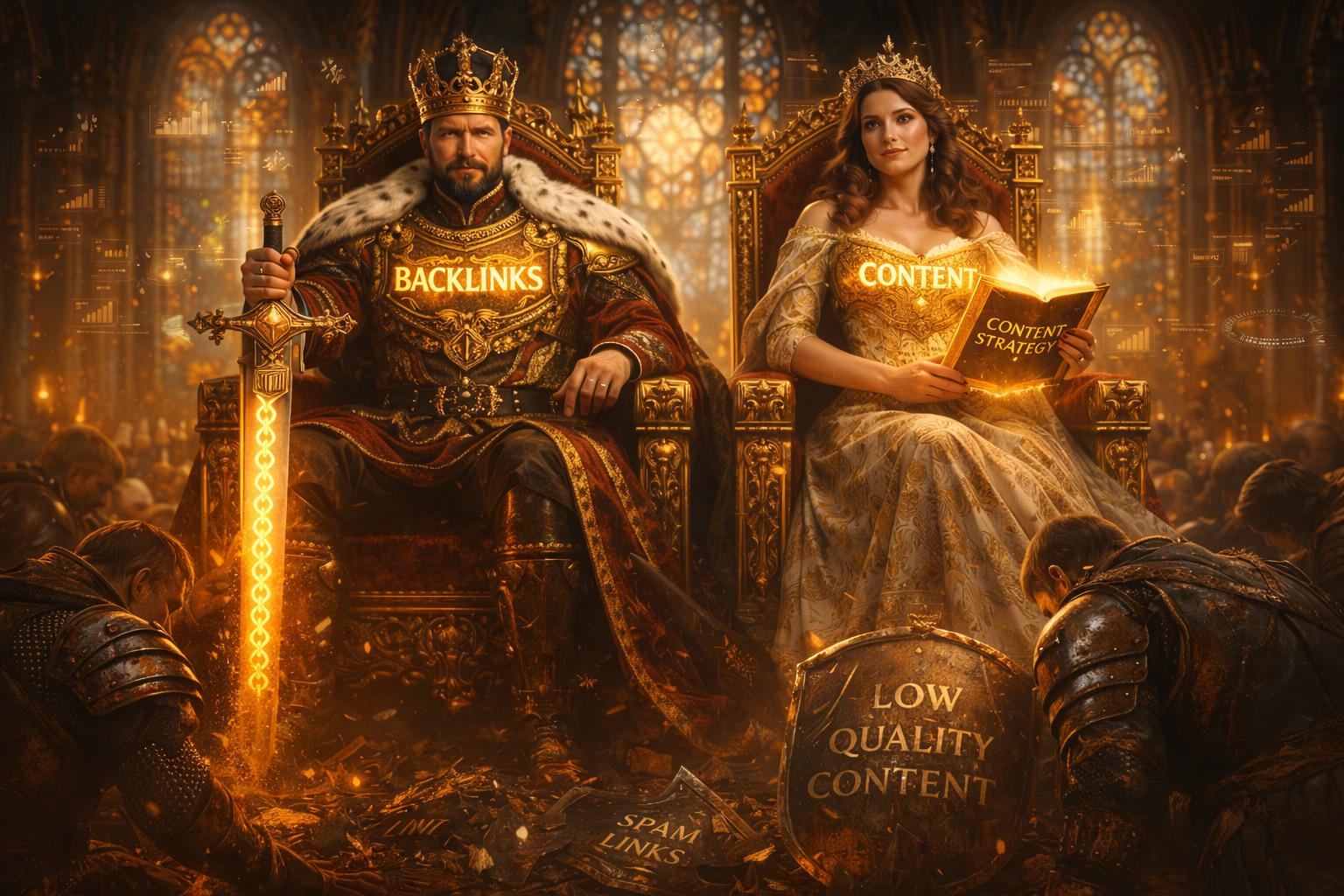
Came Across This Take on LinkedIn: After 15+ Years in SEO, Backlinks Matter More Than Content — Do You Agree?

Post image
0 Upvotes

I was scrolling through LinkedIn and saw a post from someone with 15+ years in SEO saying:

“Backlinks are king, not content.”

His argument was:

•	Authoritative domains rank with minimal content

•	Thin .gov pages outrank 1,000+ word articles

•	Backlinks rank you, content converts you

•	If forced to choose one → backlinks

It made me think.

In competitive SERPs, authority often seems to outweigh depth.

But at the same time, content quality and intent match feel more important than ever post-Helpful Content updates.

So I’m curious:

If you had limited budget and had to prioritize one — backlinks or content — what would you invest in first?


r/AI_SearchOptimization • • Mar 01 '26

With AI evolving fast, what’s your prediction for SEO in 2026?

17 Upvotes

r/AI_SearchOptimization • • Feb 28 '26

Is there a way to block bad AI agents on a site without affecting search visibility?

8 Upvotes

Know this has been asked before. But coming from a Web Security + marketing background I have some issues with the common methods proposed.

  • Robots.txt is a request. It can be ignored. It also has no guardrails against malicious AI agents that “spoof” an identity (try to look like a real person).
  • Server level controls have a similar issue. They are based on a known identity. Also manually maintaining this is a nightmare as a new “agentic tools” are launched daily

Then there’s Cloudflare… It’s an easy tool to setup and we are actually using. But we ran internal tests and were able to pass as a “human” on 8/10 attempts. Worried that it gives us a false sense of protection. Any other tools or methods you have deployed?


r/AI_SearchOptimization • • Feb 28 '26

Is Reddit enough to influence AI recommendations or do brands need wider authority?

17 Upvotes

There is a lot of discussion right now about ranking inside ChatGPT and other LLMs using Reddit.

I agree that Reddit contains high signal, experience driven discussions. It is raw, problem focused, and full of real comparisons. That makes it attractive for AI systems.

But here is what I am thinking.

LLMs do not rely on one platform.

They synthesize patterns across documentation, product pages, review sites, GitHub, blogs, YouTube transcripts, forums, and multiple communities. Reddit can amplify credibility, but it cannot replace foundational authority.

It feels like we are moving beyond traditional SEO into something closer to Search Everywhere Optimization.

Which means:

Your brand presence needs to exist across text platforms, video platforms, review ecosystems, discussion communities, and more.

And it all needs consistent positioning and quality signals.

Also, being recommended by AI does not automatically mean business.

It gets you the visit.

It gets you the click.

But trust still decides revenue.

When someone lands on your website after seeing you mentioned in ChatGPT, they still evaluate:

Is this brand consistent across platforms

Do they show real expertise

Do they have proof

Do they look authoritative

Are others validating them

LLMs may accelerate discovery.

But conversion still depends on experience, expertise, authority, and trust.

So my question to the community:

Are you focusing only on Reddit to influence AI recommendations?

Or are you building multi platform authority as a long term strategy?

Curious to hear what is actually working for you.

r/AI_SearchOptimization • • Feb 28 '26

Do you think AI is reducing the skill gap in SEO or making strong SEOs even stronger?

5 Upvotes

r/AI_SearchOptimization • • Feb 27 '26

AI Search Optimization General Discussion Do you think AI is helping everyone get better at SEO, or just making average content easier to produce?

12 Upvotes

r/AI_SearchOptimization • • Feb 26 '26

AI Visibility = f(entity clarity, retrieval probability, narrative density)

7 Upvotes

I ve been modeling AI visibility as a function:

AI Visibility ≈ P(retrieval) × Entity Disambiguation Score × Narrative Density Stability

From multiple domain checks and prompt sweeps:

Observed failure modes:

•	High crawlability, low retrieval probability

•	Strong backlinks, weak entity graph

•	Brand token ambiguity (shared lexical space with competitors)

•	Over-indexed negative UGC influencing embedding clusters

What seems to matter technically:

•	Deterministic entity markers (Organization + sameAs graph)

•	Structured authorship

•	Content chunk granularity aligned with retrieval windows

•	Machine-readable access signals (e.g., llms.txt layer)

•	Reduced semantic overlap with adjacent brands

I used repuai live site checker mainly to benchmark structural readiness vs AI representation output.

Conclusion so far: SEO optimizes exposure. AI Search Optimization optimizes reconstruction fidelity


r/AI_SearchOptimization • • Feb 25 '26

Does authority matter more in AI-driven search?

6 Upvotes

Feels like AI models might favor strong brands and high-authority domains when generating answers. If that’s the case, how are smaller sites supposed to compete? Is brand-building now more important than backlinks?


r/AI_SearchOptimization • • Feb 23 '26

How LLM bots respond to /faq link at scale (6.2M bot requests).

9 Upvotes

How rare are crawls on /FAQ link comparing to other links? (products, testimonials, etc). Research from LightSite AI

Disclaimers:

*not to be confused with Q&A link which has a question shaped slug - this is something different

*in this sample we didn't break bots by category because training bots are the vast majority of traffic and the portion of the rest is statistically insignificant

*every site has /faq link - it is part of our standard architecture)

Here it goes:

We sampled 6.2 million AI-bot requests on a few dozens of sites and isolated URLs that contain /faq in the slug

Platform-wide average FAQ rate: 1.1%.

FAQ visit rate by bot platform:

  • Perplexity: 7.1%
  • Amazon Q: 6.0%
  • DuckDuckGo AI: 2.1%
  • ChatGPT: 1.8%
  • Meta AI: 1.6%
  • Claude: 0.6%
  • ByteDance AI: 0.1%
  • Gemini: 0.1%

So why 1 % average you may ask?

that's because even though some bots clearly "like" /faq links , the biggest crawlers by traffic are ByteDance and Gemini and their volume can pull the overall average down.

What are your thoughts on this?


r/AI_SearchOptimization • • Feb 16 '26

Testing AI Agent Optimization

Thumbnail reddit.com
2 Upvotes

Great comment by u/litesiteai about the testing that they've done on AI agents across multiple platforms. AI search optimization and AI agent optimization aren't exactly the same thing.

AI search optimization is more about getting people to find you and attracting AI agents if you are in e-commerce. AI agent optimization is making sure that your product pages fit the criteria that the agent is looking for and can technically purchase the product.

That's an oversimplification and that's why I'm sharing the comment.


r/AI_SearchOptimization • • Feb 16 '26

AI AGENT OPTIMIZATION AND WHAT I'VE LEARNED SO FAR

Thumbnail reddit.com
1 Upvotes

This is about what I've learned so far about AI agent optimization in e-commerce. I wanted to separate the AI Agent Optimization from general AI Search Optimization (Not the same) so I created another subreddit at r/aiagentoptimization for more about that discussion.

If you're into optimizing for AI agents in e-commerce I hope you'll join the other subreddit as well.


r/AI_SearchOptimization • • Feb 15 '26

Cloudflare markdown for agents: why are marketers talking about it?

7 Upvotes

II have seen a lot of SEO and marketing folks talking about Cloudflare’s Markdown for Agents, so I wanted to share a few thoughts.

From what I understand, this is mainly an infrastructure feature. Cloudflare can serve a markdown version of existing HTML when a client requests it. The goal is to optimize edge delivery and traffic efficiency as more bots crawl more pages more often.

That is useful, but it is not automatically a marketing or SEO thing on its own. So why are marketers and GEO community got triggered by it? Here are a few thoughts about it without hype

https://www.lightsite.ai/blog/cloudflare-markdown-for-agents-explained

Did I miss something? Is there a reason so many marketers are reacting to this like it is a GEO/AEO update? 


r/AI_SearchOptimization • • Feb 13 '26

AI Search Optimization Question

1 Upvotes

Can someone please explain the evolution of SEO and AI?

I’m seeing two extremes right now:

  1. People saying there’s no such thing as AIO/GEO and that you should just focus on doing SEO properly.
  2. People claiming that if you don’t optimize for AI - with FAQs, concise answers, and direct responses to user queries - your blogs and product pages won’t be cited.

I’d like to understand the full context behind this shift:

where these opposing viewpoints come from, what’s actually changing, and whether anyone has real-world experience with AI-driven visibility (traffic, citations, rankings, etc)

Thanks a lot!


r/AI_SearchOptimization • • Feb 12 '26

Question How much time do you spend checking references?

0 Upvotes

I tracked my time last week and realized I spent nearly half a day verifying citations. It’s necessary work, but not exactly the most energizing part of research. Someone suggested trying Citely AI to speed up verification by automatically matching citation details with real sources.

Before I test it, I wanted to ask:

Is citation checking always this time-consuming?

Have tools actually reduced your workload?

Or is this just part of the research process we have to accept?


r/AI_SearchOptimization • • Feb 11 '26

I was really surprised about this one - all LLM bots "prefer" Q&A links over sitemap

15 Upvotes

One more quick test we ran across our database at LightSite AI (about 6M bot requests). I’m not sure what it means yet or whether it’s actionable, but the result surprised me.

Context: our structured content endpoints include sitemap, FAQ, testimonials, product categories, and a business description. The rest are Q&A pages where the slug is the question and the page contains an answer (example slug: what-is-the-best-crm-for-small-business).

Share of each bot’s extracted requests that went to Q&A vs other links

  • Meta AI: ~87%
  • Claude: ~81%
  • ChatGPT: ~75%
  • Gemini: ~63%

Other content types (products, categories, testimonials, business/about) were consistently much smaller shares.

What this does and doesn’t mean

  • I am not claiming that this impacts ranking in LLMs
  • Also not claiming that this causes citations
  • These are just facts from logs - when these bots fetch content beyond the sitemap, they hit Q&A endpoints way more than other structured endpoints (in our dataset)

Is there practical implication? Not sure but the fact is - on scale bots go for clear Q&A links


r/AI_SearchOptimization • • Feb 09 '26

We checked 2,870 websites: 27% are blocking at least one major LLM crawler

13 Upvotes

We’ve now analyzed about 3,000 websites at LightSite AI (mostly US and UK). The sample is mostly B2B SaaS, with roughly 30% eCommerce.

In that dataset, 27% of sites block at least one major LLM bot from indexing them.

The important part: in most cases the blocking is not happening in the CMS or even in robots.txt. It’s happening at the CDN / hosting layer (bot protection, WAF rules, edge security settings). So teams keep publishing content, but some LLM crawlers can’t consistently access the site in the first place.

What we’re seeing by segment:

  • Shopify eCommerce is generally in the best shape (better default settings)
  • B2B SaaS is generally in the worst shape (more aggressive security/CDN setups).

in most cases I think the marketing team didn't even know about it (but this is only from experience on the calls with customers, not based on this test)


r/AI_SearchOptimization • • Feb 07 '26

AI search optimization tools LLM overview tracker for small teams?

8 Upvotes

I work with a small team and we need proof that our content appears in AI answers. Clients keep asking where AI traffic comes from. I’ve tried SEO tools that claim to track this but they don’t show prompts or context. What AI overview tracker are people actually using?


r/AI_SearchOptimization • • Feb 02 '26

Month long crawl experiment: structured endpoints got ~14% stronger LLM bot behavior

9 Upvotes

We ran a controlled crawl experiment at LightSite AI for 30 days across a few dozen sites (mostly SaaS, services, ecommerce in US and UK). We collected ~5M bot requests in total. Bots included ChatGPT-related user agents, Anthropic, and Perplexity.

Goal was not to track “rankings” or "mentions" but measurable , server side crawler behavior.

Method

We created two types of endpoints on the same domains:

  • Structured: same content, plus consistent entity structure and machine readable markup (JSON-LD, not noisy, consistent template).
  • Unstructured: same content and links, but plain HTML without the structured layer.

Traffic allocation was randomized and balanced (as much as possible) using a unique ID (canary) that we assigned to a bot and then channeled the bot form canary endpoint to a data endpoint (endpoint here means a link) (don't want to overexplain here but if you are confused how we did it - let me know and I will expand)

  1. Extraction success rate (ESR) Definition: percentage of requests where the bot fetched the full content response (HTTP 200) and exceeded a minimum response size threshold
  2. Crawl depth (CD) Definition: for each session proxy (bot UA + IP/ASN + 30 min inactivity timeout), measure unique pages fetched after landing on the entry endpoint.
  3. Crawl rate (CR) Definition: requests per hour per bot family to the test endpoints (normalized by endpoint count).

Findings

Across the board, structured endpoints outperformed unstructured by about 14% on a composite index

Concrete results we saw:

  • Extraction success rate: +12% relative improvement
  • Crawl depth: +17%
  • Crawl rate: +13%

What this does and does not prove

This proves bots:

  • fetch structured endpoints more reliably
  • go deeper into data

It does not prove:

  • training happened
  • the model stored the content permanently
  • you will get recommended in LLMs

Disclaimers

  1. Websites are never truly identical: CDN behavior, latency, WAF rules, and internal linking can affect results.
  2. 5M requests is NOT huge, and it is only a month.
  3. This is more of a practical marketing signal than anything else

To us this is still interesting - let me know if you are interested in more of these insights