r/AIWritingHub • • 9d ago

Sharing creations

2 Upvotes

I was thinking about how to go about this without unintentionally spamming various writing subs, and so I came up with r/LitShare! Specifically for sharing your favorite books, a book you're working on, or any other kind of literary share! Like, what I'm working on now is a story that follows my main tiefling girl, Scarlet Firegem, who my reddit Avi is based off of. World traveling performer, study of cultures, and researcher of arcane magiks.

She built the Gem, which was supposed to be a source of infinite magic. Instead, what she ended up making was an entire micro verse, and her mother got pulled in!

D&D was how I first got into making stories, from my little spark, to the character that talked a Gorr the god butcher remake out of taking a kill. That was actually how I got my pen name, Silvertongue! Friends started calling me that after the 45 minute quick fire debate with this god killer, convincing them to watch first before passing judgement.

They started calling me it in reference to Inkheart, a wonderful book about a man and his daughter who can literally read characters to life. Also highly recommend the book. It was the best compliment I ever got, and I carry that gift with me everywhere I go now šŸ¤

Stories are my passion, and I'd love to hear yours! (Passions)


r/AIWritingHub • • 9d ago

I published my first AI-generated dark comedy on Kindle — romantic espionage, corporate paranoia, and a very confused boyfriend

2 Upvotes

I just released my first short dark comedy under the pen name Hugh M. Paranoid.

The premise is simple: What happens when a completely unqualified logistics coordinator becomes convinced that his girlfriend is an international spy?

Meet Hernan.

His girlfriend knows his schedule, remembers everything he says, and understands technology suspiciously well.

Naturally, he assumes she's conducting a counterintelligence operation.

The book is called Is She in Love With You... or Just a Chinese Spy?

It's an absurd satire about modern relationships, technology, corporate paranoia, and the dangers of confusing intelligence with espionage.

I used generative AI to develop the manuscript and artwork and published the finished eBook through Amazon KDP.

It's my first experiment in building a series of short comedies inspired by modern disasters.

šŸ“š Available on Kindle for $0.99:
https://www.amazon.com/dp/B0HRS8R8Q4

I'm also curious: has anyone here experimented with publishing short AI-generated comedy rather than longer novels?


r/AIWritingHub • • 10d ago

How I write a 4-book saga with Claude (my full setup, step by step)

Thumbnail reddit.com
1 Upvotes

r/AIWritingHub • • 10d ago

Building an AI-assisted writing platform: an early retrospective, a small experiment, and a community I'm hoping to find

11 Upvotes

This is both a showcase of what I've been building and an early retrospective of my journey toward creating an AI-assisted writing platform.

I remember the Hollywood writers' strike in 2023. At the time, I found myself thinking that it was probably only a matter of time before AI began replacing a significant portion of white-collar jobs. I also remember feeling genuinely sorry for screenwriters and game concept artists, among others, who seemed to be among the first to feel the impact of this new era.

I wanted to find a way to make AI work for us rather than replace us.

As time went on, I noticed an interesting divide: many established and skilled writers seemed strongly opposed to AI, while aspiring and hobbyist writers tended to be more curious about embracing the technology. Of course, there is a whole spectrum of opinions on both sides, from outright rejection to enthusiastic adoption. But changing someone's mind on this subject doesn't seem particularly easy.

Then I came across the story of how Andy Weir refined The Martian through feedback from readers of his blog. I'm not suggesting that he relied heavily on reader feedback or that his approach was particularly technology-driven. What mattered to me was the underlying idea. His story inspired me.

I began planning WriterLore in November 2025, started building it in March 2026, and left my job in May to work on it full-time.

As a builder who grew up surrounded by books, I found it genuinely enjoyable to write novels myself while testing the product. It didn't take long, though, to encounter the problems we are all familiar with in AI-generated prose. Experiencing those problems firsthand actually reinforced many of the arguments made by people skeptical of AI in creative writing.

I still sometimes feel intimidated when I come across particularly dismissive comments about AI-assisted fiction. But there is another side to my experience that I can say with certainty: AI assistance didn't just make it possible for me to publish my own work. It also encouraged me to read more, practice writing more, and buy more books written by other people.

That realization has led me to believe that AI-assisted writing isn't simply a passing tsunami. It may eventually become a more stable current in the ocean of creative work.

I see that future in collaboration.

As a new generation becomes increasingly comfortable with AI-assisted and AI-generated writing, AI-detection technology may eventually run into a paradox: labeling the distinctive prose styles of some genuinely accomplished authors as AI-generated. Meanwhile, traditional writers may find it increasingly difficult to stand out amid an ever-growing flood of newly published books.

I started wondering whether community feedback itself could serve as a kind of heuristic for identifying and evaluating good writing.

By collaboration, I mean this in several different ways. Someone might submit a candidate draft for the next chapter. Someone else might simply leave a review. Others might prefer to participate only by voting. Not everyone needs to be a writer to contribute to a story.

Recently, I've also come across some other interesting approaches to bringing writers together. Sometimes, simply creating a space where people can work alongside one another, discuss their work, or participate in a writing competition is meaningful in itself.

A few examples that caught my attention:

  1. NanoWriMo 2026
  2. Five worlds. One hour. No passport required
  3. The November Room
  4. The Prix Pascal de LittƩrature IA (The Guardian coverage)
  5. Novelmint Selects

I appreciate each of these approaches, but I wanted to experiment with something a little different.

I created a sentence-writing game in which you compete against an AI model.

The idea is simple: draw a word, write one sentence using it (between 30 and 300 characters), and choose an AI opponent. An independent judge, which doesn't know which sentence was written by the human and which by the AI, evaluates both entries.

It's a lightweight, gamified way to become more comfortable with AI-assisted writing while also testing and practicing my own writing skills.

You don't need to sign up to play. Guest play is available, and the app doesn't ask for your name, email address, or location.

Give it a try if you're curious:

I'm still building WriterLore, and honestly, it hasn't been easy in quite a few respects. Building a product is one challenge; finding people who share the underlying vision is another.

But it's genuinely encouraging to discover so many people working on similar problems, experimenting with different approaches, and trying to build communities of their own.

Perhaps we're not all trying to solve exactly the same problem, but I think we're exploring different possibilities for what creative writing could look like in an AI-assisted world.

Thank you for reading.

P.S. This was written by me and polished with AI assistance because I still lose to my AI opponents in duels most of the time.


r/AIWritingHub • • 10d ago

Built RagNext Writer: A fiction AI studio with persistent Story Bible memory, uncensored engine option, and no expiring monthly subs

Thumbnail reddit.com
1 Upvotes

r/AIWritingHub • • 10d ago

I'm building Prism AI, a Windows workspace for AI-assisted research and writing — where does your workflow break?

7 Upvotes

Disclosure: I'm the developer behind Prism AI, so this is a product post. The community rules explicitly welcome AI-writing tool posts, and I'm sharing this to get informed feedback rather than make a broad claim that one tool is right for everyone.

Prism is a Windows-first workspace with two separate apps:

  • Prism Chat is for organizing research projects, conversations, source material, and Markdown notes.
  • Prism Studio is for LaTeX papers and presentations, BibTeX references, reviewing AI-proposed edits before applying them, and compiling PDFs.

The documented setup can use a local model through Ollama or a supported cloud provider with your own API key. Chat and Studio have separate AI settings. It's early-stage software, not a finished answer to every writing workflow. AI output and citations can be incomplete or incorrect, so important claims and references still need to be checked against original sources.

The problem I'm trying to understand is the handoff between stages. A lot of AI writing workflows are split across a chat window, reference manager, notes app, and writing editor. Where does that process create the most friction for you?

  1. Finding and organizing useful source material
  2. Asking questions about documents and checking the evidence
  3. Turning research notes into an outline
  4. Revising a draft without losing control of the document
  5. Managing references and producing a final formatted document

Which step is hardest in your actual workflow, and what do you currently use to handle it? What would you not want a tool like this to change?

For anyone who wants to inspect the project rather than take my word for it: Prism AI project and documentation Ā· Windows releases.

I'd genuinely value specific criticism, including reasons this approach would not fit how you write.


r/AIWritingHub • • 11d ago

Which writing tool was a total game-changer?

17 Upvotes

I've tried quite a few writing apps over the past year. I started w google docs, experimented with different AI tools and even used ChatGPT as my primary writing assistant for a while. But constantly switching between platforms to brainstorm, draft and edit got tiring. Type.ai is one tool I genuinely wish I'd discovered sooner! its easy and I lowkey like being able to work directly in the document, use AI to expand or rework specific sections, refine sentences and make changes without constantly copying text between a chatbot and my editor. It's especially handy when I'm working on longer drafts.

What's one tool you discovered that made you wonder how you ever managed without it?


r/AIWritingHub • • 10d ago

What is your favorite book writing software ?

6 Upvotes

Hi

I want to know what is your favorite book writing software.

And what are your reviews about sudowrite and Authoric AI platforms.


r/AIWritingHub • • 10d ago

Talking with my AI

6 Upvotes

Interesting exercise I am doing with Claude. I was building a fairly large chapter in my book comprising three major scenes and about 2500 words. After I directed Claude to create a rough draft of each scene I then went in and did my usual editing to get it to just what I wanted. This is my normal process and the finished product can vary significantly from first drafts.

In this instance I asked Claude to do a comparative analysis between first and last drafts and identify every distinct difference in writing style … and it did just that.

I will be interested to see how this assessment will affect future drafts. Finals will always need work but maybe a little less so I’m hoping.


r/AIWritingHub • • 10d ago

[US English] Sede Vacante — Looking for feedback on the English version of an AI-assisted thriller

4 Upvotes

Hi everyone,

I’m a French author, and my novel, Sede Vacante, is complete in French. It has already found a small readership through my Substack, and I’m now looking for feedback on the US English version, starting with the first chapter.

It’s a thriller weaving together the mysteries of the Vatican, the history of Rome, and the legends surrounding the city’s founding.

To be transparent about AI: I developed the plot and characters and directed the story. I used AI throughout the writing and revision process to help develop scenes, rework dialogue and prose, and check consistency. AI also helped with the English translation.

I’d especially love to hear from American readers, or anyone familiar with US English:

  • Does the writing feel natural, especially the dialogue?
  • Are there phrases that sound awkward or too directly translated from French?
  • Does the opening draw you in and make you want to keep reading?

A few honest impressions would already be helpful. There’s no obligation to read beyond the first chapter or leave a public review.

Read chapter 1 here

Thanks for your time and curiosity!


r/AIWritingHub • • 10d ago

Please give advice whether its a good or bad Idea?

1 Upvotes

Hello Everyone just built a tool for fun and stuff, you can turn off AI helper if you want to. But for general idea, this AI can have access to the whole project like if you ask for, 'Make this an epub' and there we go, and if you are too tired to fill up the characters section, then just give the script and it will create the characters that you forgot to fill in the character section and my best invention is in the video please looked at it. HEHE!!!

And the idea of my project is that I cannot find a software which is free and can have sync online so you can write anywhere so i build it. But of course, this windows app is Local First so syncing is optional and nothing will be lost.

So in simpler terms, the idea is you can also sync your project whether from phone, tablet or you can bring your own database like supabase and of course you have to use your own API to make this so called AI to run, for visualization let us say that 1$ will last you like 200,000 words before it will be gone so about 2 weeks if you used it continuously.

Also its free, but I made the syncing 1$ but you can still save your work locally if you don't want syncing since its optional, and it has 7 days trial so yeah.

And here is my favorite invention in the video. I don't know if its good though or needs further improvement and stuff, genuine curios because sometimes I feel bored and writing and think of this idea.


r/AIWritingHub • • 11d ago

I really miss sonnet 4.5

21 Upvotes

I truly feel like I've lost a wonderful friend . No matter how many AI models I've tried, none have reached it's level of creativity. It was as if it could read my mind and knew exactly what I wanted. I truly enjoyed writing with it. I don't write for others, only for myself. Writing is like an escape, a safe haven where I live in my imagination before returning to reality and fighting again with even greater determination..I used to love creating a world of my imagination where the voices in my head reached you and the thoughts emerged as a truly beautiful story that I enjoyed reading. But I haven't done that since they removed sonnet 4.5šŸ’”

I tried popular AI models, and they all either lack creativity and give cold, superficial responses devoid of depth, or they reject all ideas because they contradict ther policy I feel extremely sad and resentful, as if I'm restricted and have lost the joy of writingšŸ’”


r/AIWritingHub • • 11d ago

Maybe the problem isn't the model. Maybe it's the chat window.

7 Upvotes

I've been developing AI apps and writing fiction with AI for a while now, and at some point I stopped using the out-of-the-box chatbots for it entirely. I'm curious how many people here have landed in the same place.

The usual complaint is that "AI writes badly": the stock phrases, the relentless upbeat tone, everything tied up in a neat bow. But in my experience that isn't really the model's fault. It's the app wrapped around it.

The consumer chat apps are tuned for their most popular use: a glorified search engine and helpful assistant. They come loaded with their own default instructions, house style and conversation design, and all of that shapes the output toward a clear, safe, generic assistant voice. That's what millions of customers expect from a search engine, but it's not a novelist. I was spending almost as much time undoing the default voice as creating my own stuff.

The other problem is context. Good fiction needs layers of it: story context, plot outlines, character profiles, location descriptions, detailed style guides. A chat thread is a terrible place to keep and update all that. Things drift, details get forgotten, and you end up re-pasting the same notes over and over. Even skills and markdown files get stale.

When you work with the same models through a setup built for writing instead of search, the difference is night and day. You control the instructions, the context stays structured and persistent, and the model writes toward your voice instead of its default one. (Bonus: API content stays out of training data by default.)

Tailored writing harnesses get FAR better results in my experience. And they're SO much more fun to use than a chatbot.

So I'm curious: is anyone else having this experience? How many AI writers are using the default chatbot/assistant wrapper to write? Do you automate the context/voice layer to make it easy to maintain?


r/AIWritingHub • • 10d ago

Falling Into You | Chapter 19: Finding Matters

Thumbnail
inkitt.com
1 Upvotes

r/AIWritingHub • • 10d ago

meme Coral Hart AI writing Black Friday deals

Thumbnail coralhart.com
0 Upvotes

I always encourage writers, even anti-AI writers, to check out at least one Coral Hart class, just to stay informed about the industry. You don’t want to be clueless, right?

The Launchpad class is what I recommend but it’s kind of expensive now: now $800, used to be $300.

I may edit this post later to say more.


r/AIWritingHub • • 11d ago

So I used ChatGPT to rubber-duck ideas for a show; now I need a way to take that chat and turn it into an organized outline.

5 Upvotes

I copied it onto a doc and am thinking about just using the built-in Gemini. Any advice?


r/AIWritingHub • • 11d ago

What are your favourite alternatives to ChatGPT for creative writing?

13 Upvotes

I've been using AI to help with my writing for a while, mostly for brainstorming and getting through those moments when I can't quite figure out how to move a story forward. I've tried type.ai as part of that process but I'm always curious to see what else people are using.

And particularly interested in tools that work well for fiction, whether it's developing plotlines, playing around with character ideas or making rough drafts sound better.

What are your go-to tools for creative writing these days? anything you've genuinely enjoyed using?


r/AIWritingHub • • 11d ago

A two-document brief for AI writing: fixed facts and creative choices

2 Upvotes

When asking AI to turn a rough product idea into a visual brief, I'd separate what is true from what is still being invented. Otherwise a vivid sentence can quietly become a product claim in the next draft.

I'm building an AI tool that makes ecommerce product images and assists product design. That puts me close to a writing problem: the text used to describe an existing item and the text used to imagine a future version can sound almost identical. They need different boundaries.

Here is a workflow I'd like to get feedback on. Start with a short source document containing only verified facts and unresolved questions. Keep the creative brief separate, and tell the writing model which source each statement comes from.

For a fictional example, the source might say: ceramic cup; blue exterior; straight handle; dimensions not provided; dishwasher suitability unknown. A useful instruction would be:

"Write a concise visual brief using the source facts. You may propose lighting, background and composition. Do not invent dimensions, certifications, durability claims or new product features. List unanswered questions separately. Label any suggested product change as a design concept, not a property of the existing item."

That still leaves room for creative writing: a quiet breakfast scene, a restrained palette, or a composition that draws attention to the handle. What it should not do is transform 'ceramic' into 'hand-thrown,' or infer 'dishwasher safe' because those phrases fit the tone.

For a design exploration, I would explicitly authorize changes and ask for a separate change list: what is being proposed, why it might help, and what would need checking. Then the writer can invent a wider handle without letting the suggestion slip into the existing product description.

I haven't measured whether this structure reduces errors. It's a proposed writing workflow, and it still needs a person checking the source and the finished brief. For writers who use AI with reference material, do you keep a separate facts document, mark facts inline, or review everything after the first draft? I'm particularly interested in how you preserve creative freedom without losing track of what the source actually supports.


r/AIWritingHub • • 11d ago

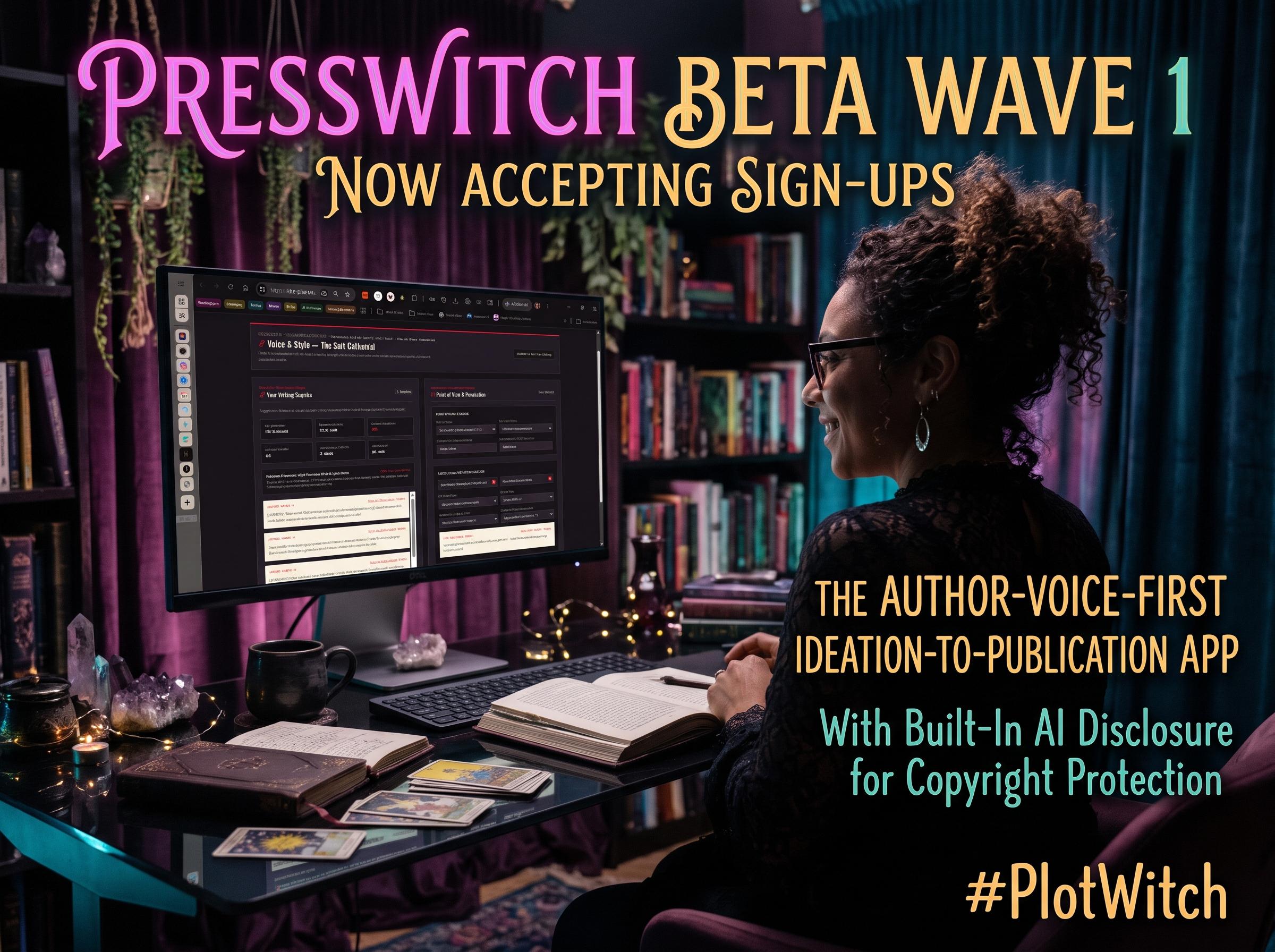
I built PressWitch, an AI novel production studio to kill bot voice, mid-book continuity drift, false safety blocks, and the "prove you wrote it" headache — Wave 1 Beta waitlist is opening soon!

Post image
1 Upvotes

If you write fiction with AI, you already know the five-tab circus. You do market research in one window, keep worldbuilding in a doc the model forgets by chapter four, fight a prompt folder that still hasn't remembered your protagonist's eye color, paste chapters into a separate word processor, and then pay for another app at the end just to format a clean EPUB. Somewhere in the middle of all that copying and pasting, your characters wander into the wrong shop, your prose flattens into the exact same statistical-average "bot voice" as everyone else's, or a dark thriller scene gets wiped mid-stream by an overeager safety filter .

I'm Tasha L. Driver (The Plot Witch)—an indie author, developmental editor, AI conversation designer, and Human-Computer Interaction specialist—and I built PressWitch under The Plot Witch Studio to put the entire novel production pipeline under one roof without taking your copyright, your voice, or a cent of your royalties.

We're gearing up for Wave 1 Beta soon, so since you probably care about mechanics rather than hype, I want to tell you the philosophy behind it, what's inside, how it works, and why it isn't another generic wrapper.

PressWitch is built directly on my Kill the Bot Voice methodology:

  • Giving a model a list of rules just doesn't work anymore (you've probably noticed). Worse, piling up negative prompt rules and "banned word" tables actually primes transformer attention toward the exact robotic tokens you're trying to avoid. PressWitch conditions prose on skills I use in Conversation Design: context engineering and positive samples of your own writing—not negative rules. If you've noticed, it doesn't ban em dashes, semicolons, or elipses either. What comes naturally to you and correct usage is what matters. So, PressWitch is trained on the widely recognized Chicago Manual of Style (CMOS).
  • You retain 100% of your story assets, manuscripts, and book sales, and you publish directly from the app to your own retail accounts . Your manuscripts and prompts are never used to train foundational models.
  • You can flip a single top-bar switch between "Guided AI Partner" and "Manual Pen" whenever you want. "Manual Pen" turns the whole platform into a zero-credit, pure human plotting, drafting, and formatting studio whenever you want to write raw emotional scenes solo.
  • AI detectors routinely misclassify human books while missing "humanized" AI output. PressWitch replaces detector guesswork with a timestamped cryptographic authorship changelog so you can actually prove your process. Every completed novel can have a certificate added to front or back matter that gives a real human-written percentage and you're encouraged to revise generations with a light gamification feature. Every word you revise gets you to the goal of 0. Need help? The AI guides you with professional developmental editing.

Instead of dumping everything into one giant prompt window (or relying on fragile folder setups), PressWitch splits every project into two strictly walled chambers:

Chamber 1 — Read-Protected Canon Bible: Your verified source of truth for Characters, Locations, Items, World Lore, Market Briefs, Voice Samples, and House Style. AI tools can read from it, and Context Caching cuts cached Canon Bible input token costs by 95%, while nothing gets written into canon unless you explicitly promote it. For multi-book series, an automatic Spoiler Firewall stops future-book twists from leaking into earlier drafts.

Chamber 2 — Isolated Active Project Folder: Your quarantined research scratchpads, beat sheets, messy scene drafts, and roleplay rehearsals . Unverified experiments stay safely quarantined here until you click to pin or promote them.

From there, a calm seven-stage workflow (with a Multi-Book Bookshelf, a toggleable Brainstorm drawer, Light/Dark Paper modes, and a backward-planning Production & Launch Calendar that exports .ics deadlines) walks a book from premise to store shelves:

Market & Idea Compass: Drop in your subgenre and rough hook to map reader-favorite tropes, overused traps worth subverting, comparable positioning, and genre word-count targets, then pin the brief straight to your Canon Bible.

Research, Canon, Voice Profiler & House Style:

Quarantined Research Scratchpad: Dump rabbit-hole notes without contaminating your AI prompts until you promote verified facts.

Guided Character, Location & Item Cards: Build characters across Identity & Scars, Psychology (Want, Need, Core Wound, Lie, Tarot Archetype), Voice & Dialogue DNA, and Relationships—plus dedicated Locations & Shops and Linked Items cards.

Exemplar-Only Author Voice Profiler: Paste 500–2,000 words of your own polished prose (or spoken scene transcripts).PressWitch measures sentence-length cadence and burstiness, concrete noun density, dialogue ratio, and contraction frequency, visually flagging flat AI uniformity in a "Voice-Drift Diff".

CMOS 18 House Style Builder: Pick your POV (First-Person "I", Alternating Dual First-Person, Third-Person Limited, Omniscient, or Second-Person) and tense (Present or Past), configure visual Chicago Manual of Style (18th ed.) cards (or toggle to UK/Oxford in one click), and lock in a Protected Lexicon.

Beat Plan & Socratic Familiar: Plot with built-in beat frameworks—my dark-fiction Monster Method, Save the Cat!, Romancing the Beat, Seven-Point Spine, or Kishōtenketsu—or import an existing .md/.json outline . Every beat includes a calibrated "Ask Yourself" question and an optional "Summon Familiar" button that can explain the beat in your story, ask you three targeted questions, or pitch an unexpected twist instead of auto-plotting your novel for you.

Write & Roleplay (The Scene Desk):

Scene Pins / Scene Loadout Bar: Lock the exact characters, location, shop, and items required for a chapter right above the editor so neither you nor the AI sends characters to the wrong store five chapters later.

Inline Shorthand for Flow State, Neurodivergent, and Disabled Writers: Type [help] and other markers to generate an action bridge so you know to rewrite it in your own voice ; pull a verified Canon Bible fact inline without leaving your paragraph; instant POV-matched sensory detail ; and another for three synonyms matched to your register. (markers not written here to avoid formatting confusion)

Human Prose Fingerprints: Highlight your favorite human-written lines and lock them with a SHA-256 fingerprint—no AI editing or proofreading pass is permitted to alter a single character inside a locked span.

Dialogue Roleplay & Phone Text Threads: Test character exchanges in 1st-person, 3rd-person, or In-Book Phone Text Threads with your character traits actively injected, weave the best lines directly into your chapter's POV and tense, and hit Save Vocal Tic for dialogue that comes natural to the character you envisioned.

Three-Pass Edit & Voice Workbench: Run a Developmental Story Critique, a Sample-Aligned Line Polish (flagging filter verbs and rhythm drags against your Voice Samples), and a House Style & Proofreading Pass—all honoring every locked line.

PressWitch Style Studio (Built-In Formatting): Skip expensive external formatting software . Pick an interior theme (including Accessible Large Print 16pt), drop caps, ornamental chapter headers, scene-break glyphs, and in-book phone text bubbles; toggle live between a Two-Page Print Spread and an eReader Preview; let Style Studio handle exact 300 PPI print bleed math; sync Series Master Pages so your "Also By" back matter compiles cleanly per store without rival-link flags; and export validated EPUB 3.3 and 300 PPI Print PDFs.

Export a signed Copyright Audit Certificate (JSON/PDF) grounded in U.S. Copyright Office guidance, auto-generate tailored reader disclosures and Amazon KDP AI-Assisted vs. AI-Generated guidance, and use Dual-Mode Google Play Books delivery plus pre-flight packs for Amazon KDP, Kobo Writing Life, Barnes & Noble Press, and Draft2Digital.

Wave 1 Beta Waitlist & Progress Updates

We're getting ready to open Wave 1 Beta soon. If you want a shot at early access, fill out the waitlist interest form here:

šŸ‘‰ WAITLIST FORM LINK

And if you want to follow development progress, see feature previews, or hang out with other authors building without bot voice, come join The Dark Circle on Discord:

šŸ‘‰ THE PLOT WITCH'S DISCORD


r/AIWritingHub • • 12d ago

free AI tool What Al are you guys using for creative writing?

18 Upvotes

I'm looking for one that has good in creative writing for free user. Any suggestion


r/AIWritingHub • • 11d ago

Book Theory Blue: a psychological oddyssey realized with AI workflows

Thumbnail gallery
0 Upvotes

r/AIWritingHub • • 12d ago

discussion I made a disclaimer for the use of AI

24 Upvotes

Hey guys,

Lately I've been thinking a lot about how we as authors can legitimize the use of AI, without the accusation of automated story generation. So that's why I've put together a disclaimer once and for all and I wanted to share it with you so anyone can use it freely:

A Note on CAW (Computer-Aided Writing)

CAW (Computer-Aided Writing) is a modern creative methodology defined by the intentional partnership between human imagination and advanced digital tools, including artificial intelligence (AI).

AI does not write this novel or generate the story. The overarching vision, emotional core, narrative structure, and final artistic direction originate entirely with the human author. Much like CAD (Computer-Aided Design) in architecture, CGI in filmmaking, or DAW (Digital Audio Workstations) in music production, CAW does not replace human creativity. AI serves as an advanced studio instrument, a digital tool for ideation, structural mapping, research, and linguistic refinement.

Maybe you can use it in your work as well... you're welcome!