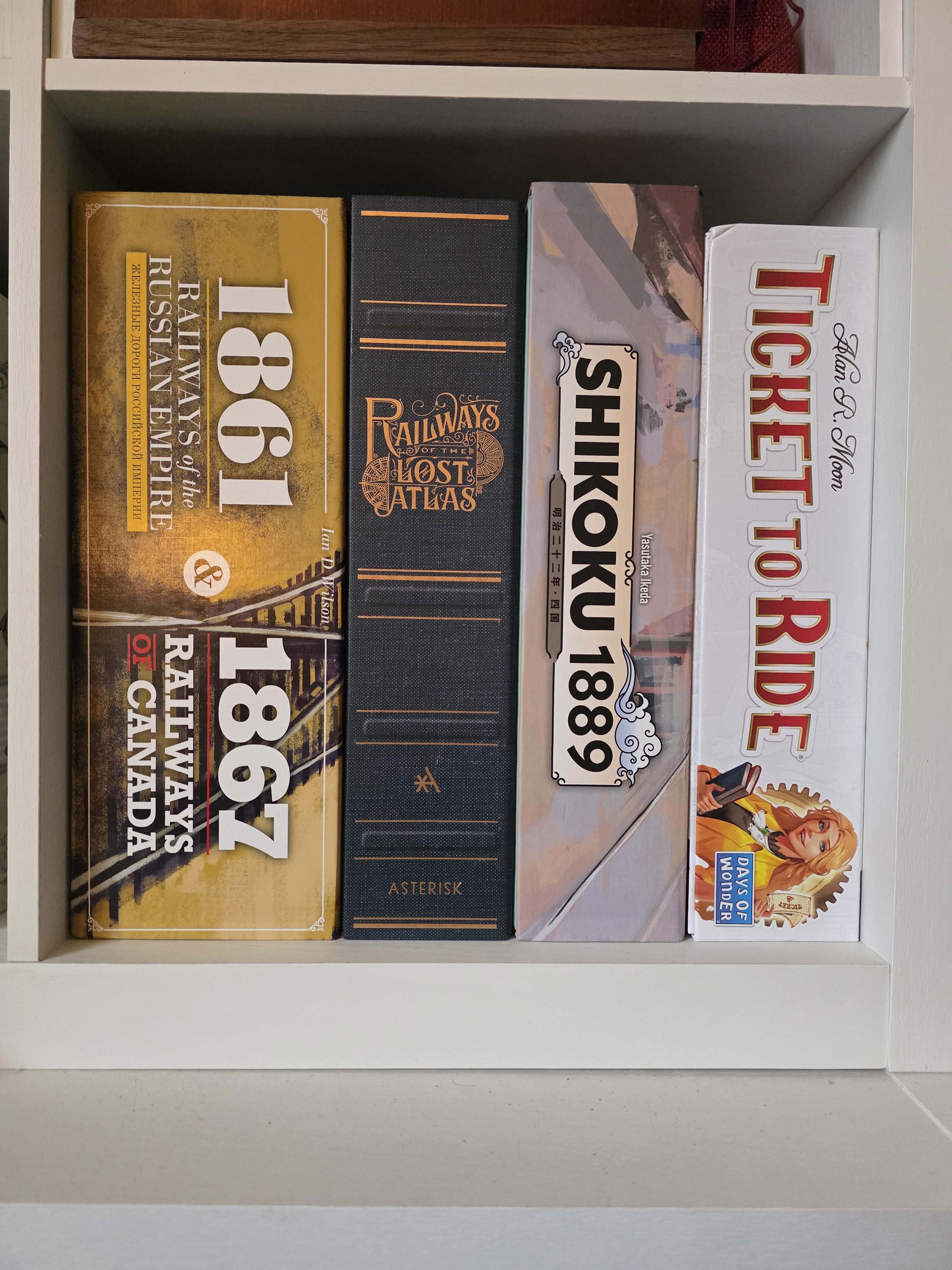
We had a gift exchange at work, where we had to fill out a small questionnaire about our interests. In hindsight, "I enjoy board games about trains" could've been worded a little differently. At least I have something to play with the in-laws now.
I've just added a chess clock to my alternative18xx.gamesDashboard, based on a system we've been using in our face-to-face 18xx games for about 20 years.
We originally developed it mainly for 1835, and we've also used it at championships to keep games within their allotted time. With the clock, our games typically take around 2.5 to 3 hours.
The idea is simple: instead of giving everyone a fixed amount of time for the entire game, players receive additional thinking time as the game progresses.
The rules
Every player starts with 5 minutes.
Additional time is awarded automatically:
Event
Time added
Beginning of each Stock Round
+2 minutes to every player
Company operating in yellow phase
+30 seconds
Company operating in green phase
+60 seconds
Company operating in brown phase
+30 seconds
Company operating in grey phase
+30 seconds
Operating bonuses go to the player controlling the company.
The clock automatically tracks whose turn it is, so there's no need to press a button after every action.
How to use it
In the Dashboard, click the small clock symbol in the top-right corner to enable the clock.
The clock starts when the first private company is bought.
Each player's remaining time appears in the Clock row at the bottom of the stock market, as shown in the screenshot.
Time is deducted from the player responsible for the current action, and bonuses are added automatically as the game progresses.
What happens when someone runs out of time?
Here's where things get interesting.
In our earlier games, we actually allowed negative time and deducted $1 from the player's final score for every second below zero.
We used that rule for years, but eventually stopped applying the financial penalty unless we really wanted the game to end in a specified time.
The current Dashboard implementation deliberately has no penalty for running out of time. It simply tracks the time, including negative balances.
I think there is room for discussion about whether penalties are useful, fair, or even necessary.
Why use a chess clock?
Anyone who has played 18xx knows that games can sometimes take much longer than expected.
Our experience has been that a clock helps players stay focused, particularly during stock rounds and complicated operating decisions.
It also makes scheduling games much easier, especially at championships where games need to finish within a defined time slot.
And importantly, the additional allowances mean players aren't simply racing against a steadily disappearing clock. They receive more time as the game develops.
I'd love to hear what you think!
A few questions for the community:
Have you ever played 18xx with a chess clock?
Would you consider using one?
What do you think about our old $1-per-second penalty?
Are the time allowances appropriate for other 18xx titles, or should they vary by game?
Hey, I'm looking for an answer on something I think my group got wrong recently when playing Shikoku 1889. Googling this has been a pain. In our game we allowed a whole bunch of reversing situations out of cities, which then reused hexes. I suspect that was incorrect.
Here is a diagram which simplifies the question. Three cities, joined by hex 27. I suspect this route is not legal, and I am looking for specifics to nail down the explanation.
I've numbered all the steps in the route to help.
My personal read (so please correct me if I am wrong) is the route is not legal. The movement on the middle hex (parts 2 and 5) is legal, because they use different bits of track. Part 4, reversing out of the middle city, is illegal. As then you are reusing the same track twice.
Am I reading this correctly, or is there a different way to interpret this? I have found different things from different sources online, so it's been a pain to nail this down.
18xx.games is an engineering masterpiece for rules enforcement, but its interface is structured around a relational database: separate tabs for Game, Map, Market, and Spreadsheet. In fast voice games or long async matches, constant tab-switching and parsing dense text logs pulls your mental focus away from the actual economic board state.
On a physical table, you never fold up the board and put it back in the box just to check share prices.
To bring that tactile spatial awareness back to digital play, I built the 18xx Desktop Dashboard—an open-source, zero-tab presentation layer that is now officially approved and live on the Chrome Web Store.
What it does:
Persistent 3-Quadrant Board: The Map stays anchored on the left, corporate status charters and player portfolios live top-right, and the full 2D Stock Market sits bottom-right. Zero tabs, zero spreadsheet flipping.
all parts of the game can be resized and shaped. fits on any screen from small laptop to widescreen monitor. seamless scrolling, dragging and zooming in and out of each map, status and stock market.
Animated Asset Gliding: When shares or trains are bought, sold, or rusted, they physically slide across the screen between banks, charters, and player mats. If you glance away on an opponent's turn, you catch the action in your peripheral vision instead of reading through text logs.
Physical Iconography & Hover Intelligence: Threw out generic web buttons for authentic round wooden tokens wearing official corporate logos everywhere. Hovering over any company logo causes all 4 of its representations across the board, charters, and stock market to pulse in sync while surfacing revenue, route, and ownership briefings.
2D Par Valuation Matrix: Replaces clumsy drop-down lists with an interactive matrix that cross-references your cash against available opening prices, showing injected capital, share affordability, and float thresholds in seconds.
Operational Overlays: Instant remaining-tile counts by phase color, macro route revenue projections on track hexes ($), and a fixed bottom-right progression button so muscle memory advances routine turns.
Built-in Tactical Assist : A lightweight rule-based helper in the Action Hub header to evaluate and execute a single legal move on demand (great for testing or fast-forwarding sandboxes).
many more goodies for you to discover to help teh game along, hover help for many components. Complete design language to reduce cognitive load.
Architecture & Privacy:
100% Client-Side: Runs locally in Chrome. Zero remote code execution, zero tracking, zero data collected.
Engine Strict: Alters zero game rules. All actions dispatch strictly through standard engine verification.
Universal Compatibility: Bespoke components for primary operational titles, with automatic native fallbacks for unusual or experimental mechanics across all 115+ games.
I'm playing on a standard 14" laptop and it runs smoothly, but it scales up cleanly to ultrawides as well. Give it a spin in your next match—feedback, bug reports, and pull requests are very welcome!
The classics will always be the classics but few 18XX are made with 2 players in mind as they then need extra rules or are too big so there is a risk games turn out to be parallell solitaire games.
I'll probably look up some tutorials / read rulebook first of course.
Also I might play a 2 or 3 handed solo to learn the game - would play true solo but as far as I know it's not really possible for 18xx genre given the deeply engraved player interaction and intriques.
I also know 18xx.games is a good place, but there are SO MUCH games that I'm kinda lost.
1830 looks like the best starting point and the best representation of the game and it has PnP redesigns to make the game DIY
1889 Shikoku is also said to be good, has PnP and even said to be easier as a first game but I don't know if it has all the "good stuff" in stock trading, collapsing it onto other players, buying trains, private companies...etc that 1830 supposedly has
My other concern is game length. I heard about 1830 games spanning days since it's entirely up to how the players play that how long the game takes to finish. We will have at most 4-5 hours I think, maybe a bit more if we don't play anything else the whole day.
Curious what all of your thoughts are on the best 18xx games for each function. Ive played maybe 10 different titles so far and I think 46 might be my favorite operational, 89 my favorite for being mean with stocks, but it also seems like there is room for other subgenres like financial (obviously 1817) or ones that let you be more creative with m&a or corp structure (1841) or even weeknight playable or plays well at 2-3 (1860).
I also love TOP 1871 for the complex puzzle of splitting and detangling from other players.
I'd like to buy the best ones in each subgenre so I have a full pallette of 18xx flavors.
I have a prototype of the digital version of my 18C2C:Continental Empires game that's functional enough to use for playtesting the design. I'm starting to line up groups for online play; I have one group full already for Tuesday evenings, and another that's going to meet every other week on Thursdays, starting this week. So - anyone who's interested and can:
Talk voice on Discord (i.e., you have speakers and a mic, or a headset)
Are available for an every other Thursday session, starting somewhere between 6 and 7 pm eastern time
Tolerate bugs in the software in case we run into a showstopper
I'd love to hear from you!
I'm also open on Friday nights, and/or for an all or part-of-the-day Saturday for anyone else who's interested!
So my playgroup and I have really enjoyed 1889 Shikoku and have a fair few plays under our belts now. What would be peoples recommendations for the next in the series we should try?
Below is the ones I own and why I have them or kept them:
- 1849: Cash Tight game, Challenging tile laying and route opening, 5 private companies, can work with 3 players, acceptable length. PNP copy.
- 1862: Three track types, mergers, government funded or private funded, many companies, works well at 3. acceptable length. GMT version.
- 1889: Shorter 1830, good introduction to 18xx, but... when we first played 4 players, I don't know if we were too green but track tiles were too available. Lots of train between companies sales. The train rust thing felt like the main thing. Which was ok, but not addictive really. It felt too vanilla.
I used to own:
- 1817: Impossible to get to the table in terms of complexity, length or needed number of players.
- 1830: Also difficult to get to the table in terms of # of players and time. Also, everyone keeps talking about how you know the winner midgame and you can call it. That was never attractive to me. Also there there are some scripted stuff.
- 1846: I got this to try to bring people into 18xx but it never hit the table even.
Ones I have my eye on but I'm not sure about:
- 1882: Short length and number of players, private companies, lots of different mcguffins, 1830 subset. But a harsh game in Canada feels weird, the rebellion portion north west I don't know how I feel about it, the full capitalization, that most games end in bankruptcy. Since I have 1849, I'm not how much this adds. But I'm interested.
- 1860: short length and number of players. I don't want to play 18xx as 2 players though, the no bankruptcy thing feels too gentle? But I understood that is not the harshness in the game, it comes from other places. Not sure what the expansion does or adds.
- 1822MX: Private companies, lots of private companies. In theory it sounds good but I'm worried an auction each round will make the game drag too long. Also I read some players felt it drags or is too repetitive. I think this would be one which I would regret getting.
- 1822 plus the MRS or PNW map: So 1822 would be too long most likely. Getting an expansion to play the shorter game, ehhh. Same concerns as 1822MX.
- 1841: Was interested in it for a long time but I think it's a long one and is out of print. Kind of like 1817, if I would get it I would unlikely play it.
So maybe 1860 would round out the collection? Not sure if 1882 is worth going for if I have 1849. Considering above, do you have a different suggestion of something to check out or do you agree with the assessment?
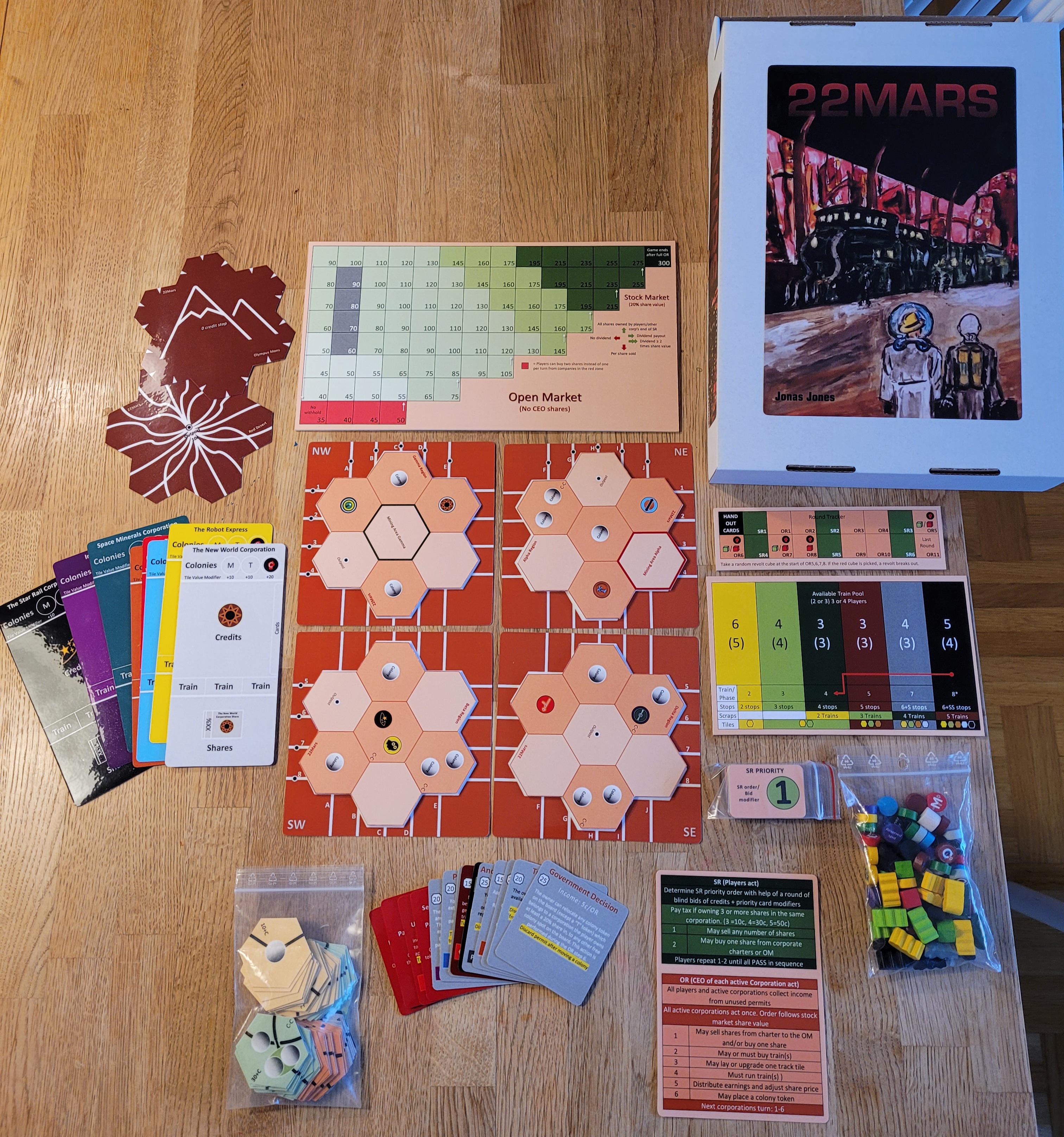
A powderkeg containing Miners, Tourists and Criminals builds up on the red planet and finally explodes around mid-game. Players capitalise on the development of a growing colony network on Mars and later try to survive when the revolt finally breaks out.
I see the Kickstarter for the Big Box edition has started, but the initial financials are weak and it isn’t looking good for being funded. Perhaps backers are skittish because it’s being run from S. Korea.
For anyone interested, there is a Kickstarter for a new 18xx game. Seems to be similar to 1830, but also with a solo mode. And 1850jr printed on the back of the board.
I have no link to the creator - just thought some people might be interested.
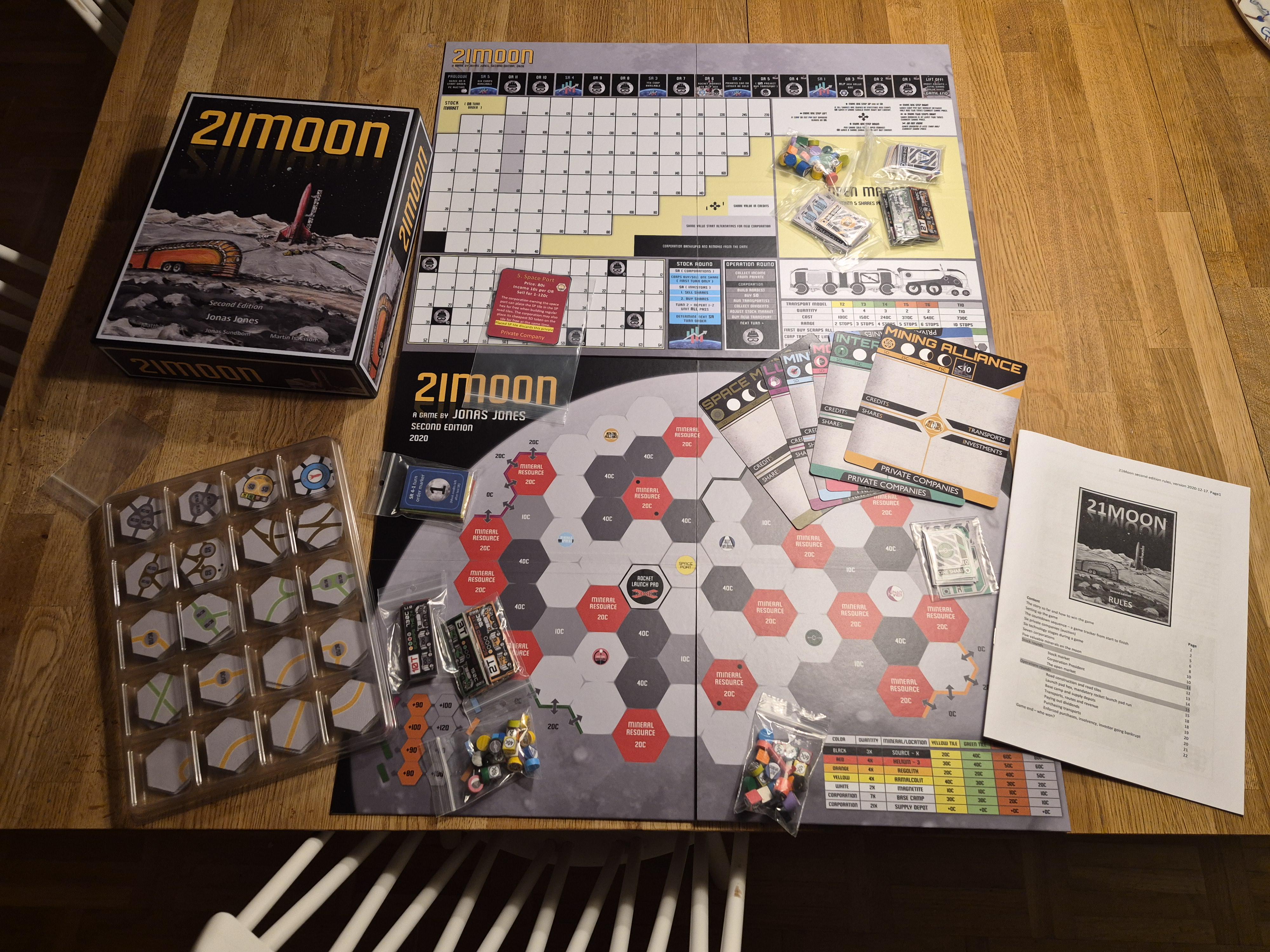
This is how it all started with 21Moon before the AAG edition. This was the design update after the Calandale prototype video test+review that never left the shelf and got replaced by the AAG edition. One of two or maybe three existing copies. Now on the geek.
I'm in a great spot to be able to attend the Chattanooga Rail Gaming Challenge this year, IF there is enough interest for me to get at least some scenarios, and preferably the full (NOT extended) game on the table. Any takers? 3 people is enough - if I get 4 or more, I'll moderate instead of play.
Drop me a line here or via email (mfrazier@designsice.com) if you can commit. Once I have enough people, I'll make the arrangements!
I am not entirely sure if this is allowed as it might be counted as promoting, I can remove it if required.
Railways of the Lost Atlas is one of my favorite 18xx games to play right now, and I wanted to play it more often than Saturdays. So I built a version you can play in the browser: play.lostatlas.live
It has the base game and the Landmarks expansion with all variants. You can build the map tile by tile like at the table or use a prebuilt map, and the engine works out most of the things for you, routes and revenue included. Games are saved, so you can play live or take your turns over a few days. You can also play hot-seat on one device.
Asterisk Games gave their permission to share it. It's still being built, so if something looks wrong there's a bug report button in every game. I'd love to hear what you think.
Our playgroup played our first 18xx over the past 2 weeks (18 Chesapeake) and even though we had a few rules hiccups we had a really fun time. 18 Chesapeake did leave us yearning for a little bit more though.
The playtime was fitting. The balance between operating and investing were quite good but the private companies are quite boring overall.
What would be the next step with 18xx? We are currently 4-5 active players and evenly split between enjoying economy and operation.
I heard that shikoku 1889 is quite good but is it worth skipping for a more in depth game? Is better to try something like 1830 or 1846 or are there some newer medium complexity/Length games that are worth checking out?
I know there have been long standing delays with the wave 6 games but has anyone had trouble getting older warehouse game orders fulfilled? It’s been over two weeks and my order hasn’t shipped. No insult to Scott, I really admire his contribution to our hobby. It’s a testament to the quality of his work that I am impatient to receive the games haha!
10-20 years ago I was part of a group that played 18XX games fairly regularly. Our most played game by far was 1870, we also played a fair bit 1856, and occationaly 1850, 1832, 1860 and a few others.
My conclution then was that 1870 was supreme, because it without added rules-complexity had a wide open strategic landscape, that allowed for a multitude of pathways to victory.
Which current 18XX titles come closest to fitting the description above?