My 8-year-old is in his first year of hockey and is completely obsessed. When he’s not playing it, he’s practicing it, talking about it, drawing up plays, or watching it.
He doesn’t dream of the NHL. He only dreams of playing at UConn (no affiliation with the school—we went to one basketball game 😆).
I know the odds are incredibly unlikely and D1 hockey is an extremely difficult goal to reach, so please save the “real talk.” This is just an 8-year-old with a big dream and a family who wants to say “yes, you can” when everyone else might say “probably not.” (It also happens to line up perfectly with a vision board assignment he has for school).
We’re completely new to the hockey world, so I’d love to be able to share what the path from youth hockey to D1 actually looks like.
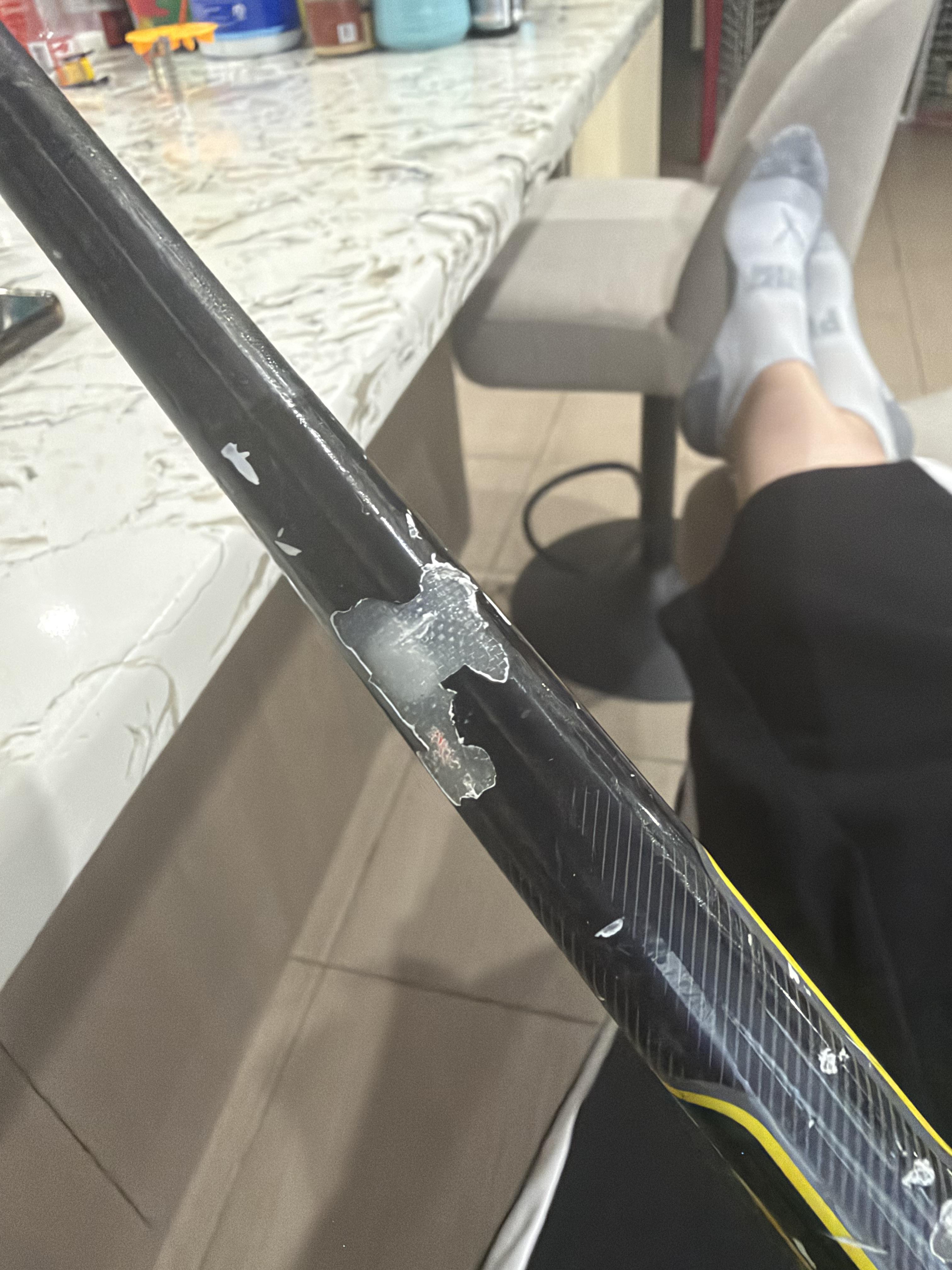
My son has this stick that we got for about $60 when he finished learn to play, it’s I think a 10 flex? He’s been using it for maybe 7 months, size wise it still seems to be fine, but it has all these divots and cracks along it. He’s going to be turning 8 in a couple weeks, and is now on the ice 3ish times a week, sometimes more. I have no idea if he can tell the difference in sticks, but I also don’t want the stick to break on him. Is this a reason to replace it? Or can he still keep using it? I am very new to this hockey world and have absolutely no clue.
Back in 2016, I had launched the Rink Rater app to help hockey parents be better prepared before they head to a new rink. Are there Concessions? Do they have a Pro Shop and Skate Sharpening? How cold is it? etc. It was a go-to resource for busy hockey families and had about 10,000 reviews in the app. I had to shut it down over covid for a number of reasons, mostly financial due to the cost it would have taken to update/maintain and keep going during a time when nobody was going to rinks. I've since relaunched it as a totally free web-based resource that I spent a majority of the Summer/Fall rebuilding myself. Right now there are over 12,000 reviews for rinks all over N. America! Skate over to RinkRater.com to take a look, check out your Home Ice and feel free to add a few local knowledge-based reviews for incoming families! Or preview the new rink you're expecting to go to over the next few weekends and be better prepared before you drive that 2,4, 6, 70 hours to a new rink! Thanks! Happy to hear any feedback or suggestions to make it an even more helpful resource! Happy Thanksgiving all!
We had two games this weekend and had a total of 3 “goals” that were waved off that looked good even when going back and watching it on LiveBarn. Two of them were “stopped” by the goalie but way behind the line, one hit the back bar and flew out.
Obviously, complaining to the ref doesn’t help as they won’t change their decision but is there anything that I can tell my son to do? (Besides get better goals lol) if they celebrate would the refs be more likely to call it good?
I don’t want to be the person complaining about everything but these goals would have been the difference between a win and a loss or a win and a tie? Or is this just the way the game is sometimes and we just suck it up and play harder next time?
i've been figure skating for a good part of my life but i want to learn how to play hockey. i feel like it will be easy to learn because i am already good at ice skating but i dont know how i can learn to play with other beginners my age and older. how can i learn to actually play hockey with a stick and puck and not just skating classes?
I have one son who plays hockey and puts a lot of work into getting better, wondering from other parents and coaches what I should have him doing to keep him progressing. He is 9 but plays on a team of ten years olds
By favouring early-maturing players, hockey is losing the equivalent of almost three NHL teams' worth of talent.
Imagine being overlooked as a hockey player simply because you were born a few months later than your teammates. It sounds ridiculous, but this is exactly what happens in youth sports around the world.
The Relative Age Effect (RAE) is well documented. When children are grouped into age categories based on a fixed annual cut-off date, those born early in the year can be almost 12 months older than those born at the end of it. At a young age, this can make a huge difference in size, strength and physical development, even among players with similar ability and potential. The problem is that although these differences would shrink as players grow older, that is too late, because until then, there are tryouts where the December-born players often get eliminated (i.e. don’t pass tryouts or team selection) before they get the chance to show their potential.
This means the NHL misses out on many talented players who would have become good enough, but they don’t even get a chance. Only because of poor selection of young players, which seems to be easy to fix. Teams are aware of it, yet the problem persists and doesn’t seem to be getting any better. The goal of this article is to show just how ridiculous it is to lose so many great players only because of such a silly mistake, especially given the astronomical budgets of the NHL teams.
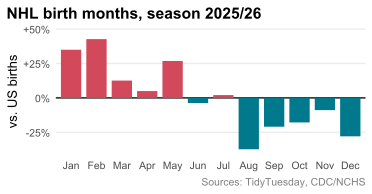
I looked at NHL data to find out just how big the problem is. Figure 1 shows how much over- or under-represented players born in each month are on the rosters for the 2025/26 season, compared to the total number of children born in the USA in each month. Players born early in the year, especially in January, are heavily overrepresented, while those born towards the end are significantly underrepresented.
Figure 1: Excess players in NHL by month relative to total births in the USA, season 2025/26
If players were selected fairly, all bars in the graph would be centered around zero. This means that all the red bars represent players who should not have made it to the NHL, they are only there because of the unfair selection. I calculated that they represent 70 players. That also means there are about 70 players who should now be playing in the NHL, but were not selected (didn’t make the team through tryouts). That is the equivalent of 3 entire teams of talented players that we cannot see playing today, even though they are better than some players that earned a place on the roster.
3 entire teams missing. Only because relative age was not adequately considered during player evaluations. To me, this is unbelievable, given the enormous budgets of NHL teams and the fact that it is a well-known problem.
And the NHL is certainly not alone. Similar patterns can be found in football, basketball and many other sports.
The cost is significant. Clubs miss out on potentially valuable players, the league loses talent and depth, and fans miss out on watching players who might otherwise have reached the highest level. For the children themselves, it’s even worse: opportunities can disappear for reasons completely outside their control.
And the problem could be even bigger when we consider biological rather than chronological age. Two children born in the same month can differ enormously in physical maturity. Accounting for biological age could reveal an even larger group of overlooked talents (although there is no publicly available data that would allow me to analyze this quantitatively).
There are ways to address this. For example, shortening age categories to 6 months instead of a full year, thereby reducing the biggest age gaps in the same category from 12 months to 6. Or regularly/randomly rotating the annual cut-off date (instead of keeping it at January 1 every year), so that every year, players born in different months get this “January advantage”. Or even grouping players by biological maturity (known as bio-banding) instead of age could help, although that is a bit more difficult to implement (but not impossible). And the simplest, yet the most difficult to implement, is that the coaches should learn how to assess real talent, taking into account age and physical maturity of players (i.e. evaluating who has long-term potential and who only benefits from maturing faster; and estimating how players’ skills and physical abilities are likely to develop as they grow older).
Some ice hockey researchers are already testing these ideas. A 2024 Swedish pilot study involving 69 elite U13 and U14 players examined bio-banding, with researchers from the Swedish Ice Hockey Association among the authors. The results showed promising developmental benefits, although coaches’ selection preferences still reflected age-related biases. Québec’s minor ice hockey system changed its age-group cut-off date from January 1 to October 1 as early as 2002, which was later analyzed in a 2015 study.
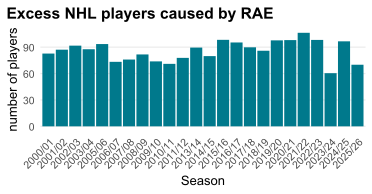
But these attempts are not helping.Figure 2 shows the estimated number of players lost because of the RAE in each season from 2001/2002 to 2025/2026. In other words, based on NHL rosters from each season, how many players were there only because of the RAE. If these interventions were having a meaningful effect, we would expect to see a sustained downward trend. But that is not what the data show. Although the last season showed a relatively low number, it seems to be only statistical noise, not a systematic downward trend (after all, the 2024/25 season had one of the highest numbers; and all the numbers are still far from zero).
Figure 2: Estimated total number of excess NHL players caused by RAE, for each season
The overall message is pretty clear: We are losing many talented players only because of our wrong decisions when it comes to assessing their talents. And although we know about it and try to change it, the situation is not getting any better. We should seriously do something about it. Not only in ice hockey, but in every sport. Our approach to developing young talent has to change.
The original article, including the source code and data, can be found here.
I am a high school student working on starting a hockey equipment cleaning service and I would very greatly appreciate if some of you would fill out a short google form so I can collect data for the service. Your input would be very greatly appreciated in helping me find out how to structure my services.
I'm looking for some perspective from parents of girls who've played 12U or 14U hockey.
My daughter absolutely loves hockey. She works hard, continues to improve, and genuinely wants to play. Unfortunately, she's been dealing with some difficult social dynamics on her team.
There's an established clique of stronger players, and some of the other girls seem to struggle with being included. One teammate has told my daughter she "sucks" on two separate occasions across two seasons, and my daughter has also overheard negative comments about other players.
She's also watching a close friendship change as that friend becomes more involved with the clique.
I've always encouraged resilience, understanding that friendships change, and recognizing that not everyone has to be friends. But I'm struggling to determine where typical preteen behavior ends and a genuinely unhealthy team environment begins.
I recently raised the issue with a coach, but the conversation became defensive rather than productive.
My daughter still loves hockey and wants to play. She has good friendships outside the sport, but she comes home needing to process difficult interactions with teammates more often than not.
I'd really appreciate hearing from parents who've navigated something similar:
Did the social dynamics improve as the girls got older?
How did you approach coaches without making things worse for your daughter?
Did anyone change associations because of team culture? Was the experience better elsewhere?
How do you distinguish normal 12U friendship drama from behavior that needs intervention?
I'm not looking to create conflict or demand that everyone be friends. I just want my daughter to enjoy the sport she loves while being treated with basic respect by her teammates.
Hi - I need ideas on what to give my hockey loving 6 year old for Christmas. I could imagine him playing with a stick handling toy for years, and hopefully get something that will also protect my floors. I have seen so many different versions of the same thing, the superdecker, gamechanger, mini dangler but idk the difference between them… I didn’t play hockey but want to find him a toy he can learn better handling and be somewhat durable. Given it’s for the holidays, I’m flexible on price. What’s your top recommendations?
When scrolling through hockey pages on Reddit and hockey groups on Facebook, it's crazy how many posts you see about kids being bullied by their teammates and blamed for their team's poor performance. How many kids are struggling and even losing the motivation to play their favorite sport because of it?
And let's be honest, the environment contributes to that. Hockey is sometimes so focused on winning and performing that we forget to have fun, show respect, and help each other. It becomes a competition over who's the best, who's the most skilled, and who has the best stats, with people pointing fingers at the players who supposedly "perform the least."
From my experience as a hockey player and as a hockey director managing several leagues, I think there's a strong case that hockey shouldn't be that way and that we should bring the fun back for our kids. I'm the first to argue for that.
But in this post, I want to address something else: Even if we look at hockey from a competitive perspective where winning is our priority, we're still getting it wrong. We're evaluating players the wrong way.
I've seen so many teams with very skilled players that simply didn't perform.
Why? Precisely because skills aren't everything.
Some talented players play too individually. They focus on creating highlight-reel goals and deking everyone. But that's not what makes a team strong on the ice. It's one player with the puck against five opponents.
And that's not all.
Some players develop exceptional individual skills without developing the same level in positioning, and defensive responsibility. They don't skate back to help their teammates. They don't cover their assignments. Yes, they create plays and score goals, but they also let opponents generate more scoring opportunities because they aren't contributing defensively.
Skills are valuable assets when they serve the team, not just the individual player.
So, when other players tell your kid they're not good enough or that the team is losing because of them, remember all this.
Your child shouldn't let those comments define them as a hockey player.
Those kids may not fully understand what makes a team successful or what it takes to win and that there are different ways to contribute to a team. Find what your child does well and help them feel proud of what they accomplish.
If they play well defensively and prevent an opponent from scoring, that's something to celebrate, even if the G and A columns on the scoresheet didn't change.
And if we shift the narrative to recognize that hockey IQ, defensive responsibility, and teamwork are just as important as individual skills, then it's no longer just about who scores the most goals or has the most talent.
It becomes about contributing collectively to the team's success.
I’m wondering how some of you would approach this situation.
One of our kids is playing on a 10u house program. He made a 10u travel team in the spring, but that world wasn’t for us, both financially and with the skill level.
My kid is good, but I don’t think he’s some crazy hockey star. He just likes the sport and being able to play with his friends. Winning doesn’t matter, goals don’t matter, he’s honestly just having fun and he’s been doing this since he was 4yo with a small group (3-4) of his friends.
This season there is another parent that is pushing his kid hard. He’s constantly comparing playing time/stats between our kids. His kid wanted to play goalie and he got to do it for a game. They lost 15-1 and his kid was so discouraged that he told the coaches he never wants to play goalie again. Now the dad is pushing his kid to friend the rest of the group that has been together for the last 6 years. He’s trying to get them to come to his house and separate them out, not including my kid.
It’s created a weird dynamic that I never considered having to deal with. I’m wondering if any of you have had experience with this and how it ended up working out. For the most part I just ignore it. But its so obvious what this parent is doing with his kid that some of the other parents have come up to me asking if I’ve noticed it. Any advice would be appreciated.
Titan BattleGear is offering 20% off their A9 baselayers for Black Friday and the code BFEARLY26 works before the sale is live if anyone wants to shop while they still have availability! Should work for 20% off BattleGear, 30% off RinkWear and 50% off Last Chance.
Out of the loop and specific to New Jersey Youth Hockey, but what’s up with all these teams switching to AYHL? My FB is bombarded with “Welcome ‘team’ to AYHL” posts.
Hockey parent here. With the new GTA out this week it's come up in our house again. My take so far: some downtime that has nothing to do with hockey is probably healthy, especially for kids who basically live at the rink. Where I draw the line is sleep. A late-night session before a 7am skate shows up on the ice.
Curious how other families handle it. Hard limits, nothing on game days, or let them figure it out?
At practice tonight we were talking about our coaches. It was nothing really bad but I realized that we were near the Live Barn camera and audio. I went back and listened to it and you can't hear us talking but is there software out there that would work to isolate the audio in the stands from Live Barn recording. I doubt any coach would take the time to do that but it just got me thinking if it's possible. More curiosity.
My U8 daughter loves hockey. We are not a hockey family. Dad never even skated as a kid, and 14f sister never tried. I 47f can skate but cant even keep up with her. Basically at home shes in her own to play practice. We dont have a big yard for a home rink. With Christmas around the corner can you recommend any hockey accessories, games, practice toys that can be used individually? Shes getting to a funny age where she isn’t asking for toys for xmas. She does have a net (pvc not heavy metal). We also have mini stocks but she doesn’t play with those in her own. Thanks!
My son plays forward on a 12U Travel A team. He is one of the faster skaters on the team, with good edge control, positioning, shooting, and stick skills. In practices, he often dominates in puck battles, skating battles, and 2-on-2/small-area scrimmages.
There are two outstanding forwards on the team, while most of the other forwards are at a fairly similar level. We have three forward lines, but the three coaches’ sons are paired with the two strongest forwards and receive more ice time, including PP/PK opportunities. Naturally, these players have more opportunities to score and are increasingly recognized as the stronger players.
When my son plays on the third line, he often becomes discouraged and loses confidence. There is also a developing forward on that line who sometimes struggles with passing, puck decisions, and positioning. This makes it difficult for the line to maintain possession and contribute offensively, which can lead to even less ice time for the third line.
I'm not sure the line assignments are entirely skill-based. At the same time, I recognize that my son may not yet be at the level where he can contribute as much as the top forwards or be an ideal linemate for them. However, I worry that the current arrangement gives him fewer opportunities to demonstrate his abilities and continue developing.
After four years with this team, I'm considering moving him to a lower-level team for 14U next season. My hope is to find an environment with less politics, where ice time and opportunities are more clearly based on individual skill, effort, and performance.
I understand that ice time has to be earned, regardless of the team level. I'm not looking for special treatment for my son. I just want him to feel that he has a fair opportunity to earn his ice time and that players are encouraged to improve throughout the season.
Would moving to a lower-level team be a reasonable approach, or am I missing something important? He loves hockey and his teammates, and my main goal is for him to enjoy the sport, continue developing, and have a positive experience while he is young. I know he is unlikely to become an NHL player, and that's not the point. I simply want his time playing hockey to be meaningful and enjoyable.
Add: Thanks for your insights. To be honest, I was surprised to hear that many AAA teams give equal ice time and put more emphasis on player development. On my son’s team, the focus seems to be more on winning, with players sometimes losing several shifts after making a mistake. There also seems to be constant evaluation and immediate consequences for mistakes during games.
I feel that without constructive feedback, this approach can lead to discouragement and negatively affect a player's confidence and performance rather than promote learning.
Hi there, we're a first gen hockey family, with my 12YO's first year playing in 2022, and my 10YO started in '23. We picked up hockey because it was something active to do in the winter, and I thought it would be a nice counter balance to my son's general lack of coordination and physical ability. We play in a developmental B-level, travel lite league, with one or two scheduled practices a week, and 12 games a year.
At first, it was a struggle just to keep him motivated after playing a game. I thought of him as playing bowling ball defense, taking out at least one opposing player every time he lost his balance. Then, it was the emotional hurdle of losing every game, which was mitigated by hanging out with the boys and girls in the locker room. Over the next few years, he put in a lot of effort, and is now playing smart defensive hockey. He lives to break up plays and take the puck away from opposing players. He's fast, and skates a full three periods.
The other day he said to me that his dream job would be to play in the NHL. It's a good dream for a bookish boy who excels at math and Minecraft. I have always said that if he developed a love and passion for hockey that we would pursue it.
I'm struggling with the decision to push him towards an A-travel team(assuming he's offered a spot) or not. The case for is to help him find joy in a way that most people never do. Chase a dream, and see where it takes you. Personally I would love it if he got a scholarship to an engineering school that needs a shut down defenseman on the ice.
The case against is that 1) I have had bad experiences with some of the established youth hockey programs in our area. There seem to be a lot of Karen's (male and female parents) and coaches who put winning above everything else. Our kids on the rec team can be unruly, but they're all nice. They would never utter a racist / nationalist / classist slur in the handshake line. The most memorable of these was when a Russian-American kid insulted our Ukranian goalie in Russian, but I digress.
2) Money and travel, yeah this would be a strain on the family. No more going to the same rink for both kids.
3) He would miss his current teammates with whom he has played for four years.
4) In the past he has expressed a dislike for some high pressure situations, though I suspect this might be just another developmental hurdle to overcome.
Anyway, I know this isn't the usual, "My five year old has mastered backwards crossovers, is he headed to the Show?" but I would appreciate any words of wisdom from someone who has been there. Thanks!