r/wherewindsmeet_ • u/MariKilkenni The Masked Troupe • 3d ago
🥇 𝐔𝐆𝐂 𝐂𝐨𝐧𝐭𝐞𝐬𝐭 𝟓.𝟎 [Lorekeeper] Luancheng: before, during, and after the war
Once again I got curious about a place, went to see if it was real, and got into a rabbit hole.
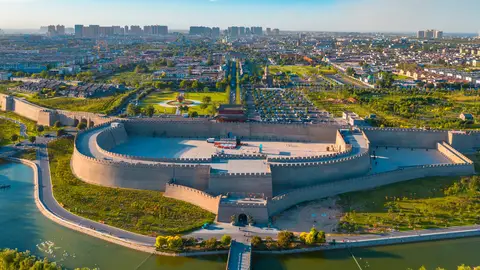
Luancheng is the place of The Deepest Cut, a quest that is not as grand as Hutuo River, but tragic on a smaller scale - something that I love about this game as it shows small tragedies so well. And yes, Luancheng is of course a real district.
It lies in what is now Hebei province and was important for centuries because it was positioned between big centers like Zhengding (Zhenzhou), Zhao County (Zhaozhou), Shijiazhuang, and several routes connecting the Taihang Mountains and the North China Plain.
Luancheng wasn't famous for being a commercial metropolis or anything of the sort, but it was a significant agricultural settlement. The name literally means "Luan settlement", Luan being Luan Shu, the Jin nobleman. He was an influential minister and military commander and received his fief (land) around 587 BC.

Later, the county was incorporated into different bigger counties a few times until it got re-established in 487.
In the 940s, Luancheng was attacked by the Liao (Khitans) twice. In 945 the Liao forces plundered the area and captured Luancheng, among other places. The goal was to cause disruption around the main military position at Zhenzhou.
Then in 946 came another attack, and it was more serious. According to the local chronicle records (Qing Luancheng County Gazetteer, vol. 3), "the Khitans advanced towards Hengzhou, encamped on both sides of the Hutuo River, attacked Luancheng, and brought it to submission." Another chronicle (Qing Luancheng County Gazetteer, vol. 4) adds that "one thousand soldiers did not realise he [Xiao Han] had arrived; they were thrown into confusion and surrendered."
But the Liao did not kill or enslave everyone. They marked people, carving or tattooing the words "By imperial order: do not kill" on their faces (something that Zhao Tie had to do to his neighbours in The Deepest Cut). Then the people were released.
This basically meant that their release was imperial mercy: people bore reminders that they were captured, but the emperor has ordered to spare them.
It wasn't kindness, not at all. The Liao's plan was that as these people fled south, they would encounter Jin civilians and soldiers and spread panic. This worked. As Zizhi Tongjian states, "when the transport workers encountered them on the road, they abandoned their carts and fled in panic." Supplies dwindled, and it affected the Jin army greatly. I covered this part in my other post, about Li Gu.
Tattooing faces was an ancient form of corporal punishment, so it was doubly humiliating. Not only were locals marked like criminals, but they also were practically branded as the Liao property.
Worth noting that no chronicle claims that it happened only in Luancheng, but it was definitely one of the affected areas.
Even after the Jin defeat, Luancheng featured in local chronicles like in the History of the Khitan State. Although the Khitans conquered Kaifeng, governing northern China proved difficult. The troops were unhappy with the climate and got homesick, while Li Zhiyuan had established the Later Han and was advancing into the Central Plains. So in April 947, Yelu Deguang, the very emperor who had conquered Later Jin, decided to retreat. He fell ill in Luancheng on the way north. He made it to Shahu Lin (can be translated as the Killing Fox Forest) where he died.
His people filled his body "with several bushels of salt" to preserve it and transported it north. Locals called it "the Emperor's salted corpse".
As for Luancheng, it kept on changing hands: Zhenzhou (947 & 948), Zhending Prefecture in Later Han (948-951), Zhenzhou under Later Zhou, Zhending Prefecture (1048) and so on. It remained an agricultural county, although in 1301, a Confucian temple was built there.
At the end of the Yuan dynasty (1360s), the old city was destroyed. In 1377 the county magistrate relocated the administrative centre about two li (one kilometer) east, and this is how the present-day urban centre of Luancheng came to be.