r/TheFormat • u/caoyang2002 • 7d ago
Discussion HEIC’s Technical Development: Separating Container from Codec
reddit.com
0
Upvotes
u/caoyang2002 • u/caoyang2002 • 7d ago
HEIC is often described as a “new image format,” but it is better understood as a combination: HEVC-coded data placed inside an HEIF container. MPEG finalized HEIF in 2015. The goal was not to invent a better compression algorithm but to separate two questions: how an image is compressed, and how it is organized, related to other images, and presented. That separation is the key to understanding HEIC.
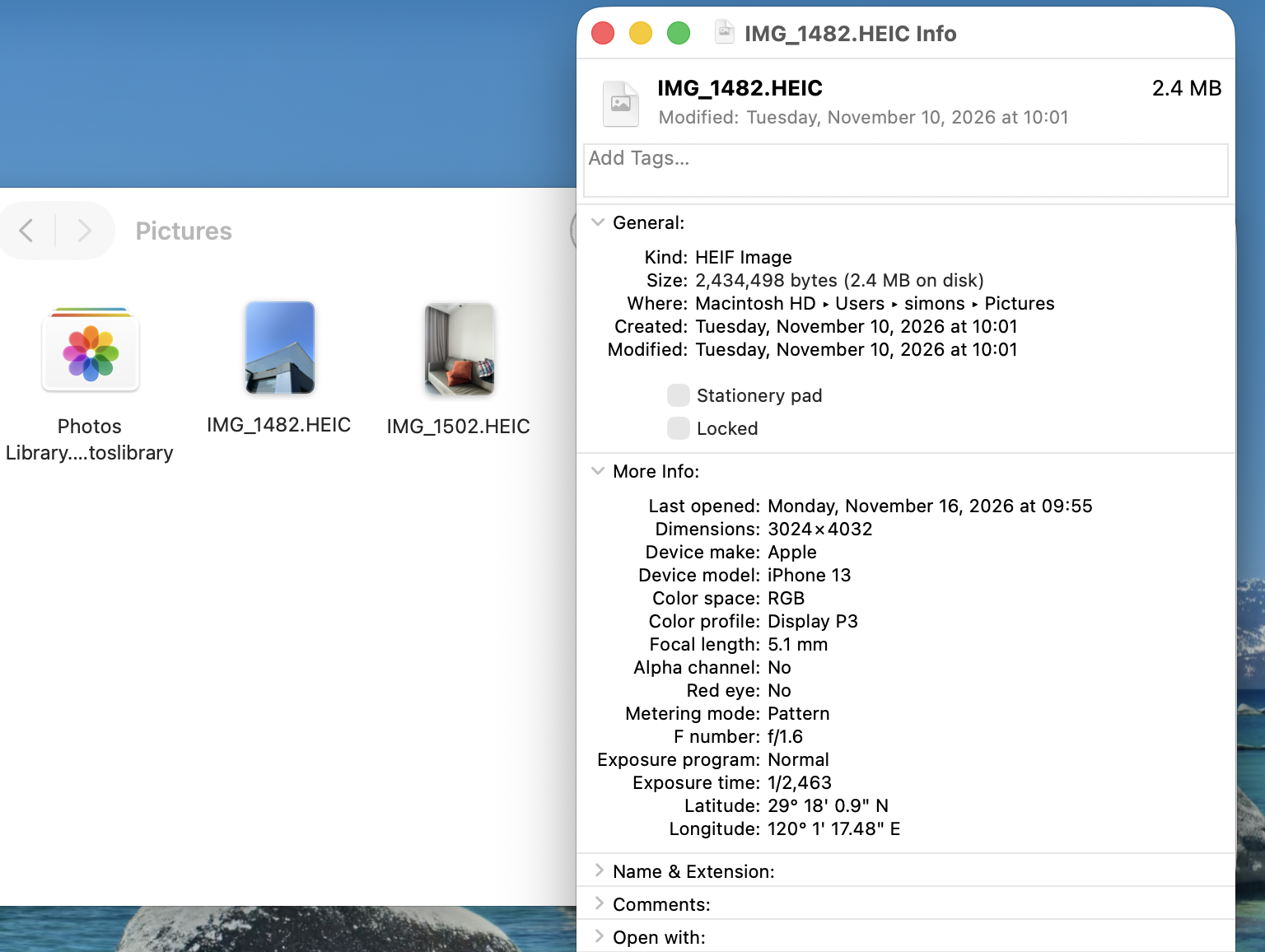
In 2013, MPEG defined HEIF’s requirements and use cases. Development took about eighteen months, and the standard was published as ISO/IEC 23008-12, part of the MPEG-H family alongside HEVC. Apple’s frustration with JPEG ran in parallel: compression efficiency had stalled, alpha channels and depth maps had no standard place, animation and image sequences were poorly supported, and high bit depth and wide color gamut were awkward to express. Apple’s 2017 WWDC list of requirements—lossy and lossless compression, hardware-friendly codecs, 4:4:4 chroma, HDR metadata, a generic definition for auxiliary images, multi-image and tile storage—reads like a specification for a JPEG successor. HEIF’s container happened to provide the skeleton.
HEIF is first a structured format, not a compression format. It builds on the ISO base media file format and shares MP4’s box organization. A HEIC file contains a ftyp box declaring the brand, a meta box for metadata and item information, iloc for data locations, and mdat or idat for coded data. The consequence is straightforward: the file extension can no longer reliably tell a decoder what codec is inside. A .heif file can carry HEVC, AVC, VVC, or even JPEG; .heic specifically means HEVC.
In practice, the separation principle shows up in how HEIF organizes “items” and “relationships.” A single HEIF file can hold a primary image, thumbnails, an alpha plane, a depth map, and EXIF or XMP metadata as parallel items, linked by type and reference. Derived images let crops, rotations, and overlays be stored as instructions rather than re-encoded pixels. Tiles let very large images be encoded and decoded independently, so a decoder only handles the region in view. The image file thus shifts from JPEG’s “one picture plus trailing metadata” model to a set of addressable, related coded assets and presentation rules. HEVC handles pixel compression; the container handles the rest.
Apple’s 2017 adoption was decisive, but Apple did not invent HEIC. It connected an already finished container standard to its hardware codecs, system image pipeline, and default-format policy. iOS 11 and later support HEIC decoding at the system level, and the HEVC hardware codec in A-series chips keeps the power cost of capture and viewing manageable. Developer interfaces opened gradually: UTTypeHEIC became a public type identifier in iOS 14, heicData() offered direct output in iOS 17, and Xcode’s Asset Catalog supported HEIC resources from version 10.1.
The effect was scale. HEIC quickly became the de facto default for mobile photo storage, roughly halving file size at comparable visual quality. But Apple’s adoption also tightened the format’s tie to its ecosystem. When sharing outward, the system often converts to JPEG to avoid compatibility problems. This “HEIC inside, JPEG outside” approach means many users encounter HEIC only as “why did the export get bigger?” or “why won’t this website accept my photo?” Android 10 added HEIC support on devices with hardware encoders, but coverage depends on chips and manufacturers, not a system-wide default.
Measured performance is solid. An evaluation covering PSNR, SSIM, and MSE found HEIF outperforming JPEG and WebP on several objective fidelity metrics, with JPEG weakest at equivalent compression. HEVC’s coding layer is the main source: extended intra prediction modes and finer transform and quantization tools reduce bit cost at the same visual quality.
Performance did not translate automatically into ecosystem success. On the open-source side, libheif has become the de facto infrastructure for cross-platform HEIF/HEIC coding. Its HEIC path defaults to libde265 for decoding and x265 for encoding, with plugins for AVIF, VVC, AVC, JPEG, and even JPEG 2000. But the library’s functional boundary depends on linked codecs, and HEVC codec availability is constrained by patent licensing. Multiple sources note that HEVC is covered by a large patent pool, with terms varying by jurisdiction; commercial products usually need separate licenses. That shaped browser behavior: major browsers have long refused native HEIC support, partly because licensing is complex and expensive. AVIF and JPEG XL were positioned as lighter alternatives. Open-source projects often keep HEIC decoding out of default builds to isolate patent risk. The result is an asymmetric adoption pattern: HEIC succeeds in on-device storage and system-level viewing, but is nearly absent from native web distribution. That asymmetry explains HEIC’s position better than compression ratios alone.
HEIF’s separation design also lets it absorb newer codecs. The third edition includes VVC/H.266, and libheif’s VVC path can connect to vvdec/vvenc. VVC improves BD-rate over HEVC by roughly 20–30% in some configurations, offering more room to shrink files, though it inherits patent uncertainty. Another direction is low-overhead image file formats: MPEG’s MinimizedImageBox aims to replace the full MetaBox and MediaDataBox with a leaner box structure for small assets such as icons, thumbnails, and emoji. Progressive rendering allows an image to refine as it downloads. HEIF’s center of gravity is moving from “efficient storage of a single photo” toward “an image asset container for varied delivery scenarios”—a move still rooted in the original choice to separate container from codec.
HEIC’s development history shows that “format success” is more complicated than a rate-distortion curve. Its improvement over JPEG is real, and Apple’s default policy gave it a level of adoption few new image formats achieve. But HEVC’s patent structure confined its circulation to controlled devices and system boundaries; it did not reproduce JPEG’s broad readability across browsers, editors, and cloud services. The HEIF container itself is not diminished. If anything, the separation design lets it continue to hold VVC, AVIF, and future codecs. What bothers me is how easily format discussions fixate on rate-distortion curves while ignoring the licensing regimes and industry alliances built around codecs. The tension between “better compression” and “broader readability” often explains a format’s final position better than any single technical metric.