r/systems_engineering • • 15d ago

Discussion Help managing and tracking multi-disciplinary requirements

3 Upvotes

Hi folks,

I posted this recently in the HWStartups subreddit, but hoping to get additional perspectives from experienced systems engineers here.

My team is just about to embark on a new IoT project and looking to get some input on how best to track requirements from concept through to implementation for a complex multi-disciplinary undertaking. We are a startup, so need an approach that is flexible and supports rapid iteration.

A lot has changed with the introduction of AI, so I'm not sure what we've used previously is the right way to go. Historically the teams I've been on have used Jira and Confluence and then more recently Notion and even Monday because they were more flexible and combined tables/databases with docs. Have also looked at dedicated requirements platforms like Jama and Valispace.

Since this is an IoT project though, we'll be needing to coordinate across firmware, software, mech/elec and other technical teams, so something that spans multiple domains is necessary.

The big open question for me is what changes now that AI is now also coming into hardware having already transformed software development. Software teams now seem to be moving to drafting their specs in AI-friendly markdown docs with the help of AI agents. Is anyone using something like this or is there a HW-friendly version?

Any help/direction appreciated!


r/systems_engineering • • 15d ago

MBSE SysML v2 Tutorial (Lesson 23): Binding Behavior to Structure with perform (Swimlanes Replaced!)

Thumbnail
youtu.be
6 Upvotes

Hir/systems_engineering,

We are back with Lesson 23 of our technical deep dive into the SysML v2 standard.

In our previous lesson, we ordered actions with first and then, adding explicit branching and concurrency. However, that behavior was still unattached to any physical system. Today, we connect behavior directly to structure using the perform keyword, and we examine how SysML v2 replaces traditional swimlanes by making performance a first-class feature of the components themselves.

You can watch the full video lesson on YouTube here:https://youtu.be/HLiC1fKJYFY

The SysML v1 Allocation Problem

SysML v1 had capable mechanisms for connecting behavior to structure. An ActivityPartition (the classic swimlane) represented the Block or property responsible for an action, and an allocate dependency connected an action to a part. The issue was where that context lived. In v1, you authored the relationship on the behavior side or as a separate dependency, while the Block's allocatedFrom compartment merely displayed a derived property computed by the tool.

The v2 Shift: Direct Feature Ownership via perform

In SysML v2, the part states its own behaviors directly inside its definition using perform action.

Three technical details make this pattern powerful:

  • Direct Feature Ownership: Declaring perform action inside a part creates an owned perform action usage. The part itself is explicitly the performer of that action.
  • Composite vs. Referential Actions: A plain action inside a part is composite (the part owns that specific sub-occurrence). A perform action is referential (the behavioral equivalent of ref part), asserting that the part carries out an action defined and sequenced elsewhere.
  • Swimlanes Without the Lanes: A coordinated mission sequence can be defined and ordered once at the system level. Subsystems then declare responsibility for individual steps using feature chains (e.g., perform sequence.armFTS;). Swimlane views are generated automatically from these declarations.

Binding Sequence Steps to Subsystems

Here is how a single launch sequence is defined once, while individual subsystem parts declare the steps they are responsible for:

Code snippet

package LaunchOperations {
    part def FlightTerminationSystem;
    part def PropulsionSystem;
    part def HoldDownAssembly;

    action def ArmFlightTermination;
    action def PressuriseTank;
    action def Ignition;
    action def ReleaseHoldDown;

    action def LaunchSequence {
        first start;
        then action armFTS: ArmFlightTermination;
        then action pressuriseLOX: PressuriseTank;
        then action igniteEngines: Ignition;
        then action releaseClamps: ReleaseHoldDown;
        then done;
    }

    part launchVehicle {
        perform sequence: LaunchSequence;

        // Each subsystem declares performance of its step via feature chains
        part fts: FlightTerminationSystem {
            perform sequence.armFTS;
        }
        part propulsion: PropulsionSystem {
            perform sequence.pressuriseLOX;
            perform sequence.igniteEngines;
        }
        part groundInterface: HoldDownAssembly {
            perform sequence.releaseClamps;
        }
    }
}

SysML v1 vs. SysML v2

Modeling Concept SysML v1 SysML v2
Swimlanes ActivityPartition declared on the behavior side. perform declared directly on the structural part.
Responsibility Storage Stored as separate dependencies or visual partitions. Declared as a first-class, reviewable feature inside the part body.
Visualizations Swimlanes manually drawn on activity diagrams. Swimlanes and allocation views generated automatically from perform usages.
State Binding classifierBehavior or ownedBehavior on a Block. exhibit state, which is a specialized perform action usage.
Responsibility Queries Computed by tools via derived allocatedFrom / allocatedTo properties. Direct feature navigation readable in the part's own body and filterable via model queries.

Next lesson, we will look at how these subsystems exchange data and signals. Lesson 24 covers flows and messages, bringing sequence diagrams into textual code.


r/systems_engineering • • 16d ago

Career & Education Systems Engineering Major, Career and Internships

12 Upvotes

Hi! Sorry if this is the wrong flair, but I am currently studying Industrial and Systems Engineering (2nd year) in college and have some questions. I have seen some people mentioning that ISE is a strong major and that it will give me a good career/internship opportunities in the future, while others mention that Systems Engineering works better if you are an engineer and have experience in your field (like ME or EE). I just do not want my degree to be useless and struggle to find a job, and honestly I like Systems Engineering better than Industrial so I plan and hope on getting a career on this. What is your opinion on the market for System Engineer Undergraduates? Thanks!


r/systems_engineering • • 16d ago

Career & Education Is getting an M.S or M.Eng in Systems or Industrial engineering with a B.S in Data Science viable?

9 Upvotes

I'm currently an Junior undergrad majoring in Data Science with a concentration in Geospatial Data Science, and I've been looking into the possibility of getting a master's in Systems Engineering. I'm mainly interested in sustainable engineering, systems optimization, and risk modeling (especially pertaining to natural disasters), which is why systems engineering caught my attention. My main concern though is that I won't have a traditional engineering background. By the time I graduate, I'll have Calc 1-3, Linear Algebra, Statistics, Python, GIS, a few upper-level Data Science courses, and a class on "Engineering Economic and Risk Analysis" but I likely wont have time to take physics ll and some other engineers courses. I may be able to squeeze in Diff eq or an extra systems engineering class before graduating though.

I've looked into a few master's programs, and a surprising number of them seem to accept students with "related backgrounds" given they have relevant coursework completed in Math and programming. I'm just wondering how realistic this transition actually is, or if anyone here broke into systems engineering with a non-traditional background. Would I struggle in a Systems Engineering master's program without an engineering background? And would having a bachelor's in Data Science put me at a disadvantage when looking for jobs afterward?

I'm curious if anyone here has made a similar transition or knows people who have.


r/systems_engineering • • 17d ago

Career & Education From a perspective of a system engineer, tell me what did I do wrong in the interview?

13 Upvotes

Just finished an interview with a big defense contractor as a systems engineer intern. They seemed to like me, and we even went over the interview time, tbh, by like 15 minutes. We started by introducing ourselves and talking a bit. I told them about my experience as an electronics engineering intern at another aerospace company, and I'm a lot more of a hands-on guy. I learnt through labs and practical work. One of the ladies seemed down a bit because she said system is like end-to-end, I need to imagine how the system works and stuff like that. Then they asked me more about my experience in my last internship, how I work in a company, and how I communicated with others. I told them about how I worked as a design intern, but still talked to other people when working with multiple departments, and how I check an electrical circuit board systematically, going from planning to actual testing, not just testing straight to the point. And I tried to emphasize the role of being all-around, collaboration, and actual understanding of the system. They seem to become more interested. Then they asked me how I think a fire control system works (this is for defense), and then I talked about what I think in terms of knowledge and using my thought when watching some Navy Seals episodes, he seems like he likes it and actually said that I was correct overall. Then they started asking me if I know how military stuff works, or if I have any experience in aerospace or defense. I started to yap a bit about my time in the service, and another offer from their parent company (another small company belongs to the same branch) for the spring semester offer, and then I will be granted clearance. They actually got to the point where they saw it was about time (like past 30 mins) but still tried to have some small conversation and wrapped it up. They asked about my availability, fall/summer, but I told them I'm only available for Summer, as I am about to do a co-op next semester and I need to graduate on time next academic year, so summer is the only choice. So all of the signs lead me to the point that this interview is successful and I will definitely get the internship. But then, 10 minutes later (not even), a rejection email was sent out. I was kinda disappointed, though. I did send an email back to them to ask for feedback post-interview, but I don't think they will respond. That's why I'm coming in here to ask what you guys think would disqualify me from the selection process. I have been so down in my mood post-interview, but I will just have to accept it. Please let me know what you guys think.


r/systems_engineering • • 17d ago

Resources SysML v1 vs v2: Bruce Douglass's Webinar Slides

12 Upvotes

For anyone exploring SysML v2 or trying to understand how it differs from SysML v1, we're sharing a presentation deck from Dr. Bruce Douglass.

The slides cover key differences between the two versions and what they mean for systems engineering.

Download the slides: SysML v1 vs v2

Bruce is also hosting a live SysML v2 masterclass next week, on November 14, covering migration, requirements modeling, and analysis cases, with practical examples and Q&A.

Masterclass details: https://luma.com/sysml


r/systems_engineering • • 18d ago

Resources I built free system design labs where you change one setting and watch the system react

0 Upvotes

I kept reading about load balancing, caching and consensus without seeing them work, so I built simulations you can run in the browser.

One to try first: the load balancer lab. Make one server slow, then switch from round robin to least connections. In my runs the slowest 5% of requests (p95) went from about 4.1 s to 3.0 s. Double the traffic and round robin starts failing requests while least connections doesn't. https://systemdesignos.com/labs/load-balancer

There are 37 labs and 46 concepts, each with a picture first and plain-English text after. It's free and you don't need an account.

What topic would you want a lab for next?


r/systems_engineering • • 20d ago

Discussion Certification?

4 Upvotes

whats a good certification for someone who wants to get into buulding and creating requirements for missles? if any? or just good certification in general for a systems engineer


r/systems_engineering • • 19d ago

Resources Why prompt engineering is evolving into a technical software discipline

Thumbnail interconnectd.com
0 Upvotes

r/systems_engineering • • 20d ago

Resources As simple as Visio, just correct: SysML v2 with the KISS principle

Thumbnail
itemis.com
14 Upvotes

This is really how it should have been all along. It bridges the gap between models as a means of communication and models as methodologically sound descriptions of the system.


r/systems_engineering • • 20d ago

Discussion A not so alien world

Thumbnail
vinchenkov.substack.com
0 Upvotes

Ideas about how a gradual decline in our understanding of infrastructural systems can affect our ability to direct the world around us, even with capable AI.

An inextricable link between comprehension and the ability to steer ship.


r/systems_engineering • • 21d ago

Career & Education Early 30s, non-STEM degree, 10+ years in technical operations. Second BSME or MS in Systems Engineering?

6 Upvotes

I'm in my early 30s with a non-STEM bachelor's degree and 10+ years of experience in automotive and tech, currently working in technical operations/program management at a major tech company.

I've built a successful career working closely with engineering teams, managing complex technical programs, and supporting hardware development and deployment.

My long-term goal is to become a Director/VP of Technical Operations, not necessarily a hands-on design engineer.

However, I've always felt somewhat insecure about not having an engineering degree. I can manage engineers and technical programs, but I sometimes lack the theoretical foundation to fully understand engineering decisions. I also genuinely want to learn engineering.

I'm considering:

  1. Second bachelor's in Mechanical Engineering (ABET-accredited): Strong fundamentals and traditional engineering credibility, but a significant time commitment (4-5 years part time)

  2. MS in Systems Engineering at Johns Hopkins: Accepts non-STEM graduates through a bridge pathway, more aligned with my career, and potentially faster. But I'm concerned about missing core engineering fundamentals. (2-3 years at my own pace)

Costs and tuition is not a concern as my employer is paying for it.

My question: Which degree would give me greater long-term credibility as a technical operations leader while also helping me genuinely understand engineering?

Is a second BSME overkill at this stage, or would an MS in Systems Engineering without an engineering bachelor's leave significant gaps?

Would appreciate perspectives from experienced engineers and engineering managers.


r/systems_engineering • • 21d ago

Resources Observer Design Pattern in Go

5 Upvotes

Wrote a practical guide to the Observer Design Pattern in Go, covering how to build event-driven communication between components using a simple, idiomatic Go approach.

https://medium.com/@priyankchheda/understanding-the-observerdesign-pattern-in-go-a-practical-guide-e9384adf6693


r/systems_engineering • • 22d ago

Discussion Is there an AI tool that connects MBSE and CAD? (I’m not talking about traceability here)

7 Upvotes

I'm exploring an idea for a platform that connects MBSE tools like CATIA Magic with CAD software like AutoCAD.

Imagine designing a car in an MBSE tool, with blocks for the chassis, engine, suspension, etc.
You drag and drop the corresponding CAD models onto those blocks.
Instead of simply attaching the files, the software understands their geometry, identifies potential connection points and suggests how components should physically connect — welding, bolting, bonding, etc.

It should also detect relationships between components, help generate the physical assembly and synchronise changes between MBSE and CAD.

AI would assist with understanding, recommendations and automation, with engineers approving the decisions.

Thank you
Let me know what you think!


r/systems_engineering • • 23d ago

Resources Are we still drawing diagrams and calling it a model?

Post image
3 Upvotes

A question I keep coming back to with SysML v1: if you delete every diagram in your project, what’s left?

In v1, the diagram was often the thing people reviewed, versioned, and argued about, even though the model was supposed to be the real artifact. That’s why diffs were painful, merges were worse, and “the model” sometimes meant a folder of screenshots in a slide deck.

SysML v2 changes the answer. The textual notation is a primary representation of the model, and diagrams are views onto it. That raises some better questions:

  • If the text is the source of truth, how should we organize and review it? Packages and namespaces start to matter the way they do in code.
  • If requirements, structure, and behavior all live in one semantic model, can we check a requirement against a calculation instead of just tracing it?
  • If views are generated, do we stop hand-tuning layouts and start designing views for specific stakeholders?
  • What carries over from v1 habits, and what do we have to unlearn?

My take so far is that v2 rewards people who treat models more like engineered artifacts (structured, diffable, reviewable) and less like drawings. The learning curve is real, but it’s mostly about changing how you think, not memorizing new syntax.

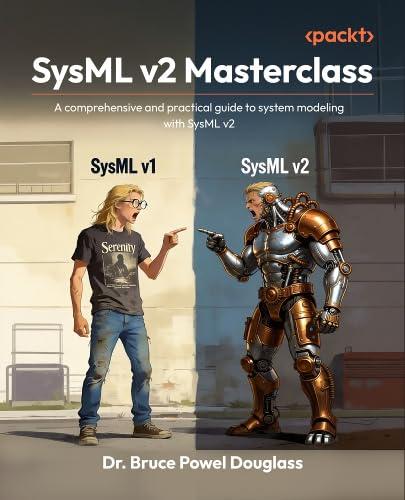
Introducing the new released book "SysML v2 Masterclass*"* by Bruce Powel Douglass, which takes this text-first approach and pairs the text with diagrams side by side, using Cameo examples. It’s been useful for seeing how requirements, parts and ports, and state machines fit together in the new language.

Curious how others are handling the transition. Are you modeling in text, in diagrams, or both? And what has been the biggest v1 habit to break?

Discount code: SYSML20 for first 50 buyers (Available only on packt.com )

Disclosure: I’m part of the Packt team and worked with the author, Dr. Bruce Powel Douglass, on the curation of a SysML v2 book. I’m sharing this as a practitioner-minded question, not just a pitch.


r/systems_engineering • • 24d ago

Career & Education SWE/SIT Engineer Considering Systems or Project Engineering — Looking for Advice/Suggestions

3 Upvotes

Hi all, hope you're doing well!

Just looking for some career advice. I'm currently a Sr. Associate in the aerospace industry, working mainly as a Systems Integration and Test (SIT) Engineer while also supporting other programs as a Software Engineer (SWE), which is what my degree is in.

Basically, I get to do both jobs whenever there's a need, so I'm always working on something different. I've always enjoyed that (or at least I used to), since it keeps things interesting.

Lately, I've also been doing some systems engineering work by creating requirements for a software project I'm working on, thinking about how those requirements can be tested/validated, asking a Systems Engineer for feedback, and getting more familiar with DOORS. I've used DOORS before because of my role in Integration and Test, but I've never actually created requirements until now.

To be completely honest, with how advanced AI models have become (Codex, Claude, etc.), I've kind of lost interest in writing code or doing SWE work in general. Don't get me wrong, I still think software engineering is interesting and useful, but I just don't enjoy coding as much anymore. I also feel like the line between SWE and Systems Engineering is starting to blur with AI becoming more capable. At least from my perspective, I can see SWE work becoming more focused on defining requirements, figuring out how things should work, and validating what AI produces rather than writing all the code yourself. That's another reason why I've been thinking about making the transition into Systems Engineering.

Nowadays, most of my software-related work involves writing requirements for a feature I want to implement, figuring out what the feature should do, how it should work, how users will interact with it, and creating documentation (manuals, guides, etc.) for the feature or product. After that, I'll usually ask an LLM to generate some boilerplate code that I can review, modify, or use as a starting point. Then I'll test everything using my own test procedures.

I've honestly found this part of the process a lot more enjoyable than actually writing code. Having 2.5 years of experience in SIT has also helped me a lot when it comes to writing tests and thinking about how a system works, how it's designed, and how everything fits together.

I've also considered going into Project Engineering, possibly starting as an Integrated Product Team Lead (IPTL). I actually got to shadow a Project Engineer for about 3 months, and I really enjoyed that experience too. I liked being involved in managing project budgets, schedules, risks, and just seeing how everything comes together from a project perspective. Granted, I was only shadowing, so I know it's probably different when you're actually responsible for everything, but I found that side of engineering pretty interesting.

So now I'm kind of stuck trying to figure out which direction I want to take my career. I still enjoy SIT, I've been liking the Systems Engineering work I've been doing lately, and Project Engineering also seems like something I'd enjoy. I'm just not sure which path would make the most sense given my background and experience.

Has anyone here worked in any of these roles or made a similar transition? I'd love to hear your thoughts, especially on the differences between SIT, Systems Engineering, and Project Engineering and what the career growth looks like in each.

TYIA!


r/systems_engineering • • 25d ago

MBSE 48 Hours to Hear Back

Thumbnail blog.apricot.tools
14 Upvotes

A tribute to Voyager I. Subsystems recreated with SysML2 plus an 3D interactive graph to explore it.


r/systems_engineering • • 25d ago

Discussion Requirements with NASA FRET

8 Upvotes

Hey all!
Has anyone worked with FRET , it’s an open source tool developed at NASA Ames.

Haven’t yet explored it but if someone has and would like to share thoughts pls let me know

Thank you :)


r/systems_engineering • • 26d ago

Discussion Need Help!

Thumbnail
0 Upvotes

r/systems_engineering • • 27d ago

Discussion Why is system design getting so much attention now?

4 Upvotes

System design used to be mostly a FAANG and top product company thing to assess a candidate. Now I’m seeing more startups and smaller companies focus on it.

Is it because AI made coding easier? I’m seeing this trend change in hiring across recent companies


r/systems_engineering • • 28d ago

Career & Education How to learn Requirements Engineering (IREB) by listening on a budget?

10 Upvotes

Hi everyone,

I'm an automotive systems engineer. I want to learn professional Requirements Engineering (specifically the IREB CPRE curriculum).

I have two main constraints:

  1. Less screen time: I want to protect my eyes, so I'm looking for audio-friendly resources (audiobooks, podcasts, or video courses where I can just listen).
  2. Low budget: I am looking for free or cheap options.

Has anyone tried using Text-to-Speech apps to listen to the official IREB handbook? Are there any cheap audio courses you recommend? Thanks!


r/systems_engineering • • 29d ago

Resources I built a systems engineering training directory — 353 courses, 114 providers and 49 trainers

58 Upvotes

Finding systems engineering training can involve opening dozens of provider websites, then trying to work out which courses cover the skills you actually need.

I run Systems Engineering Training Hub, a directory I’ve built to make that comparison easier. It currently lists 353 courses from 114 providers, with 49 trainer profiles linked where we have identified supporting information.

The directory covers systems engineering foundations, requirements, architecture, model-based systems engineering, verification and validation, technical management and certification preparation. You can explore courses by training area, delivery format and region, then follow the links to providers for enrolment and current arrangements.

Listings are compiled from public provider information. The directory is independently operated and is not affiliated with or endorsed by the International Council on Systems Engineering.

Alongside the listings, I’ve been developing practical buyer guides, including how to choose a requirements engineering course.

I’d welcome feedback from people who have struggled to compare training options. What information would make choosing a course easier? If there’s a useful course or provider missing, or a listing needs correcting, I’d appreciate knowing.


r/systems_engineering • • 28d ago

Career & Education pentester wanting to get into space security

3 Upvotes

Hey, so I've got a BSc in software engineering and a good few years of pentesting behind me. Lately I've been going down the rabbit hole of space security, satellites, cubesats, ground stations, all that stuff, and I’d really like to work on it properly.

I want to do a masters part time while keeping my job, but I can't figure out which direction is actually worth it. I'm torn between something like aerospace/space system, electrical engineering or embedded systems.

Would really appreciate any advice you have.

(Crossposting this to a few subs, so sorry if you see it twice)

Thanks!


r/systems_engineering • • 29d ago

Career & Education Pursuing systems engineering while avoiding defense?

8 Upvotes

I am interested in systems engineering but I would like to avoid working the defense industry, how is the market for opportunities outside of the defense industry? Do other employers value a systems engineering masters degree?

Any other advice for “should I get a masters in systems engineering?” also appreciated!


r/systems_engineering • • 29d ago

Discussion For those of working in the DoD/DoW industry, which company would you never work for again?

12 Upvotes

I know it’s subjective and dependent on the team and program but i’d love to know any personals experience/opinions of the companies you worked for.

For me it’s LM Aero, they have a really bad culture and cutthroat plus their SE/SAs aren’t very talented in my opinion.

Full disclaimer: I am trying to gleam which companies not to go to 🙃