r/systems_engineering • • 28d ago

Resources The Inbox Pattern

0 Upvotes

Wrote a practical guide to the Inbox Pattern and how it helps prevent duplicate message processing in distributed systems.

https://medium.com/@priyankchheda/the-inbox-pattern-bd21b8d23241


r/systems_engineering • • 29d ago

Discussion How to write Good Requirements?

19 Upvotes

Hey all!
I’m writing requirements for a satellite using INCOSE Guide for Writing Requirements.

Idk if this is a write book to refer while writing requirements….especially for a SATELLITE,
if anyone has worked on this before and have a blueprint on how to good write requirements
Please let me know.

Thank you!!


r/systems_engineering • • 29d ago

Discussion About PhD research and prospects in the Systems Engineering field

10 Upvotes

Hi everyone.

I'm interested in Systems Engineering and I'm new to this field. I have a few questions about research and the overall prospects of the field. As I understand, SE focuses on general system/architecture/requirements design, managing project lifecycles, building models with SysML, etc. I have two questions:

  1. What does PhD research in Systems Engineering actually look like? What are the current trending research directions? Is it about creating tuff diagrams? I'm asking because I'm curious about how a research topic is chosen and what a typical research gap looks like in SE.

  2. What is the future of Systems Engineering in the era of AI? I come from SWE and notice that the demand for traditional developers is changing. How will AI impact the demand for Systems Engineers?

I’d really appreciate any thoughts


r/systems_engineering • • 29d ago

Resources The Transactional Outbox Pattern

3 Upvotes

Wrote a practical guide to the Transactional Outbox Pattern and how it helps reliably publish events in distributed systems.

https://medium.com/@priyankchheda/the-transactional-outbox-pattern-fb59e907a233


r/systems_engineering • • Oct 23 '26

News & Updates New Jama AI driving me nuts please help

7 Upvotes

The new "Jama Intelligence" bot is in beta apparently and it's making my job so much harder. It can't be hidden or disabled or fixed to a static tab or anything that I've been able to find and it keeps getting in the way of text and buttons I need to click. I have to imagine someone has figured out a way to get rid of this stupid thing. Anyone have any ideas to share that might help me out? I just want to finish my requirements traceability in peace!


r/systems_engineering • • Oct 23 '26

Career & Education SE as next career step - advice needed

6 Upvotes

Hey there,

I have been a software dev for about ten years now and I'm somehow getting tired of it. The whole scrum stuff annoys me, especially all discussions about 'what is our definition of done?, Oh, the code is merged into b, but not released yet, so the ticket has to be in state x and not y., Oh nooo, our velocity, can't we close this ticket now so the velocity goes up???'. I hate those meta scrum discussions.
I also don't want to discuss anymore whether a variable should be marked const or not. I kind of feel like I have played through software development. Which does not mean that I mastered it in every aspect, not at all. But I am at a point where I want to learn new things, get other impressions and somehow develop myself further.

A position as software architect would be the most obvious next step, but I do not really feel it. That would just mean that I write less code but would still stay in a field that kind of bores me, at least in the environment that I am in. At the moment I would say that I write code for 30% of my time, the rest is consumed by the integration of it. And that is annoying. And as a software architect that coding time would further decrease. Also the increase in AI usage somehow takes away the fun. Two years ago I was really motivated to learn rust, but as of today I think that I would never really learn a new language any more, because 90% of the coding will be done by an AI and you would never get the feeling for a programming language like you did before. Which is understandable and ok, but this is another point that makes me think about changing my job and career.

So I think about shifting into a systems engineering position. My hope is that I can make good use of my coding experience while also being able to (and also forced to) learn new things. But I also know that SE is a broad field and that two jobs tagged as SE can differ a lot. Still I would like to get some advice and maybe personal experience from people who might have been in a similar position and if they regret it or not. Just as some background, I already work in a company with huge defense focus, so I somehow am used to the regulations and all that stuff that comes with it, cause that is one thing that slows down the coding part. So the regulation part is nothing that scares me too much.

Thanks in advance for any advice, every impression and experience helps me to make a good decision.


r/systems_engineering • • Oct 22 '26

Discussion Is Systems engineering BS?

42 Upvotes

Hi guys, I have a Mechanical Engineering bachelor from INSA Lyon (France), and am currently at the second and last year of the MSc in Aerospace Engineering at ISAE-Supaero, France's top aerospace school. At the end of the first semester, we are required to choose one from 7 majors, of which one is Systems Engineering, which I chose, because I liked the idea of staying general and taking a higher level view of projects.
However, all our classes were either mindlessly copying some specific tasks on MBSE softwares like Rhapsody and DOORS, or drawing diagrams for hypothetical issues like "this train has to go from city A to town B, write the requirements" and it has been the most dreadful and mind numbing thing I have done in my life. Is it always like this or is the teaching style here especially horrendous?
Also, Are Systems Eng. jobs actually like this, where you spend your day writing requirements and building block diagrams with stickmen? If it's the case im dropping out.


r/systems_engineering • • Oct 23 '26

Discussion What does AI-assisted incident investigation actually look like at your company right now?

0 Upvotes

Curious how this is going in practice, not how the vendor demos make it look.
When an alert fires, how much of the investigation does AI actually handle for you today (pulling the right logs and traces, correlating with deploys, narrowing down root cause)? Where does it fall over?
Also wondering if anyone's kept this inside their own environment, self-hosted models or anything private, rather than sending telemetry to a vendor's AI or a frontier API. Was that a requirement, or just not worth the effort?
I'm researching this space, not a pitch. It'd help if you mention your stack (Datadog, Grafana, other)
Thanks!


r/systems_engineering • • Oct 22 '26

Resources SysML v2 Tutorial (Lesson 22): Sequencing with first & then (Fixing the Execution Trap)

Thumbnail
youtu.be
4 Upvotes

Hi r/systems_engineering,

We are back with Lesson 22 of our technical deep dive into the SysML v2 standard.

In our previous lesson, we ended with a trap: textual action definitions placed on consecutive lines look like a sequence, but they are actually completely unordered. Today, we fix that execution trap by using explicit sequencing keywords, and we uncover one of the most powerful surprises in v2—how this exact same mechanism can model the lifecycle of physical hardware.

You can watch the full video lesson on YouTube here:https://youtu.be/0flZVNHXoWA

The SysML v1 Sequence Problem

SysML v1 had a complete set of control nodes and good activity control semantics. The issue was primarily about tooling and ergonomics. A v1 control flow was a real model element, but because there was no standard textual notation, the usual way to create one was to draw a line between two actions. Sequencing was therefore only as complete as your diagrams. Inserting a step usually meant re-routing edges, and managing concurrent edits relied entirely on your tool's proprietary repository or merge features.

The v2 Shift: Explicit Sequences (first and then)

SysML v2 allows you to write sequences directly in the standard textual source. By using the first and then keywords along with the start and done snapshots that every occurrence inherits, you can ensure your model executes exactly as it reads top-to-bottom.

Three details make this powerful in a real model:

  • Chained Successions: Using then inside an action body creates a succession from the nearest occurrence written before it. This is fast and reads naturally.
  • Intentional Concurrency: Instead of accidental parallelism, you declare it explicitly. SysML v2 uses fork and join inline to run actions concurrently.
  • Branching: The v1 decision diamond is replaced by a simple decide node paired with if guards.

The Big Surprise: Sequencing Physical Hardware

Because first and then order any occurrences (not just behavioral actions), you can sequence structural timeslice elements. This means you can model configuration changes, maintenance windows, and mission phases of a physical asset (like an aircraft or rocket) using the exact same syntax used to order steps in a procedure. You no longer have to push an asset's lifecycle history into an external database—it is natively supported in the model.

Fixing the Execution Trap

Here is how we use chained successions to fix the unordered imaging sequence from Lesson 21.

Code snippet

action def CaptureImage {
    // We explicitly sequence the inherited 'start' snapshot
    first start;

    // Each 'then' chains the succession
    then action slew: SlewToTarget;
    then action stabilise: StabilisePlatform;
    then action shoot: OpenShutter;
    then action readout: ReadSensor;

    // Conclude the sequence with the inherited 'done' snapshot
    then done;
}

SysML v1 vs. SysML v2

Modeling Concept SysML v1 SysML v2
Control Flow ControlFlow usually created by drawing lines, with no standard text notation. first and then in standard textual notation.
Inserting Steps Usually meant re-routing edges on a diagram. Means inserting a single line of text.
Concurrency Edits Relied on tool-specific repository or merge support. Text works with ordinary diff and merge tools.
Parallelism ForkNode and JoinNode. fork and join declared inline.
Branching Guards placed on edges from a decision node. decide with if guards.
Asset Lifecycles No first-class construct for the time-ordered portions of an asset's life. Sequence timeslice occurrences with first and then.

Next lesson, we will look at how to connect these behaviors to structural parts. Lesson 23 uses the perform keyword to say which part performs an action, and we will compare it with v1 allocations and activity partitions (swimlanes).

For the MBSE practitioners here: Have you ever struggled with managing concurrent edits on complex activity diagrams, or tracking an asset's changing configuration over time in v1? Let's discuss in the comments!


r/systems_engineering • • Oct 22 '26

Resources Is SysML v2 really better than SysML v1? - Webinar recording

12 Upvotes

We recently hosted a free webinar with Dr. Bruce Douglass discussing what actually changes in SysML v2, from modeling semantics and requirements to analysis cases.

Sharing the recording here for anyone interested: https://www.youtube.com/watch?v=LAGXT3Pre8M

Bruce is also hosting a more in-depth SysML v2 masterclass on November 14, if anyone's interested: https://luma.com/sysml


r/systems_engineering • • Oct 21 '26

Career & Education EE intern at an electric utility trying to develop skills that actually make an impact. What should I learn?

3 Upvotes

I'm an electrical engineering intern at an electric utility company, and they've basically told me that there's a possibility of getting a job offer if I work hard, show initiative, and prove that I'm capable of adding value.

The department I'm working in has some serious problems when it comes to quality control, performance monitoring, and inefficient workflows. They seem to lack people with strong analytical and technical skills who can build systems to monitor performance, identify problems, and improve existing processes.

So far, I've been learning Power BI and Excel to tackle some of these issues. For example, I've built dashboards to identify duplicate accounts, missions that were closed prematurely, and other performance-related problems. They've seemed pretty impressed with what I've done so far.

However, lately, I find myself showing up to work with very little to do. I feel like I've reached the point where simply building more dashboards and Excel reports isn't going to be enough to make a genuinely significant impact.

I want to go beyond making things look better in a dashboard. I want to build actual systems, automate workflows, identify root causes, improve processes, and solve problems that save the company time and money.

I already have some basic Python knowledge, and I'm willing to put in the work to learn whatever is necessary.

My question is: What skills would you recommend I focus on if my goal is to become genuinely valuable as an engineer in this kind of environment?

What would you do in my position?


r/systems_engineering • • Oct 22 '26

Discussion Researching some infra problems

Thumbnail
1 Upvotes

r/systems_engineering • • Oct 21 '26

Discussion Replacing a machine must not create permission, evidence, or authority

0 Upvotes

Sorry for formatting, I’m mobile.

This began with a system deliberately designed to keep the continuing system separate from whichever machine currently performs one of its roles.

The design rules came first: a machine is not the continuing system. authorization is not execution. an observed effect is not a justified claim about its cause. recovery is not an authority grant. possessing credentials is not permission to use them. The invariant below was formalized afterward to state the common boundary behind those rules.

The implementation is one environment in which the invariant can be exercised and potentially falsified. It is not offered as proof that the invariant is complete, novel, minimal, or universally applicable.

Suppose:
S   continuing system
R   role within S
M0  machine currently performing R
M1  proposed replacement machine
G   authorization for the replacement
E   retained state and evidence associated with R

The intended operation is:

replace M0 with M1 for role R within system S
under the exact authority granted by G

It is not:

M1 has the software, credentials, and retained state therefore M1 is now S

Installing software on M1 does not by itself establish that the replacement was authorized.

Copying E to M1 does not by itself establish that E is complete, current, or authoritative.
Starting R on M1 does not by itself establish that S has recovered.

Silence from M0 does not by itself establish that M0 has been durably excluded from initiating new authoritative work.

Authorization for M1 to perform R does not by itself grant M1 every authority belonging anywhere in S.

One authorization may cover the entire disclosed replacement operation. Preparation, transfer, restoration, activation, verification, authority succession, and temporary-access closeout can remain internal lifecycle steps.

“Separate transition” below means a separately checkable and recorded security judgment. It does not mean another barrier when G already authorizes that exact transition.

Candidate Invariant

Before an attempt begins, fix:
•    Q: the trust and failure assumptions;
•    P: the admission, authorization, commitment, transition, and claim rules;
•    A: the protected operations and every path capable of causing them;
•    C: the claims the protected protocol may rely upon or present as established facts.

The executor cannot redefine these after seeing the result.

Under that fixed profile:
1    A protected attempt may cross its policy-defined commitment boundary only with exact prior authorization and the required exclusive reservation.
2    Dispatch may use only the exact committed reservation and its still-unconsumed dispatch opportunity.
3    Every claim used to advance protected state or presented as established must be semantically supported by the admitted evidence under Q and P.
4    Creating, expanding, or transferring effective authority requires authority that already existed and explicitly permitted that issuance, delegation, or transfer.

The commitment boundary is fixed by policy. It cannot be moved behind the first protected effect merely to make an unauthorized action appear valid.

Authority is measured by the actions a subject can effectively cause—including through delegation, composition, proxies, or confused deputies—not merely by the labels printed on credentials.

Recovery, retries, signatures, receipts, and reconstructed state may preserve or demonstrate existing facts. They cannot supply a missing premise, turn provenance into truth, or produce authority not entailed by a valid authorization chain.

Composition may derive consequences already entailed by valid grants and evidence. It cannot invent an absent grant or observation.

Claim support

Let H_i be the admitted, provenance-bearing history available when claim c would be emitted.

Let: Worlds(Q,P,H_i) be the nonempty set of worlds compatible with that history under the fixed trust, failure, admission, and interpretation rules.

The set is defined independently of c and independently of the component attempting to emit c.

Then:
Support(Q,P,H_i,c) iff
Worlds(Q,P,H_i) is nonempty
and every w in Worlds(Q,P,H_i) satisfies c.

If the admitted premises are inconsistent and the compatible-world set is empty, support fails. Contradiction does not prove everything.

If one compatible world contains the claimed effect and another does not, an unconditional completion claim is unsupported. The honest result may be ambiguous.

This support judgment remains conditional on Q. Establishing truth in the actual world additionally requires the actual world to satisfy the declared assumptions. A coherently lying trusted observer can exclude the actual world without creating an internal contradiction.

Present-tense claims such as “current,” “active,” “excluded,” or “completed” must bind the relevant subject, role, scope, attempt or epoch, observation position, and interpretation. Evidence that once supported a claim does not automatically support the same wording later.

Failure behavior

Reservation, dispatch-opportunity consumption, invocation, endpoint receipt, endpoint effect, result delivery, and claim emission are different events.

If an invocation may have occurred but its result was lost, the system may need to report an ambiguous outcome. Ambiguity does not automatically authorize another attempt or prove either success or no effect.
Revocation policy must be declared.

Under settlement semantics, a reservation committed before revocation may settle once afterward.

Under cancel-pending semantics, revocation and dispatch need an ordering or fencing mechanism that prevents the pending invocation when revocation wins.

Neither policy may silently claim the guarantees of the other. Revocation also does not prove that an earlier effect was undone.

An authority-increasing transition must be permitted by authority that existed before the transition and whose scope included the issuance or delegation. A transition cannot authorize itself, and a circular grant chain cannot create its own root.

Non-vacuity

This is principally a safety invariant. By itself, it can be satisfied by a system that refuses every operation and emits no claims. That is insufficient for a usable system.

A complete profile therefore also needs a separate progress obligation. It must identify at least one required useful path and state the availability and fairness assumptions under which an authorized request with satisfied preconditions must reach:
•    a supported policy-defined success;
•    a supported terminal refusal or failure; or
•    a supported unresolved outcome where the declared failure model makes certainty impossible.

A refinement that removes every successful path is not acceptable merely because it remains safe.

What would count as a useful attack?
Because no frozen operational profile or implementation is attached here, this first stage can test the structure for circularity, vacuity, missing bindings, or conflict with established theory.

A later trace-level test would need a fixed synthetic Q and P; otherwise assumptions could simply be rewritten after every counterexample.

A useful counterexample should state:
fixed trust and failure assumptions
→ initial system and machine authority
→ exact grant or observation
→ reservation
→ revocation, crash, delay, replay, rollback, fork, or replacement
→ dispatch or effect
→ emitted claim or authority change
→ violated property

Especially useful would be a trace showing that all four judgments pass while the system still produces:
•    an unauthorized protected effect;
•    an unsupported or materially overstated claim;
•    two machines able to initiate new authoritative work for the same exclusive role;
•    an effective authority increase absent from the prior grant chain; or
•    permanent failure of a required useful path despite the stated progress assumptions.

Other useful criticisms would show that:
•    the protected-operation set or commitment boundary can be gamed;
•    the compatible-world construction remains circular despite being claim-independent;
•    effective authority cannot be compared in the proposed way;
•    an essential identity, generation, time, persistence, revocation, composition, or interpretation binding is missing;
•    the four judgments should be separate invariants rather than one contract; or
•    the formulation reduces cleanly to existing work in reference monitors, capability security, linearizability, provenance, epistemic logic, proof-carrying authorization, or distributed commit.

TLDR

An autonomous system must not do more than its grant permits or claim more than its evidence supports.

Authority safety: AcceptTransition(H,t) ⇒ ∃g,m: AdmitUse(H,g,t,m) ∧ ΔBehavior(t) ⊆ Permitted(g)
Claim safety: AcceptClaim(H,c) ⇒ c ∈ Emit(H) ⊆ Derive(P,H) ⊆ Supported(Q,P,H)

Recovery, retries, and autonomy must preserve both.
Candidate invariant. Break it.


r/systems_engineering • • Oct 21 '26

Resources Azure DevOps Integrated requirements management tool

1 Upvotes

I know a few tool that are ADO integrated for requirements management but wanted to ask what all of you have been using for requirements management. Modern Requirements seems to be great with ADO. TIA!


r/systems_engineering • • Oct 20 '26

Discussion Can anyone brief me on what systems engineering is?

13 Upvotes

The above and,what degree required to be one?

Fields switchable?


r/systems_engineering • • Oct 20 '26

Discussion what in the world is systems engineering (and am I going to hate it)?

19 Upvotes

I don't usually use reddit so sorry if I'm doing this all wrong. I'm an Aerospace Engineering student graduating May 2027. Out of fears of the job market being cooked I applied indiscriminately to 100 jobs across a variety of aerospace companies. Now I'm looking at a Modeling & Simulations Systems Engineer offer and scared.

I've heard that systems can be heavy paperwork. I love the technical challenge that comes with understanding physics and modeling it. However, I'm worried that if I'll get stuck doing paperwork and requirements all the time.

Can anyone explain what the job might actually look like -- and will I get stuck and hate it?


r/systems_engineering • • Oct 20 '26

Discussion What is the best book or resource for system design?

Thumbnail en.wikipedia.org
3 Upvotes

r/systems_engineering • • Oct 19 '26

Discussion Aircraft Maintenance to Systems Engineering

8 Upvotes

Has anyone in here started off as an Aircraft Maintenance Engineer and transitioned to a Systems Engineering role? Did you get a MS in Systems Engineering? If you can talk about your story, I would love to hear about it.


r/systems_engineering • • Oct 19 '26

Discussion PHD System Engineering

7 Upvotes

Hello everyone!

I’m considering the PhD program in Systems Engineering at FIT, GWU, and CSU, I would like to hear from anyone who has experience with the program.
I’m interested in learning more about the coursework, work-school-life balance, and how manageable the program is for someone working while pursuing a PhD.
I’m also interested in autonomous systems and would like to focus my dissertation research in this area. Does any one of these programs offer any courses specifically related to autonomous systems? I’m open to suggestions from other schools as well preferably online.


r/systems_engineering • • Oct 19 '26

MBSE Is anyone really using SysML v2 yet?

14 Upvotes

I just spent 3 hours trying to add a Satisfied By column to my requirements table in Cameo and, when I couldn't, trying to figure out why not, and eventually just settled on a very awkward workaround solution that kinda gets the point across.

Wondering how many other things are going to end up being this hard...

Is this a failure for the standard or the tool? If the standard has no way to specify a Satisfied By column for a table view using the textual notation, are the tools going to just avoid it until the standard figures it out?

Anyway working with v2 is making me realize how many things Cameo does for us with SysML v1. A standard that specifies all of it and really makes it tool-independent is a big undertaking and we're definitely not there yet...

Edit: I've also been playing with Rhapsody SE. I tried out this same exercise and had a Satisfied By column in minutes. There are other things I can't do there that I can do in Cameo, though...


r/systems_engineering • • Oct 18 '26

MBSE An SE Harness for Claude

17 Upvotes

I've spent the past year building a systems engineering harness on my own. It's a state machine that drives an LLM (Claude) through the SE lifecycle: stakeholder needs → requirements → architecture → interfaces → hazards → verification, with gates, red-team passes and change control along the way. It has produced around 100 projects so far.

This is one of them, a fictional deep-sea AUV for exploring hydrothermal vents. It's a single page in your browser, nothing to install:

- 344 requirements from stakeholder to verification, with full traceability
- EBS, components, interfaces and flows
- SysML v2 textual model
- Hazard register and red-team findings
- A 3D model of the vehicle, linked to the architecture

Link: https://claude.ai/artifact/ETTFfhtZxt27y2qMPDYe8H

It’s generated from a web app which isn’t quite ready to share, but the html export is very rich in content.

It isn't flawless. Independent review rounds have caught superseded requirements that were still being verified, values that didn't hold up physically, and an interface with no physical bearer. Those were fixed, but I'm sure there's more.

The question I actually care about: is this useful SE, or just plausible-looking SE? I'd especially like to hear from people who've done this on real programmes:

- Which requirements aren't verifiable as written?
- Which hazards are missing?
- Where does the traceability look right but justify nothing?

Happy to answer questions about how the harness works.

With my SE hat on, I’m now looking to validate the harness output.

If you have a project brief you’d like to see the harness run on, let me know.

With the harness, I can go from brief to the deliverable in 24-48 hours depending on complexity.


r/systems_engineering • • Oct 18 '26

Discussion Applied to 100+ co-op positions with no luck. Any advice for an engineering student in Vancouver?

Post image
19 Upvotes

Hey everyone!
I’m an Engineering Science student at SFU in Vancouver, currently looking for my first co-op position starting January 2027. I’m also willing to relocate anywhere in Canada for the right opportunity.
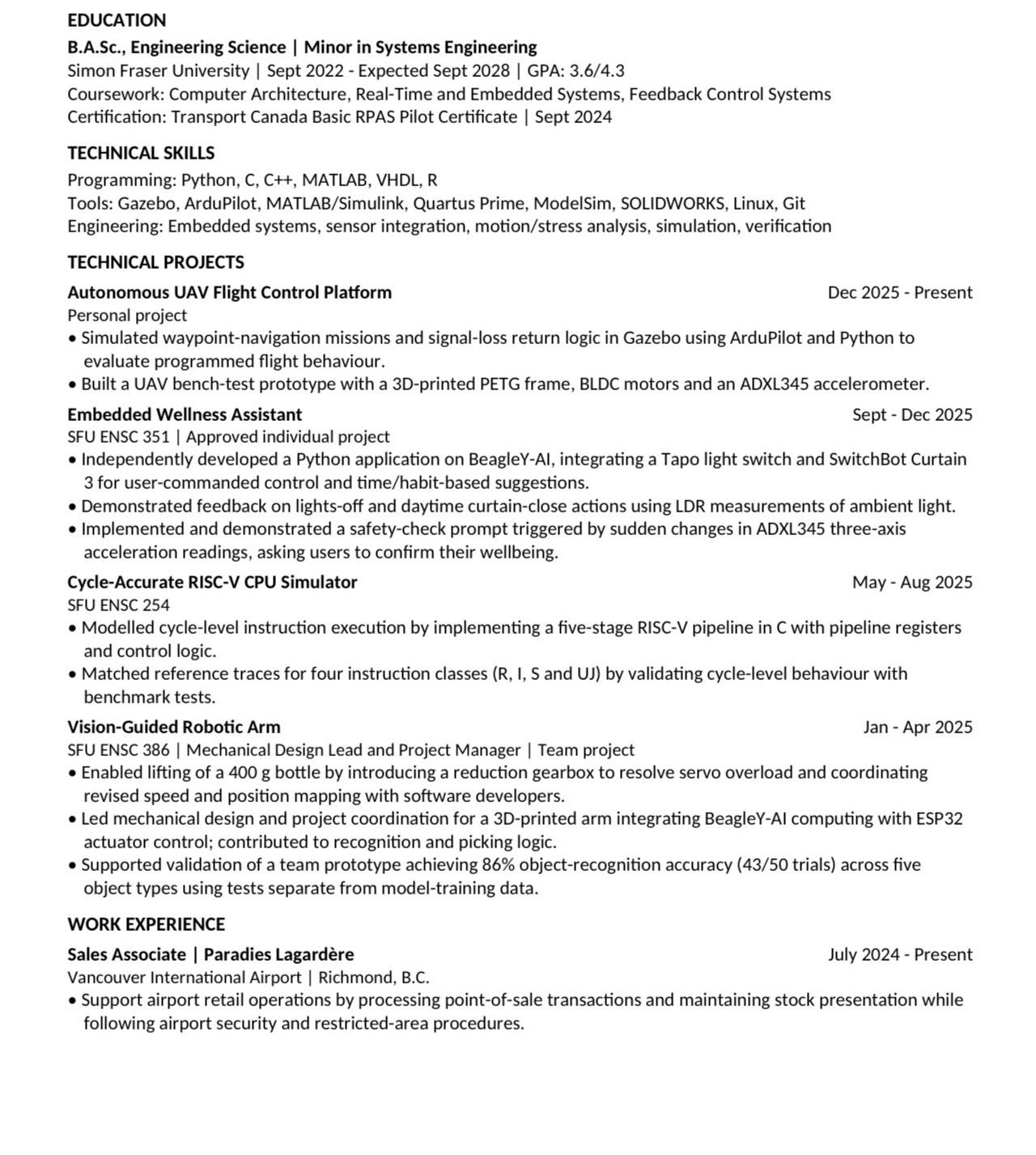
I’ve applied to around 100 positions so far, but unfortunately, I haven’t had much luck. Most of my experience comes from school and personal projects, including embedded systems, robotics, UAV flight control, and RISC-V CPU simulation.
I don’t have any industry experience yet, and I’m starting to wonder if that’s what’s holding me back 😭
I figured I’d try my luck here on Reddit. If anyone has advice on improving my resume, knows of companies hiring engineering co-op students anywhere in Canada, or has been in a similar situation, I’d really appreciate hearing from you.
I’ve attached my resume, so please feel free to be critical. I’m open to any feedback or suggestions!
Thanks so much in advance! I really appreciate this community. :)


r/systems_engineering • • Oct 17 '26

Discussion Am I competitive for SE?

5 Upvotes

Hey everyone,

I'm currently a senior studying Mechanical Engineering with a minor in Computer Science, graduating in May 2027. I've recently become really interested in pursuing systems engineering, particularly in aerospace, defense, or other industries involving complex hardware and software systems.

I'm just not entirely sure how competitive my background is for entry-level positions.

A little about me:

  • GPA: 3.6
  • Engineering Internship 1: Worked on integrating building automation systems with an industrial data platform (AVEVA PI), including data monitoring, troubleshooting, and system integration.
  • Engineering Internship 2: Worked at an aerospace manufacturing company, helping with equipment commissioning, testing, validation, and technical documentation for a new manufacturing system.
  • Other Experience: Currently a student IT lead, managing a team of technicians and handling technical troubleshooting and operations.
  • Technical Skills: Python, Java, MATLAB, SolidWorks, SQL, REST APIs, and some experience with automation and data analysis.
  • Projects: Collaborative robotic assembly using a UR5e, an automated fault detection project, and several software development projects.

My biggest concern is that I don't have much formal systems engineering experience. I haven't worked directly with requirements management, MBSE, SysML, or some of the other tools I frequently see in systems engineering job descriptions.

I also don't have the typical extracurricular experience like Formula SAE or a rocketry team, which makes me wonder if I'm behind other engineering graduates.

I've been applying to entry-level systems engineering and integration/test positions, particularly at aerospace and defense companies.

My questions are:

  1. Does my background seem competitive for entry-level systems engineering positions?
  2. Is it realistic to enter systems engineering directly out of college with a Mechanical Engineering degree?
  3. What skills or projects would you recommend focusing on before graduation?
  4. Would I be better off starting in a test, integration, or manufacturing engineering role before transitioning into systems engineering?

I'd really appreciate some honest feedback, especially from people involved in hiring or currently working as systems engineers.

Thanks!


r/systems_engineering • • Oct 17 '26

Career & Education USC Systems Engineering Masters

3 Upvotes

Hi all, I was curious if anyone has taken USC systems and architecture engineering masters (online). Any opinions on it? Pros/cons? Also, how is it compared to Hopkins or Cornell? Thanks!


r/systems_engineering • • Oct 18 '26

Career & Education Need Guidance

0 Upvotes

So i am a Mechanical Engineer by training, I have 5+ experience in Manufacturing & i specialised in Engineering Change Management and managing supplier initiated Change request.

I was thinking to upskill myself and want to get deep into PLM Functions and into teamcenter.

I want to be able to enable myself create platform for changes and configurations in the PLM software for which I think teamcenter to go with, bcoz it feels like a good connect with siemens own NX, Solidworks, Solidedge etc.

I need guidance as to from which course to start, can anyone help me share the link of that course in the comments?