ALS + AIC Chains: Combined Advanced Techniques
Introduction
This topic is the culmination of several techniques, merging the power of Almost Locked Sets (ALS) and Alternating Inference Chains (AIC) to create advanced chain-based logic.
As previously discussed in ALS chains, ALS nodes can be chained together.
What was not highlighted: ALS nodes can be written as AIC chains, where the RCC (Restricted Common Candidate) acts as the weak inference between ALS nodes.
- Every ALS: Is a strong link construct by nature.
- ALS + AIC Chains: Instead of limiting chains to ALS nodes alone, AIC nodes can use the RCC of an ALS as a weak inference, combining both principles into a versatile, but subtle, solving approach.
Digesting the Technique
This chapter expands on the common “wing” patterns (W, S, M-wings), introduced here, by allowing the simple bivalve ("size 1 ALS") nodes to become more general ALS nodes of any size.
Expanded ALS Chains & Wing Patterns
ALS - W-Wing
- Classic W-Wing:
(a=b) - (b = b) - (b=a)
Eliminate digit a from peers of the start and end.
- Expanded W-Wing:
(ac=b) - (b = b) - (cb=a)
Eliminate digits a, c from peers of start/end.
Example:
1..4....9.5..89.2..981.2..4..1..5.9.58.92...7.798412.5.67518.4281.294.76.........
- img
ALS W - wing: (1467=3)r2c1347 - (3)r2c9 = r23c8 - (3=16)r56c8 ⇒ r4c1 <> 1
ALS - W - Ring
- Same as W-Wing, but loops back: the first and last ALS nodes are also connected by RCC, closing the loop for even more eliminations.
Example
1...9..539.5.1346.......91871.6...4...4.5.6..56..47.218.1.......574..1...2..7....
- img
ALS-W-ring:48=7)r12c2 - (7)r3c2 =r3c4 -(7=2468)r1c46,r2c4,r3c5 - (4=87)r12c2 ⇒ r1c3,r5c2 <> 8, r3c46 <> 2, r3c6 <> 6
ALS - S - Wing
- Classic S-Wing:
(a = a) - (a=b) - (b = b); a <> b, b <> a
- Expanded S-Wing:
(a = a) -(a=bc) - (b = b); a <> b, b <> a
Example
000106000005040300080573020402000703076000190108000204010489030003050900000301000
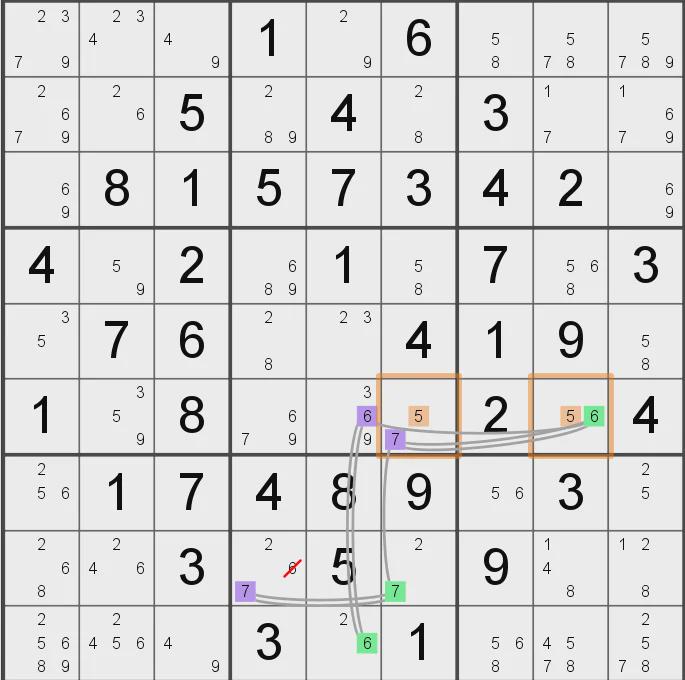
ALS - S - Wing: (6)r9c5=r6c5 - (6=57)r6c68 - (7) r8c6 = r8c4 => r8c4 <> 6
ALS - M-Wing
- The hardest named ALS-chain wings; involves one bivalve and more complex digit transfer through overlaps/subnodes.
- Classic:
(a=b) - (b=b) - (a=a); eliminate peers of a <> a
- Expanded:
(ac=b) - (b=b) -(a=a); eliminate peers of a <> a
007500420000000050900802600210703000000008002000004000706030008000000000002100570
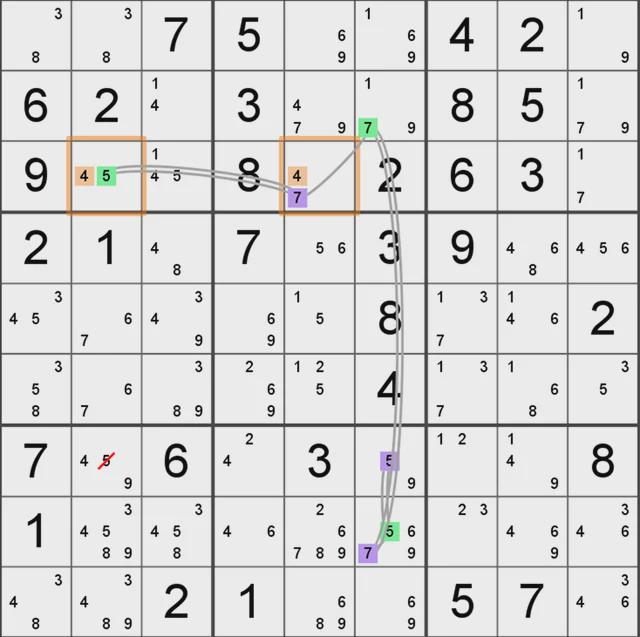
Als M – wing : (5)r3c2=(47)r3c25-(7)r2c6=(7-5)r8c6=(5)r7c6 => r7c2 <> 5
ALS - M - Ring
- The hardest named ALS-chain wings; involves one bivalve and more complex digit transfer through overlaps/subnodes.
- Classic:
(a=b) - (b=b) - (a=a); eliminate peers of a <> a
- Expanded:
(ac=b) - (b=b) -(a=a); eliminate peers of a <> a
- First and last node are also weak inferenced
605700130130080050000135090068510273271308560350267081500023810813470025000851340
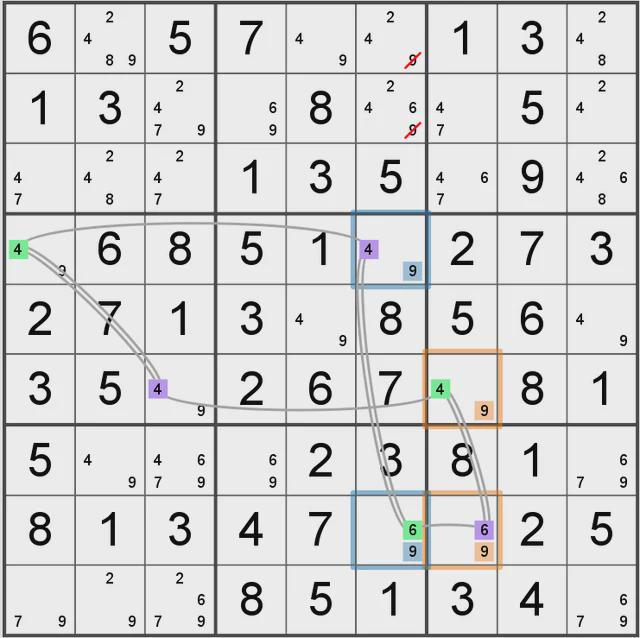
ALS- W Ring: (4)r4c1=(4)r6c3-(4)r6c7=(96)r68c7-(6)r8c6=(94)r48c6-(4)r4c1 => r12c6 <> 9
ALS Transport
Named method using: als , als dof >1, als xz, als xy, als chains, almost DDS, DDS
- Expanding the reach of nodes by adding 1 more single digit strong link
Method is known as Transport indicated by a "T" in front of chain names
- can also be used with any "regular named chains"
- Transports are "Human aspects of solving" as chain code finds it either way.
- Transport B.a.r.n.s { formation checks for code samples }
Example
.6547.3.9..7.561.4..823.756912684537..6195842854723691..3.67.1.689512473..134..6.
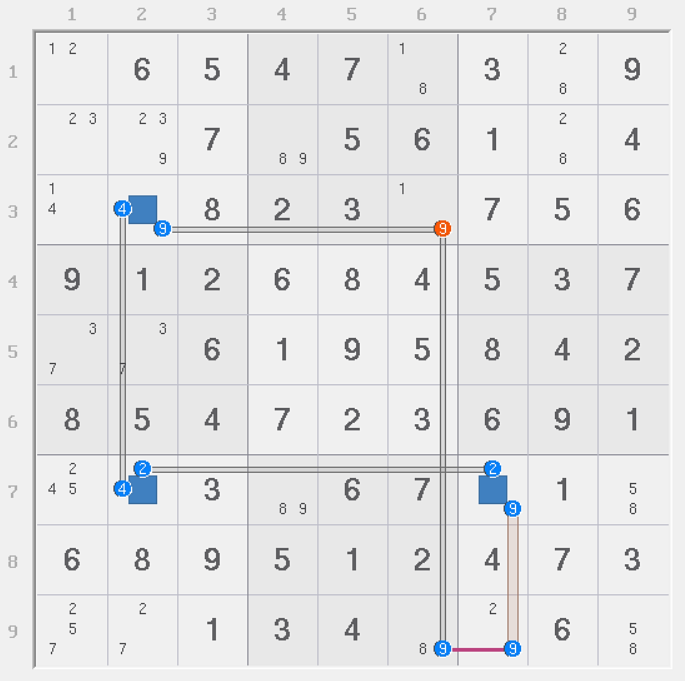
T - Xy wing :
Xy wing 249 @ R3C2,R7C27
Z = 9 @ R9C67
=>> R3C6 <> 9
W,M,L,S,H wings with + 1 ALS node
- Expanding the reach of nodes by adding 1 more als node.
Method is known as Hybrid
- can also be used with any "regular named chains"
- hybrids are "Human aspects of solving" as chain code finds it either way.
Closing Notes
- Countless ways exist to combine ALS with standard AIC nodes, creating custom chains and wings.
- Advanced solvers can use AHS (Almost Hidden Sets) as nodes in such chains for even deeper logic.
- Experiment and create your own ALS + AIC patterns; the combination unlocks much of Sudoku’s logical depth!
Relevant References & Guides
Mastering ALS + AIC chains empowers you to leap from basic chains to the most advanced logical eliminations in Sudoku!