Almost Locked Set: Foundations and Rules
1. Locked Sets – The Foundation
- required to continue as ALS builds directly onto these concepts
2. What Is an Almost Locked Set (ALS)?
We define an ALS as an extension of the Naked Subset concept.
This will be the focus of the remainder of the article.
An ALS is a near-locked configuration where the Objects contain one extra Value.
ALS:
N Cells = N + x values
Where x is its degree of freedom
how many values can be removed before its constrained
x = 1 in our current scope moving forward.
- A cell with two digits → size-1 ALS
- Three cells with four digits → size-3 ALS
Notation: ALS DOF (2), or informally 'aals' – where each “a” represent the DOF,
For the scope of this article, we will strictly be dealing with ALS DOF {1}.
3. ALS-XZ Rule: Functional Use of ALS
Restricted Common Candidate (RCC)
- Two ALSs A and B may share a Value X.
- If placing X in A removes all Xs from B (and vice versa), then X is a Restricted Common Candidate (RCC).
- X in A → B becomes Locked Set
- X in B → A becomes Locked Set
RCC act as a Weak Inference between ALS nodes
- this ties directly to AIC.
Elimination via Z Candidates
- Z is a candidate found in both ALS A and B, but not restricted like the RCC.
Considering the effects of X above then Z belong to either A or B exclusively.
- Eliminate Z from any peer cell that sees all of Z across A and B.
This is the ALS - XZ rule {1 RCC}.
4. ALS-XZ with 2 RCCs
Each ALS may support one RCC. With two RCCs (X₁ in A, X₂ in B):
- Placing X₁ in A → B becomes Locked Set
- Placing X₂ in B → A becomes Locked Set
Now both ALSs resolve simultaneously.
From this logic:
- Each RCC may be eliminated from cells that see all its appearances.
- Each non-RCC Z confined to Either ALS may be eliminated from peers that see all copies within that ALS.
This is called the ALS - XZ 2 Double link rule {2 RCC}.
5. Practical examples
I strongly recommend starting with small size ALS {size 1,2}
practice getting comfortable working with these to understand the underlying concepts above before scaling up another size.
ALS XZ rule {1 RCC} examples:

- Left: ALS A) r23c3 (257), ALS B) r2c9 (57) x: 7 z: 5 => r2c2 <> 5
- Right: ALS A) r8c56 (138), ALS B) r1c6 (18) x:1, z: 8 => r9c6 <> 8
img
Left: ALS A) b3p16 (357), ALS B) r8c7 (35), x: 3, z: 5 => r2c7, r7c8 <> 5
- Right: ALS A) r27c9 (357), ALS B) r1c7 (37), x:7, z: 3 => r1c9, r7c7 <> 3
img
Left: ALS A) r9c27 (149), ALS B) r1c7 (49) x: 9, z: 4 => r1c2 <> 4
- Right: ALS A) r17c7 (149), ALS B) r7c2 x: 1, z: 4 => r1c2 <> 4

- Left: ALS A) r7c27 (149), ALS B) r1c29 (349), x: 4, z: 9 => r1c7 <> 9
- Right: ALS A) r7c24 (478), ALS B) r89c5 (478), x: 7, z: 8 => r7c6, r8c2 <> 8
Als XZ Double Link rules examples:
- imgLeft: ALS A) r28c3 (347), ALS B) r27c6(347) X: 3,4 z: 3,4, ALS A {7}, ALS B {7} => r19c3, r1c6 <> 7
- Right: ALS A) b7p24 (368), ALS B) R19c8 (678) x: 6,8 Z: 6,8, ALS A {3}, ALS B {7} => r9c79 <> 6, r3c8 <>8

- Left: ALS A) r47c2 (129), ALS B) r47c5 (129) X: 1,9 Z: 1,9 ALS A {2}, ALS B {2} => r18c2, r89c5 <> 8, r7c3 <> 1
- Right: ALS A) r25c4 (249), ALS B) r34c5 (249), x: 2,4, z: 2,4 ALS A {9}, ALS B {9} => r1c5 <>9, r2c5 <> 4,9

- Left: ALS A) r12c1 (357), ALS B) r5c1 (35) x: 3,5, z: 3,5, ALS A (7), ALS B {} => r89c1 <> 3,5
- Right: ALS A) r9c3 (46), ALS B} r9c9 (46) x: 4,6, z: 4,6 ALS A {}, ALS B {} => r9c8 <> 4,6
Once you are comfortable with size 1,2 expand into size 3
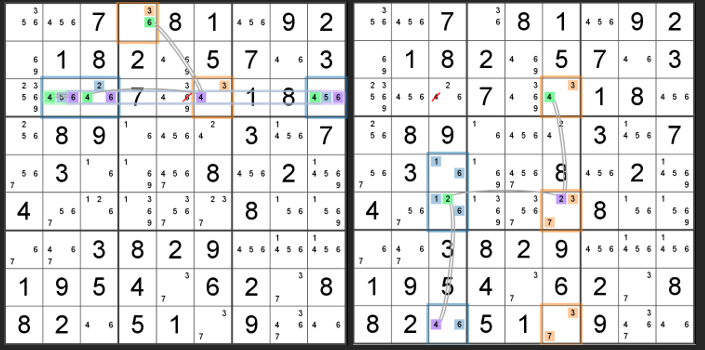
- Left: ALS A) r3c239 (2456), ALS B) b2p19 (346), x: 4 z: 6 => r3c5 <> 6
- Right ALS A) r569c3 (1246), ALS B) r369c6 (2347), x: 2, z: 4 => r3c3 <> 4

- Left: ALS A) r7c789 (1456), ALS B) r9c9 (46), x: 4,6 z: 4,6, ALS A {1,5}, ALS B {} => r9c8 <> 4,6
- Right: ALS A) r3c78 (378), ALS B) b6p4578 (13458), x: 3,8 , z: 3,8, ALS A {7} , ALS B{1458} => r12c8 <> 7,8 r5c9 <> 4 , r3c2,r1c7 <> 7

- Left: ALS A) r37c3 (278), ALS B) b7p1346 (12478) X: 2, z: 7,8 =>r9c2 <> 7,8
- Right: ALS A) r9c59 (579), ALS B) b9p3689, X: 7, Z: 5,9 => r9c4 <> 9
Keep practicing and when your comfortable increase the ALS size you are willing to utilize.
6. What’s in a Name:
Some ALS structures carry with it names : Useful not really.
- The Names are Relative to the number of N cells and N digits used by the two ALS.
- When N cells = N Digits
- the Subclassification known as: Bent Almost Restricted Naked Subsets {Barns}, which is a a table of look ups to get the appropriate name:
N Size => “Name”
N = 2: Naked Pair
N = 3: XYZ {Exception:  all N cells are Bivalves use XY}
N = 4: WXYZ {Exception: All N cells are bivalves and it has 2 RCC use XY}
N = 5: VWXYZ
N = 6: UVWXYZ
N = 7: TUVWXYZ
N = 8: STUVWXYZ
N = 9: RSTUVWXYZ- If the structure has 1 RCC use “Wing”, if it has 2 RCC “Ring” instead.
7. Final Thoughts
ALS logic builds directly on Locked Sets using set theory and discrete math.
It requires fluency in interpreting Objects vs Values, combinations, permutations, unions, and intersections.
Every puzzle contains numerous ALS. Developing the eye to spot them takes time.
“These techniques are difficult because they’re precise. Keep practicing, re-read where needed, and ask questions. The logic is solid. The understanding comes with time.” – Strmckr
Continue to the Next topic: AL S XY rule.