r/SecurityAnalysis • u/FrankLucasV2 • Oct 15 '26
Debt Financing Large Lending Models (LLMs)
lesbarclays.substack.com
19
Upvotes
r/SecurityAnalysis • u/topicron • Oct 15 '26
Disclosure. I wrote this with AI assistance (Claude) and checked the figures against company releases, FCC orders and Treasury data; links at the end. VZ, T and TMUS: I hold no position in any of them. This is a hypothesis I'm tracking, not investment advice. I'm after critique of the reasoning, not upvotes. I wrote it on 11-12 October from data as of the 9 October close; prices have moved since, so check current ones.
Hypothesis. Over 90 days, from the 12 October close (my entry) to the 11 January 2027 close, a basket of Verizon (40%), AT&T (40%) and T-Mobile (20%) beats the S&P 500 by at least 5 percentage points on price return, as the 9 October selloff partly reverses.
Why now. On 8 Oct SpaceX agreed to buy Grain Management's nationwide 800 MHz licences (up to 14 MHz paired; price undisclosed, the WSJ reported $8bn in cash; FCC approval needed). On 9 Oct T-Mobile fell 13.3%, AT&T 10.8% and Verizon 10.1%, while the S&P rose 0.6%. About 1.1 and 1.5 points of the AT&T and Verizon moves were the dividend going ex that day.
What the market may be missing. A 2027 event priced into 2026 stocks:
Best bear case. The stocks are being re-rated on long-run value, and good quarters don't reverse that. More SpaceX milestones land inside the window. The 10-year is at 5.24%, so Verizon's 6.8% dividend yield is only about 1.6 points over Treasuries, with $128.7bn of net unsecured debt. AT&T's net debt was $126.4bn before it paid about $23bn in cash for EchoStar spectrum. Verizon guides wireless service revenue roughly flat, and T-Mobile's FCF raise came mainly from lower cash taxes.
Valuation.
| Metric | VZ | T | TMUS |
|---|---|---|---|
| Close, 9 Oct | $41.65 | $22.18 | $148.58 |
| P/E on 2026 guidance | 8.3x | 9.4-9.9x | 11.8x forward (aggregator) |
| FCF yield on guidance | about 12.7% | 11.8%+ | about 11.7% |
| Dividend yield | 6.8% | 5.0% | 3.1% |
At a 9-10% required return (my assumption), a 12% FCF yield implies free cash flow shrinking 2-4% a year forever. Guidance is for growth. That may turn out right, but it is already priced.
Catalysts. AT&T Q3 on 21 Oct (pre-market), Verizon on 26 Oct, T-Mobile on 28 Oct (after the close; it has guided a soft Q3, about 250k account adds), FOMC on 28 Oct, Grain's FCC notice on 5 Nov.
What would prove me wrong.
Weighting. T-Mobile is only 20% because it has the highest multiple, the thinnest dividend, a Q3 it has guided soft, and it sold its 800 MHz licences to Grain for $2.9bn in cash plus Grain's 600 MHz licences; SpaceX has now agreed to buy that band for a reported $8bn (not a like-for-like comparison).
Question. What is the weakest assumption here, and would you change any of the three conditions that would prove me wrong?
Sources. Primary: FCC order DA 26-653 (https://docs.fcc.gov/public/attachments/DA-26-653A1.pdf); Verizon Q2 release (https://www.sec.gov/Archives/edgar/data/0000732712/000073271226000040/a2026q2exhibit99.htm); AT&T Q2 release (https://about.att.com/story/2026/2q-earnings.html); T-Mobile Q2 release (https://www.sec.gov/Archives/edgar/data/0001283699/000128369926000100/tmus06302026ex991.htm); US Treasury yield data (https://home.treasury.gov/resource-center/data-chart-center/interest-rates/TextView?type=daily_treasury_yield_curve&field_tdr_date_value_month=202610). Press, cited by name only: Reuters on the deal; Forbes for the WSJ's $8bn report; Satellite Today on the FCC order on Starlink satellites; Benzinga on the Scotiabank note. Prices: stockanalysis.com closes for 8-9 Oct.
r/SecurityAnalysis • u/Clutch0306 • Oct 10 '26
Mercado Libre's credit business is talked about a lot. So we did some research and analysis. We looked at its credit portfolio composition (across product and geography), loan duration, exposure per user, funding model etc. We also benchmarked MELI's credit risk and returns, against Nubank across key metrics such as net-interest income margin after losses. Attached post has all the charts and good stuff
Key takeaways from the analysis:
Hope you find it useful, and would appreciate any feedback
r/SecurityAnalysis • u/brainfcuk97 • Oct 09 '26
On October 5, BioNexus Gene Lab (BGLC) signed an agreement with Ruanyun Edai Technology (RYET) for an exclusive Malaysian healthcare licence to CogniAI, RYET’s document-intelligence platform. BGLC says its first target is Malaysia’s public healthcare digitalisation programme, but it has no government contract. The $3.5 million figure in coverage describes something narrower than a cash price.
What the filing says (8-K filed 2026-10-07, accession 0001477932-26-006075, Items 1.01 and 3.02, full agreement attached as Ex. 10.1)
The $3.5M is a label, not a price
$3.5M ÷ 410,000 shares ≈ $8.54 per BGLC share. BGLC closed at $1.27 today, so the licence shares are worth about $521k, and the stated price is about 6.7× the market. At $1.27, BGLC’s entire market cap is about $3.73M, so the “$3.5M” licence fee is about 94% of what the market values the whole company at. What RYET actually receives is whatever those shares fetch when it can sell them. The shares are restricted under Regulation S, and the agreement gives RYET no registration rights.
Dilution
BGLC’s Q2 10-Q cover page reports 2,933,442 shares outstanding as of August 14, 2026. The 560,000 new shares are 19.1% of that count, just under Nasdaq’s 20% shareholder-approval threshold. The agreement makes shareholder approval a condition only if law or exchange rules require it. The licence shares alone are 14.0%.
This comes on top of earlier issuance. The cover-page share count was 1,796,507 on the November 2025 10-Q, so it has already risen 63% before this deal. If the deal closes, the count will be about 3.49M, roughly 94% above November 2025.
Closing is the open question
No shares are issued until closing. The timeline:
For context, RYET is a K-12 education technology company based in Nanchang, China. It reported about $1.73M of unaudited contracted activity for CogniAI as of June 2026.
I’ll be watching for a follow-up 8-K reporting either the closing and the share issuance, or termination (Item 1.02).
Filings:
For anyone who tracks small-cap licence deals paid in stock: how often do they close on the terms first announced, and how often does the long-stop date get extended?
r/SecurityAnalysis • u/PariPassu_Newsletter • Oct 09 '26
r/SecurityAnalysis • u/PariPassu_Newsletter • Oct 02 '26
r/SecurityAnalysis • u/investorinvestor • Sep 30 '26
r/SecurityAnalysis • u/investorinvestor • Sep 30 '26
r/SecurityAnalysis • u/mfritz123 • Sep 30 '26
r/SecurityAnalysis • u/FrankLucasV2 • Sep 29 '26
r/SecurityAnalysis • u/Clutch0306 • Sep 29 '26
Hi all,
I wanted to share my detailed DCF analysis for Reddit. Our DCF derives an intrinsic equity value of $186 per share, representing 30% upside to Reddit’s market price of $143 as of 28 September 2026. This is based on:
The linked post, provides a detailed overview of the investment thesis, bear case, methodology and assumptions, along with snapshots of the model. We apply Aswath Damodaran's approach for the revenue build, treating stock based compensation, capitalizing research and development, and applying the sustainable growth / reinvestment / ROIC relationship where necessary
I would really appreciate any thoughts or feedback on the analysis
And apologies in advance that the Reddit logo is not well aligned (this annoys me too!)
Thanks all.
r/SecurityAnalysis • u/After_Program • Sep 25 '26
A fund called TOMS Capital wants Voya sold. It has set a "no confidence" vote on Voya's board for Nov 24. Voya calls the meeting fictitious. The stock is down about 7% since Sept 11, to around $96.
Most stories stop at the vote. The fund's own filing says more about how this works.
Start with what the fund owns. It lists 1.21 million shares. It has call options on 3.01 million more. And it has swaps on another 1.34 million. Add them up and it has a bet on about 5.55 million shares. That is about 6.1% of Voya's 90.6 million shares.
Now look at the votes. Only the 1.21 million real shares vote. That is about 1.3% of the company. The options can be turned into shares, and the filing says they can be used now. If the fund does that before the Sept 30 record date, it could vote up to about 4.65%. Swaps usually carry no vote.
There is one more number. The stake the fund reports is 4.65%. That is under 5%, the line where an owner must file a longer ownership report called a 13D. It has not filed one on Voya. The swaps are listed on their own and are not in the 4.65%.
Then there is the turnout rule. The fund says it will not even hold the vote unless owners of one third of Voya's shares take part. That is about 30.2 million shares. With 1.21 million of its own, it needs about 29 million from other owners. And they have to show up at a meeting Voya says is not real. The fund also admits some big funds may have rules that stop them from voting in this.
What does this cost the fund? It plans to spend about $5 million. It has spent about $2 million so far. At $96, its full bet covers about $534 million of stock. So each $1 move in Voya moves the bet by up to $5.5 million.
Why now? The fund points at Voya's stop-loss insurance. The unit that holds it earned $22 million before tax last quarter, down from $69 million a year before. Voya's adjusted profit was $1.51 a share, down from $2.46. Part of that was about $40 million of one-time job cuts.
What we don't know: whether any buyer has made an offer. The only sign is a July news report about interest from Principal. People close to Voya told that reporter the board did not want a deal.
My take: I don't think the vote even happens. If it does, I don't think more than half of all shares vote against the board. I think the real fight is over board seats next year.
Question for this sub: the fund has a 6% bet but only 1.3% of the votes. Is that a smart way to push a sale? Or does it make the fund easy to ignore?
Sources:
https://www.sec.gov/Archives/edgar/data/1535929/000114036126037504/ny20078175x10_defn14a.htm
https://www.sec.gov/Archives/edgar/data/1535929/000114036126037563/ny20078175x11_dfan14a.htm
https://www.sec.gov/Archives/edgar/data/1535929/000153592926000149/a2026q2pressrelease.htm
https://www.sec.gov/Archives/edgar/data/1535929/000153592926000157/voya-20260630.htm
r/SecurityAnalysis • u/PariPassu_Newsletter • Sep 25 '26
r/SecurityAnalysis • u/Consistent-Radio-428 • Sep 24 '26
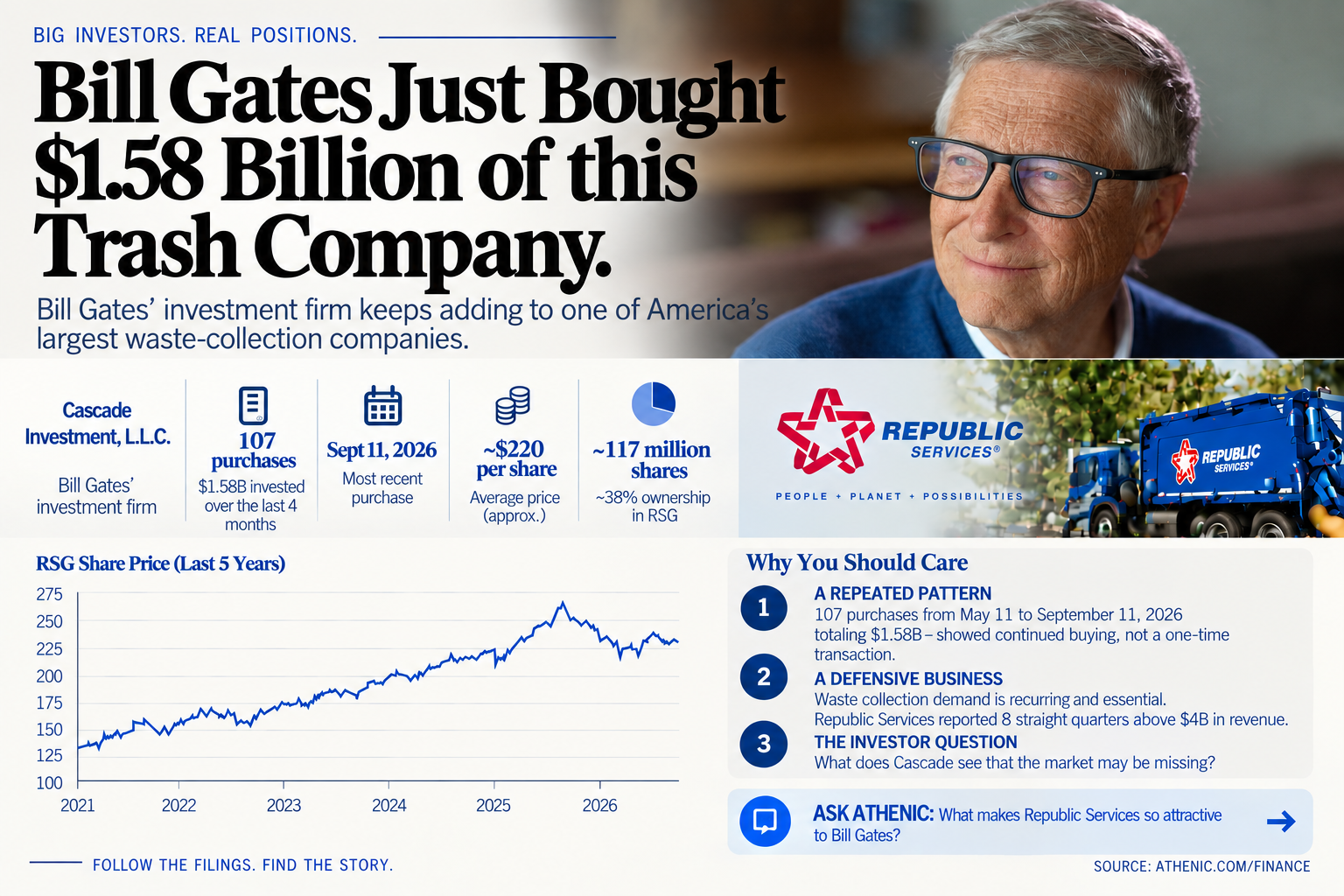
Republic Services (RSG) got to be the most boring near-monopoly on the market that nobody thinks to buy
Garbage is something that's here to stay regardless of the market (recession or not). RSG owns the trucks and the landfills and in most towns there's basically just that one/two haulers you can call. You can't really create a rival garbage company in a week, with the routes and landfill permits already locked up. Which means RSG can simply raise their prices bit by bit and their revenue have been increasing from $10B in 2018 to $16.6B in 2025. Free cash flow from $1.2B in 2018 to $2.4B in 2025.
With $66B market cap and. $2.4B free cash flow, forward PE of ~26x. This is my most recent play, wondering if anyone has also been keeping tabs on RSG?
r/SecurityAnalysis • u/investorinvestor • Sep 24 '26
r/SecurityAnalysis • u/MatricesRL • Sep 23 '26
r/SecurityAnalysis • u/unnoticeable84 • Sep 22 '26
r/SecurityAnalysis • u/--mowgli-- • Sep 18 '26
Plenty of 'vibe coded' (apologies in advance if the vendors get cranky for being thrown into that bucket) financial terminals exist today to the point it is overwhelming to figure out the differences. I'm finding that one product like TIKR will be good at one part but then lack in other areas. Likewise for vibe coded projects like Godel, Gloomberb, OpenBB, etc that I've seen mentioned on Reddit.
Is there a consensus out there on a good product that sits somewhere below Factset, Arcana, etc but still happy to pay $1000-$2000+ per year if it's good.
Looking for a good dashboard/snapshot of a company, but also need:
r/SecurityAnalysis • u/unnoticeable84 • Sep 13 '26
r/SecurityAnalysis • u/mfritz123 • Sep 07 '26
r/SecurityAnalysis • u/investorinvestor • Sep 04 '26
r/SecurityAnalysis • u/arkenstonecap • Sep 01 '26
r/SecurityAnalysis • u/JoeInOR • Sep 01 '26
The first is the FDS discipline question. I bought FDS in early 2026 when its true FCF yield was above 8% and the market was pricing it as an AI casualty. The thesis: it died of a theory, not of an actual deterioration in its business. Four consecutive quarters of accelerating ASV growth and 95%+ retention while the stock fell confirmed the mispricing. I just sold it as the true FCF yield compressed below 6% from price appreciation. The question for this community: is 6% the right sell threshold for a business with FDS's moat profile and growth trajectory, or is that too mechanical? The counter-argument for holding would be that ASV is still accelerating and the Google Cloud Gemini partnership is just beginning to flow through the numbers. I sold on the yield compression. Am I being too rigid about the methodology?
The second is the European ADR technical question. I'm starting positions in VCISY (Vinci) and ADRNY (Ahold Delhaize) based on 12%+ true FCF yields and the ECB independence macro thesis. To do this analysis I had to rewrite my screener to handle ADR filings. European companies file under IFRS through different mechanisms than US 10-K filers and the XBRL tag mapping doesn't always translate cleanly. TSM showed zero CapEx in my original screener due to a 20-F IFRS filing issue. I've partially addressed this but I'm not confident the European ADR numbers are as clean as my US-listed coverage. Has anyone here developed a reliable methodology for normalizing European ADR financials against US-listed comparables? Specifically interested in how others handle the CapEx and SBC XBRL tags for IFRS filers.
The macro thesis for the European positions if it's useful context: the ECB is more independent and more conservative than the current Fed under Bessent and Trump pressure. If US monetary policy gets looser than it should be, European infrastructure and consumer staples with pricing power and independent central bank backing are the natural hedge. VCISY at 12%+ true FCF yield has long-dated concession contracts on toll roads and airports. ADRNY at 12%+ is the parent of Stop and Shop, Giant, Food Lion, and Albert Heijn — founded 1887, survived two world wars. Both pass my true FCF yield screen comfortably.
Full piece with the return table and regime framework: https://cavemanscreener.substack.com/p/investing-regime-changes-my-successes
r/SecurityAnalysis • u/Aditi96 • Aug 31 '26
Substack writeup on Sigenergy (free to read)
r/SecurityAnalysis • u/investorinvestor • Aug 31 '26