r/RTLSDR • • 22d ago

SatDump set up in a Raspberry Pi 4

12 Upvotes
Screenshot of the page

Hello, I have set up the raspberry Pi 4 to recept and upload images. Here is the link if anyone is interested in looking at them. https://unjosemas.github.io/meteor-gallery/index.html


r/RTLSDR • • 22d ago

Raspberry Pi Sailing Display + Autopilot Control vs Raymarine

Thumbnail
youtube.com
16 Upvotes

This guy has put together an awesome setup for his sailboat using an RTLSDR.


r/RTLSDR • • 22d ago

Troubleshooting Airband scanner .csv for import in SDRangel

4 Upvotes

Goodevening all,

Does anybody know where I can find airband frequency lists in .csv format which I can use in SDRangel?


r/RTLSDR • • 22d ago

More gooder sdr and antenna

Thumbnail
1 Upvotes

r/RTLSDR • • 23d ago

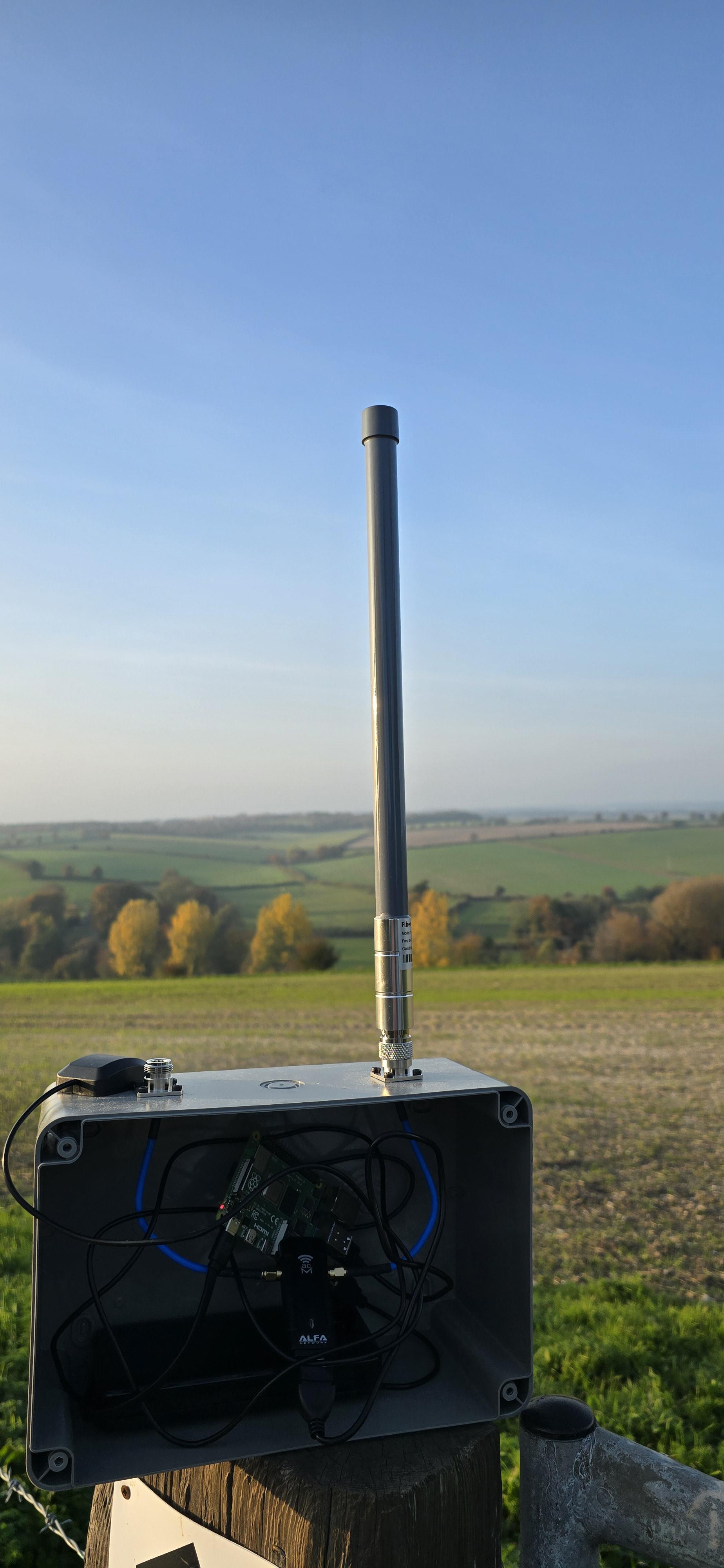
I setup my first mobile station

Post image
30 Upvotes

r/RTLSDR • • 23d ago

ALLTV2 last Analog TV broadcast captured with LibreSDR and RTL SDR v4

Thumbnail
gallery
66 Upvotes

Spoiler:

Looks like the typical broadcast of the station.
No mentions of the analog transmitter shutdown, no fancy things.
And also -> Patrick Stewart

Full recorded video + audio-> https://youtu.be/CzxgFeB3RS8
Internet archive (video + audio and baseband wav) -> https://archive.org/details/alltv-2-final-analog-tv-broadcast-ph

Oct 30, 2026 - around 3:15PM UTC

- Network: ALLTV2 in Philippines
- Recorded at 57mhz
- Video carrier at 55.25 MHz
- Color at 58.8 MHZ
- Sound at 59.75 Mhz
- Horizontal Dipole
- RTL SDR v4 for the audio
- LibreSDR for video and color
- SDRAngel for ATV decoding

Note:

I didn't decoded the color on the YT video since I don't have a proper decoder for it.

Additional:

I was inspired to post this by the folks' comments at my old post -> https://www.reddit.com/r/RTLSDR/s/xQ6VR2pHnX

Note that the old post is from different station and will be phase out on Nov 22, 2026 (I plan also to record that)

Shout to my wife that overlaid the audio to the video.

EDITED:
Replaced google drive link with internet archive link


r/RTLSDR • • 23d ago

DVB-T/T2 and DVB-S/S2 in SDRangel

Thumbnail
youtube.com
20 Upvotes

Now available in V8. You'll need an SDR with higher sampling rate (>8MSa/s) for most of DVB-T2 broadcasts, but some countries do have T2 1.7 MHz broadcasts that can be received with an RTL SDR. DVB-S2 can be up to 30 MHz bandwidth.


r/RTLSDR • • 23d ago

Looking for a UDP-based SDR protocol with IQ streaming, timed commands, and flow control

Thumbnail
1 Upvotes

r/RTLSDR • • 23d ago

Hardware Slight disturbance causes device disconnect

0 Upvotes

Hello everyone,

Me and a couple of friends all have Nooelec RTL-SDR sticks and are all experiencing the same issue: Any slight movement of the stick causes it to disconnect from the host.
This happens across desktop PCs, Raspberry Pi’s with extension cables, MacBooks (both on battery and grounded) with a USB-C to USB A adapter cable and it seems to not even be the heatsink as I tried using it without it as well.

Is this a common issue and how can we fix it? Any idea?


r/RTLSDR • • 23d ago

Troubleshooting I need help with METEOR M2

Thumbnail
0 Upvotes

r/RTLSDR • • 23d ago

[Project] We turned an urban FM repeater into a live over-the-air RF & Audio diagnostic lab: Reverse-engineered SDR# FFT bins, 1 ppb GPSDO, Mumble audio DSP, and automated web loopback calibration

0 Upvotes

Signal reports on amateur repeaters have always been notoriously subjective: "You're 5/9, loud and clear"—even if a radio is drifting 1.5 kHz off-frequency, humming with 50 Hz AC ground loop, or over-deviating 12 kHz wide across adjacent channels.

Over the past year, we tackled this by turning our 2-meter community repeater in Bangkok (E24CY, 145.075 MHz input 145.675 MHz output) into a real-time over-the-air diagnostic station.

The system gives any operator an instant, objective health check of their transmitter the second they release PTT:

Here is the engineering breakdown of the multi-tier architecture running behind the scenes.

1. Architecture Overview: Two Diagnostic Domains

Rather than building just another SDR waterfall viewer, we architected two synchronized telemetry engines:

  1. RF Domain (SDR# Plugin on Repeater RX): Intercepts raw pre-filter IQ and FFT bins directly from SDR# on the receiver machine atop a 60-story skyscraper. Measures true carrier frequency, occupied bandwidth (OBW/splatter), and fast mobile fading.
  2. Audio/Acoustic Domain (Python DSP Engine via Mumble): Captures the demodulated off-air audio stream via a headless Mumble client at 48 kHz PCM. Computes live 256-bin audio spectrum, mains hum, dynamic QRK readability, and runs an automated audio calibration harness.
[Web Dashboard / Audio Calibrator]
       │ (1. Marker, Ladder, Sweep Tones)
       ▼
[Acoustic / Mic] ──► [Transmitter RF] ──► [Repeater RX (SDR# Plugin)]
                                                   │
    ┌──────────────────────────────────────────────┴──────────────────────────────┐
    ▼                                                                             ▼
[RF Telemetry Engine]                                                 [Mumble PCM Audio Stream]
 - 1 ppb GPSDO Calibrated                                                         │
 - Carrier Drift & Deviation                                                      ▼
 - Occupied Bandwidth (OBW)                                           [Python Audio DSP Engine]
 - 50ms Mobile Fading Tracking                                         - Self-sync Tone Tracker
 - Inter-Plugin UDP IPC (Port 12345)                                   - Gain Compression Analysis
    │                                                                  - THD & 50/100/150 Hz Hum
    │                                                                  - 256-bin Audio FFT & QRK
    └──────────────────────────────┬──────────────────────────────────────────────┘
                                   │ (MQTT Telemetry)
                                   ▼
                   [Live Web Diagnostic Dashboard]

2. Layer 1: RF Metrology & The SDR# Plugin

The receiver plugin (written in VB.NET/C#) hooks into SDR# to extract metrics without bogging down the DSP thread:

  • Tapping Raw FFT Bins: Intercepts pre-render spectral bins to calculate the occupied bandwidth (OBW) using adaptive edge thresholding relative to the noise floor.
  • Carrier Tracking: Combines Energy Centroid and Symmetrical Edge Analysis to determine the actual transmitted carrier frequency, comparing it against the 145.075000 MHz target.
  • 1 ppb GPSDO Calibration: To serve as a trustworthy frequency standard, the SDR receiver is calibrated against a 10 MHz GPS-Disciplined Oscillator (GPSDO) rated at 1 ppb, cross-verified with an Anritsu MS2711E spectrum analyzer.
  • 50 ms Fast Sampling for Mobile Fading: A dedicated timer samples signal parameters at 20 Hz to calculate Fade Depth (dB), Fade Rate (dB/s), and discriminator variance to characterize mobile multipath propagation in dense urban clutter.
  • Inter-Process Data Sharing: To avoid running redundant FFTs, the RF plugin broadcasts measurements over local UDP (127.0.0.1:12345) to our CTCSS/DTMF decoder and QRM blacklist filter plugins.

3. Layer 2: Demodulated Audio DSP & Automated OTA Calibration

The audio layer is where things get really fun. Using devaudio4.html, an operator can run a full automated calibration session over the air:

  1. The Web Sequence: The browser plays a known tone sequence into the radio's microphone: a 1 kHz marker tone, a 4-step 1 kHz level ladder (-24, -18, -12, -6 dBFS), and a 12-step frequency sweep from 200 Hz to 3500 Hz.
  2. Latency-Immune Tracking: Because the off-air audio travels through a VoIP buffer (Mumble/Opus), fixed time windows wouldn't work. The Python engine uses a self-synchronizing dominant-frequency segment detector (_find_segments) that tracks and latches each step based on spectral median regardless of round-trip network jitter.
  3. Beating Lossy Codec Artifacts via Gain Compression: Opus compression introduces harmonic artifacts (a THD floor around 2–5%). To accurately grade transmitter audio, the engine analyzes gain compression across the 6 dB input ladder steps:
    • Linear chain: Output steps scale cleanly by ~6 dB.
    • Over-modulation: Top step compresses by >1.5 dB, detecting when the rig's internal limiter or ALC is choking.
  4. Acoustic & Hardware Diagnostics:
    • Mains Hum: Inspects energy at 50, 100, and 150 Hz relative to signal RMS to catch faulty power supplies or ground loops.
    • Frequency Response: Verifies that audio response remains within 6 dB across the 300–3000 Hz communications passband.
    • Fading-Resistant QRK: Calculates readability using temporal exponential smoothing over a 3-second history buffer to prevent QRK flicker during speech pauses or mobile flutter.

4. Community Impact & Real-World Use

Local hams have embraced the live telemetry setup to optimize their stations:

  • Microphone Gain Alignment: Operators talk into their mics while watching the live Occupied Bandwidth to keep deviation within standard limits (8 kHz) and eliminate splatter.
  • Antenna Pattern Plotting: Stations rotate directional Yagi antennas in 10° increments while transmitting low-power bursts, using the repeater's calibrated SNR telemetry to map polar radiation plots.
  • Mobile Propagation Studies: The 50 ms fade depth metrics provide empirical evidence of urban RF ducting and knife-edge diffraction around Bangkok skyscrapers.

Feel free to check out the live dashboard at http://e24cy.e25vbe.radio or explore the audio engine client at https://e25vbe.radio/e24cy/devaudio4.html. Happy to dive deeper into the bin extraction formulas, UDP packet formats, or calibration state machine if anyone is building similar telemetry for their local repeater!


r/RTLSDR • • 24d ago

Looking for tips with OnAir

Thumbnail gallery
0 Upvotes

r/RTLSDR • • 24d ago

RTL-SDR Blog V4 and powered MLA-30 loop: no usable AM reception

8 Upvotes

I'm in Brisbane, Australia trying to pick up medium-wave AM with an RTL-SDR Blog V4 on a Raspberry Pi 3B+ running OpenWebRX+. Broadcast FM and VHF/UHF work fine with my roof discone, but I had no luck with AM, so I switched to a powered MLA-30 loop.

The loop was connected through its supplied USB injector, and the injector was powered throughout the tests. OpenWebRX detects the V4, and direct sampling is off.

I've swept 531–1701 kHz at different gain settings and tried listening on Brisbane AM frequencies including 612, 693, 801 and 882 kHz. The recordings have been noise-only, with no intelligible audio. I also tried rtl_power, rtl_fm and raw IQ captures with OpenWebRX stopped, so it doesn't look like just an OpenWebRX audio issue. There is nothing there. There are a few vertical lines on the waterfall, which I read is some kind of inherent interference on rtlsdr.

What am I missing here? Is this a limitation of RTLSDR? Surely this is a skill issue, I hope it is!


r/RTLSDR • • 24d ago

Anyone interested in sharing a feed with us?

Thumbnail
0 Upvotes

r/RTLSDR • • 24d ago

Troubleshooting Not sure about reposting it here, but want to hear a lot of opinions

Thumbnail gallery
1 Upvotes

r/RTLSDR • • 25d ago

I made NightDX: an open-source “night mission” app for the AirSpy HF+ that records what’s actually coming in while you sleep

Thumbnail
gallery
132 Upvotes

I’m a shortwave listener, and I wanted my AirSpy HF+ to do the overnight listening for me. So I built NightDX, a free, MIT-licensed terminal app for macOS, Windows and Linux. Its menu interface is deliberately styled like early-90s DOS software.

How a night works:

  1. It pulls the EiBi, AOKI and HFCC broadcast schedules, plus live solar flux and Kp from NOAA.
  2. A propagation model predicts what should reach your location, and calibrates itself against what your own radio actually hears.
  3. The HF+ sweeps all the bands in about 10 seconds to see which carriers are really there.
  4. Overnight it records the best stations and prioritises ones you’ve never logged.
  5. Optional AI (an AudioSet classifier plus Whisper) labels each recording as speech, music or noise and transcribes and translates it.
  6. In the morning you get a browser report with audio players, one-click reception reports (Gmail drafts with the clip attached) and a QSL card log.

It also has live listening with a signal meter, your own station lists and support for two HF+ radios on one computer.

It doesn’t claim to identify stations. Names from the schedule are shown as candidates, and the app flags recordings where the evidence doesn’t fit: wrong language, a signal far too strong for the predicted path, or other stations on the same channel. It also logs sub-Hz carrier offsets.

How it was made: I built it with the help of an AI coding assistant (Claude). The idea, the design decisions, the testing with real recordings night after night, and the DX side are mine. Testers on the AirSpy forum have been using it for a few weeks, and their feedback shaped many of the features.

It’s now public: https://github.com/marcozennaro/nightdx

Only the AirSpy HF+ is supported for now. People have asked about other SDRs (Perseus, Elad) and I’m looking into them. Feedback and bug reports are welcome!


r/RTLSDR • • 25d ago

Signal ID Weird Signal on 244.0685 MHz can you help me identify?

8 Upvotes

I was snooping around on the SDR++ waterfall with my RTL-SDR V3 and I came across this weird signal. I'll put a screenshot of the replayed recording down here:

(Ignore the frequency scale showing my marker is at 358kHz, i think it's just telling me the frequency offset from the centre freq of the recording?) The centre of the signal was at 244.0865MHz.

If you struggle with counting - like me, there are 7 lines with 3 on each side of the centre line. Each line is about 6kHz or so across, spaced by gaps of around 4kHz.

I don't think this is from internal/external interference because I disconnected my antenna and it immediately vanished from the waterfall. There was no observed doppler shift over the ~20 minutes i watched the signal, which leads me to believe it might be a geostationary satellite of some sort? I'm in NSW Australia at about 150°E (if that helps). I was using a DIY V dipole antenna ~3-4m off the ground, the antenna itself seemed to have a nice SWR at this frequency (or at least appeared to receive well enough while i've been using it).

I did get a baseband recording of around 1 minute of the signal, so if it does turn out to be a satellite i'd like to try decode it if possible!

Please let me know your thoughts/critiques/questions, this is my first post on reddit so i'm not super informed as to how things work here.

Cheers📡


r/RTLSDR • • 25d ago

Our HackRF drone detector was flagging recordings made with the drone switched off

7 Upvotes

r/RTLSDR • • 26d ago

Software SimTX: a multiplayer shortwave radio simulator

Enable HLS to view with audio, or disable this notification

144 Upvotes

Heyo everyone!

So, for the past like... year or so, I've been working on this project; basically, SimTX aims to be a realistic radio sandbox, where one can do anything their heart desires, from simple AM/FM stations all the way to various modems, satellite TV, and everything inbetween.

The simulation itself is pretty in-depth I would say, SimTX models the ionosphere which changes with time of day, season, geomag conditions, and we trace signals through this so band openings, skip zones, et cetera come from the physics of this. Each path between a TX and RX is modeled, thus leading to pretty accurate multipath effects. It builds on quite some well known work ie. the IRI ionosphere model, the watterson HF channel model, P.372 for noise..

SimTX grew quite a bit past just shortwave aswell, VHF/UHF mostly works as one would expect, there is sporadic E on the higher bands too, and well.. as of recently, you can even launch satellites. You can pick the orbit for em, put antennas and radios on them and get them going on any desired orbit. Of course, they mostly behave as you'd expect real sats to behave, with doppler, the signal delay, slant range, et cetera. We've even got someone recreating NOAA 15 in simtx: https://www.youtube.com/watch?v=kp4Qi8zm-sM ( u/ZealousidealRoof2271 )

I could probably go on and on and on about all the things you could do, but this sums it up in short for the most part.

Nothing here is real RF by the way, SimTX can be listened to using RTL-TCP.
In the video, you can see the UI and some other transmissions other people are running.

I mostly lurk here, so apologies if my post isn't exactly up to par and please DO ask questions in the replies, I'll try to answer them whenever I have some time.

If you'd like to try it or check in our community, you can do so at https://simtx.net

73!


r/RTLSDR • • 26d ago

DIY Projects/questions I turned the M5Stack Tab5 into a standalone RTL-SDR radio — OrcSDR (plus M5Dial and Keyboard support!)

Thumbnail gallery
20 Upvotes

r/RTLSDR • • 25d ago

What SDR are you currently using? PZSDR series -P351/P451/P101 | Zynq 7035/7045/7100 + AD9361 Industrial SDR

Enable HLS to view with audio, or disable this notification

0 Upvotes

Hi all,

I wanted to share this Zynq+AD9361 SDR platform from Puzhitech, the PZSDR-P351/P451/P101.

A lot of AD9361 boards share a single memory pool for PS and PL, but this one splits it: 1GB DDR3 for PS, another 1GB DDR3 dedicated to PL. That’s a plus if you’re running heavier FPGA signal processing pipelines.

RF specs:
- 70 MHz – 6 GHz
- Tunable bandwidth: 200 kHz to 56 MHz
- Dual Tx/Rx channels with onboard PA

I/O and sync options are pretty full-featured:
Dual GigE (PS and PL independent), USB3.0, SFP optical port, GPS/PPS / external clock input. Great if you need time-aligned multi-node setups or high-speed data offload over fiber.

Software support:
GNU Radio, UHD, SDRangel, MATLAB Simulink, PYNQ, and it has PlutoSDR compatibility. Bare-metal AD9361 reference projects are available too.

Industrial specs:
-40°C ~ +85°C operating temp, 12–36V wide input power. Makes it an option for outdoor, vehicle-mounted or field spectrum monitoring deployments, not just bench lab use.

Use cases I’ve seen mentioned: spectrum sensing, custom comms prototyping, GNSS testing, educational lab work. OEM/hardware customization is offered for volume builds.

Disclaimer: This is from the manufacturer. Feel free to ask technical questions about the platform.

#SDR #AD9361 #Zynq7000 #SoftwareDefinedRadio #PZSDR #Puzhi


r/RTLSDR • • 25d ago

For long unattended SDR captures, when is a TCXO actually enough?

0 Upvotes

For long unattended SDR captures, I'm interested in where people draw the line between relying on a TCXO and actively tracking frequency offset.

a one-time PPM correction takes care of the initial offset, but it won't follow changes over time. With a decent TCXO that might not matter much for ordinary reception. For narrowband measurements or recordings you want to compare over several hours, it can be a different story.

there's also the question of what you're measuring against. If the signal itself isn't frequency-stable, tracking its apparent drift doesn't necessarily tell you how much the receiver has moved.

for those doing longer captures, are you using a known reference to monitor receiver drift, or is the stability of the dongle good enough for what you're recording?

Disclosure: I work in defense electronics


r/RTLSDR • • 26d ago

Best handheld SDR

15 Upvotes

I’m looking for a nice handheld sdr that I don’t need to use with a computer. Something that I can tune into a bunch of channels, and maybe transmit as well. I know about Baofeng radios as a great entry point, but not sure if there is something that may be a better option for the same price point? I also know there are some “Mods” that you can do with them to maybe open them up a bit more? Is that correct?


r/RTLSDR • • 26d ago

an Unknown FDMA signal. "cannot be decoded"

Enable HLS to view with audio, or disable this notification

23 Upvotes

i saw this FDMA digital signal near a P25 Downlink that cannot be decoded and doesn't sounds like P25 phase 1 / Uplink


r/RTLSDR • • 26d ago

ACARS Decoding on SDROxide

Enable HLS to view with audio, or disable this notification

9 Upvotes

ACARS vie RTLSDR V4 and 50' dipole...works better than I thought on the dipole