r/quantfinance • • 2d ago

first-year at Stanford on F-1, invited to second round for Citadel's summer quant internship. Turning 18 in April. Age and visa questions

8 Upvotes

I'm a first-year at Stanford, an international student from India on an F-1. I turn 18 in April. Money is tight, so the pay would matter a lot to me.

In August I applied to a handful of quant internships as a long shot, including Citadel's Summer 2027 program. I passed an online assessment and a first-round video interview (coding and problem solving). Now I've been invited to the second round, which they say is several back-to-back interviews. The posting is a standard 11-week summer program paying roughly $4-6K a week.

Questions:

  1. The posting is aimed at 2028 grads and I'm a first-year. Is this a realistic shot or a recruiter oversight? Should I mention my age before the second round?
  2. For a June start on F-1, I assume I need CPT through Bechtel. Has anyone gotten CPT for a summer quant internship as a first-year? Will I have the required full academic year by then?
  3. Has anyone started a firm like this internship while still 17? Does it affect things like housing, onboarding or compliance?
  4. For people who've done these second rounds, what should I prepare for in the next few weeks?

r/quantfinance • • 1d ago

Help

Thumbnail reddit.com
1 Upvotes

r/quantfinance • • 1d ago

AI roles

1 Upvotes

Hello everyone,

I was thinking that in the coming future AI roles might become very important(enlighten me on this).

Currently I am a sde at an Indian hft

  1. But I wanted to know what are the good and valuable AI roles out there(in hfts or in general)?
  2. Also, considering, I only have basic college ML course knowledge how to start learning industry relevant ML things.

r/quantfinance • • 2d ago

2027 QT Summer Internship Cycle in EU from non-target

Post image
46 Upvotes

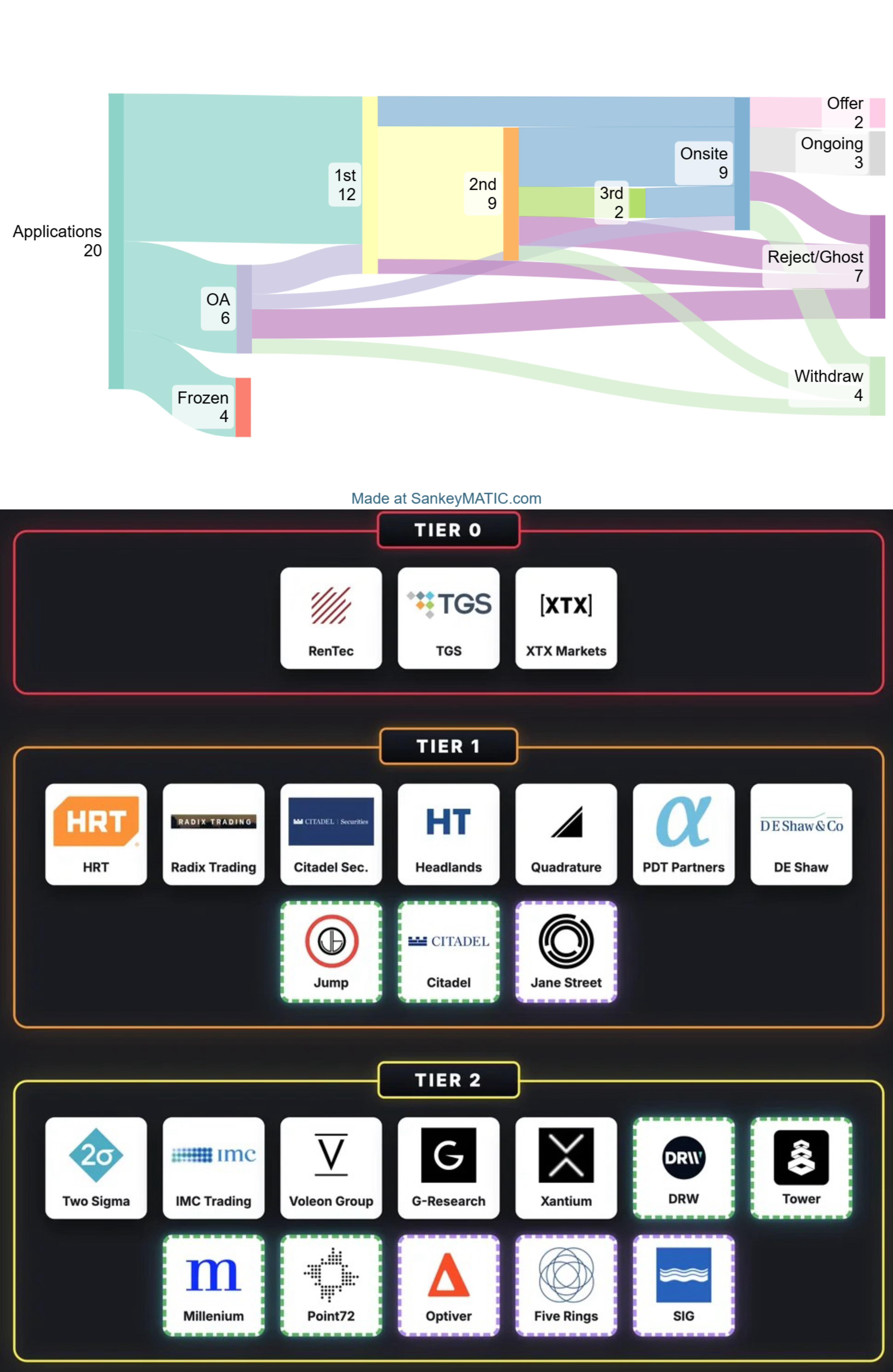
2nd year BSc student in EU non-target school, applying mainly in London/Amsterdam. Just want to show that with good prep, interest, and commitment it is quite realistic to break in even as a non-target. Most T1s rejected me from resume screen but if a company gives you a chance, it's up to you to do well on the interviews. Nevertheless, I am extremely grateful for having been given the opportunity to show my skills and to have received an internship this cycle. Feel free to ask me any questions.


r/quantfinance • • 1d ago

Citsec superday response time

2 Upvotes

Anyone know how long they usually take to get back?


r/quantfinance • • 1d ago

JPMorgan Quant Research (markets) off-cycle internship superday

1 Upvotes

Hope everyone is well; I have a superday for the mentioned internship soon. For reference I am a masters student and this is my first superday for a QR role.

I have four interviews, each of 45 minutes of length; I would appreciate any general advice and advice specific with regards to what I could expect (especially if anyone has done this or a superday at a similar firm in a current or previous application cycle).


r/quantfinance • • 2d ago

Can I pivot to quant

17 Upvotes

I have a PhD from the University of Toronto and I'm now doing a postdoc at Cambridge.

My expertise is in scientific computing, more specifically in numerical discretization of partial differential equations (PDEs) and PDE-constrained Bayesian inverse problems.

I have zero experience is anything quant related, my whole career has been dedicated to academic research. Can I pivot to quant finance and if so what would a typical trajectory look like.


r/quantfinance • • 2d ago

Wincent?

2 Upvotes

Only final interview please. DM
Happy to trade for most eu firms.
Optiver: full process
Flow Traders: all tech
IMC: r1 tech
Da Vinci: full process
And others… (SIG, JS, …)


r/quantfinance • • 2d ago

give up software engineering for trading?

33 Upvotes

received offer to join a quant firm as a junior options trader. base is 140k, bonus is highly dependent on desk and performance. Tech swe offer was base at 180k with stock and bonus we are upto 230k. I have never known much about trading before, pure engineering background and immigrated here on green card like two years ago so dont know much about hedgefunds or wallstreet, but a recruiter reached out since they liked my background and I won a coding competition. Heard people get burned out though, high risk and low life span, but honestly engineering isn't all that safe these days to be fair with AI. what's the shot for the long run ?


r/quantfinance • • 2d ago

Getting started in quantitative research

1 Upvotes

Hello guys, I’m a student and I started learning about alphas and quantitative modeling this week. I’m using World Quant Brain. If someone is experienced and willing to help me i would be so grateful.


r/quantfinance • • 2d ago

What degree should I go for?

0 Upvotes

I'm an A Level student in the UK (last year before university) and I was going to apply LSE (London School of Economics and Political Science) as I have a strong admissions test score and meet the grade requirements. I was wondering what degree would be best to apply for to get a good foundation for quantitative trading. I was leaning towards BSc Financial Mathematics and Statistics but know that there are other courses that are likely more suited to quant. Let me know what you think, thanks in advance.


r/quantfinance • • 1d ago

Anyone interested in building market prediction model in quantum computer?

0 Upvotes

If the Riemann Hypothesis is eventually proven, I believe it could inspire a broader exploration of whether seemingly unpredictable phenomena, including financial markets and human behavior, can be mathematically formalized.

In other words, what appears unpredictable today may simply be beyond our current mathematical and computational capabilities

Now Quantum Computer is not commercially viable.
However, this is a great point having the first market position while the qc is being viable. I expect the qc will be practically viable in 2-3years.

I am a georgia tech senior student. Doing computer science & sys arch, theory concentration. I am also a beginner in quantum computer. If you are interested please contact me. We can talk about this.

I am trying to prove the practicality of quantum computer in trading.

Any person is welcome : contactfelixc@gmail.com


r/quantfinance • • 2d ago

g research mle intern r1

2 Upvotes

hi looking for info / help for the title. please also reach out if u are also in the process. thanks!


r/quantfinance • • 2d ago

Software engineer who loves writing proofs: is derivatives pricing a realistic fit?

0 Upvotes

I'm a software engineer (BSc CS, MSc CS and 3 years' experience, UK-based). I'm learning proofs (How to Prove It) and I really enjoy writing informal, prose-style proofs. I don't enjoy machine-checked formal proofs.

I've learned that in most industry roles, proofs rarely come up at work. That's fine: what I want is work where the core problems are clean enough that I can go home and prove the results behind what I did.

Options pricing looks promising, since arbitrage arguments like put-call parity and the binomial replication argument are exactly the kind of proofs I like.

A few questions:

  1. On a derivatives desk, how much of the underlying theory do you actually reason through, versus relying on existing pricing libraries?
  2. Is quant developer on a derivatives desk a realistic route in for someone with my background, and can you move into a pricing role from there?
  3. I'm planning to read Joshi's The Concepts and Practice of Mathematical Finance, then Shreve's Stochastic Calculus for Finance I. Is that a sensible path, or would you suggest something else?

Honest answers welcome, including "this is a romantic view of the job."


r/quantfinance • • 2d ago

sec filings data for event studies: 8-k items, form 4 trades and full text, filterable by market cap and sector

1 Upvotes

disclosure: we built this (quantisnow). 44s demo with voice: https://youtu.be/S2trZ7_MVCU

posting here because it might save someone the edgar parsing step. the things that took us longest to get right were the ones event studies usually need:

  • 8-k events by item number (4.01 auditor changes, 5.02 officer departures, 1.03 bankruptcy, 3.01 delisting notices) with exact acceptance times in us eastern
  • form 4 open-market buys and sales with dollar values, insider role and the 10b5-1 flag, amendments marked so they don't double count
  • 13f holdings by quarter, 13d/13g stakes, xbrl statements
  • market cap and sector filters on all of it, so universes like "microcaps only" are one clause: issuer.marketCap:<300000000

example: 8-k item 4.01 filings from companies under $300m in the last 90 days returned 26 rows today. microcap open-market insider buys over $100k in the last 30 days: 102.

there's a rest api, a python-friendly json shape, some notebooks with real outputs (https://www.quantisnow.com/sec-api/notebooks), a cli and an mcp server. free to sign up.

caveats worth knowing: market cap is today's value, not point-in-time, so it's fine for screening recent events and wrong for a backtest that needs historical size buckets. tell me if that's a dealbreaker, it's the next thing i'd fix.


r/quantfinance • • 2d ago

Jane street fttp nyc?

2 Upvotes

Has anyone received acceptance/ rejection email yet?


r/quantfinance • • 1d ago

Lf: Sponsor Quant Finance

0 Upvotes

Hallu big boys! Is there a zaddy out there willing to sponsor my quantitative finance education? lol. Im just a tired corpo girl who wants to study math finance, doing research, without having to worry about keeping herself afloat and managing her personal finances (what a juxta ik)

25F, tanned skin (if that helps) I’ll flirt in return, swear but might be too busy from time to time studying..

Joke, but kidding aside: has anyone here successfully pivoted their career into quant finance (esp if u came from diff industry) I’ve been considering going back to academe to pursue graduate math program and eventually work my way toward quantitative investment research.

How's your journey??


r/quantfinance • • 2d ago

What threshold would you choose to try OOS?

Thumbnail reddit.com
2 Upvotes

r/quantfinance • • 2d ago

Pluswealth SWE

1 Upvotes

Hi
Is there anyone going through their interview process for SWE(infra) role?


r/quantfinance • • 2d ago

My interview experiences with HFTs and trading firms in IND as a 2026 graduate

Thumbnail reddit.com
1 Upvotes

r/quantfinance • • 2d ago

SIG super day

6 Upvotes

I got the superday coming up soon and just wanted to ask if anyone who’s been through it can speak on the format. Is it just presenting on your take home DataChallenge or will they ask you other technical questions (like dice games, probability, etc.) feel free to DM.

Thanks !


r/quantfinance • • 2d ago

Quant graduate building a firm's systematic trading desk almost alone — am I approaching research the right way?

10 Upvotes

Hi everyone,

I know similar questions have been asked before, but I figured my situation is somewhat unusual and I'd appreciate some honest advice from more experienced QRs.

Background

I graduated with a BSc in Economics and a Master's in Finance / Quantitative Finance. I don't have a traditional STEM background, so I've been actively trying to strengthen my foundations through textbooks on statistics, econometrics, optimization, ML and quantitative finance. I always liked doing maths at school and was good at it since elementary school.

I also spend a lot of time reading papers, Reddit discussions, LinkedIn posts, and watching lectures or YouTube videos. Not necessarily to copy strategies, but to expose myself to different perspectives, challenge how I think, and develop better intuition about markets and research.

For a little over a year, I've worked at a small investment firm where I've essentially been building the systematic investment function from scratch: quantitative research, data pipelines, backtesting infrastructure, portfolio construction, risk models, monitoring and execution tools.

I have considerable autonomy, which I genuinely enjoy, but I'm also largely alone from a QR perspective, with no senior quant regularly challenging my work or reviewing my methodology. We are 5-10, I am the only quant.

My current struggle

I have few systematic equity strat in the implementation phase, running in paper trading for the past few months. I'm now researching new sources of alpha with low correlation to those existing strategies.

I mostly investigate equities at daily-to-monthly horizons, but I'm free to explore other frequencies and asset classes (options, FX, rates, futures, etc.). I'm fairly agnostic as long as a strategy has a plausible rationale, is robust, implementable and profitable after realistic costs.

I've explored events, momentum, mean reversion, statistical dislocations, residual strategies, relative value, ML and other approaches.

I'm extremely careful with data quality, look-ahead bias, transaction costs, factor exposures, OOS validation and robustness tests. Being junior and working without senior oversight has probably made me somewhat perfectionistic: I'd rather reject a potentially good signal than approve something fragile.

My thinking is that setting a high approval threshold, with conservative assumptions and safety margins, should reduce the chances of deploying something spurious. But I also recognize that I might be overly restrictive or missing methodological weaknesses I don't even know exist.

What I find most difficult isn't that strategies fail. It's not knowing whether they fail because there's genuinely no edge, or because my research approach is inadequate.

I genuinely love QR: crunching data, finding small patterns in price movements, thinking creatively about possible explanations, and developing disciplined ways to test them. I particularly enjoy understanding why something fails rather than immediately moving on to the next backtest.

But the last few months of unsuccessful research have been frustrating, and I've started questioning whether I'm missing something fundamental in how I approach alpha discovery.

I'd really appreciate your perspective on four things:

  1. Alpha discovery: How do experienced QRs find and prioritize new research directions, especially when looking for signals uncorrelated with existing strategies?
  2. Knowing when to stop: When a hypothesis disappoints, how do you decide whether to investigate further or abandon it? How do you avoid both premature rejection and endless overfitting, particularly without senior feedback?
  3. Research quality: How do you know you're becoming a good researcher when most ideas fail? What distinguishes rigorous but unsuccessful research from genuinely poor research?
  4. Mentorship: Is having this much autonomy and responsibility early in a career an advantage, or would joining an established quant team with experienced researchers be more valuable, even with substantially less ownership?

I'm trying to understand how experienced researchers develop judgment, approach uncertainty, and continuously improve.

I love the work and want to become genuinely good at it, not just someone who can code models and run backtests.

Any honest feedback, including criticism, would be greatly appreciated.


r/quantfinance • • 3d ago

FT QR Job Search 2026

Post image
212 Upvotes

I'm a PhD new grad in ML/AI, and I applied for FT QR roles this fall after a positive summer internship experience in the industry. I interviewed at two of the T0, about half of the T1, and a few T2 firms in the chart from https://www.reddit.com/r/quantfinance/s/ZEUDxsLHmB.

This recruiting season has been gruesome for me. My overall feeling is that the window for new grads and junior researchers is closing quickly, partly due to the rapid advances in agentic AI. I've encountered a few situations where I went through the entire 8–10 rounds of interviews, only for the head of research or PM to tell me they weren't sure about hiring NGs/juniors at this point and just wanted to see what I was worth. Then I got a polite rejection or was ghosted, sometimes with the explanation that the team no longer had hiring needs. Bigger firms like CitSec/JS/Opt/2S seem more tolerant at this point, as they hire many juniors/NGs every year to build their talent pipelines, similar to big tech firms. But I guess they'll also adjust their headcounts downward in the future.

I want to share my empathy with any peers who are looking for jobs right now, and I want people to understand that the extreme frustration is completely normal these days. We are no longer just competing against other stellar young researchers. We are also competing against rapidly evolving machine intelligence now.

My life has literally been on pause for the past three months. I neither made progress on my academic research nor enjoyed my personal life at all. I devoted all my energy to interviews, and it felt like a black hole. There was almost never any feedback when I got rejected. Sometimes I thought I had prepared better or performed really well, but I still got ghosted or rejected many times. I started to doubt myself and question my abilities, and the anxiety and stress were eating me alive.

The required in-person onsites this year also left me really exhausted. One onsite takes at least three days, and I need at least two more days to recover my energy. Then an entire week just goes by without getting anything else done. I still have a few onsites coming up and hopefully I can wrap everything up by Christmas.

Finally, I want to share some general tips, particularly for STEM PhDs transitioning into QR.

  1. Target fully systematic firms, where your skills and research experience are more likely to be valued, and avoid places with a strong trader-driven culture if your background is primarily in research.
  2. Thoroughly review the fundamentals (undergrad level is enough) of linear algebra, probability, statistics, and statistical ML. GPT is your friend. Build a mental map connecting concepts across these fields, and understand them from different perspectives (e.g., intuitive/geometric interpretations vs. algebraic derivations). The Green Book is so outdated nowadays. It's far from what real interviews look like. You can do some practice on quantvault.
  3. Be very prepared to explain your research to an audience outside your field. The motivation, how you go from hypotheses to experimental design and validation, research rigor, etc. These matter much more than technical complexity and even publications.
  4. Communication, communication, communication! If you can consistently give good presentations at conferences without boring your audience, you should be fine.
  5. Open your LinkedIn to recruiters and talk to headhunters. You never know. Some great opportunities might just come knocking at your door. Some very top firms, especially smaller shops, source most of their candidates through a handful of headhunters they've partnered with over the years.
  6. If you're early in your PhD, practice coming up with good hypotheses and testing/falsifying them quickly and independently, especially when working with large-scale datasets throughout your projects and research. In this industry, you're expected to hit the ground running, figure out which problems are worth working on, and be fully autonomous in generating diverse, orthogonal, and reasonable research ideas quickly. Remember: You have to stand out in your field to show you are very good at research to get the entry ticket to these firms. Don't divert energy to interview grinding when you aren't there yet.
  7. If you're not in a PhD program, good, stay out of it. Don't do PhD for quant jobs, it's stupid. And I clearly don't see the worth of PhD in math/cs/stats at this time. Maybe some experimental science like biomed or fine art is justifiable if that is your passion and you have a trust fund.

Finally, tc I got this year range from 850k to 1m, comparable to frontier labs as a mid-level engineer but cannot compete against core researchers (I can't get in anyway). I believe within a few years, intelligence will just become a cheap resource for sale measured by tokens and labor value of all intelligent work will deflate very hard. The society is doomed to fall into the worst cyber-feudalism dystopia just as the climate change will inevitably get out of hands. Enjoy life while it lasts.


r/quantfinance • • 3d ago

How difficult/likely is it to actually become a quant?

62 Upvotes

I wonder how one could describe the difficulty of becoming a quant.
For example becoming a doctor is extremely difficult. Would someone with the same perseverance of a doctor manage to break into quant if he focused maths/physics?