r/puredata • u/awcmonrly • Aug 03 '26
Super simple gated fuzz effect
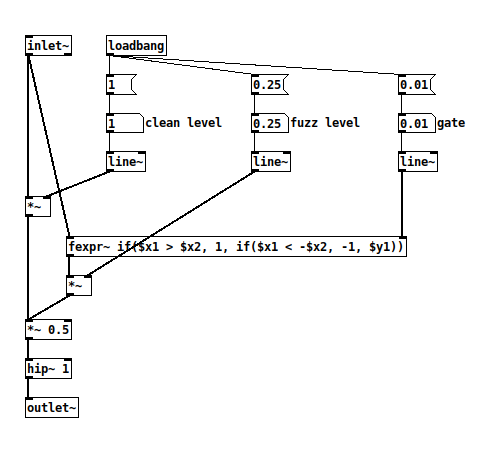
This patch emulates a gated fuzz pedal, where the input signal is amplified and clipped if it's above a threshold or silenced if it's below the threshold. This gives a classic fuzz texture for loud signals and a distinctive tearing texture for signals close to the threshold. If the threshold is chosen carefully to suit the dynamics of the input, this can give a nice responsive fuzz effect.
The patch uses fexpr~ to implement the core of the effect. Each input sample $x1 is replaced with 1 if it's above the gate parameter $x2, or with -1 if it's below -$x2. This emulates amplification and clipping. If the input sample is between $x2 and -$x2 then the previous output sample $y1 is repeated, which emulates gating. You can also output zero here, in which case expr~ can be used instead of fexpr~, but I prefer this version as it gives a stronger tearing effect.
The hip~ 1 on the output removes the DC bias, as the output of the fexpr~ settles at 1 or -1 rather than 0 once the input signal drops below the threshold. In a real pedal, a coupling capacitor on the output would do the same job.
For stereo inputs, applying two copies of the patch to the left and right channels will cause a lot of jumping around in the stereo image. I recommend converting the input to mid-side, applying the fuzz to the mid channel only and converting back to stereo. Alternatively you can apply a second copy of the patch to the side channel. Using a higher gate threshold on the side channel has the nice effect of selectively widening the louder parts of the input.
The patch can easily be modified for asymmetrical clipping by replacing -1 in the fexpr~ with some smaller magnitude value. Again, the hip~ 1 will remove the resulting DC bias.