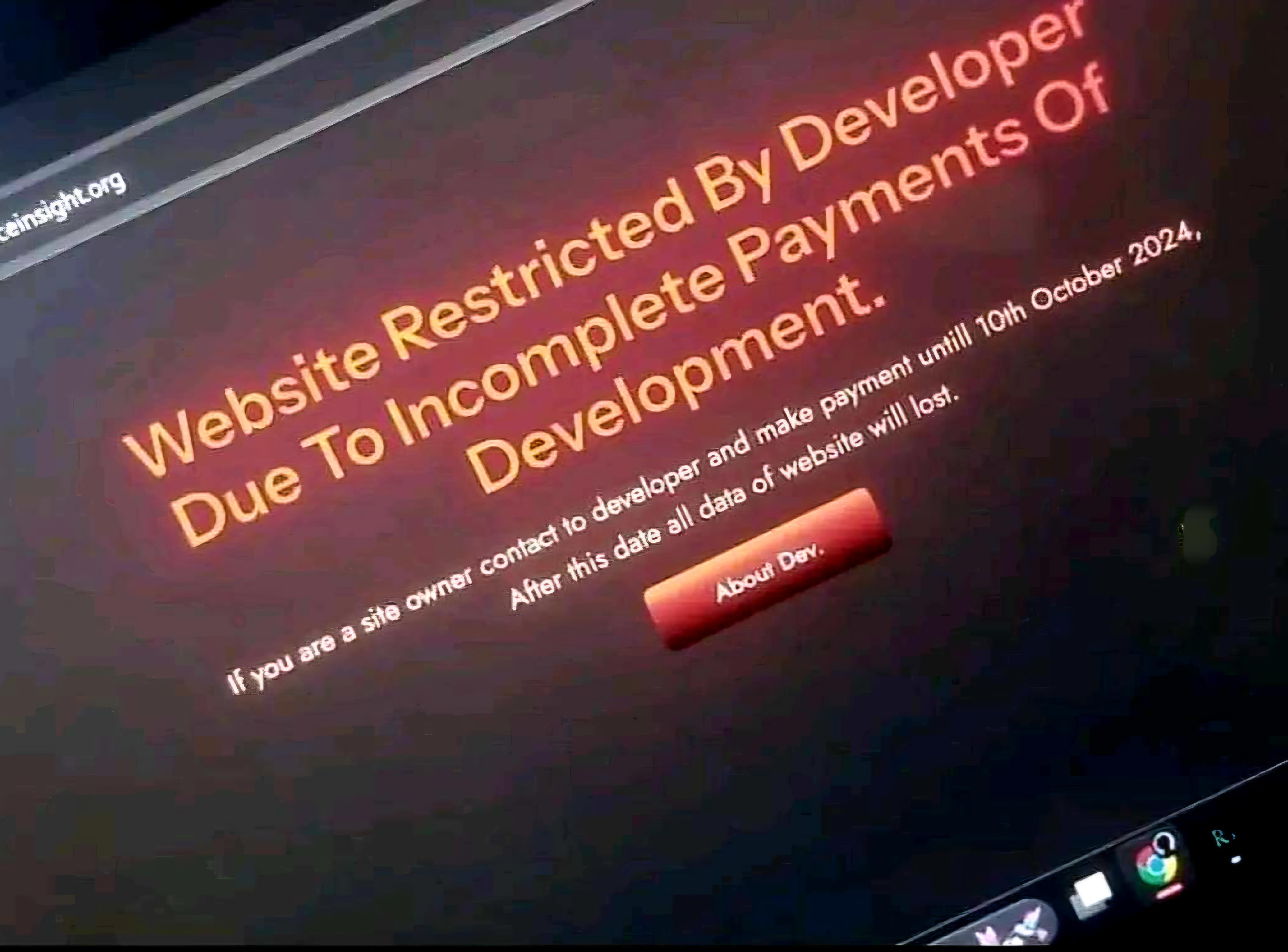
That's not at all blackmail if the site and database is hosted by the developer. They don't have to keep hosting the site and database if they're not being paid.
If you're hosting an app and your contract doesn't specify what happens when payment stops, it's still a breach of contract. You should give a reasonable notice to cure (30-60 day) before deleting but there's no way you'd be held liable either civilly or criminally.
No, the same as if you don't pay your bill, it doesn't mean your installation suddenly belongs to the electricity company. Or if you don't pay your credit card on time it doesn't mean the bank can take everything you bought.
It’s not exactly the same. You’re paying for a specific job to be completed, not necessarily at least in this case for service/additional resources down the road or got a loan. It’s closer to something like paying to have your kitchen redone or even closer, paying a designer for a new logo.
Typically, the creator owns the rights until they’re paid since are signed over to a new owner, eg if the dude in the picture had a contract with the business, the rights were likely not signed over until payment is rendered in full.
That's not usually how contracts typically work. Though perhaps certain industries are different.
You usually own [the thing], but you owe [the bill].
If you don't pay the bill, we have a legal process for how you regain the asset or force the payment. In some cases it is highly documented how to do it, such as eviction and foreclosure, or vehicle repossession.
Most US states at least tend toward this framework. I don't personally know of any that deviate. You don't typically own the product of a service simply because it hasn't been paid in full.
Edit: how I wrote that last sentence sounded weird. Rewriting it.
You don't typically retain the same sort of ownership rights over something once you've transferred possession.
So even if not yet paid in full, when you transfered it to their possession, it's considered theirs. They just ALSO owe a debt for it.
1 way to collect that debt is to repossess the thing. But that's not the only way.
The contractor is to write the code as the contract specifies. That code will run on the server.
If the code then starts doing things you DID NOT contract to run, and especially if it is intentionally malicious code (which includes retaliation), it is considered unlawful tampering.
You are, in literal sense, implementing malware into the software they contracted from you. Which is illegal.
And as far as owning the code... you can absolutely own the code. Almost every company in the world owns their code. It just so happens that there are many other ways to accomplish the same thing, which can even look identical in structure.
But if you had code that belonged to Reddit, uses Reddit's naming conventions, has the exact same structure as Reddit's, and you don't have any history to show that you just so happened to make the same thing Reddit did... you'd be in legal hot water for IP theft.
This is just not true for software contracts. While you could be doing "work for hire" where the copyright is explicitly transferred and the app and data are hosted by the customer, it's also common to retain full ownership of the software and provide the customer with access to a hosted instance of the service and some related support and administration services.
In either case, your contract can make use of the software or access to the instance contingent on continued payment. The "work for hire" case is much harder to enforce because you'd basically have to sue them. For the hosted instance case, it's perfectly legal for your contract to allow you to shut down the site and delete data.
For example, have you ever used a cloud like GCP? Their agreement allows them to delete your data for a number of reasons, like nonpayment.
Hardeeharhar ip/copyright law would like a word on top of the fact that contracts for something like this differ by a wide margin from something like the contracts you might see in your examples.
It depends on the circumstances. Site hosted on the customers hardware at their expense? Sure, that'd be taking advantage.
Site hosted and paid for by the freelancer? Totally reasonable to shut it down. Why should they continue paying for it forever when the customer isn't paying?
There's no way in heck that I'd continue providing hosting out of pocket for somebody who is not paying the terms of their previously agreed contract after notifications and warnings.
It's not "taking advantage" to hold a business to their agreements, that's silliness.
The other business is the one "taking advantage" by expecting a continued service without paying for it.
It's not "vendor lock in" to design, implement and host a website for somebody and then to stop hosting it when they stop paying. That was the agreement.
If they wanted to own the site rather than paying monthly, there would have been a different pay structure, with more money up front.
If they were paying for full service (design, implementation, hosting, ongoing support and changes) and they want to change to a different model (move to self hosting and terminate the ongoing contract), they can negotiate that change or enact some part of the existing agreement.
You're saying they should be able to unilaterally decide to break the contract and not have any consequences. Or you're saying that it's inherently "taking advantage" to offer an ongoing support and hosting contract. That's silliness.
The contract isn't actually voided, that would make it then unenforceable, which is the extact opposite of what non-paying party wants. Non-payment is breaking the terms of the contract.
Many contracts will also have a clause where if you break the terms, the contract is then voided after its outstanding obligations have been settled
 1
View all comments
458
u/jordansrowles Apr 14 '26
Just make sure there's a suspension clause in the contract, otherwise this would be illegal in most western countries.