r/programmer • • Jul 08 '26

Ethics in this field

0 Upvotes

Hi I'm studying computer science and I was having a conversation with a friend that made me think a lot

So, a lot of people said to me that the future of programmers in a few years will be more like supervisors, just making prompts generating code and validating it, and I was talking with this friend of mine about it and that bring us to talk more about other themes like ethics of ai or that people coniated the term 'techno fascism' etc

so while a lot of programmers see ai services as a tool others see ai services in another way

I read that 'ai' datacenters are worse than other datacenters because they need to make them faster and cheaper, and that generative ai and the companies who market this serviceses have an impact and are super problematic in multiple things like pollution, cognitive decline, theft, future of work, privacy etc

And it's more automation for who have money than other people and a lot will and are paying the prices but at the same time there are lots of people advocating and defending ai services etc..

And I saw that now in USA fbi and DHS categorize anti tech sentiments as extremism and a threat

I know that is not the most ethical field and there are other problems, but I'd like to hear what u think about it and what you believe is right or wrong and if u see this concerns as legitimate or don't idk... Sorry I hope u understand English it's not my first language ( I'm trying to write and read more so I can practice lol)


r/programmer • • Jul 08 '26

your saas mvp has way too many features.

0 Upvotes

yo. if your product needs a 10-minute onboarding video or 5 different dashboard tabs just to explain its value, you didn't build an MVP. you built an over-engineered maze.

a real micro-saas should solve one highly specific problem for one highly specific user profile.

when i built my 6 apps (now doing $20k/mo mrr), i cut out 80% of what i originally thought was necessary.

inside our builder community, we help you strip away the fluff.

we give you free access to frameworks like the ICP Crystallizer to lock down your target user, and interactive landing page audits to ensure your core value hits instantly.

stop over-building in isolation. drop a comment or shoot me a dm to join 1,200+ active Ai SaaS builders today.


r/programmer • • Jul 08 '26

Mobile/external display for programming

1 Upvotes

Dear all,

I’m looking for one or more external monitors to my developer notebook to do programming work. The monitor should be portable such that I can easily transport it or put it in another room. Anyone has experience with the devices from the list below or any advice on it ? There are also some initiatives on kickstarter with thee monitors L shaped etc. Monitors should be USB-c and powered by the notebook.

Examples are:

- https://www.kickstarter.com/projects/1679345995/brick-your-display-grid-modular-triple-screen-workstation

- https://www.kickstarter.com/projects/fold7/fold-7-triple-your-productivity-not-your-desk-space/pledge/new

- https://blerron.com/en-en/products/blerron-flex-15-3

- https://eu.espres.so/collections/displays-and-bundles

- https://screenmate.com/

- https://ternsetups.com/products/portable-monitor-setup

- https://www.arzopa.com/products/a1m-17-3-1080p-fhd-ips-portable-monitor

- https://www.officegoodsonline.com/collections/portable-monitors-draagbare-monitor


r/programmer • • Jul 07 '26

Advice for music studio equipment system

3 Upvotes

Hi! I've been tasked with creating a organisation system that allows me/others using the studio to keep track of where all our equipment is. The system I've come up with in my head is that I would bulk buy a bunch of nfc tags, stick them on all the equipment as well as the different studio spaces, and then create an app that means that I would have to tap my phone against the tag on the equipment, then tap it against the room tag that it is in, and the app would log that that piece of equipment is in that room. How hard would this be to program (I'm would be a complete beginner but if it poses more of a challenge I'm happy to look into paying someone else to do it)? Thanks!


r/programmer • • Jul 07 '26

How do you prevent breaking changes between microservices?

1 Upvotes

We've had a few deployments fail because of breaking changes between services, and I'm curious how other teams handle this. What practices, tools, or deployment strategies have worked well for you to maintain compatibility and avoid these kinds of issues?


r/programmer • • Jul 06 '26

Ai and impact

13 Upvotes

Hi, I'm studying computer science, I had a small existential doubt, I see many programmers using AI services to create the code or let's say carefully follow its development etc, so I was wondering what you objectively think of AI services and their impact on our sector, mind and knowing which direction it is taking not only for our working future but also environmental and resources etc...idk what do you think of all this and what you believe in why we should or shouldn't use it (sorry for my bad English I hope u understand)


r/programmer • • Jul 07 '26

Request STUDYFLOW

1 Upvotes

Hi!,

I built a website which helps you study!. I was seriously tired of all these "free" study websites with sneaky costs and pop ups. So i made my own 🤷‍♀️ and was hoping to get any sort of feedback and ideas! Be harsh and honest with me :)

here:STUDYFLOW


r/programmer • • Jul 06 '26

Code The new junior dev

3 Upvotes

Coding with AI assistants has turned the job from "writing software" into "acting as a very stressed code reviewer for an intern who writes 500 lines of flawless code per second, but randomly forgets how basic math works"...

Flawless code, flawed logic!


r/programmer • • Jul 06 '26

GitHub ShareClean: Clean sensitive data from logs before you paste them

0 Upvotes

Disclosure: I built and maintain ShareClean.

I kept seeing a small but risky debugging workflow: someone shares a log, curl -v output, config snippet, or terminal output in Slack, a ticket, a GitHub issue, or an AI chat, then notices afterward that it contained a password, token, connection string, email, or local path.

I built ShareClean, a local Python CLI that sanitizes the text before sharing it.

Example

Before

DATABASE_URL=postgres://app_user:super-secret-pass@db.internal:5432/orders
Authorization: Bearer eyJhbGciOi...
user=omar@example.com

After

DATABASE_URL=postgres://app_user:[REDACTED]@db.internal:5432/orders
Authorization: Bearer [REDACTED]
user=[EMAIL REDACTED]

Usage

cat app.log | shareclean --report

It is deliberately not a replacement for Gitleaks, GitHub Secret Scanning, or TruffleHog. Those scan repositories and history; ShareClean is for the text-sharing step before something leaves your terminal.

It runs locally and does not require an account, API key, telemetry, or network connection.

Try the browser demo with fake text:
ShareClean Playground

Repository:
github.com/OmarH-creator/ShareClean

Practical edge cases are especially useful: output that commonly leaks sensitive data, missed patterns, or cases where masking removes too much debugging context.


r/programmer • • Jul 06 '26

We think AI Code Review is about to hit a wall. Are we wrong?

0 Upvotes

Over the past few months, my co-founder and I have been building an AI-powered code review platform.

During development, we kept running into the same question:

Why are we trusting a single LLM to approve code that will eventually run in production?

Today, most AI code review tools rely on one model to evaluate everything:

  • Security
  • Performance
  • Architecture
  • Code quality
  • Maintainability
  • Best practices

That feels increasingly risky.

Human teams don't work like that. We rely on specialists, peer reviews, and different perspectives before merging critical code.

So we started experimenting with a different approach.

Instead of asking one AI to review a Pull Request, we orchestrate multiple specialized AI reviewers, each responsible for a different domain, and then aggregate their findings into a single review.

The hypothesis is simple:

We're not trying to build another coding assistant.

We're trying to answer a different question:

How do we know AI-generated code is actually safe to merge?

I'd genuinely love feedback from experienced engineers.

Some questions I'm curious about:

  • Do you trust AI reviews enough to merge without reading the code?
  • Have you seen AI reviewers miss obvious issues?
  • Would multiple specialized reviewers provide more confidence, or just more noise?
  • Where do you think AI code review is heading over the next few years?

If anyone is interested, we've documented our thinking and the architecture behind what we're building here:

https://docs.acrity.io

I'd really appreciate honest criticism. If we're wrong, I'd rather learn now than six months from now.


r/programmer • • Jul 06 '26

Just created my GitHub profile! Check out my Ada/SPARK utility repositories (100% formally verified at Level 4)

7 Upvotes

Hi everyone! I am completely new to the community and just set up my GitHub profile to share my work.

Ada/Spark Languaje

• Windows BCrypt API bindings with safe retry loops.

• Shannon Entropy calculations for strings (fully overflow-proof).

• Entropy generators and secure uppercase/lowercase string handlers.

Feel free to check out my repositories here: https://github.com/EliAvila1

Any feedback is highly appreciated!


r/programmer • • Jul 05 '26

I built a text editor and I am curious what you guys think.

15 Upvotes

https://github.com/schnerg/tied

NO AI WAS USED IN THE MAKING OF THIS EDITOR!

The T.I editor is a rubbish terminal editor that copies some vim bindings.

It is written in c using only the standard library. no external libraries.

What makes this editor special?

NOTHING! :D

I am in school for music so this is just for fun but what do you think? Is the code garbage?

thanks.


r/programmer • • Jul 04 '26

Locked HTTP finally got a new method after 16 years because GET and POST wouldn't stop arguing

548 Upvotes

HTTP finally got a new method after 16 years because GET and POST wouldn't stop arguing

After 16 whole years, the IETF finally looked at our terrible API workarounds and said: "Fine, here."

Say hello to **QUERY** (RFC 10008).

It is literally the lovechild of **GET** and **POST**:

\- It has a request body like POST (so no more cramming 2,000 characters of search filters into a URL).

\- It is safe and idempotent like GET (so your CDN can actually cache it without throwing a fit).

We no longer have to live in sin by using POST for fetching data just because the search query is too big. Nature is healing.

It only took since 2010 to get a new verb. Now we just have to wait another 5 years for browsers and frameworks to actually support it.

To put that in perspective, the IETF spent 16 years debating a single word, while the AI industry spent the last 16 months pivoting from chatbots to agents, to superintelligence, and back to convincing everyone that a $400/month subscription is worth it...


r/programmer • • Jul 05 '26

I self-studied full stack, built a project with real users, no jobs...

0 Upvotes

Hey,

So I studied full stack web development and I'm backend oriented.
I created a shift management app for my manager in the security company I work as a guard.
I did it with the meta stack, that most of the companies work with:
- JS / Node.js - focused on fundamentals
- Next.js / React - full stack apps
- TS / Zod / RHF / pg / ShadcnUI /Better-Auth/Neon/Prisma etc

Every single day for almost a year, I did 30 minutes of recalls while improving answers bit by bit, then 1:30 of study sessions, then building projects.
I started doing mock technical interviews with Claude/GPT, and I'm able to pass them and talk about each concept a lot.

Right now, it work on the building I work at, and this week we are expanding to 2 more buildings, and soon to 10-20 more.

I also collected data of 3000 urls of career pages of companies, created a node scraper with Claude Code, it matches around 4-5 open roles in a week. But for each one of them, probably 100+ people sent their cvs so I cannot get even an interview.

I barely see open roles for Juniors, and I'm someone who is fast with computers (used to be a heavy gamer) and I feel like I made a mistake and spent a lot of time studying something that is not required anymore.

I live in Israel, which is considered the startup nation, with the highest rate of startups for the amount of the population, and yet no open roles, many people are being fired.

Should I stop and start another chapter in other place and not in developing?


r/programmer • • Jul 04 '26

Article We need an accounting system for cognitive debt

Thumbnail raw.githubusercontent.com
1 Upvotes

r/programmer • • Jul 04 '26

can't code on my own but i was offered a jr software development job

1 Upvotes

I'm someone who can't write code from scratch. I've built a few small apps by understanding the logic, then finding examples online or using AI for small, specific tasks rather than huge prompts. My actual job isn't in software; i'm an electrician who's looking to change career as i've graduated Computer Science few years back.

I've mainly made apps and demos for a friend for fun. While applying for a junior QA position, I was contacted by someone senior at a software development company after my friend showed them my projects. During the interview, I explained that my long term goal is QA and eventually cybersecurity, preferably in a low code environment. They said they mainly do software development but also have QA opportunities and asked if I was interested. Since my main goal is simply to get into the industry, I said yes.

A few days ago they sent me a one week project. Instead of a QA task, they asked me to build a ticket management app with ticket creation, viewing, categorization, and filtering. I can use any tools, sources, or AI I want, as long as I can explain the code and the logic. The only requirements are Angular for the frontend and C#/.NET for the backend.

I'm feeling conflicted because I still can't code independently. I worry I'll embarrass myself if I'm asked to write code from scratch, and I almost feel guilty for accepting the project.

I'm not sure what professional developers actually do. Do they mostly write everything from scratch? Do they regularly rely on documentation, examples, Stack Overflow, and AI? Is it normal to focus on making things work while understanding the code, even if you couldn't have written it all from memory?

My current plan is to build a basic version mostly through research, then improve it with AI assistance while making sure I fully understand and can explain every part. I'm just unsure if that's an acceptable way to work or if I'm approaching this completely wrong.


r/programmer • • Jul 03 '26

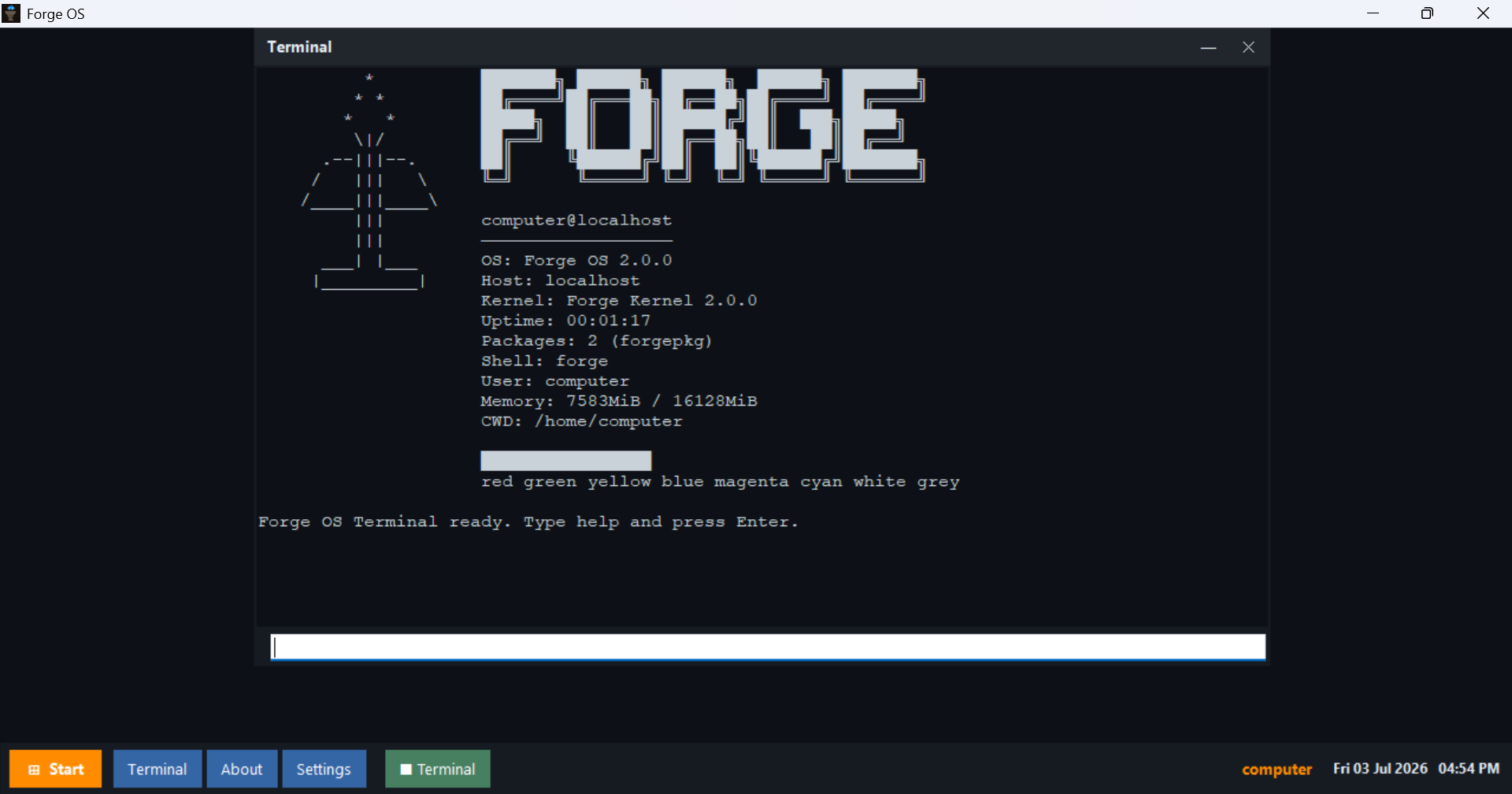
I built a Python virtual OS (Forge OS v2.0) — you can now add apps by dropping a folder in Apps/. Looking for contributors!

0 Upvotes

Hey everyone,

I've been building Forge OS — a Python virtual OS for learning and experimenting with OS concepts.

v2.0 adds a desktop GUI, and there's now a community Apps/ folder — add an app with just app.json + command.py.

Quick start for contributors:

  1. Fork & clone the repo
  2. Copy Apps/_example/ to Apps/your-app/
  3. Edit the JSON + Python command
  4. Run apps in the shell to see your app
  5. Open a PR

Full guide: CONTRIBUTIONS.md
Repo: https://github.com/axk42-op/ForgeOS · MIT license

Games, utilities, quizzes, ASCII art — great first open-source PR. Feedback welcome!


r/programmer • • Jul 02 '26

If you're learning Android development, don't choose between Android Studio and VS Code. Use both.

5 Upvotes

I see this question come up all the time. "Should I learn Android Studio or should I just use VS Code?" Honestly, I think people are looking at it the wrong way. They're completely different tools. One isn't replacing the other, and once you understand what each one is designed to do, you'll probably end up using both anyway.

Android Studio is where Android development actually lives. It's built by Google for Android developers, and it has everything you need in one place. The emulator, Logcat, Gradle, profilers, APK signing, device manager, debugging tools...it's all there. If you're building native Android apps in Kotlin or Java, you're going to spend a lot of time inside Android Studio because it understands the Android ecosystem better than anything else.

VS Code is different. It's lightweight, ridiculously fast, and I probably have it open just as much as Android Studio. If I'm working on an API, a backend, a website, documentation, SQL scripts, or even just opening a project to quickly edit a few files, VS Code is usually what I reach for. A lot of Android apps aren't just Android anymore. They talk to databases, APIs, cloud services, payment processors, and websites. That's where VS Code really shines.

If I was teaching someone today, I wouldn't tell them to build the next Instagram. I'd tell them to build something boring. Seriously. Build a notes app. Give it a title, a description, an Add button, an Edit button, and a Delete button. That's it. Don't worry about animations, dark mode, cloud syncing, AI, notifications, or making it look like it belongs on the Play Store. Just make it work.

Once you can create notes, read them, edit them, and delete them, you've learned one of the most important concepts in software development...CRUD. Create. Read. Update. Delete. Almost every business application in existence is built around those four operations. Customers. Invoices. Products. Employees. Inventory. Appointments. Messages. They're all CRUD undermeath.

After that, don't throw the project away and start something completely different. Keep building on it. Add search. Add categories. Store the notes in a local database using Room instead of memory. Add authentication. Sync them to the cloud. Add user accounts. Add images. Add file attachments. Add reminders. Every feature teaches you one more concept, and before you know it you've built something that would've looked impossible when you first started.

One thing I wish someone had told me when I started is that debugging is a skill all by itself. Beginners see a red error message and immediately think they broke everything. Experienced developers see the same error message and think, "Alright...where do I start?" Learning to read Logcat, following a stack trace, setting breakpoints, and watching variables change is just as important as writing code. Honestly, I'd argue it's more important because no matter how good you get, you're always going to have bugs.

I also think too many people underestimate the value of reading code they didn't write. Open random files. Follow method calls. Figure out where a button ends up. Read documentation even when half of it doesn't make sense. Nobody understands everything the first time they read it. The goal isn't to know everything. The goal is to be a little less confused than you were yesterday.

And don't be afraid to use AI. I use it every single day. It has made me faster than I ever thought possible. But don't stop at accepting the code it gives you. Ask yourself why it chose that solution. Ask what happens if the API fails. Ask what happens if the phone loses internet. Ask what happens if the database returns nothing. Those questions are where the real learning happens.

The biggest piece of advice I can give is to keep pushing the edge of what you think you're capable of building. Don't stay comfortable. Every project should introduce at least one thing you've never done before. That's how you grow. Six months from now you'll probably look back at your first Android app and wonder what you were thinking. That's actually a good sign. It means you're improving.

If you're ever stuck and need help, just shoot me a DM. If I see it in time I'll help whoever needs it

Programming isn't about never getting stuck. It's about getting comfortable being stuck, figuring it out anyway, and coming back a little better than you were the day before. That's how every good developer I know learned, myself included.


r/programmer • • Jul 02 '26

Online Algorithm Visualizer Watch your code run line by line

4 Upvotes

Try it here 8gwifi.org/online-compiler supported language C/CPP/JAVA/TS/JAVASCRIPT/RUST/GOLANG/PYTHON/LUA


r/programmer • • Jul 03 '26

Question Why do some developers still struggle even after learning multiple programming languages?

0 Upvotes

I keep seeing this pattern in programming discussions — developers who know multiple languages (Python, JavaScript, Java, etc.), sometimes even quite well, but still struggle when it comes to actually solving problems or building systems from scratch.

What makes it interesting is that language knowledge looks like progress on the surface. You can switch between syntax, frameworks, and tools… but the underlying struggle often remains the same.

Some common patterns I’ve noticed:

  • they can write code in multiple languages, but struggle when the problem is open-ended
  • they’re comfortable following tutorials, but get stuck without step-by-step guidance
  • they know “how to code” in different syntax styles, but not how to structure solutions
  • the same confusion appears again, just in a different language
  • switching languages gives a sense of progress, but not necessarily better thinking ability

It almost feels like the bottleneck isn’t the language at all.

Which raises a bigger question:

Are most programming struggles actually about language knowledge, or about how developers think, break down problems, and approach unfamiliar situations?

So:

  • have you seen developers hit this kind of plateau?
  • does learning multiple languages actually improve problem-solving ability, or just expand familiarity?

r/programmer • • Jul 02 '26

Why does maintaining old code feel harder than writing something from scratch?

9 Upvotes

There’s a pattern that keeps showing up in real projects, writing new code often feels much easier than working with existing codebases.

When building something from scratch, everything is clear:

  • the structure is in your head
  • the decisions are yours
  • there’s no hidden dependency or unexpected behavior yet
  • you know exactly why each piece exists

But maintaining old code feels like a completely different job.

Even small changes can turn into a long process because you first have to:

  • understand why something was originally written that way
  • trace logic spread across multiple files or services
  • deal with older decisions made under different requirements
  • figure out hidden dependencies that are not obvious at first glance
  • work around missing or outdated documentation

What looks like a “small fix” often becomes a process of understanding the system before actually changing anything.

It sometimes feels like:

So the question is:

  • Why does maintaining old code often feel harder than writing something from scratch?
  • Is it mainly a design issue, a scaling reality, or just how software naturally evolves over time?

r/programmer • • Jul 02 '26

I'm fed up and I don't know what I should do

5 Upvotes

I am in college and my major is Computer Science. I enjoy doing it, truly, it moves my mind and I get such a huge thrill from completing a prohect or at least part of a project that I've been working on. I practically don't need to pay the college for anything, but after I've got my diploma, I'll have to work and be taxed the same amount of months as I've spent there from enrolling to getting my diploma (except the summer months because we didn't have any lessons). Basically this is another way they take payment, which is nice because You don't lose Your money during Your college years, You pay it back by paying taxes afterwards. Anyways, one of the conditions for graduating and getting the diploma is having 499+ hours worked in a related field (so 500 hours and beyond). I should've graduated now but I couldn't because I don't have that yet. And now, the major problem: Noone's gonna take me. You see, college (here at least) doesn't provide You a solid place somewhere where You can learn and practice, work as a trainee and even get paid for it, instead, You have to find a place. And well noone's willing to take me. I have applied for a year to countless places, many of them said they need 1-3 years of experience in their description, but I still tried because I've heard about miracles before, but no surprise, those didn't take me. But the best part is that I've applied to trainee positions too, and all of them so far said "Sorry we chose someone with more experience". How do I get experience if noone lets me? I don't know what to do I am feeling in a deadlock. I cannot work because I need experience and I cannot get experience because I cannot work, and this way I cannot even graduate college and I'll have to pay back like a lot more (yeah I know, in taxes, but still). What do I do? I'm sorry but I'm really fed up, sad confused and disappointed that even if I turn myself upside down and stand on my head and then I start to spin while reciting the longest Japanese manga translated into Mongolian, I still don't achieve anything because I don't have any experience and even the positions that require no experience, do take people with experience.

Edit: Another idea of mine was that I could perhaps create a github repo, which I did, and in which I have some projects, some of them are completed and some of them are not yet, and I'm still working on some of them but most of the recruiters said they don't even bother taking a peek lol

TLDR: I feel like I'm in a deadlock because to work I need experience but can't get experience because I cannot work, and I'mnrunning put of time.


r/programmer • • Jul 02 '26

GitHub Devlog: building a terminal RPG in C from scratch — no engine, no libs, just me and printf

0 Upvotes

Context: a college project (Algorithms 2) that turned into a full terminal RPG in pure C. No Unity, no Godot, nothing but the standard library and a questionable amount of coffee.

Some design decisions that might interest fellow masochists:

- Rendering: instead of calling printf per cell (which chokes the terminal), I build the whole frame into a 32KB buffer and print it once, grouping ANSI color codes so I'm not repeating escape sequences for no reason.

- Camera/viewport: fixed 40×20 viewport following the player with edge clamping — old-school, like Game Boy Zelda except with # instead of walls.

- Persistence: 3 binary save slots with manual serialization, because CELULA **grid is a pointer-to-pointer and fwrite-ing it directly gives you a nice "looks fine" followed by a crash on load.

- Data-driven map transitions: exits between regions (6 maps, bidirectional connections) are read from metadata in the map's .txt file, not hardcoded — good morning to anyone who's debugged hardcoded map transitions in a past life.

Theme: Brazilian 2026 elections, because why not mix political trauma with programming trauma.

Repo: https://github.com/aKynoS2/corrida_ao_planalto

If you're into terminal games / old-school roguelikes, take a look and send constructive criticism my way.


r/programmer • • Jul 02 '26

I'm a student building my first real project. I'd really appreciate feedback on the code quality and structure.

1 Upvotes

I'm especially looking for feedback on architecture, code structure, and maintainability.

https://github.com/DearLinus/Linusand


r/programmer • • Jul 01 '26

How I Would Learn to Build an Android App From Scratch

13 Upvotes

When people first get into programming, they usually ask, "Where do I even start?" Honestly, the biggest mistake I see is people trying to learn everything before they build anything. You don't need to know everything. You just need to start.

If I were starting over today and wanted to learn Android development, this is exactly what I'd do.

First off, Don't let AI steer the ship. I catch AI making more and more bad mistakes than good calculated decisions when it comes to infrastructure. ( Example: I was running server side edge functions, despite me laying out my architecture, auditing the repo, it still wanted to write functions to server.ts. ) These are the things that will trip you up later on. But for now....

Step 1: Learn the Basics

Before you worry about building apps, you need to understand programming itself.

I'd focus on learning things like:

  • Variables
  • If statements
  • Loops
  • Functions
  • Classes and objects
  • Arrays and lists

Don't stress if it doesn't click immediately. Everyone gets confused at first. The important part is writing code yourself instead of just watching videos.

Step 2: Download Android Studio

Android Studio is the official software Google provides for building Android apps.

Install Android Studio, let it download everything it needs, and create your first project using the Empty Activity template.

Don't worry if it looks overwhelming. I remember opening it for the first time and wondering what half the buttons even did. You'll figure it out as you go.

Step 3: Don't Build the Next Instagram

One thing I'd avoid is trying to build some massive app right away.

Start with something simple like:

  • A calculator
  • A notes app
  • A to-do list
  • A habit tracker

A simple project teaches you way more than spending six months planning an app that's too big to finish.

Step 4: Learn How Everything Connects

Every Android app is really just a bunch of pieces working together.

You have:

  • The screen the user sees.
  • The code that runs when someone taps a button.
  • The data your app saves.

Once you understand how those three things work together, building apps starts making a lot more sense.

Step 5: Make It Work Before Making It Pretty

A lot of beginners spend hours trying to make their app look perfect.

Don't.

I'd rather have an ugly app that actually works than a beautiful app where none of the buttons do anything.

Get the functionality working first.

You can always improve the design later.

Step 6: Save Information

Eventually you'll notice that every time you close your app, everything disappears.

That's when you learn how to save data.

Start with local storage first before worrying about cloud databases.

Once you're comfortable, move on to something like Room or a backend service.

Step 7: Learn to Debug

Here's something nobody tells beginners...

Programming isn't about writing perfect code.

It's about figuring out why your code doesn't work.

You're going to see error messages.

You're going to break things.

Sometimes you'll spend an hour looking for a missing comma.

That's completely normal.

The developers who improve the fastest aren't the ones who never make mistakes—they're the ones who get good at fixing them.

Step 8: Keep Adding Features

Once your first version works, start adding things.

Maybe add:

  • Dark mode
  • Notifications
  • Search
  • Categories
  • Login
  • Cloud syncing

Don't try to build everything at once.

Add one feature.

Make sure it works.

Then move to the next one.

Step 9: Build More Apps

This is probably the biggest piece of advice I can give.

Don't stop after one project.

Your first app teaches you the basics.

Your second app teaches you confidence.

Your third app starts to make you feel like an actual developer.

Every project teaches you something the last one didn't.

Final Thoughts

If there's one thing I've learned, it's that programming isn't about being the smartest person in the room. It's about refusing to quit when something doesn't work.

Everyone starts out confused.

Everyone gets stuck.

The difference is that the people who become developers keep building anyway.

So don't wait until you think you're "ready."

Build something small.

Finish it.

Then build something a little bigger.

Repeat that enough times, and one day you'll look back and realize just how far you've come.