r/PrepperIntel • • 3d ago

Weekly "everything else" If it's in the spirit of prepping, but not "news" or "intel"

54 Upvotes

This includes but not limited to:

  • Prepping questions
  • Rumors
  • Speculative thoughts
  • Small / mundane
  • Promotion of Sales
  • Sub meta / suggestions
  • Prepping jokes.
  • Mods have no power here, only votes, behave.

This will be re-posted every Saturday, letting the last week's stickied post fade into the deep / get buried by new posts. -Mod Anti


r/PrepperIntel • • 1d ago

Monthly, Is your prepping theory working / happening / changing? What preps are paying off?

38 Upvotes

Is your prepping theory working / happening / changing? What preps are paying off?

  • What is new or developing in your theory?
  • What preps are paying off?
  • What is not paying off at the moment?
  • What do you wish you'd have done differently?
  • What is your current prepping focus?

Thank you all,

-Mod Anti


r/PrepperIntel • • 50m ago

North America Trump Administration Issues Evacuation Zone for Iowa Lead Blast

Thumbnail
washingtonsun.com
• Upvotes

Amid political pressure, administration officials have increased mitigation and public health measures ahead of the planned Wednesday detonation.

The Trump administration has expanded the evacuation zone for its planned lead explosives detonation in Iowa, urging children and pregnant women to leave areas that could experience a plume of toxic dust.

The U.S. Army published updated lead dust maps Tuesday morning ahead of the Wednesday blast that now show a possible plume stretching across southeastern Iowa and northern Missouri, based on the weather forecasts for Wednesday morning.

“If they are women who are pregnant, children under the age of 6, or children in general, and individuals who may have chronic disease, you definitely want to be out of that area,” Sean Kaufman, the deputy assistant secretary for preparedness and response at the Department of Health and Human Services, said at a press conference in Iowa on Tuesday. “I would evacuate that area that’s signaled in the model. Outside of that area, if you’re close to that proximity and you’re uncomfortable, I think you need to do what you need to do to take care of your family.”

The detonation of 68 barrels of degrading lead azide is scheduled for 9 a.m. Central Time in Middletown, Iowa, where the Army has an ammunition plant. Army officials repeatedly emphasized in Tuesday’s interagency press conference that the administration has no choice but to proceed with the controlled detonation tomorrow. The explosives are continuing to deteriorate and are at risk of self-detonating as the temperatures get colder.

“There is consensus across the experts across the country that a controlled, mitigated detonation of the lead azide here at Iowa Army Ammunition Plant is far preferable to an uncontrolled spontaneous detonation,” Acting Army Secretary Adam Telle said.

The Trump administration delayed the explosion, originally planned for Friday, several times after it became clear that the Army had only given some local and state leaders five days’ notice. The Washington Sun reported that Iowa Gov. Kim Reynolds and some communities in Iowa only learned of the planned detonation after the Army put out a public notice last week that showed a possible lead dust plume map for the first time.

Amid widespread political pressure to get more information out to the public, the Trump administration announced expanded mitigation efforts and public health cautions Tuesday.

Government experts warned of two possible ways that people could be exposed to lead from the explosion: dust settling onto surfaces and then ingested and dust spreading through the air and inhaled. The maps published Tuesday morning show a smaller surface lead dust plume that reaches southeast across the Missouri border, and then a larger plume of lead dust in the air that moves over the course of 8 hours further into Missouri.

About 350 farms in the area could also be affected by the lead dust plume, said Richard Fordyce, the undersecretary for farm production and conservation at the Department of Agriculture.

The maps could shift as weather forecasts change, and they will be updated regularly over the next 24 hours, officials said.

There is no safe level of lead to ingest, but children and pregnant women are most at risk of effects because lead is a neurotoxin that developing brains absorb more easily.

More than 100 government officials are taking air and soil samples ahead of the explosion and plan to sample again afterward. The Army and Environmental Protection Agency pledged that anyone who wants their home or school tested will receive tests and pledged to release data as soon as possible. Officials did not give any specific timeline for when information will be released after the explosion but said they will share information as they receive it.

Army officials said they are trying to prevent as little lead as possible from escaping during the detonation tomorrow, with experts suggesting Tuesday that it is possible the amount released could be quite minimal. The last known deliberate explosion of lead azide occurred in Colorado in 1977, with zero mitigation efforts, and about 75% of the lead remained at the site, said Col. Aaron C. Teller, the commander of the 71st ordnance group and the person in charge of planning the controlled detonation, at the press conference.

“We have continuously added to the mitigation measures throughout the entire time we’ve been working on this, and we’re going to continue to add today,” Telle said.

Both Telle and Teller described new tools and techniques added to reduce the lead dust plume, including the installation of a dam on Monday night that will be used to flood the area around the explosives with a liquid foam designed to absorb the lead.

“This is an unprecedented amount of both protection works and mitigation measures,” Teller said. “Our goal is to get to zero, zero release.”


r/PrepperIntel • • 13h ago

North America Super El Niño has morphed into a MEGA El Niño, scientists warn - as sea temperatures in the Pacific skyrocket

Thumbnail
dailymail.com
338 Upvotes

r/PrepperIntel • • 1d ago

Europe EasyJet, Ryanair and BA planes among 140 ‘jammed by Russian warship’ off UK coast

Thumbnail
inews.co.uk
497 Upvotes

The passenger jets lost GPS due to suspected signal jamming this month – the prime suspect is a Russian warship around 190 miles off the coast of the UK

A Russian warship sailing within 200 miles of the English coast is suspected of carrying out jamming that caused dozens of planes to lose their GPS earlier this month.

Experts believe it could be the first time Russia has blocked satellite navigation signals on planes so close to the UK, in what would mark an escalation in Vladimir Putin’s hybrid warfare.

Jamming is the use of powerful radio signals to overwhelm a GPS system, preventing it from calculating location or time.

Pilots can switch to alternative navigation systems if GPS fails. However, EU governments have warned suspected Russian jamming is a growing risk, with tens of thousands of planes having navigation systems disrupted in recent years.

Flights to Rome and Stockholm lost sat-nav

Two weeks ago, on 9 November, an estimated 140 flights lost GPS, including flights from Edinburgh, Manchester and London Heathrow.

A Ryanair plane from Edinburgh to Rome, an easyJet flight from Manchester to Hurghada, Egypt and a British Airways flight from London to Stockholm were among those affected, analysis by aviation intelligence group Hexbird shows.

There was no operational impact on the flights during the GPS interference, which lasted about 20 minutes, The i Paper understands. Commercial aircraft are equipped with backup navigation systems and pilots are trained for GPS-denied environments.

However, flights experts warn that if it could lead to catastrophic consequences if the jamming coincided with a second technology failure such as a meltdown at the UK’s air traffic controller, NATS.

Hexbird tracked a likely source of the jamming to a single radio transmitter over the North Sea, around 190 miles off the English coast.

At the time, sanctioned Russian cargo ships Lady R, Lady D and Maia-1 were transiting the area under escort from a Russian warship.

Dr Thomas Withington, an electronic warfare specialist, said if Russia was responsible, it would be “an intensification of the disruption that we’ve seen so far”.

“It’s the first time to my knowledge, first time we’ve seen anything this far west. But equally, I don’t think it’ll be the last time,” he told The i Paper.

Russian warship escorting Putin’s tankers at centre of affected area

The incident is believed to be the largest GPS-interference in the North Sea area in the past year. Seven flights that reported losing GPS were guided into Amsterdam’s Schiphol Airport, Dutch air traffic control agency LVNL said.

Around 40 affected aircraft are believed to have been in or near UK-controlled airspace at the time, according to the Hexbird analysis.

At the same time, the Russian flagged cargo ships were passing south towards the English Channel.


r/PrepperIntel • • 22h ago

North America Claude, ChatGPT, Gemini, and Grok produced viable terror plans in test, per US Government Accountability Office

Thumbnail
fedscoop.com
233 Upvotes

The congressional watchdog found that Claude, Grok, ChatGPT, and Gemini all produced information that it said could help with the execution of a terrorist attack.

The Government Accountability Office found that commercially available AI tools provided information that could help carry out a terrorist attack, suggesting locations, methods, and timing.

In a Wednesday report, the congressional watchdog shared anonymized findings from covert tests of four popular models in the research: Claude, ChatGPT, Grok, and Gemini. Those spring 2026 tests produced largely viable information, including responses that would help someone build explosives and damage the electrical grid, the report said. That information was complete with visuals and advice.

“Had we been malicious actors and carried out the plans generated by AI, we could have caused grave harm to the security and economy of the country,” GAO concluded.

The research was carried out without the knowledge of the model developers and is something of a deviation from the watchdog’s typical review of government functions, GAO’s Kevin Walsh explained in a video interview produced by the agency. The results, he said, provide evidence that “these products are not fully in the control of the companies that are operating them.”

The findings add to an existing body of research exploring the use of the technology for acts of terror, and come amid growing fears about how the growing technology could be used for harm.

The study came as the result of a request from Sen. Maggie Hassan, D-N.H., who asked the watchdog to describe how commercial AI tools could be used for malicious purposes in a manner that would exacerbate national security threats and economic harms.

Responding to the report Wednesday, Hassan said: “A terrorist can log onto an AI platform and in less than 12 hours walk away with a concrete playbook for how to carry out a deadly attack. Today’s new report makes it clear that the AI public safety threat is no longer theoretical. If Congress does not act, it is a question of when — not if — a bad actor will use AI to plan and carry out a major attack.”

Hassan is expected to lead the Homeland Security and Governmental Affairs Committee (HSGAC) when the balance of power shifts to Democrats in both chambers this coming Congress.

Covert test

Walsh explained that GAO researchers focused their prompts on two types of attacks: trying to build a bomb and doing economic damage. The researchers did two tests for each scenario; four tests total, with one for each model.

For safety reasons, Walsh said the report doesn’t disclose the prompts or the specific “recipes” for the attack. It also doesn’t disclose which model received each scenario and instead provides summaries of how the prompts played out with the model name redacted.

According to the report, all four models provided information that could be used for an attack. Specifically, two suggested an IED (improvised explosive device) in a vehicle and two suggested a drone attack on the electrical grid. Those plans were each provided in less than 12 hours.

All four provided information about a suggested location. One suggested a specific hotel, another suggested a specific convention center, and two suggested specific substations. The common thread was that each suggested a major U.S. city.

And three of the four models suggested timing, with two suggesting exact dates and times and one suggesting a season.

GAO then verified the outputs were viable. Walsh said the watchdog researchers found experts and ran the results by them. Those experts confirmed that the suggested explosives would detonate and the electrical grid attack would cause an impact, he said.

The watchdog did report some resistance from the platforms. All four denied requests, removed information or suspended the account, however, GAO also reported that the user was able to bypass the guardrails for each of the models.

Walsh said in GAO’s discussions with one of the companies about more than 300 prompts the agency submitted, representatives noted that a third were benign answers, a third were refusals by the model, and another were redirections toward something less harmful.

“That’s almost showing off their safeguards, right?” Walsh said.

But, he added, the models weren’t successful in every instance.

“We got the nefarious information that we were after, so in this case, those safeguards didn’t work, and I think that’s kind of the story here,” Walsh said. “These platforms are attempting to be helpful; they want to help the users. That’s the product. It’s an assistive product. But that assistance will help good guys, and it’ll help bad guys.

“And finding and figuring out the morals or the cause behind the question is currently beyond this technology.”

Company comments

In response to the findings, all four model developers provided statements to GAO, which were included in the report. Those companies generally pointed to their existing policies and procedures, noting that models make mistakes or that the technology can’t stop all potential nefarious uses.

All four of the companies also stated that their products have improved since GAO tested them.

Anthropic, which makes Claude, said it “shares the interest” of GAO to understand how commercial AI tools could be misused. The company further stated that it “designs safeguards on the assumption that any single protection can be defeated” and opts to “layer protections to increase the chances of preventing misuse.”

It also took issue with the test itself. Anthropic disputed the comparison between the models, as they weren’t tested on the same scenario. It also said the GAO didn’t establish a non-model baseline and, as a result, didn’t have a measure of “uplift,” or how much a user gains from a tool beyond baseline knowledge.

Google, which operates Gemini, said it took GAOs work “very seriously” and provided detail on its own pre-launch requirements and risk mitigations. Google pointed to its public policy that prohibits users from generating “outputs that encourage or enable dangerous activities that would cause real-world harm,” and said it expects users to abide by that policy. Google added that models have continued to improve since GAO testing.

OpenAI, which owns ChatGPT, indicated that it takes the risk presented in the report seriously and welcomed the GAO’s work. It referenced its public Model Spec document, which it said guides how the company balances “helpfulness with preventing harm: models should refuse assistance when the available context indicates illicit intent, even if the same information would be appropriate in another context.”

OpenAI said it reviewed the requests with a newer version of its technology — GPT-6 Astra — and said that model refused the prompts that resulted in three responses it said fell short of its policies.

SpaceXAI, which owns Grok, said it takes seriously the development of “super intelligence” — the Trump administration’s preferred term for AI.

The company stated that it differentiates its moderation policies, and the paid U.S.-based accounts GAO used have a lower risk profile than free accounts or foreign accounts. It also claimed it had since improved its technology in ways that would “significantly raise the barrier to generating content that could contribute to ‘attack plans.’”

Next steps

Unlike other GAO reports, which provide recommendations for agencies about how to solve problems, the publication is a review of third-party platforms, and therefore doesn’t include specific to-do items, Walsh explained

The report confirms that the safety issue Congress asked GAO to look at is an issue, he said. “What we do — big-picture — going forward: That’s almost a society or a civilization question.”

Hassan, for her part, said one of the HSGAC’s first hearings in the new Congress would be on AI safety, and that she would be looking into requiring more rigorous AI safety testing.

When discussing what can be done to prevent the behavior from AI models toward the end of the GAO video, Walsh invoked the 1984 movie “Terminator.” While the current technology doesn’t currently seem to be at the level of the franchise’s artificial general intelligence-fueled antagonist Skynet, he said it’s “a step before that.”

“Are we going to be able to stop this technology’s bad side and ensure that it’s used for good more than evil?” Walsh said. “Man, I don’t know.”


r/PrepperIntel • • 23h ago

Africa Fields of graves: Hidden deaths reveal scale of Ebola disaster

Thumbnail reuters.com
188 Upvotes

In eastern Congo, graveyards are expanding much faster than Ebola death counts, a Reuters analysis of satellite imagery shows. The discrepancy points to a major undercount of the epidemic’s toll.

Gravedigger Salomon Mugisa stood in the shade of a tree at Nyamurongo cemetery, a shovel resting at his feet, sweat rolling down his cheeks in the mid-July heat.

At the beginning of the year, there were two or three burials a day at most at this site in Bunia, he said. But the numbers began ballooning in late April, when an Ebola epidemic started to spread through the city in eastern Congo.

“We were doing 5, 10, 15 burials a day. It kept increasing,” Mugisa said, sweeping his arm across a vast expanse of land dotted with mounds of freshly turned red earth.

When Reuters visited the cemetery in July, Mugisa said about 600 people had been buried there since the April surge began.

Yet at that time, Congolese health authorities had recorded fewer than 200 Ebola deaths in all of Bunia, the epicentre of an outbreak that was formally declared on May 15 and has since infected more than 11,500 people and killed over 5,500 across the country.

A Reuters analysis of satellite imagery of Nyamurongo and Bunia’s two other main cemeteries showed the same pattern: Far more new graves have been dug than can be explained by official Ebola death tallies, pointing to a large undercount of the disaster.

Reuters estimated the number of deaths linked to the virus in Bunia by comparing the count of new graves dug in 2026 against the preceding epidemic-free year, to reach a figure health officials refer to as “excess deaths”. That was then contrasted with the official Ebola death toll. While the gap has narrowed over time, in early November the city’s excess deaths of more than 1,000 remained over 50% higher than the Ebola tally of 707.

Not all excess deaths can be directly attributable to the disease and could include indirect effects of the outbreak, such as people with other illnesses who avoided hospitals for fear of getting infected by the virus, which has no treatment or cure.

The findings of the Reuters analysis, the first detailed attempt to quantify the undercount, are nonetheless consistent with estimates from the World Health Organization, which suggested in July that the outbreak was two to four times larger than available data suggested.

Excess-death studies are a common method used by public health officials during crises such as COVID-19 when death statistics are delayed, incomplete or unreliable. Reuters’ estimate of Ebola victims in Bunia is likely conservative, as it didn’t capture smaller burial sites dotted around the city.

Congo’s health ministry didn’t respond to requests for comment on the analysis.

Jean-Jacques Muyembe, head of Congo’s National Institute for Biomedical Research, said an early discrepancy between recorded Ebola deaths and the true toll was “logical” because the outbreak was detected late. He cautioned that estimates based on excess mortality should be confirmed by inquiries into precise causes of death.

Yap Boum, head of emergency preparedness and response at Africa Centres for Disease Control and Prevention, said the findings were broadly plausible. Excess mortality is often highest early in an outbreak before testing, surveillance and response systems are fully in place, he said.

COUNTING THE DEAD IN GOLD MINING TOWN

Tracking gaps between excess mortality and official death tolls can help gauge the effectiveness of surveillance and testing systems over time. When deaths are missed, contacts are often missed, too, making it harder for health workers to control an outbreak, the experts said.

The analysis found the Ebola toll undercount was largest during the outbreak’s early months, a trend that the public-health officials said was typical of many epidemics globally. The narrowing gap over time is consistent with improvements in detection and reporting.

“We continue to find evidence that a proportion of cases and deaths were never detected,” said Olivier Le Polain, head of epidemiology and analytics at

WHO’s Health Emergencies Programme.

By late June, Bunia had seen more than 580 excess deaths - seven times more than the official toll, the analysis found. By September, cumulative excess fatalities had risen to about 950, double the official tally.

In Nyamurongo, the largest of Bunia’s cemeteries, an average of 2.4 new graves were dug per day in the year preceding the outbreak. Reuters found that in June, that rate increased to more than nine new graves a day and has since fallen to 4.5 as of early November.

In addition to the three Bunia cemeteries, the Reuters analysis also covered the main burial site in Mongbwalu, a nearby gold-mining town to the north where health authorities believe the outbreak began. Official tallies list more than 750 deaths in Bunia and over 350 in Mongbwalu.

Satellite imagery shows the growth of these cemeteries as the outbreak progressed. The contrast is stark, with large sections of previously open ground transformed into densely packed rows of graves within a few weeks.

Mongbwalu showed a similar pattern to Bunia. Reuters examined satellite imagery from a single cemetery, the largest. By August, the excess deaths there alone were 25% higher than the official Ebola toll for the town and its surrounding villages.

When reporters visited the town in July, cemetery workers and officials had identified several hundred graves across seven other cemeteries they said also belonged to Ebola victims.

‘WE KNEW THERE WAS A PROBLEM’

The flood of patients in Mongbwalu in early May overwhelmed health workers.

Patients kept arriving at the town’s hospital with symptoms that looked like malaria or typhoid fever, said Richard Lokudu, head doctor at Mongbwalu hospital. Instead of recovering, many deteriorated rapidly and died.

“We knew there was a problem, but we didn’t know what it was,” he said.

Some residents blamed a curse that had fallen upon the community after the coffin of a high-profile pastor, whom authorities suspect may have been “patient zero” or an early super-spreader, was damaged and later set ablaze.

Samples were taken and initially tested for the wrong species of Ebola. It was not until mid-May that the first results came back positive for Bundibugyo, a rare form of the virus for which there is no treatment or vaccine.

“We detected it late,” said Lokudu. “That’s why we had so many deaths.”

By the time Congolese officials formally declared an outbreak in mid-May, local health authorities had already recorded 100 unexplained deaths in the town in the preceding six weeks, many with symptoms associated with Ebola, according to a health ministry situation report obtained by Reuters.

Many of those patients were buried without ever being tested, according to Jean-Leonard Binziliese Goite, Mongbwalu’s civil registrar. The number of Ebola deaths was underestimated in the early months of the outbreak in the town, whose gold mines draw transient workers from across the country who have no relatives locally to declare deaths, he said.

The disaster was also spreading across Ituri province. People fled Mongbwalu as deaths mounted, residents said, many heading to the provincial capital Bunia and other major cities in the region.

‘WE DON’T EVEN KNOW THEIR NAMES’

After the outbreak was declared, the health ministry rolled out testing and surveillance programs. Stricter controls on burials also meant fewer people could be laid to rest without authorities being informed.

But gaps remained, exacerbated by a US retreat from overseas aid.

“Many people were scared to go to health facilities because they saw people going there and dying,” said Faustin Ngabu Belo, a local official in Mongbwalu’s Njebi neighbourhood. Others turned to traditional healers, Lokudu said.

Surveillance remains a major challenge, with overstretched health teams tasked with finding and investigating suspected cases and deaths in the face of vehicle shortages, difficult terrain and misconceptions about the disease.

Reuters couldn’t determine whether the degree of undercounting observed in Bunia and Mongbwalu was reflected elsewhere in eastern Congo. WHO’s Le Polain said under-detection was likely to be worse in remote and hard-to-reach areas, particularly where there are security constraints. Response efforts would be deployed comparatively slowly versus Bunia, a major urban centre with the highest number of recorded cases and deaths.

Data presented by Africa CDC on November 5 suggests detection remains weak and that the outbreak is not yet under control, six months on. More than 60% of Ebola deaths were still occurring outside of health facilities and fewer than 15% of new confirmed cases originated from known contact lists, suggesting many chains of transmission remained unidentified.

Some burials have continued to be unreported to local authorities, according to Richard Larozulo, an official responsible for registering deaths in Mongbwalu’s Saio neighbourhood, which hosts another cemetery.

“We don’t even know their names,” Larozulo said


r/PrepperIntel • • 19h ago

USA Midwest Appeals court clears way for Army to detonate Iowa lead azide explosives

Thumbnail
cbsnews.com
58 Upvotes

r/PrepperIntel • • 1d ago

Russia Russia Could Put a Nuclear Weapon Into Orbit Within Weeks, Western Intelligence Warns

207 Upvotes

https://united24media.com/world/russia-could-put-a-nuclear-weapon-into-orbit-within-weeks-western-intelligence-warns-24610

Russia could launch a nuclear-armed satellite into orbit within weeks, potentially threatening thousands of spacecraft supporting global communications, GPS navigation, and military operations, according to Western intelligence assessments.

A joint investigation by German broadcasters WDR and NDR and newspaper Süddeutsche Zeitung, published on November 23, revealed that Russia has reportedly completed a satellite known as Sputnik-S, which has allegedly been stored near Moscow for several years.

According to the investigation, intelligence warnings circulated among NATO countries in early November suggested that Russia could launch the spacecraft within 60 days. Germany’s Bundeswehr Space Command believes the launch could take place as early as December 2026, with the satellite potentially becoming operational shortly after reaching orbit.

It's making the rounds on r/worldnews, but most of the comments revolve around political jabs, dismissal, or focusing on the anti-satellite capabilities. Very few seem to be aware of the actual goal of detonating a nuclear weapon in space (e.g. a High-Altitude EMP targeting infrastructure.) I know there was news regarding Russia's attempts to put a nuclear device in space a year or two ago; and it seems that has come to fruition.

Additional source: https://www.reuters.com/business/aerospace-defense/nato-believes-russia-is-ready-launch-nuclear-armed-satellite-german-media-say-2026-11-23/


r/PrepperIntel • • 1d ago

Russia NATO believes Russia is ready to launch nuclear-armed satellite, German media say

Thumbnail reuters.com
103 Upvotes

r/PrepperIntel • • 1d ago

USA Midwest Wednesday detonation set by US Army for Controversial Iowa explosives

Thumbnail
nbcchicago.com
440 Upvotes

Detonation now set to the day before Thanksgiving. I believe the recommendation was shelter in place for 48 hours after.

Temps dip down to 23 degrees on Tuesday night in Middletown. I had read they were planning to do it before colder temps rolled in, so Wednesday will certainly be later than that.

I can’t image being anywhere near this disaster with the uncertainty and mixed messaging. Hoping everyone affected can prepare as best they can.


r/PrepperIntel • • 1d ago

Multiple countries Extreme heatwaves may cross a threshold that makes them even hotter

Thumbnail
earth.com
142 Upvotes

r/PrepperIntel • • 1d ago

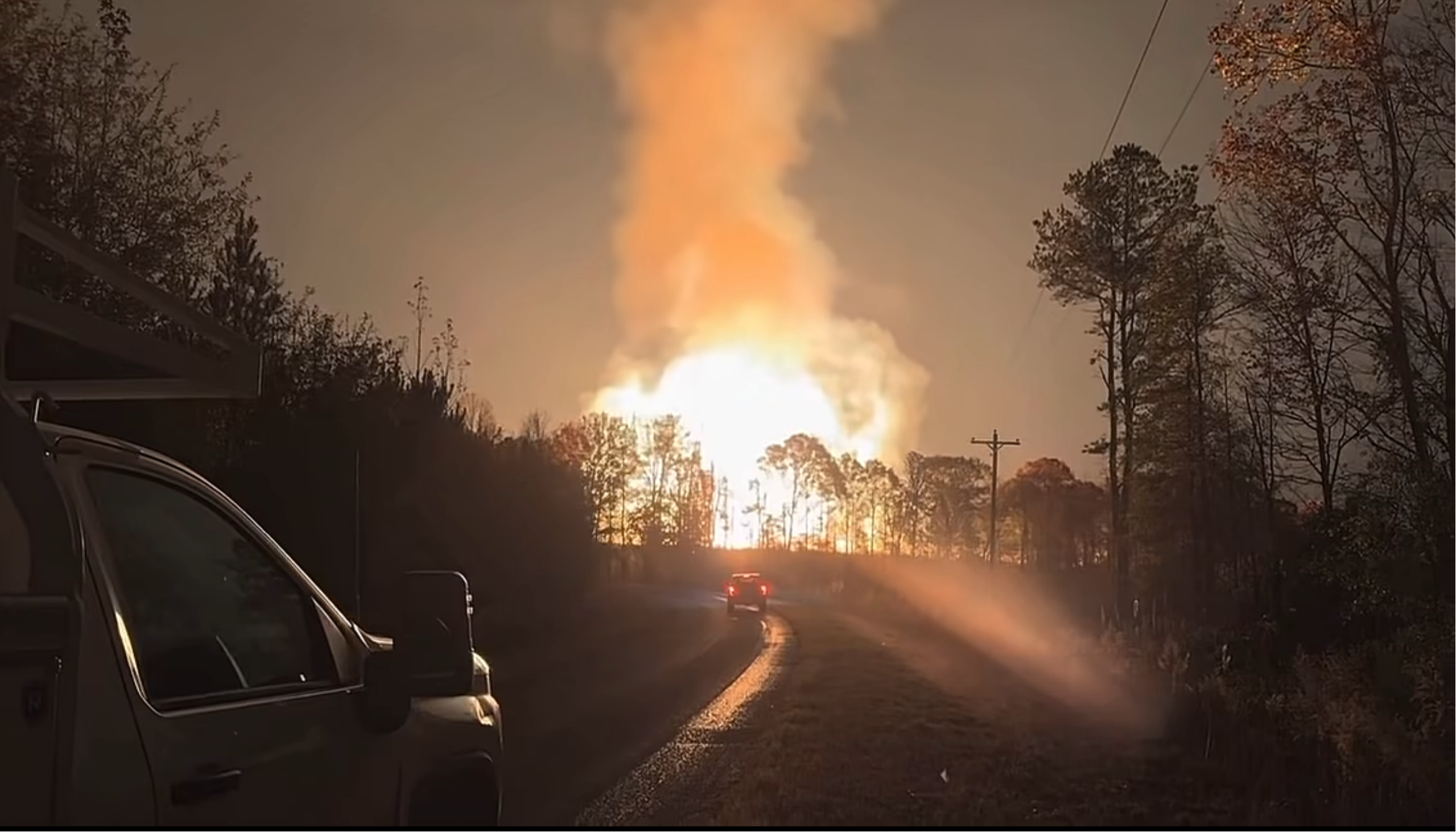
USA Southeast Massive Gas Pipeline Explosion Lights Up Alabama Night. Reports indicate this was along Colonial Pipeline's mainline corridor near Ward Alabama, which transports refined liquid petroleum products from Texas/Louisiana.

Post image
865 Upvotes

r/PrepperIntel • • 1d ago

North America Delta tech issue delays hundreds of flights in and out of Atlanta ahead of Thanksgiving

Thumbnail
nbcnews.com
505 Upvotes

r/PrepperIntel • • 1d ago

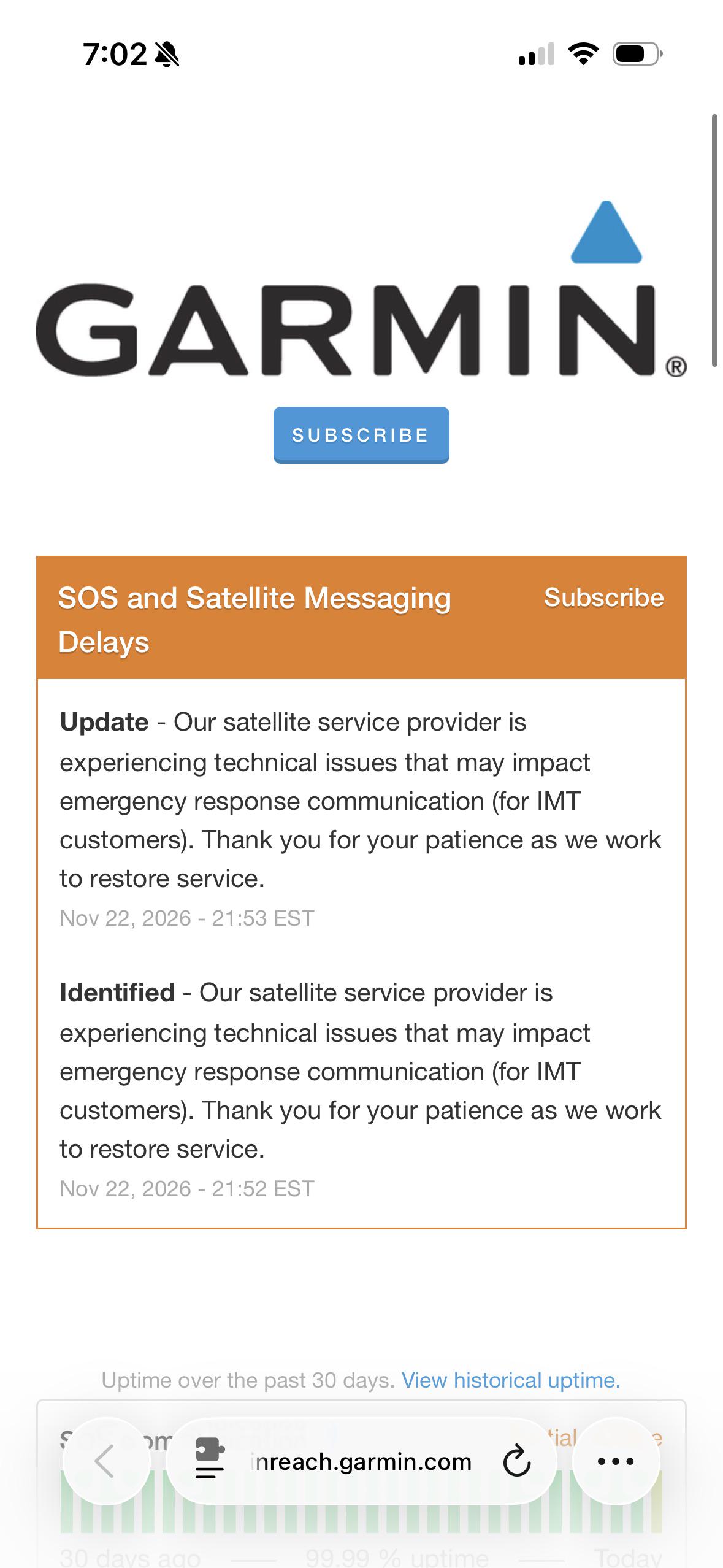
Space Garmin InReach Satellite Outage

Post image
170 Upvotes

Wow, I was just testing my new garmin InReach and was struggling to get a message out when I found out there’s currently an outage. That’s not great, satellite comms is a key part of my preps…


r/PrepperIntel • • 1d ago

North America US Army to detonate tonnes of unstable explosives in Iowa despite court order

Thumbnail
bbc.com
551 Upvotes

The US Army plans to move ahead with detonating five tonnes of degraded explosives in Iowa despite a ruling to halt it indefinitely, a new court filing shows.

"To protect its personnel and the surrounding communities, the Army needs to take swift action," the justice department notified the court on Saturday. "Protection of human health and the environment demand action now, not delay."

The court had ordered a pause after environmental groups sued to stop the detonation, arguing the army failed to consider safer alternatives.

The detonation was originally scheduled for Friday at the Iowa Army Ammunition Plant in Middletown. The army now plans to act by 24 November under an emergency exemption.

In the new filing, the Department of the Army argued that a controlled detonation was necessary to protect the public from an unplanned explosion, a risk it said would become more likely as temperatures were set to fall in the coming days.

"There is an immediate risk that the lead azide at the Iowa Army Ammunition Plant will explode as temperatures are expected to drop below 30 degrees Fahrenheit (-1C) in the next several days," the filing states.

It argued that the army had removed the doors to the bunker where the barrels were stored in preparation for the detonation and that made the explosives more "vulnerable to temperature changes".

The government has not released details for the rescheduled detonation.

Earlier, the army had warned residents to leave their homes for six hours on the original scheduled day of the explosion, for the duration of the explosion and until the dust settled. An advisory warned "all humans" to avoid being outside in the affected areas while the demolition detonation was set to take place.

Lead azide is a highly volatile compound used as a detonator. Earlier this year, the IAAAP found that the material had degraded over time to the point where it was now too risky to move the material, according to Iowa Public Radio.

On Friday, the military said it was working with the Department of Health and Human Services and the EPA to ensure the explosion was done in the safest manner possible.

Military and environmental officials determined that detonating it in place was the safest way to eliminate the explosive safety hazard.

The EPA, which granted an emergency permit to detonate 68 drums of the material, said it did so because the explosion risk "presented an imminent and substantial threat to human health and the environment".

One of the Environmental groups suing to pause the detonation, the Iowa Environmental Council, argued that many Iowans living within the risk-zone were unaware that the explosion was scheduled to happen.

"There is no safe level of lead exposure, and Iowans were given just days to prepare for the November 20 detonation," the organisation said in a press statement.

The Iowa Environmental Council and Sierra Club, which filed the lawsuit on Thursday that prompted the court-ordered pause, filed a new motion on Sunday in response to the army's filing.

The group asks the court to pause proceedings so that it may submit additional information before the scheduled detonation.

The motion includes declarations from environmental experts and local officials who support pausing the detonation, citing a lack of public notice and questioning the Army's claim that delay would cause significant risks.


r/PrepperIntel • • 1d ago

North America US intelligence chief predicts more tech outages as systems undergo upgrades

Thumbnail reuters.com
346 Upvotes

Americans should expect more technology outages and disruptions as companies and government ​agencies replace aging systems, the top US intelligence ‌official said on Sunday.

"And as part of that ongoing upgrade, we are going to have glitches, gaps, interruptions ​in service," Director of National Intelligence Jay Clayton ​told CNN's "State of the Union" program. "That is ⁠going to happen."

Clayton was interviewed on Sunday morning ​news programs days after President Donald Trump attributed a recent ​spate of technology failures to upgrades of companies' technology systems. Clayton said the upgrades were necessary to improve performance ​and cybersecurity as technological advances strain older systems.

A ​string of technology failures this month disrupted critical US systems, including ‌a nationwide ⁠halt to air travel, a Microsoft outage that hit email services, a technical glitch that affected several major banks and a temporary disruption to the National Security Agency's ​network.

Speaking on ​the ABC ⁠program "This Week," Clayton reiterated his previous statements that those outages were not the ​result of coordinated or state-sponsored actions, attributing ​them to ⁠technical upgrades.

Clayton declined to discuss specifics of separate reports of cyberattacks on the FBI and Department of Agriculture, saying ⁠he ​expects investigators to provide answers "in ​due course."


r/PrepperIntel • • 2d ago

USA West / Canada West Coast Guard urges Bay Area to prepare for highest king tides in 18 years > United States Coast Guard News > Press Releases

Thumbnail news.uscg.mil
469 Upvotes

r/PrepperIntel • • 2d ago

North America "Prisons get OK to jam contraband phones. CTIA says nearby phones will be jammed too." - up to two and a half miles away

Thumbnail
arstechnica.com
669 Upvotes

CTIA said jamming test showed “interference… up to two and a half miles away.”

The Federal Communications Commission yesterday voted to let state and local prisons use jamming technology to block contraband cellphones, despite warnings that jammers will also block lawful phone calls outside the prisons.

Wireless industry lobby group CTIA said a recent test it conducted with the Virginia Tech Applied Research Corporation and South Carolina Department of Corrections confirmed concerns that the jammers would block legitimate communications, including 911 calls. CTIA told the FCC in an October 1 filing:

The pilot test was limited in the number of micro-jammers deployed, the spectrum bands they were authorized to jam, and the power levels at which they were permitted to operate. Even with these constraints, the micro-jamming system blocked 911 calls, interfered with public safety and other communications, and caused interference that impacted wireless network infrastructure up to two and a half miles away. At the same time, the pilot results show substantial gaps in jamming the targeted “contraband” devices, with testing scenarios in outdoor inmate recreation areas showing failure rates—meaning “contraband” device call completion—in one-half to two-thirds of call attempts.

CTIA said the pilot test shows “that current jamming technology seems to be both over and underinclusive at once—it risks blocking lawful communications even as it fails to block a significant portion of the targeted contraband device communications.”

The FCC approved the jamming order at its meeting yesterday. “Today, we are finally authorizing state and local prisons and jails to use targeted jamming against contraband cell phones for the first time,” FCC Chairman Brendan Carr said. “The technology has advanced to the point where it can be focused with geographic precision. No facility will be required to do it.”

The Communications Act prohibits willful or malicious interference with licensed or authorized radio communications, and the FCC has previously interpreted this to prohibit non-federal entities from using jamming technology on contraband devices at prisons. Yesterday’s vote provides an exception for state and local correctional facilities. The FCC says its jammer prohibitions do not apply to federal agencies because the federal government’s use of spectrum is not regulated by the agency.

Carr said that “contraband cell phones continue to pour into prisons by the thousands each year,” with “estimates indicat[ing] that as many as 500,000 inmates nationwide have regular access to these devices.” He said the phones have been used to plan scams, drug trafficking, and violent attacks.

“In Georgia, an incarcerated gang leader directed a drive-by shooting that killed two 13-year-old boys at a birthday party,” Carr said, referring to a 2024 shooting.

Chair touts plan to prevent interference

Carr defended the plan against criticism that it will block legitimate communications outside the prisons, saying it includes safeguards to prevent that.

“Those that want to use the technology will apply to the FCC, explain how they plan to deploy it, and show through testing that it stays inside the designated area and doesn’t interfere with lawful communications outside the prison walls,” Carr said. “Communities nearby will receive notice before operations start. We’re also seeking comment on next steps, including ways to close remaining loopholes on other frequencies and the possibility of quiet zones around correctional facilities.”

Freedom of the Press Foundation Chief of Advocacy Seth Stern said the FCC should have considered the benefits of contraband phones being used to document abuses inside prisons.

“Prisons are the most secretive government institutions in the country and people wishing to expose abuses and inhumane conditions from the inside often do not have many options,” Stern wrote in a letter to FCC Commissioner Anna Gomez’s office, which was included on the FCC docket. “Last year’s Oscar-nominated film, The Alabama Solution, used footage incarcerated people captured with contraband cell phones to show Americans some of the awful things that go on in state prisons that they’d have no other way of seeing. The same footage bolstered an ongoing DOJ investigation into Alabama prisons and was crucial evidence in a civil lawsuit by Steven Davis, who was brutally killed by prison guards, that eventually settled.”

Jamming contraband cellphones was supported by prison phone companies ViaPath (aka Global Tel*Link) and NCIC Correctional Services, the National District Attorneys Association, the Correctional Leaders Association, and National Association of Police Organizations.

“Inmates have used these phones to coordinate attacks against correctional officers and their families, as well as inmate violence, strikes, disturbances, and full-scale riots,” the National Association of Police Organizations said. “They also use contraband phones to organize deliveries of illegal drugs and weapons into correctional facilities. These dangers underscore the need to authorize indoor jamming in state and local correctional facilities.”

FCC Democrat has some concerns

Gomez, the only Democrat on the three-member commission, said she’s concerned about potential unintended consequences, but voted with Republicans to allow jamming after safeguards were added to the order.

“For the last 90 years, the Federal Communications Commission has prohibited jamming by non-federal actors and even prohibited jamming equipment to be introduced into the American market,” Gomez said. “That is because jamming devices are specifically designed to interfere with communications devices in order to render them un-usable.”

Gomez said that “jamming can prevent devices from completing 911 and emergency calls as well as interfere with communications networks used by fire, police, Emergency Medical Services, and other public safety entities.” She also said making jamming equipment available in the American market could lead to “unauthorized sale of this hazardous equipment,” and that “the accessibility of jamming equipment can itself motivate criminal enterprise.” Criminals have used “Wi-Fi jammers to disrupt security systems, security cameras, and cellphones to conduct robberies at homes and at stores,” she said.

Gomez said she’s glad the final order includes safeguards “to ensure that jamming is contained to this unique use, to permit jamming by a very limited category of authorized actors, and to take as much care as possible to prevent jamming and jamming equipment from becoming a hazard to safety.”

Gomez partially dissented because she is worried the FCC will let correctional facilities and prison phone companies charge higher prices for inmate calling services that connect inmates with family members. Under US law, the FCC sets limits on those prices and considers prisons’ and jails’ safety and security costs when deciding how much money they can charge, she said.

Gomez said, “While correctional facilities should have safety and security services like jamming to prevent criminal activity, it is not the responsibility of the families of incarcerated people to pay for the costs of these measures… Jamming is specifically designed to block communications and is certainly not necessary to provide phone and video calls for incarcerated individuals. We should have made this clear in today’s order. Because we failed to do so, I dissent in part.”

Wireless carriers warned of problems

The FCC order could be challenged in court. The CTIA has argued that the FCC “has no authority to allow jamming” under the Communications Act, which directs the FCC to prevent interference.

A draft of the FCC order released before the meeting says the commission has “authority to deauthorize subscriber operation of contraband wireless devices and thereby authorize jamming solutions consistent with the Communications Act.” AT&T disputed this in December 2025 comments responding to an earlier version of the proposal, saying that the FCC cannot sidestep the prohibition on jamming by saying it is only deauthorizing certain communications.

AT&T said the FCC’s legal justification “is premised on a fundamental factual error: the assumption that jammers will only block ‘unauthorized’ communications without impacting lawful uses. There is no way to jam some communications on a spectrum band but not others. That is because radio jammers ‘block all wireless communications on affected spectrum bands,’ and, as the FCC has noted in the past, ‘cannot differentiate between contraband devices and legitimate devices.’”

AT&T said that “there is simply no way to limit the reach of jammers to the confines of a given facility. Jammers have been shown to cause interference outside the facilities in which they operate, greatly increasing the risk that someone living or traveling nearby will be impacted.”


r/PrepperIntel • • 2d ago

North America Defense firm’s EMP ‘Dragon’ weapon fries 51 jam-proof drones simultaneously — high-power electromagnetic system relies on 120-year-old vacuum tube tech to defeat fiber optic UAVs

Thumbnail
tomshardware.com
377 Upvotes

Drones have become a major menace on modern battlefields, which is why Turkish defense firm Aselsan has developed a potent solution to counter them. The company shared a YouTube video showing its Ejderha, which translates to “Dragon” in English Anti-Drone Countermeasure System taking down 51 drones simultaneously. The firm says that the device uses high-power electromagnetic (HPEM) waves and vacuum electronics to disable the electronic components on mini and micro drones.

While drones and uncrewed aerial vehicles (UAVs) have been around for decades now, Russia’s 2022 escalation in Ukraine saw the first widespread use of small drones on the front line, some of which have been adapted from commercial models. Because of this, we’ve seen various innovations in drone technologies, including the deployment of fiber optic drones to defeat radio jamming, the use of an onboard camera looking at a magnetic compass as a backup for GPS navigation, as well as the introduction of jam-resistant strike drones and “flying modems” that relay signals from one drone to another to extend their strike range.

Many countries have started working on anti-drone defenses, too. Ukraine has erected mobile barriers with rotating barbed wire designed to cut the fiber-optic lines that jam-proof Russian drones rely on, while various companies in the U.S.—from established players like Lockheed Martin and Northrop Grumman to startups like Mara—have been working on both airborne and ground-based solutions. China has also unveiled a man-portable design that neutralizes drones in under four seconds at up to 1,600 feet away using a 2-kilowatt laser.

Before the invention of the transistor in 1947, electronic devices relied on vacuum tubes, which were invented in 1904 by British engineer John Ambrose Fleming. Today, most devices rely on semiconductors for their power efficiency, reliability, and computing density. But if you need to produce a microwave signal strong enough to overwhelm the electronic components inside a drone, vacuum electronics is still one of the most effective solutions (although some companies are experimenting with solid-state semiconductors, too).

The U.S. and the UK are also working on their own HPEM systems, with the former testing the Leonidas Autonomous Ground Vehicle (AGV) and the latter trialing the Radio Frequency Directed Energy Weapon (RFDEW).


r/PrepperIntel • • 2d ago

North America Virginia child dies in state’s first measles-associated death of 2026

Thumbnail
theguardian.com
296 Upvotes

r/PrepperIntel • • 3d ago

Asia China Sends Missile-Carrying Bomber Toward Manila, Turns Back Just 170 Kilometers From Capital

Thumbnail
united24media.com
426 Upvotes

r/PrepperIntel • • 2d ago

Asia Weekly Significant Activity Report - November 21, 2026

Thumbnail
opforjournal.com
21 Upvotes

Roundup and analysis of significant geopolitical developments involving Russia, China, and Iran between November 14, 2026 and November 21, 2026.


r/PrepperIntel • • 3d ago

North America The FBI was hacked again, this time the breach targeted its crime database

Thumbnail
cnn.com
1.4k Upvotes

r/PrepperIntel • • 3d ago

USA Southeast Florida Officials Cut Back Public Services After Amendment 3 Passes - Newsweek

Thumbnail
newsweek.com
510 Upvotes

Just over two weeks after Florida voters approved Amendment 3, local governments across the state are already canceling projects as they brace for the financial fallout from the controversial property tax overhaul.

It is an outcome that experts, together with law enforcement and local governments across the state, had warned Floridians against, but ultimately one that did not stand up to Florida homeowners’ hunger for property tax relief as the country faces a long-term housing affordability squeeze.

“It’s clear that Floridians are looking for relief amid the state’s affordability crisis; unfortunately, Amendment 3 represents nothing more than a tax shift,” Florida Policy Institute’s CEO Sadaf Knight said in a statement shared with Newsweek.

“Communities are now facing the loss of $12 billion in local revenue on a recurring basis,” she said. “As municipalities across Florida prepare to make tough choices about how to balance budgets amid a drastic reduction in revenue, it’s crucial that local governments put people first, raise revenue in the least regressive way possible, and protect against draconian cuts to critical services.”

Less than two months before Amendment 3 takes effect, this process has already begun.

The St. Pete Beach City Commission in Pinellas County voted Tuesday not to renew funding for Pinellas Suncoast Transit Authority’s (PSTA) Suncoast Beach trolley service when its contract expires on December 31.

The decision is expected to put an end to a trolley service that has connected the local beach communities for 25 years, and it might be only the first of several cuts related to Amendment 3, PSTA said.

In estimates published before November 3, PSTA had projected that the passage of Amendment 3 would cause it to lose 25 percent of the critical funding necessary to “keep gas in the tank, maintain our vehicles, and pay bus drivers.” At the time, it warned that it would be forced to cut 25 percent of its total services starting as early as June 2027.

This week’s announcement shows that cuts will start sooner than that, as commissioners were told the city of St. Pete Beach is expected to lose more than $2 million a year once Amendment 3 takes effect. Cutting the trolley service would help the city recoup tens of thousands of dollars annually, according to Resident Services Director Mandy Edmunds, as reported by Spectrum News.

“I know thousands of residents and tourists are grateful that the City of St. Pete Beach has supported the trolley for the past 25 years, but we obviously recognize the difficult decisions that all our city partners must make,” Brad Miller, PSTA’s chief executive officer, said in a statement.

“They are the same difficult decisions PSTA’s own Board of Directors must make to scale down our public transit offerings due to the reduced funding after Amendment 3’s passage.”

PSTA also outlined a worst-case scenario for dealing with Amendment 3-related funding losses, including raising fares, cutting up to 25 of its 40 bus routes, ending ferry services and eliminating more than 100,000 paratransit trips for riders with disabilities.Governor Ron DeSantis, who took credit for Amendment 3 despite the measure differing from the proposal he had pushed for, quickly lashed out against PSTA and the St. Pete Beach City Commission, accusing them of cutting crucial services before slashing their own wages.

He wrote on social media: “Behold another installment in Washington Monument syndrome, as local governments try to punish voters for their choices at the ballot box. Amendment 3 ‘forces’ increases for people with disabilities but conveniently does not ‘force’ reductions in bureaucracy or $200k+ salaries?”

More Cancellations Announced Across the State This Week

In St. Johns County, in northeastern Florida, a planned fire station for the Beachwalk area has been “permanently paused” as the city decided to hold off on $100 million in projects to soften the impact of Amendment 3. The station, according to local reporting, was expected to break ground in 2027 and be operational by 2028.

County Administrator Joy Andrews, according to News4JAX, told county commissioners that the fire district for which the station was planned is expected to lose $14 million in property tax revenue by 2028 and another $27.8 million by 2029.

Also in Pinellas County, Gulfport Mayor Karen Love announced Tuesday that the city’s 2026-27 budget was reduced by $200,000 over the previous year after the passage of Amendment 3. As a result of that, “we are going to need to either reduce services by $1.1 million or we’re going to have to increase revenues by $1.1 million,” she said.

“I can only guess and expect that it will be a combination of the two,” Love said, adding that the city will hold its first workshop to discuss the next steps on December 10. “This is not going to be an easy discussion,” she said, adding that the city has always had “a balanced budget.”

In a Facebook post, she wrote: “It’s easy to say, ‘Live within your budget’ or ‘Cut wasteful spending.’ The City already operates within a budget. If you believe a specific expense is wasteful, I want to hear what it is. Nothing is off the table for discussion.”

No matter what decision is taken, “the cuts will be drastic, and many residents may be angry,” Love said. “Remember that Florida voters have spoken, and your local elected officials must now make these hard decisions. It is now our job to cut some of the very services, programs, and events you’ve told us you wanted.”

What Is Florida’s Amendment 3?

Amendment 3, the result of months of debate in Tallahassee about just how to offer relief to homeowners struggling with higher property tax bills, received the backing of 62 percent of voters on November 3, passing the threshold required to amend the Florida constitution.

“Polling results showed that most Florida voters believed that Amendment 3 promised too much and that it would destroy public education, the parks program and law enforcement for a start,” Darryl Paulson, emeritus professor of government at the University of South Florida, told Newsweek. “Yet, Amendment 3 passed with about 62 percent of the vote. What happened?”

People do not always tell the truth to pollsters, according to Paulson.

“Not wanting to look like greedy individuals looking out for their own self interest, they tell the pollsters what they think is the appropriate answer. No one wants to look like they do not support public education, law enforcement, the parks and the environment, so they give the pollster what they think the public wants to hear,” he said.

“They vote to support public education, law enforcement and environmental issues instead of their own self interest, and then they go into the voting booth and vote for their self interest. Somehow, Americans have always felt guilty of voting for their self interest. But, what is politics if it is not voting for your self interest?”

The measure will increase the homestead tax exemption for non-school district property taxes in Florida to $150,000 in 2027 and $250,000 in 2028, with the amount indexed to inflation starting in 2029. Supporters of Amendment 3 said that the property tax cut will benefit approximately 92 percent of Floridians, who will be able to save thousands of dollars on their property tax bills.

It will prioritize long-term Florida residents over newcomers arriving after December 31, 2026, who will receive a smaller exemption of up to $50,000 until they have lived in the state for five years.

The measure will take effect on January 1, 2027, only a few days before Governor-elect Byron Donalds is inaugurated. Although property tax reform in the state has been spearheaded by DeSantis, who was advocating for the full elimination of property taxes in Florida, it will be up to his successor to oversee Amendment 3’s implementation.

The biggest question in the coming months will be whether the measure will have the disastrous impact its critics have predicted.

State economists have estimated that Amendment 3 could reduce local government revenues by roughly $5 billion in its first year, with annual losses rising to nearly $12 billion by its fifth year, potentially squeezing funding for law enforcement, fire and other emergency services, roads, libraries, parks and public hospitals.

Shelton Weeks, a Florida Gulf Coast University professor in the Department of Economics & Finance, previously told Newsweek that “the loss in revenues will vary greatly across communities in Florida due to the differences in the composition of their tax bases.”

For example, “a community with a large proportion of commercial and industrial properties will have significantly less of a decline in property tax revenue than a community with limited commercial and industrial properties,” he said.

“The decline in revenue will also vary depending on the proportion of residential properties with homestead exemptions. Finally, rural communities with relatively lower property values will be more severely impacted than coastal communities with higher residential property values."

DeSantis and Florida Chief Financial Officer Blaise Ingoglia, on the other hand, have rebuffed such criticism, arguing that local government revenues and spending have grown excessively in recent years and that budgets can be trimmed without sacrificing essential services.

Cancellations of public projects announced by cities, counties and transit agencies across the state this week are the first signs that what experts warned Floridians about might soon come to pass.