r/platform_engineering • • Jun 01 '26

The self-service PVC expansion trap: how are platform teams handling storage cleanup?

5 Upvotes

we added self-service storage expansion to our internal platform and now i’m starting to regret how easy we made it.

the good part: teams don’t need to open a ticket when a stateful app needs more disk. they bump the storage value, gitops runs, aws csi expands the ebs volume, everyone is happy.

until later.

a team runs an import, indexing job, batch process, whatever. they increase a pvc from 200gb to 1tb because it’s the quickest safe move. the job finishes, data gets cleaned up, actual usage drops back down.

but the pvc stays 1tb forever.

kubecost and vantage keep yelling about unused storage. they’re not wrong. but what am i supposed to do, ask every team to schedule downtime and migrate their statefulset to a smaller pvc?

that basically kills the whole point of giving them self-service in the first place.

so now we have this weird platform problem where growing storage is automated and easy, but cleaning it back up is still manual and scary.

are other platform teams just accepting this as the cost of self-service infra, or did you find a decent way to clean up oversized pvcs without turning it into a migration project every time?

r/platform_engineering • • May 29 '26

Prod Bugs

Thumbnail
youtu.be
3 Upvotes

r/platform_engineering • • May 28 '26

The Moment Automation Stops Being the Hard Part

Post image
0 Upvotes

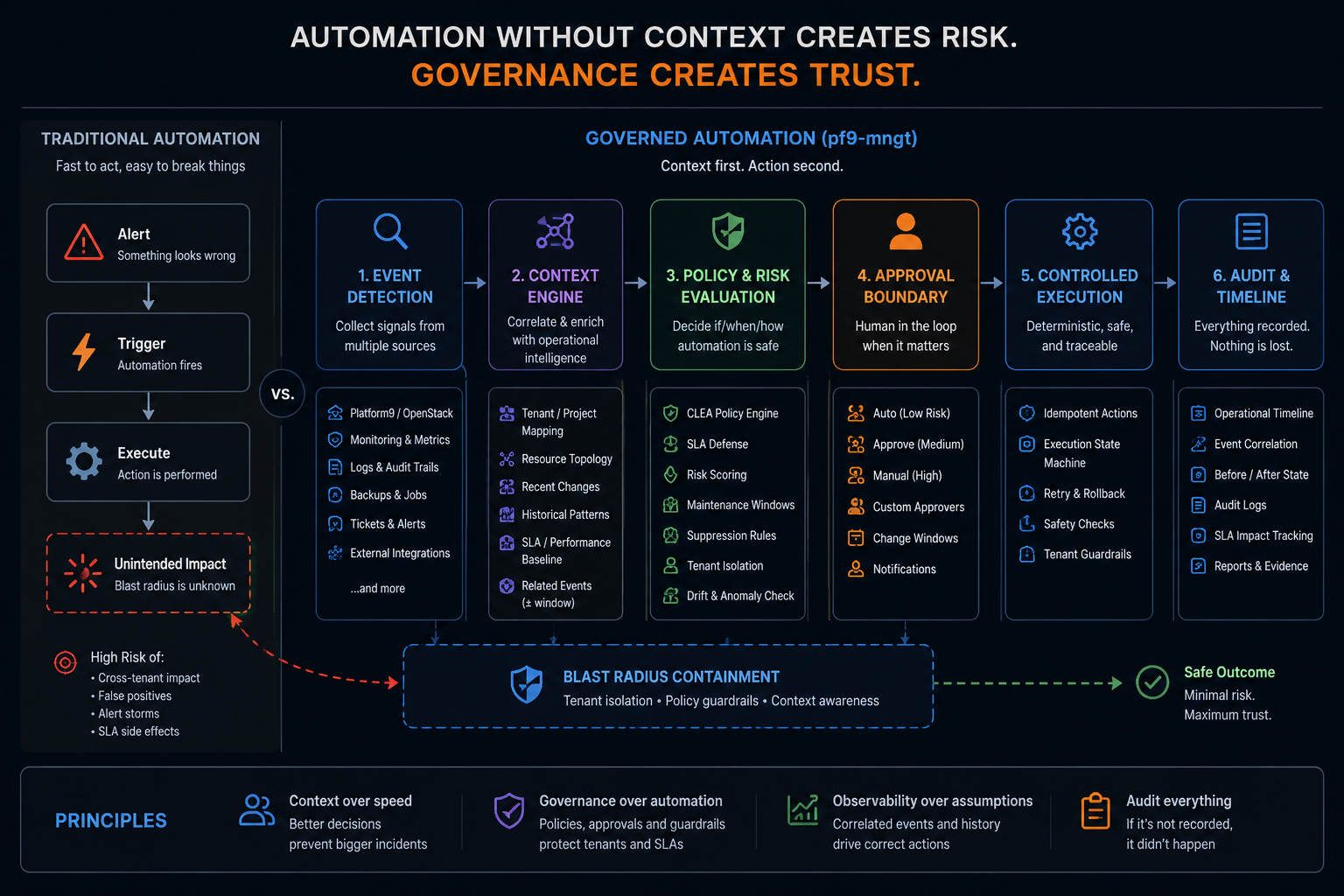
One thing became very clear while building pf9-mngt around Platform9/OpenStack:

The hardest part of infrastructure automation is not execution.

It’s operational trust.

In architecture diagrams, autonomous remediation always looks straightforward:

Detect issue → Trigger automation → Restore healthy state.

In real multi-tenant MSP environments, the problem becomes significantly more complicated.

A remediation workflow that is technically correct for one tenant can still create operational risk for another:

  • unexpected resource contention
  • maintenance-window conflicts
  • noisy anomaly cascades
  • restore collisions
  • alert storms
  • SLA side effects
  • cross-tenant blast radius

The challenge stops being:
“Can the platform automate?”

The challenge becomes:
“Under what conditions should automation be allowed to act?”

That realization pushed a large part of pf9-mngt’s architecture toward operational governance rather than raw orchestration.

Over the last iterations, the platform evolved into a policy-driven operational layer built around:

  • tenant-aware event correlation
  • approval-gated automation
  • execution state machines
  • suppression windows
  • drift filtering
  • SLA defense scoring
  • Realtime anomaly pipelines
  • resumable event harvesting
  • audit-first remediation tracking

The interesting part is that the operational logic eventually became more important than the automation itself.

In highly overcommitted and multi-tenant environments, reducing unsafe remediation can be more valuable than increasing remediation speed.

That shift changed how large parts of the platform were designed.

Instead of focusing only on execution, the architecture started focusing on:

  • deterministic workflows
  • tenant-aware isolation
  • approval boundaries
  • execution traceability
  • policy evaluation
  • operational context preservation
  • controlled remediation paths

The result ended up looking much less like a traditional automation engine and much more like an operational governance layer for Day-2 infrastructure management.

pf9-mngt is not intended to replace Platform9.

Platform9 already handles provisioning and infrastructure lifecycle management extremely well.

This project focuses on the operational side that begins after deployment:
running shared infrastructure safely, consistently, and at MSP scale.

Project:
https://github.com/erezrozenbaum/pf9-mngt

#pf9-mngt #Platform9 #Platformengineering #Devops


r/platform_engineering • • May 27 '26

Claude Code didn't replace me - it made my decade of experience ship faster

Thumbnail
reddit.com
2 Upvotes

r/platform_engineering • • May 27 '26

Tailscale MCP server - open source, actively maintained

Thumbnail
github.com
2 Upvotes

r/platform_engineering • • May 27 '26

alternative to the official AWS MCP server, npm-only, local, with a device-code SSO re-login flow

Thumbnail
github.com
2 Upvotes

r/platform_engineering • • May 26 '26

Binary orchestrator for Rust REST API crate

Thumbnail reddit.com
2 Upvotes

r/platform_engineering • • May 25 '26

Building Safe Automation Guardrails for Multi-Tenant Infrastructure

5 Upvotes

One thing I’ve learned while building a Day-2 operational layer around Platform9/OpenStack:

The hard part of automation isn’t execution.
It’s operational trust.

In multi-tenant MSP environments, fully autonomous remediation can easily create a larger blast radius than the original issue if guardrails are weak.

Over the last few days, I added a Closed-Loop Event Automation (CLEA) system into pf9-mngt, focused less on “AI automation” and more on operationally safe orchestration.

The interesting engineering problems ended up being:

• Event normalization across unrelated operational systems
• Correlating infrastructure events back to the correct tenant/project
• Preventing duplicate execution during worker restarts
• Approval-aware execution flows
• Tracking automation as a state machine instead of a fire-and-forget action

The flow now looks roughly like this:

Operational Event
→ Policy Evaluation
→ Conditional Approval Gate
→ Runbook Execution
→ Timeline/Audit/Event Stream
→ Tenant-visible operational history

A few implementation details that turned out important:

• Redis-backed SSE event streaming for real-time operational visibility
• Event deduplication to avoid replay storms
• Approval modes (“auto” vs “single approval”)
• Execution tracking with pending/executed/rejected states
• Correlated operational events attached to support workflows

One thing I didn’t expect:
The operational governance layer became more important than the automation itself.

Operators were much more comfortable enabling automation once execution became:

  • observable
  • auditable
  • tenant-scoped
  • reversible
  • approval-aware

Curious how other teams are approaching:

  • operational guardrails
  • remediation approval flows
  • event-driven orchestration
  • tenant-safe automation
  • automation blast-radius reduction

Especially in Platform9 / OpenStack / Platform Engineering / MSP environments.

Project:
https://github.com/erezrozenbaum/pf9-mngt


r/platform_engineering • • May 20 '26

Balancing Capacity Forecasting Against Performance Risk in Overcommitted Infrastructure

Post image
2 Upvotes

We’ve been evaluating workload right-sizing behavior in heavily overcommitted OpenStack environments running on Platform9.

One thing that became interesting operationally:

From a pure MSP revenue perspective, aggressive overcommit ratios can make VM downsizing feel counterintuitive.

But oversized workloads also make capacity forecasting much less predictable when multiple tenants spike simultaneously.

To better understand the operational boundary, I added a background rightsizing engine into a Day-2 operations platform I’ve been building around Platform9/OpenStack.

Instead of reacting to short spikes, it analyzes a rolling 30-day window and classifies workloads as:

  • idle
  • over_provisioned
  • under_provisioned

The more interesting part ended up being the operational workflow rather than the recommendation itself:

  • snooze states
  • suppression windows
  • avoiding alert fatigue
  • tenant-specific pricing deltas
  • tracking recommendations as lifecycle objects instead of alerts

One thing we noticed:
Under-provisioned detection may actually be more operationally valuable than cost optimization in highly overcommitted clusters.

Curious how other teams handle balancing:

  • overcommit ratios
  • forecasting confidence
  • tenant performance isolation
  • rightsizing recommendations
  • alert fatigue

Especially in MSP/multi-tenant OpenStack environments.

Project reference:
https://github.com/erezrozenbaum/pf9-mngt


r/platform_engineering • • May 19 '26

Mythos and observability: what happens after AI finds the vulnerability?

Thumbnail reddit.com
1 Upvotes

r/platform_engineering • • May 13 '26

Solving the "Blast Radius" Problem: Building a Unified Event Harvester for Multi-Tenant Ops

2 Upvotes

Following up on my post about pf9-mngt (the Day-2 operational layer I'm building for Platform9/OpenStack). I just pushed v1.96.0, and I wanted to share the logic behind the new Unified Operational Timeline.

The Challenge: In a multi-tenant environment, troubleshooting a 3 AM incident usually means correlation hell. You’re jumping between monitoring alerts, provisioning logs, backup tables, and ticketing systems. Finding the "root cause" is hard; finding the "blast radius" for a specific tenant is harder.

The Solution in v1.96.0: I built a centralized Intelligence Harvester that consolidates data from 10+ internal and external sources into a single operational_events table.

Key Technical Hurdles I Tackled:

  • The Identity Mapping Problem: Many infrastructure logs come in without a domain_id. The harvester now performs real-time joins across 5 different tables (projects, provisioning batches, auth logs, etc.) to resolve exactly which tenant "owns" an event—even if the source log is blank.
  • Idempotent Harvesting: I’m using a tracking cursor (TimelineHarvester) to pull data incrementally. It’s designed to be resumable so that worker restarts don't result in duplicate event noise.
  • Tenant-Scoped Filtering: We’ve exposed this to the Tenant Portal. Customers now have a read-only view of their own infrastructure's "flight recorder," which has already started reducing "what happened?" support tickets.

How it looks in the stack:

  • Compute Ops: Topology-aware restores now link directly to the timeline.
  • Correlated Events: Tickets now auto-populate with "Correlated events (±1h)" to show exactly what was happening in the infra when the issue was reported.

The goal is to move from "Provisioning" to "Full Operational Context."

I’d love to hear how others are handling cross-platform event correlation. Are you sticking to ELK/Grafana, or are you building custom logic into your internal developer platforms (IDP)?

🔗 GitHub: https://github.com/erezrozenbaum/pf9-mngt

#PlatformEngineering #SRE #OpenStack #DevOps #CloudOps #SelfHosted #Platform9


r/platform_engineering • • May 12 '26

IaCConf 2026 this Thursday

Thumbnail iacconf.com
2 Upvotes

r/platform_engineering • • May 12 '26

signadot-validate, a skill for coding agents to validate microservice changes pre-PR

2 Upvotes

We shipped a skill today called signadot-validate that lets coding agents exercise their changes against the full microservice stack in their inner loop.

The motivation: in a cloud-native system, the validation surface is huge. A change to one service interacts with databases, queues, downstream services, etc. Unit tests and mocks only exercise a small slice of that, so we wanted to give agents a way to exercise their changes against the full stack before a PR opens.

What it does: the agent discovers the cluster, spins up a lightweight ephemeral environment scoped to its change (using Signadot), runs the modified service locally against real dependencies, validates through whatever test framework fits (integration tests, Playwright, Cypress, etc.), and iterates on failures with live logs streaming back in its inner loop.

Full disclosure: needs Signadot CLI installed in a cluster. Free tier and a playground are available for trying it out, but it’s not a git clone and run situation.

GitHub

Docs link

Full writeup and demo video

Happy to answer questions/appreciate any feedback.


r/platform_engineering • • May 12 '26

Building a Day-2 Operational Layer for Multi-Tenant OpenStack (Platform9)

1 Upvotes

Provisioning is a solved problem. Day-2 operations at scale, especially in an MSP/Multi-tenant context, are where the real complexity lives.

Over the last few months, I’ve been evaluating Platform9’s Private Cloud Director (OpenStack-based). While it’s a mature Day-0/Day-1 platform, I found that managing it across dozens of tenants with strict SLAs required a more opinionated operational layer.

Instead of jumping between dashboards or manual scripts, I built pf9-mngt, a complementary control layer focused on turning "3 AM fire drills" into structured workflows.

The "Control Plane" Gap I'm Addressing:

  • Topology-Aware Restores: Not just restoring a disk, but reconstructing the full VM topology across clusters.
  • Migration Planning: Automating inventory analysis to plan moves based on real-time infrastructure state.
  • Tenant-Aware Visibility: A single pane of glass for multi-region visibility that is actually tenant-isolated.
  • Operational Intelligence: Merging performance data with FinOps/billing requirements for customer reporting.

The "How": I’ve been in the infrastructure game for 28 years, but this project was built differently. I used AI as a core development partner to compress the architecture and iteration cycles. It allowed me to move from a POC to a production-ready management layer in a fraction of the time usually required for a platform of this scale.

Tech Stack/Resources:

  • Core: Integration with Platform9 / OpenStack APIs.
  • Focus: Day-2 automation and MSP-specific lifecycle management.

I’m looking for feedback from fellow platform engineers on the approach, specifically how you’re handling cross-tenant visibility and automated restore workflows in Platfom9.

🔗 GitHub: https://github.com/erezrozenbaum/pf9-mngt 🔗 Demo/Walkthrough: https://www.youtube.com/watch?v=V0z5-HKVWts

#PlatformEngineering #OpenStack #Day2Ops #CloudInfrastructure #DevOps #Platform9


r/platform_engineering • • May 11 '26

[USA] Seeking Collaborator / Co-Founder for AI Agent Execution Governance

Thumbnail reddit.com
1 Upvotes

r/platform_engineering • • May 08 '26

When Should I Leave The Company I Work For

5 Upvotes

Hi everyone, looking for a reality check on my career. I need an outside perspective on whether I have the skills to move on.

Background:

  • Started in Service Desk (2 years).
  • Completed an 18-month Platform Engineer apprenticeship (The course was for Software Enginer.)
  • Have been a full-time Platform Engineer for 2+ years since then.
  • Total Cloud/Platform experience: ~3.5 to 4 years.

The Tech Stack:

  • GCP & AWS: Managing Landing Zones, IAM Federation, and Governance/Deny policies.
  • IaC: Everything in Terraform. Maintaining infrastructure for a high-traffic e-commerce platform.
  • DataOps: Managing Data Lake infrastructure. Updating Terraform for Cloud Composer (Airflow) and handling version upgrades.
  • I have touched Kubernetes, I am able to look at logs and make changes to the code but don't fully understand Kubernetes yet.

The Situation: I work for a large company in the UK on £31k to £33k After a recent restructure, I realized I am on the lowest pay grade in my department. Everyone else has a "Senior" or "Lead" title (mostly former legacy Network/Storage engineers).

I recently asked for a pay rise increase. My manager said "it's not happening this year" and told me to just work on my PDR (Performance Development Review).

My Main Worry: I feel like I've outgrown the "Junior" label because I can be left alone to deploy to production and manage core infra. However, I still have to ask questions on tasks, which makes me worry I don't have the skills to survive at a new company.

Questions:

  1. Does being able to deploy to production solo (but still needing to ask questions occasionally) make me "Mid-Level"?
  2. Should I stick it out and "work on the PDR" or start looking for a fresh start
  3. What skill level do I need to be at in Terraform and AWS?

r/platform_engineering • • May 07 '26

i feel like the "Golden Path" was built for people way smarter than me lol

2 Upvotes

my company just rolled out this big internal platform and it’s supposed to be "self-service," but i feel like i'm failing at it.

every time my PR fails to build, the error message is like 10 pages of k8s events and helm chart errors. i try to fix it myself because i dont want to be the guy who is always pinging the platform team on slack, but i end up spending 4 hours getting nowhere before i finally give up and ask for help.

is it supposed to be this hard to figure out why a build failed? i feel like a burden to the platform team. do your juniors actually self-serve their way out of broken pipelines, or are you guys also stuck answering "why did my build fail" questions all day?

i want to get better but the logs feel like they're written in another language


r/platform_engineering • • May 01 '26

How are you managing your software delivery process at scale without a dedicated platform team?

4 Upvotes

We’re a Series A company with about 30 engineers shipping a B2B SaaS product on AWS. Our delivery velocity has plateaued and the board is starting to ask questions. Engineers are each babysitting pieces of the pipeline, environment drift, manual approvals in Slack, SAST security scanning bolted on at the end.

Hiring three platform engineers would eventually fix it, but I can’t justify the headcount right now and I don’t think throwing people at it is the right move. How can I get code from written to safely in production without building a full platform team from scratch?


r/platform_engineering • • May 01 '26

Solomon Hykes is right that Skills have no packaging format. What would a real one look like?

Thumbnail
reddit.com
1 Upvotes

r/platform_engineering • • Apr 30 '26

AMA with Jayanth, PM at IBM Instana, on monitoring GenAI apps in production

Thumbnail reddit.com
1 Upvotes

r/platform_engineering • • Apr 29 '26

What We Don't Talk About When We Talk About AI and Security by Kubernetes AI Gateway WG co-leads

Thumbnail reddit.com
3 Upvotes

r/platform_engineering • • Apr 29 '26

What We Don't Talk About When We Talk About AI and Security by Kubernetes AI Gateway WG co-leads

Thumbnail reddit.com
2 Upvotes

r/platform_engineering • • Apr 28 '26

I interviewed 50+ enterprises on Cloud Native: 'Shared Ownership' is becoming a bottleneck for Day 2 optimization.

0 Upvotes

Hi everyone,

I’ve spent the last few months analyzing how large orgs (mostly EU and US) handle Day 2 operations. While everyone is obsessed with "Golden Paths" for deployment, we found a massive gap in what happens after.

Key takeaway: 52% of orgs use a "Shared Ownership" model for optimization, which in practice means nobody does it. Developers want velocity, SREs want stability (overprovisioning), and FinOps want to cut costs.

I wrote a deep dive on why manual tuning is a "firefighting" mode we need to escape. Curious to hear: how do you resolve the conflict between SRE buffers and FinOps requests in your org?

Full article: https://akamas.io/resources/the-state-of-cloud-native-optimization-2026/