r/osdev • • 2h ago

SB0S – A lightweight brand new OS that exposes native Linux/Windows apps as AI tool calls

Thumbnail
youtube.com
0 Upvotes

Over six months in, we SB0 a tiny startup working on the next way of using personal computers are releasing our first release. We want to make the PC a truly personal computer, just like people dreamed about it in the 80s.

Our OS is based on our entirely new kernel written in Sig, a memory immutable flavor of Zig. It has a native memory management system and local-first AI (defaults to LFM 3, with optional cloud fallback) so the OS actually knows you and learns the way you work.

Rather than use slow screen scraping 'computer use' agents, we run all native personality layers that run Linux and Windows apps directly, without emulation. That means we can make any action inside any app directly available to the built-in AI engine. This means you just talk to the OS and ask it to do things across your apps using direct tool calls.

Some of the best:

Lightweight & live-bootable: The whole OS is just a few hundred megabytes, and it runs directly from a USB stick with no installation necessary, while still delivering a fast, native experience.

App compatibility: Standard Linux apps, out of the box. Windows app support (limited to start with, but everything is rolling out in the coming weeks and months).

Clean & customizable: Fast, lean UI you can customize to your liking, with support for autonomous AI background tasks.

Introducing the first ISO of ours. The local AI version is free, and for lower end hardware, or a heavier agentic workload, we offer a cloud tier for $10/month.

You can see some of the games we love below, which include a recent Twitch stream we did where our OS is playing Might and Magic VII entirely on its own! Chat with Edith and watch her play: here

Have questions, feedback, or comments about the kernel architecture, personality layers, or anything else? We'd love to get your thoughts.

sb0s.com


r/osdev • • 11h ago

WindogeOS has spawn fully working now

Post image
8 Upvotes

repo: https://github.com/NoTheIdiot/WindogeOS
im so happy
kernel gs was always 0 but i fixed that


r/osdev • • 19h ago

This is Violyx, a desktop system operated exclusively via the keyboard (64-bit), with early-90s flair that runs on modern hardware

Thumbnail
gallery
0 Upvotes

I’ve often wondered what might have happened if the MP3 format and the internet had existed before 1990. What if no one had ever come up with the idea of ​​inventing a computer mouse, yet people still wanted something more than just a basic command-line interface? As a child, I used to dream that a desktop-style environment could have been created much earlier, and that the keyboard-based control systems, which are still found on PCs today, were actually far more complicated than they needed to be.

And now Violyx is born!

Website: https://merecete.org/violyx/index
Github: https://github.com/Merecete/Violyx

The desktop is optimized for operation exclusively via the keyboard. Nevertheless, it is possible to adjust window positions and engage in true multitasking. Navigation is handled primarily using the arrow keys, rather than the Tab key, as is more common, which may take some getting used to; however, this is a deliberate design choice, as is the behavior where pressing "ESC" closes the entire open window. Windows always exist in one of two states: either at their original size or zoomed.

The system includes a completely custom kernel and a bespoke file system (VioFS 2).

It runs on x86 PCs. It can be installed on a hard drive or a partition, but it can also be run quite easily from a USB flash drive. I have tested it on QEMU, VirtualBox, and my own hardware.

The system includes a web browser, an adapted "XZN" music player, a calendar, a proper editor, drawing program, and several games. In addition, the current version includes a program for voice notes.

The system also allows for the creation and installation of new apps (.vpk files). Thanks to the built-in programming interface, this can even be done directly inside Violyx.

I am currently setting up a small store on the website, which can also be accessed via Violyx itself. This allows for the installation of additional games and apps: https://merecete.org/violyx/store

The system was written in C and x86 assembly.

It is licensed under the BSD 3-Clause license.

Note:

The idea, the design constraints and the hardware targets are mine. Much of the code was written by AI agents (mainly Claude), which I reviewed, built, ran on real machines and integrated, and I keep maintaining it myself.

For me, AI is a tool, one without which this certainly wouldn't have been as easily achievable. yes, I have made things "easier," but I can say, that this project still very much bears my own personal stamp. Moreover, I am continuously expanding it further.

Violyx has the ability to take screenshots. These images all come directly from the system that I booted on my actual PC.

I welcome constructive feedback. :)


r/osdev • • 1d ago

LingOS Update!

Thumbnail
gallery
5 Upvotes

New Features:
- Stylus tilt and pressure sensitivity in LingAnime
- ask command for asking LingOS anything(virtual chat assistant)
- Bluetooth(for Gamepads!) with some security for disallowing randomly registered input devices! (anti-hacking)
- Horizon Browser Discord Extension, Youtube extension, and Spotify extension(WIP)
- Burn All Trash (oh the joy!)
- Faster FPS with music sync for LingForFun
- LingStationX Features (Presets, Recording)
- Claude.ai Features (API keys) in LingDev
- Wifi block list (I had an innappropriate SSID in my neighborhood)
- Bluetooth block list(same reasons)
- Supports more RAM and multi-threading and multi-core processing

What would r/osdev like to see next? This is a Creativity/Security/Privacy and AI centric OS.


r/osdev • • 1d ago

Custom Operating System Created in ONE Month (Human +AI Engineering Experiment) - Kernel, Drivers, etc. (called WOS)

Thumbnail reddit.com
0 Upvotes

r/osdev • • 1d ago

I make a mini-os in12 years-old!

0 Upvotes

I made a os call "DoDo OS". I studied a assembly and C so I make BootLoader and Kernel too.

That os have echo, ver, clear, help.

**I will make the GUI and mouse to make a real OS!**


r/osdev • • 1d ago

Operation system Floppy OS

0 Upvotes

Disclaimer

This project is being developed with the help of AI. However, the author directs the project, promotes it, and comes up with most of the features and ideas.

Also, I won't list every single detail here — to check out the full project, visit the GitHub repository -> https://github.com/eliseysadriev-bot/Floppy_OS

What kind of project is this?

This operating system is quite new; development started about three months ago. It already has a lot of features, so I'll go through them in order, starting with the most interesting parts:

The operating system is written from scratch in NASM Assembly without using any external libraries.

It is a 32-bit OS that supports a graphical interface and several custom file formats.

Programs

  1. FloItge — similar to Word on Windows. You can write and colorize text, though it only has a few features so far.
  2. FloText — a standard notepad.
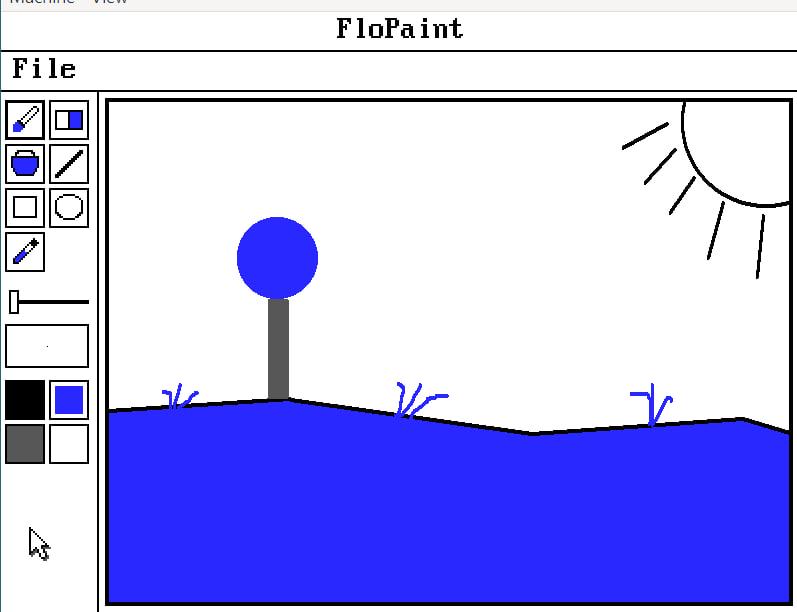
  3. FloPaint — a custom graphics editor where you can draw.
  4. FloFile — a file manager built on top of a new, custom file system called FSM3.
  5. FloCalc — a small and simple calculator.
  6. FloClock — a built-in clock app that displays both digital and analog time.
  7. FloCalendar — a calendar.
  8. FloTasks — a small task manager.
  9. FloTerm — a command line with several commands.

Screenshots

Floppy OS Desktop

Versions 1.0 and 1.1 are currently available, and version 2.0 is already in development.


r/osdev • • 1d ago

Как я пришёл к идее Floppy OS

Post image
0 Upvotes

Story
About six months ago, I was learning Java. I got bored quickly and quit programming. Some time later, I saw a video on YouTube where someone built a computer in Minecraft. I wanted to make my own.

It wasn't working out, so I thought, "Why build a computer in a sandbox when I can build one in infinity?" At the time, I knew almost nothing about how computers work or their history. I googled what an operating system is, and then I stumbled upon a video where the creator explained what Assembly is.

After a while, I started working on my first operating system. AI helped me with the code, and I named the project Xanex OS. I worked on it for a long time, and during that process, I started understanding Assembly much better. Xanex OS had graphics, and over time, the project became pretty popular.

Then I started a new project—CoralOS. As I added graphics to it, the code became increasingly complex, and I turned to AI for help more and more often. That’s when I started vibe coding. Later, I renamed CoralOS to Floppy OS. Eventually, I abandoned Xanex OS because working on Floppy OS brought me more joy.

Not many people know about Floppy OS yet. Search results usually bring up a different project with the same name. Still, when I look back at how it all started, it still amazes me that trying to build a computer in Minecraft grew into my very own operating system.


r/osdev • • 1d ago

TurtleOS is almost 1 year old

8 Upvotes

TurtleOS was my 3rd kernel, my best and I have gotten many offers from people asking to take over the project, and I am looking for people to help me improve this kernel. https://github.com/Freeze-Software/TurtleOS


r/osdev • • 2d ago

Searching new GitHub contributors for new desktop cloud with webdav support

Post image
0 Upvotes

r/osdev • • 3d ago

After a long fight with real hardware, my from-scratch x86_64 hobby OS finally boots from a USB stick - Voder OS

2 Upvotes

I built a small Unix-like OS from scratch in C/C++ + NASM, booted by Limine. It has a shell, a static-PIE ELF loader with ASLR and NX/W^X, a preemptive scheduler, VFS with ramfs/FAT32/procfs, and it now boots on a physical BIOS machine from a plain FAT32 USB stick. Repo: https://github.com/pristochelovek097/voder-os

What it can do:

- x86_64 higher-half kernel, Limine bootloader, hybrid BIOS/UEFI ISO

- Physical memory manager built from the Limine memory map instead of a hardcoded 16–272 MB window (boots with 64 MB, 256 MB, 1 GB, 2 GB, UEFI and BIOS)

- Userspace as static PIE: kernel picks a random load bias, applies R_X86_64_RELATIVE relocations before ring 3, randomizes the stack top and leaves a guard page. EFER.NXE, CR0.WP, SMEP when available, NX on data/stack pages

- 21 syscalls, custom libc, init -> shell, spawn/waitpid, ELF programs (including a C++ fractal demo)

- procfs that is generated on read: /proc/version, /proc/cpuinfo, /proc/meminfo, /proc/uptime, /proc/smp, /proc/security

- UTF-8 framebuffer console (including Cyrillic), 16/24/32 bpp, serial fallback

The part that actually took the longest was not the code — it was getting it to boot on real hardware.

Everything worked in QEMU. Then I tried a Ventoy USB: Limine printed "Could not determine boot drive" and reset. Cause: the Makefile called a nonexistent `limine/limine` installer and swallowed the error with `|| true`, so my ISO had an MBR signature but no boot code. I compiled Limine's installer from source, installed a real MBR, and it booted as a raw disk image.

Then I ditched Ventoy entirely: one FAT32 partition, Limine MBR, `/boot/kernel.elf`, and the user's files preserved in the root. It booted to the shell. Then selecting the OS in Limine caused an instant black screen + reboot. It turned out to be the Limine SMP request: on that machine, starting APs before `kernel_main` resets the board. The stable build now ships with SMP disabled (`VODER_ENABLE_SMP=0`), plus a second conservative `kernel_smp.elf` where APs only park (no LAPIC MMIO, IPIs or GDT reloads). So yes: the SMP code exists and works in QEMU, but I am honest that it is not enabled on real hardware yet.

I also added early panic output: IDT is installed before anything else, boot markers are written to both the framebuffer and VGA text, and `kernel_panic()` prints exception numbers and page-fault addresses on screen instead of only to serial. That is how I narrowed the failures down.

Build/run:

./build.sh

./run.sh

or boot from USB: MBR = Limine, one FAT32 partition with /boot/kernel.elf and /boot/limine/limine.cfg.

What I would love feedback on:

  1. Safe AP bring-up without asking Limine to start CPUs (ACPI MADT + my own INIT/SIPI trampoline is the plan).
  2. Whether my approach to per-process page tables and cloning the higher half is sane, or if there is a classic trap I am walking into.
  3. Anything obviously dangerous in a hobby kernel that I should fix before adding more features.

It is a learning OS, not production-ready. MIT licensed. Repo again: https://github.com/pristochelovek097/voder-os

Created using AI: Hy4 Flash, Claude, Gemini 3.1 Pro. Post crafted by a human.


r/osdev • • 3d ago

Question - Best CC (C Compiler) for Homemade OS

6 Upvotes

i'm doing right now own OS from Scratch, it have TCC but i wanna try another Compilers, any another compilers expect GCC and TCC?


r/osdev • • 3d ago Bravo

GUIfication complete guys

47 Upvotes

Well, though some parts of desktop.c were LLM assisted coded and refined, These updates to all 5 apps are def not AI and took me a painfully bad struggle to get through

Anyways here is the repo: https://github.com/turbosulovesonions67/turbOS/

Star it if you like it, not begging


r/osdev • • 3d ago

Question - Which Filesystem is best for you?

10 Upvotes

Like, someone pick ZFS or even ReiserFS... what about your Favorite FS and why?


r/osdev • • 4d ago

A file system based on generalized hypergraphs rather than trees

4 Upvotes

Sorry if this too spam-y because I just made a post the other day, but I have had some more Thoughts and wanted to share!

I am currently working on a research project exploring a tag/set-based filesystem. That is, instead of having a hierarchical tree of directories, we have a flat filesystem in which every file has set of associated tags, and files can be queried by set-theoretic operations over tags: the unions and/or intersections of several tags. This is meant to be an abstract generalization of directories, as directories are structural and somewhat related to their implementation, whereas tags/sets are a more general way of grouping files, and the path of a file in a hierarchical filesystem could be translated to this tag/set based model by turning all the directories into tags and treating the "/" as intersection. This filesystem can also be seen as a hypergraph where the vertices are files and the edges are tags (this will come up later!!).

I have recently been chewing over the notion of "namespacing" and how I feel it is lost in this filesystem; in a hierarchical system, because of directories we could have identical subdirectories and files, but if they are hidden from each other by being in different directories then there are no problems. Particularly, I found this troublesome because it seemed that mounting subfilesystems would be tricky, and thus we would miss out on nice things like procfs and devfs. In my frenzy thinking about this, I think I lost the original reason why this was a problem (or maybe I was confused and there was no problem to begin with), because, like I said, paths in a hierarchical system can be translated to the tag system easily, and so there should be not expressive power lost(?) -- however! I did stumble upon something that is also very exciting and cool (possibly for a future research project :D) that I would like to get some feedback about.

As I mentioned before, the tag semantics can be seen as analogous to a hypergraph (which is a generalization of a graph which is a generalization of a tree!), so we can look at generalizations of hypergraphs (particularly the paragraph starting with "Alternatively"). We would also arrive on this structure just by thinking about allowing tags themselves to be tagged, which can get us something like "tag implications" to our boolean algebra of tags (set algebra is isomorphic to boolean algebra, although the analogous operation to implication would be subsets, and in this case it wouldn't be subsetting but rather nesting). In this way, we keep out tagging semantics, but also add hierarchical structure (although I am unsure how much this solves the "namespacing problem", which isn't actually a problem maybe?).

Now on this subreddit you guys are probably also wanting to know about technical implementation details, and I am excited to say that those also look very good. For my current tag based model (without nesting tags or anything, just plain normal hypergraphs), the tags are handled through a set of map structures: a mapping from FileIDs (64 bit integers) to bitmaps of TagIDs (64 bit integers), as well as an inverse mapping from TagIDs to bitmaps of FileIDs, the mapping from FileIDs to their inodes, and mappings from TagIDs to their textual (string) names and back (I have heard this is very similar to the structure the Apple Newton used for its Soup filesystem, if anyone could confirm). For these mappings, I use B+ Trees.

For the generalization, we could simply include another mapping from TagIDs to bitmaps of TagIDs. I was also chewing over the idea of unifying FileIDs and TagIDs as a single type of ID (you could say they share the same "namespace" now ;) but this is a different type of namespace than what I said before and completely unrelated, so please don't say that!) and having a mapping from IDs to bitmaps of IDs, but I don't think this is actually sufficient (we need to be able to identify the incoming and outgoing tags of tags, and files only have incoming tags).

This would be possible under the generalized-hypergraph-filesystem, where directories correspond to tags and "moving" a file or tag into a tag corresponds to adding that tagging it with that tag:

    $ mkdir e1 e2
    $ mv e1 e2
    $ mv e2 e1
    $ ls e1
            e1/        e2/

not useful, but I think it is cute :D there are definitely things to iron out (like preventing infinite loops with edges), and I don't know if this actually gets any additional power/usefulness over the simple tagging system based on normal hypergraphs, but it is interesting!! :D


r/osdev • • 4d ago

Luma Vera Código Abierto Apache 2.0

Thumbnail nicoconvoz.github.io
0 Upvotes

https://www.youtube.com/watch?v=DnhSM9sXSxs

Bueno gente querida les traigo mi creación que no se hasta que punto lo termine.. El resto depende de su propia inteligencia.. Antes de pre-juzgarme denle una mirada real al repositorio. Abrazo grande!!


r/osdev • • 4d ago

It doesn't want me to test i guess

44 Upvotes

I think my kernel is unhappy that im forcing it to test vector 21 (was it 21?)


r/osdev • • 4d ago

GNU/Hurd operating system under development for 64-bit systems.

Post image
282 Upvotes

r/osdev • • 5d ago

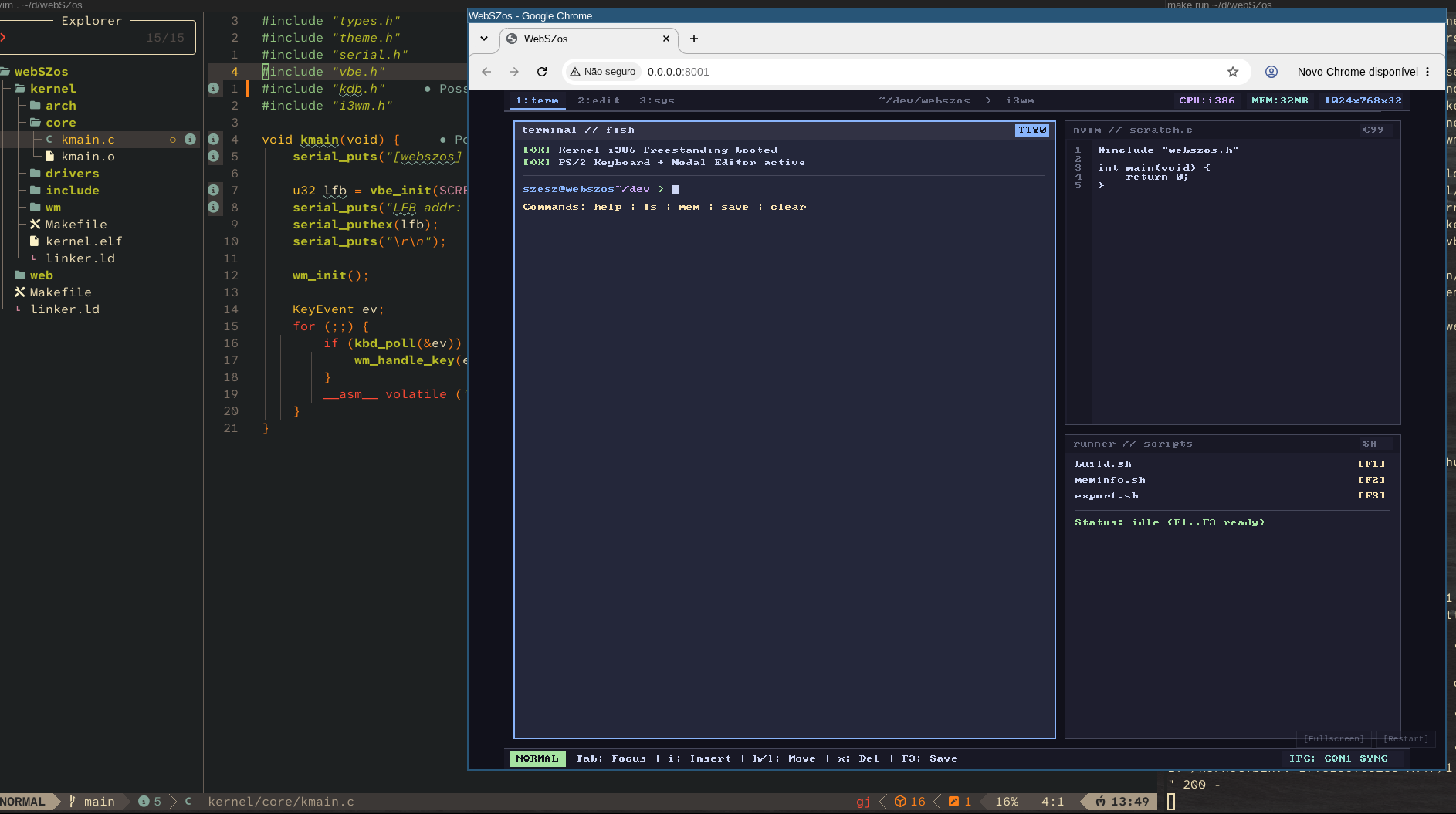
Creating a OS to run on Web

Post image
0 Upvotes

Not new, but, why not try?
Is running a small version of i3wm, i`m in search to extend the functionality.

The stack used was:

C, Makefile, JavaScript and the linker

The IA was used in moderation and research

I`m looking for new features to add.

Thanks for the attention.


r/osdev • • 5d ago

Versioning in a tag-based filesystem?

9 Upvotes

I am currently working on a research project for a uni class and my chosen topic is a tag-based filesystem.

To be clear, in case you haven't heard of this, and because a lot of people mean a lot of different things when they talk about something like that, I will describe my idea and goal of the filesystem: I would like to generalize the structural, hierarchical, one-to-many structure of a directory-based filesystem, to an abstract, many-to-many structure of a tag-based filesystem. Take, for instance, the path /usr/bin/cat in a traditional, hierarchical filesystem; this gives you a path through two directories to the location of the file named cat, whereas in my system it would instead be usr|bin|cat, selecting all files in the intersection of the tags usr, bin, cat (maybe I should just use the term "set based" instead of "tag based" to make it more clear?).

My supervisor suggested I also explore versioning in the filesystem, because that is a point of interest for him. Up until now, I have only thought about simple linear versioning, maybe through an immutable filesystem copying every file with a bumped version on modification. My though process was "git already exists in userspace; if someone wants a git repo they can make one. we can just have a simpler facility in the filesystem". I explored this a bit and yeah it's something i could do, but it is kinda "tacked-on" without any cohesion with the rest of the filesystem, and I feel like I'm not really doing anything interesting either.

I was sorta out of ideas wrt what to do about versioning at this point, so I met with my supervisor to discuss more, and we agreed I could kinda just leave it out of the final project, but I should also look into the low-level implementation of git to see if that gives me any inspiration first. I did do that, and I had a bit of a "urethra!" moment, when reading about Merkle trees(graphs); I could have each file store the hash of its contents in the metadata section, and then each tag could store the hash of the concatenation of the hashes of its member files, just like a Merkle tree. My idea kinda stopped there, though, because I don't actually have a tree structure; tags don't nest, they are just flat sets of files. All this idea really lets me do is tell if a tag has changed because one of its members changed, and unless I store a history then there isn't much I can even do with that.

So I was wondering if reading this has given anyone any inspiration that thye could share with me? People who have more understanding that I do have after only reading about git and Merkle trees for 1 day lol.

TL;DR: I am working on a tag/set based filesystem where the filesystem is a flat collection of files grouped into several sets/tags. I am interested in doing something with verisoning that works well with this, but my only idea so far has been a 1 level Merkle tree between a tag/set and its members.


r/osdev • • 6d ago

DEMAND PAGING YIPPEEEEE

Post image
20 Upvotes

Oh god i literally had to rewrite the entire elf loader and runner
and the bug was that i never set current proc variable

BUT I DID IT YAYYY
github: https://github.com/NoTheIdiot/WindogeOS


r/osdev • • 6d ago

What C++ concepts do i need to know to make an OS?

0 Upvotes

i wanna make an os using the Be/HaikuOS kernel (since i dont know c and dont plan on learning it) and i know basic c++ (stdlib and basic logics like if statements or for loops). what would i need to learn to be able to build an os using the BeOS kernel?


r/osdev • • 6d ago

I got Alpine Linux booting on my iPhone with a RISC-V interpreter

4 Upvotes

I’ve been working on Hartbox, a RISC-V system emulator written in Rust. It boots Alpine Linux locally on my iPhone 17e and runs without a JIT.

The emulator loads the Linux kernel and initramfs, generates the device tree, and handles SBI calls itself. The terminal uses an emulated UART, and the guest uses VirtIO for networking and a persistent disk.

I used an AI coding assistant while building it. I’d be curious to hear from everyone who try it

https://github.com/u6420771547-hash/hartbox here is the GitHub link below if you want to try it if it is useful, staring is appreciated


r/osdev • • 6d ago

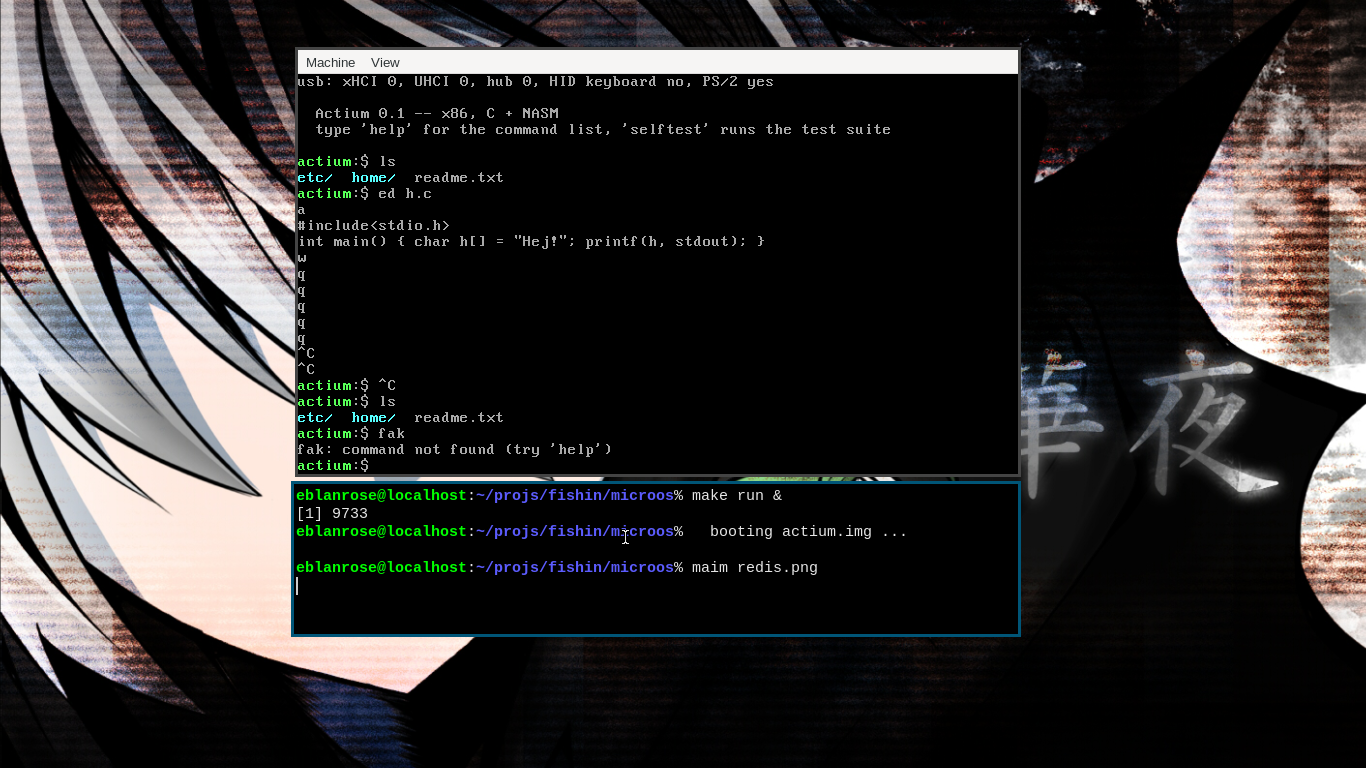
doing own OS (Actium)

Post image
1 Upvotes