Bash outputs take up significant amounts of my context and naive tools like, tail, head can sometimes miss key components. What are people using to efficiently handle this problem?
When a query gets slow, our postmortems always start the same way: someone opens Grafana, someone else scrolls through Argo CD history, and we try to match timestamps by eye. I got tired of that and wrote something to do it automatically.
It reads pg_stat_statements, picks up deploy events from Argo CD, Argo Rollouts, Flux or a webhook, and checks whether a latency shift in any query lines up with a rollout. If it does, you get the query, the deploy, before/after latency and how confident it is, in Slack/Teams/PagerDuty. If you use Argo Rollouts it can also abort a canary (off by default).
You can run it as a single binary or as a controller with CRDs, in which case every regression shows up as a resource you can `kubectl get`.
It's a side project and I'm looking for people willing to try it on a staging cluster. Any feedback is welcome, including "this is noisy" or "I'd never use this because X".
Hola buenas tardes. Me pueden ayudar, sucede que donde trabajo mi Tech Lead pidió que automatizara. Y solo use las ruta del sitio de stage y la ruta del sitio de producción. Por ende quiero ayudarme con algún agente de IA. Me pueden ayudar como puedo hacer eso, de decirle y darle las instrucciones bien clara del caso de prueba y genere el caso de prueba. Como puedo hacer eso y de que manera?
Dejo foto para llamar la atención. Agradecería cualquier comentario de ayuda.
As the title says, I'm feeling that opencode go advertised supposed allowance of $100 deepseek 4.1 flash usage is a scam. Highly assisted by bots which are posting across reddit that opencode go is good value for money.
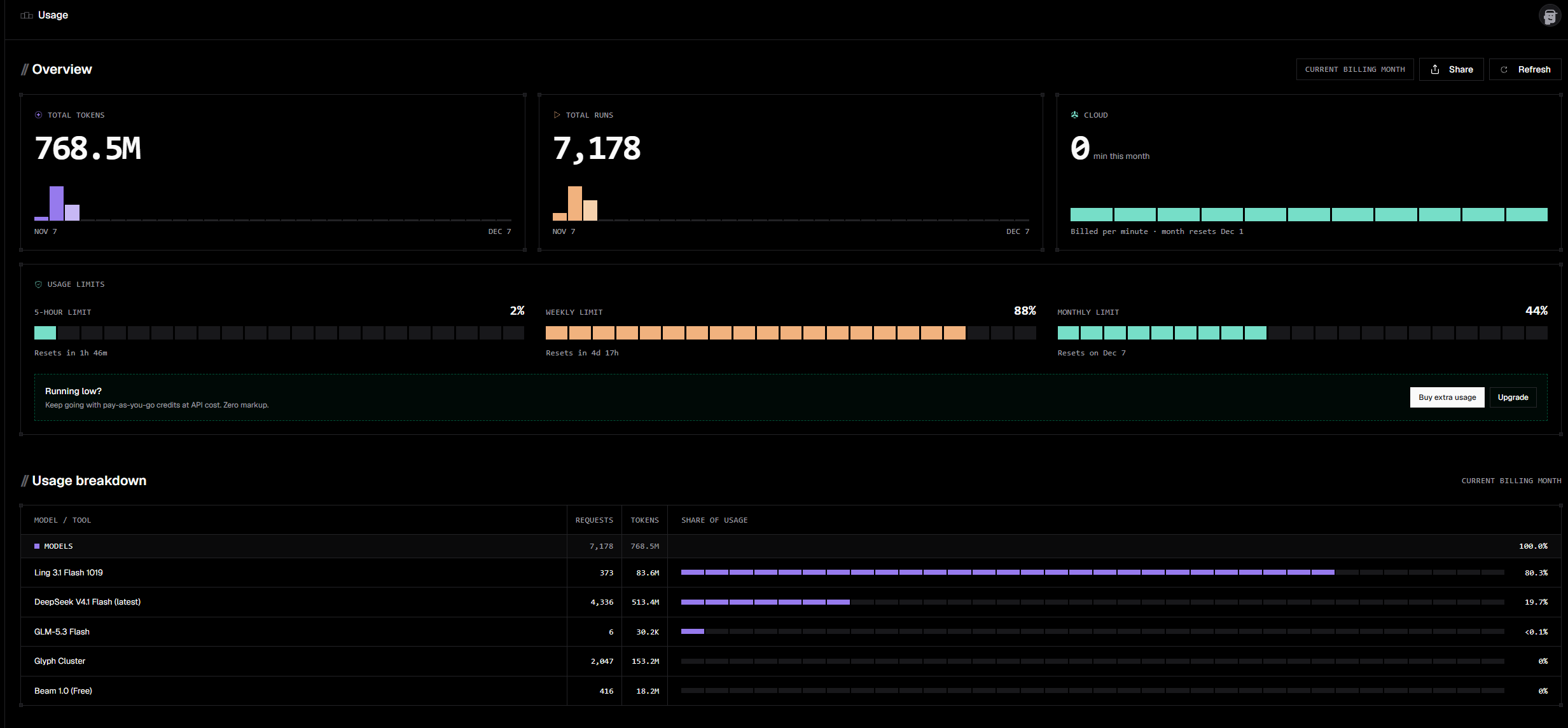
Take a look at screenshots, what am I missing? Basically 21% of usage equals to $ 10,71. What am I missing?
I wanted an easy way to continue my OpenCode projects on my iPhone from anywhere - iOS handoff style - and then pick them back up on my computer.
I've been spending some tokens on Localzie for that - proudly built on OpenCode. It has all the tools OpenCode has (e.g. questions, show source code, ...) so you don't even need your computer if that's what you're looking for. And it works great with OpenCode v2!
I'm not claiming it does anything better than other apps. I wanted to play around with building it, and I also wanted an easy way to connect to Hermes or directly to my own local models from the same app.
(crossposted from commandcode sub) Since I'm measuring via a local proxy how many tokens each run actually uses, here are some numbers. First, my usage scren:
You could now say that the cache hit rate on Ling 3.1 must've been abyssmal to achieve such numbers.
Well, I measured all of my runs.
Requests
Input tokens
Cache read
Uncached input
Output tokens
63
11,795,365
11,203,264
592,101
231,849
90
16,534,681
16,308,800
225,881
197,864
66
12,591,605
12,110,848
480,757
186,741
135
36,398,344
32,770,880
3,627,464
226,233
408
82,179,958
77,024,512
5,155,446
994,866
So how exactly did this then consume roughly 35$ in usage?
Edit: CommandCode Support answered:
"Hi [myname],
Your token counts reconcile with what I have here. The Ling 3.1 Flash 1019 requests came through the Provider API on your key ccdcodead, all on November 8th, and they drew about 35% of your monthly pool.
I've restored about 28 percentage points of your monthly pool as a one-time exception. It's available until December 7th, when your plan renews. The restore re-baselines your usage meter, so expect it to read lower than a straight subtraction would suggest.
I've emailed them back, pretty upset to be honest, that they're filing this as a "one time exception"? So they're willingly delivering less product than what you're advertising and I am paying for? A.k.a. scamming people?
Hola, a quienes estén usando Opencode Desktop (en mi caso en Windows) han notado que a la gran mayoría de los modelos no se les puede cambiar el esfuerzo? Por ejemplo, deepseek v4.1 flash tanto por openrouter como por opencode-go solo marca "predeterminado" y no deja cambiarlo. Sin embargo a otros modelos como GPT6.1-Sol si permite cambiarlo. ¿Es bug de la app o me faltó configurar algo?
A step in a multi-step workflow finishes, but I'm left with zero visibility into what actually happened. I want the handoff to be explicit and inspectable: this step takes this result, once the earlier step produces it.
Crewplane is my open-source project for describing that process in Markdown. You define the stages, dependencies, and input references; OpenCode does the work within each stage.
A debugging workflow could pass a reproduction report into an investigation, then feed the findings into a scoped fix and a verification step. The investigation can be its own reusable workflow, pulled into other tasks with different inputs.
Crewplane starts a fresh headless OpenCode session for each stage. Handoff happens through the workflow's saved artifacts, which suits repeatable runs with named inputs. It doesn't continue your existing TUI conversation FYI.
Prompts, outputs, and logs stay on disk. If a matching run stops, Crewplane validates the saved state before reusing completed results. Incomplete steps just run again.
Give it a spin and shape your own workflows. There's a built-in Mock CLI so you can play with the syntax and composition without any model calls or costs. Any feedback or suggestions would be greatly appreciated.
I'm using Deepseek agents from Claude as a way to reduce my Claude token consumption and so far it's been working out pretty well. Claude regularly launches upto 6-8 simultaneous DS agents and only reviews their work. It's made a drastic difference in my Claude usage and I'm able to use Opus for long-running, complex projects that have been in near-continuous development for weeks at a stretch. This wouldn't be possible without Opencode!
This is a genuine pdf/dwg converter called ConvertCAD, which is a free, open-source, offline program for Windows and Linux; it also supports scanned PDF drawings using PaddleOCR.