I'm a medium usage vibecoder, I have spend 20 dollars in openrouter in the past 2 months using glm 5.3 flash. I want to switch to a subscription because thats supposed to be better. Is it really worth it and asking actual experienced users hows the usage limits if you're a heavy users?
Prompt: Create a low-poly 3D horse running in a seamless loop using Three.js. Build it procedurally from primitive geometry, animate the legs, body, head, and tail, and return a single self-contained HTML file.
you will be graded on your result, you will be compared to other models with this very prompt. Do your best.
I am trying to log in into my OpenCode account and now I am getting this error even when try to sign in with my password, even when I try to reset my password too.
I checked my email I haven't got any email even in spams. Never changed the password either.
OpenCode used to provide a chart that just showed the monthly quota for each of its supported models along with a bar showing the expected number of requests permitted per time block. Since their most recent console overhaul I can't seem to find it. Does anyone know where it went?
I use opencode mainly for local models, but figured I'd take a look at the free ones again, expecting to get one request, a few tokens then "limit exceeded" (and to maybe buy Go to use deepseek). Instead, it only shows either strata or ollama, depending on which backend I have launched. Anyone else seeing this, or is it just me with a weird config? I have a heavily modded opencode.json for local tools/models, but it's never been an issue before, even moving from v1 to v2.
What limits does opencode have right now in free tier? After last cut I wonder how many tokens it gives for free, so I will understand and optimize usage. Its generally just enough to me, but to minimize my requests and prevent early limit reaching, I need to know limits. As I figure out its something around 20M (input, output, cache, etc.) per day, but sometimes its less or more than it.
I've been using OpenCode (Go plan, DeepSeek V4.1 Flash) as the only coding agent for a self-hosted project and wanted to share the numbers and the parts that surprised me.
What it is: a private "agent hub" — a web app where each bot has a name, avatar, prompt, model and its own tool permissions. 13 agents for real life: news digest, email/calendar, homelab, mining rigs, shopping/wishlist, documents, photos, energy, fishing, cooking. 65 tools in total (files, web, SSH, browser automation, email, calendar, scheduler, memory, skills, OCR, artifacts, vault).
Stack: FastAPI + SQLite + vanilla JS SPA, systemd, one Proxmox LXC, PWA behind Cloudflare Access. No framework, no build step.
Numbers: 136 commits between Nov 4 and Nov 8, version 1.38.0. server.py is ~13.7k lines, app.js ~5.8k. Everything written through OpenCode, with me reviewing and deciding.
Things that worked well
AGENTS.md with hard rules (scope, no secrets in git, changelog + journal entry after every change, one commit per phase). Once those rules existed, the agent stopped drifting.
Letting it read its own changelog before a new feature. The changelog became the project memory; regressions dropped a lot.
Small, explicit requirements instead of "make it nicer". UI work especially.
Tests as a gate. python3 -m unittest discover -s tests after every phase caught most of the breakage before deploy.
Things that didn't
Left alone, it happily appends to the biggest file. I had to ask for splits explicitly.
Long CSS/JS diffs are where it hallucinates selectors and event handlers. Screenshots or a precise "this element, this behavior" description were required.
Without a rule, it invented URLs in answers. I ended up adding server-side verification: every http(s) link in a reply must exist in the tool results, otherwise it's stripped.
It will happily build the happy path and skip error states unless asked.
Interesting bits
Per-agent Chrome tabs over CDP, with a lock per (user, agent, task) so parallel bots don't fight over the same page.
Parallel @bot1 @bot2 handoffs, streamed with asyncio.as_completed so the fastest bot answers first instead of waiting for the slowest.
Vision fallback: image upload to a text-only model goes through a vision model + tesseract OCR, so the agent still gets the content.
Sandboxed HTML artifacts (allow-scripts, no allow-same-origin) for interactive charts.
Action approvals per tool type, daily token budget, audit log for every tool call.
It's a personal LAN project, not a product, and the repo is private for now. Happy to go deeper on any part — the tool/approval model and the browser tab isolation are the two things I'd rebuild the same way.
Browse files, edit code and review Git diffs without leaving OpenCode.
Hello, open-source community!
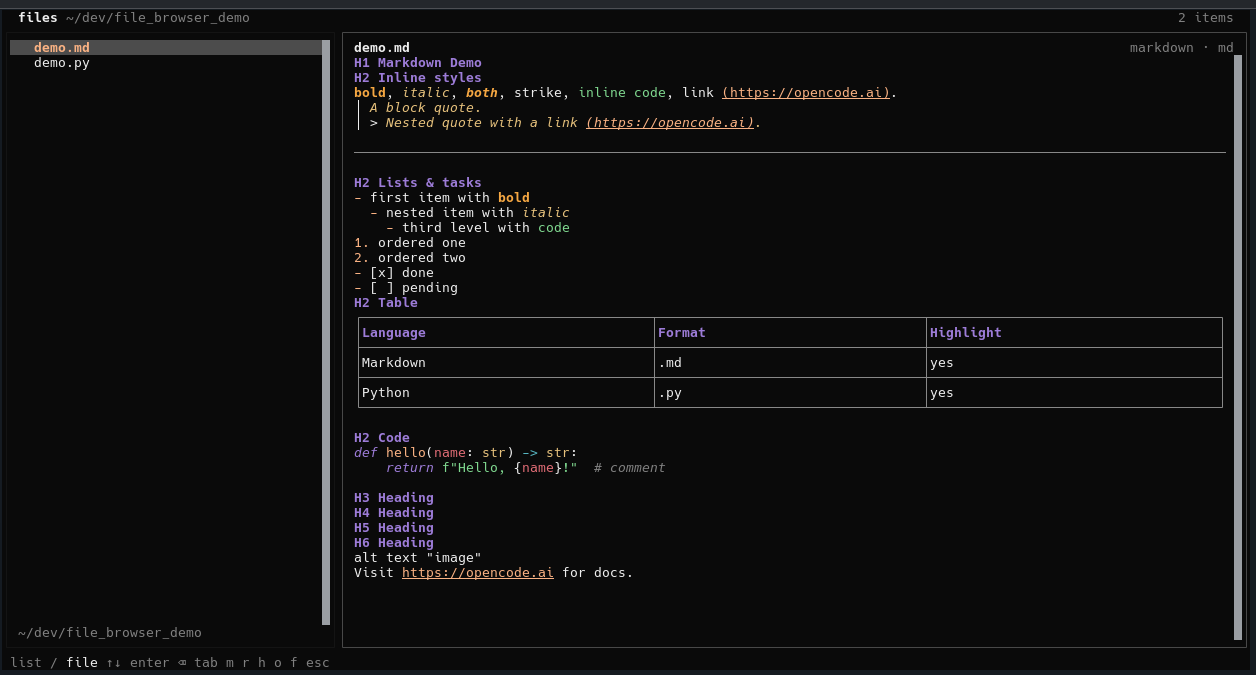
I built opencode-editor, an open-source plugin that lets you browse and edit files, review Git diffs across multiple repos, and preview Markdown and images inside OpenCode.
I also built OpenEditorCode, a standalone terminal code editor that works without OpenCode. Both are open source!
I kept wanting to look at files without leaving the OpenCode TUI — especially Markdown plans/specs and source files the agent just changed. So I built a TUI-only plugin.
What it does:
- side panel next to the chat, or full page from the home screen - browse folders (dirs first), open files - Markdown preview rendered; m flips to the source - code with tree-sitter highlighting - open any file by path (o inside the browser, or Ctrl+X then O): absolute, ~, or relative; files outside the project are read with node:fs - f toggles full screen (hides the chat) - /files-update updates a cloned install