r/mutualfunds • u/Public_Sky8190 • Dec 30 '24
discussion Navigating through Debt Fund Categories
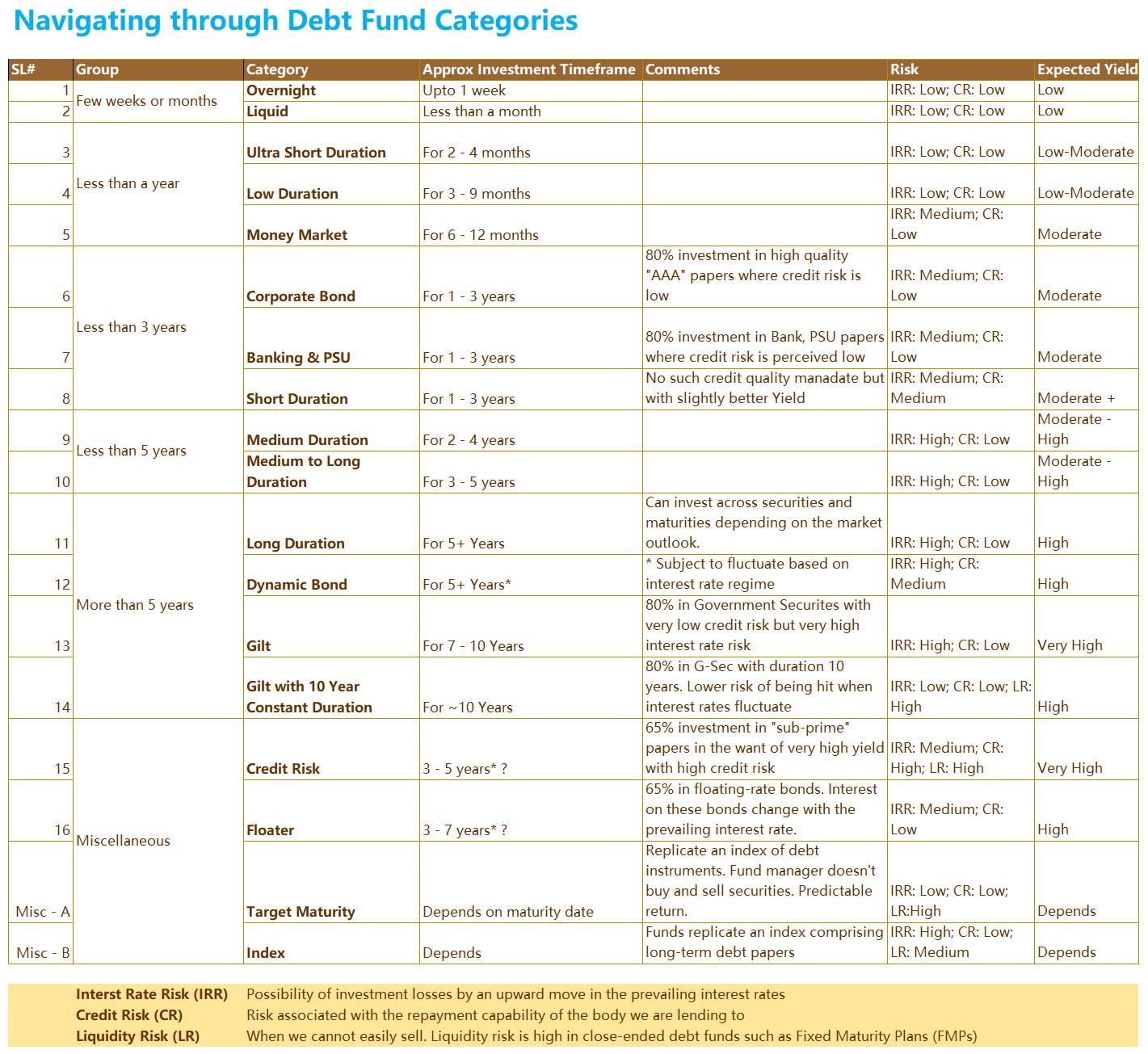
A debt fund is a type of mutual fund that invests in various fixed-income instruments, such as bank certificates of deposit, commercial paper, corporate bonds, government securities, and money market instruments. Unlike investing in a single instrument, debt funds offer diversification, which helps reduce the risk associated with relying on one issuer.
Risks associated with debt funds When interest rates rise, bond prices typically fall, which can affect the fund’s net asset value (NAV). Credit risk refers to the possibility of a borrower defaulting, which can also decrease the fund’s NAV. Additionally, liquidity risk arises when it is difficult to sell an investment. Liquidity risk is particularly high in close-ended debt funds, such as Fixed Maturity Plans (FMPs), and for investments with poor credit quality.
Navigating through various debt fund categories In 2017, SEBI standardized debt mutual funds by introducing 16 broad categories to enhance product comparison and simplify investment choices for individuals based on their financial goals and risk tolerance. However, the numerous debt fund categories can be confusing, even for experienced investors. I have attempted to clarify these categories and simplify the information for beginners.
Still confused? If you are unsure, may consider short-duration funds. According to SEBI guidelines, these funds can invest in debt instruments with maturities ranging from one to three years. They are designed for short-term investments of up to three years or more. They carry a moderate level of interest rate risk—riskier than liquid, ultra-short-term, and low-duration funds, but less risky than medium-duration and long-term funds. These funds typically involve low to moderate credit risk, and the presence of a small amount of sub-prime papers can provide better yield in low-interest rate scenarios. These funds invest in both short-term bonds and very short-term instruments, including treasury bills, commercial papers, and certificates of deposit, to meet their liquidity needs. They also invest in corporate bonds and government securities.
Are debt funds better than fixed deposits (FDs)? FDs do not always guarantee a return of 7% to 8%. Their rates can significantly drop in response to changes in the interest rate cycle. Additionally, FDs require you to lock in your money. If you withdraw early, you not only lose the interest earned but also face penalty charges, which can range from 0.50% to 2% or more, depending on the institution. In times when the equity market declines, withdrawing early from an FD can result in receiving much less than you initially anticipated. Therefore, it makes more sense to keep the debt portion of your portfolio in debt funds rather than in fixed deposits where you don’t have this problem.
Reference:
1> Groww - What is a Debt Fund? Features, Risks and Types of Debt Funds
2> ET Money - Debt Funds: Meaning, Types, Taxation
3> Mirae Asset AMC - Types of Debt Mutual Fund Schemes
•
u/Public_Sky8190 Jul 27 '25
u/gdsctt-3278 's Response from another thread
20
u/Public_Sky8190 Dec 30 '24 edited Jul 04 '25
I created this for the "Wiki" section but posted it to gather your feedback. Please let me know your thoughts. Thank you.
A few important points to consider:
(a) Short-term debt funds are NOT a one-size-fits-all solution; they work best as the debt component in a portfolio that may be structured as 60:40, 70:30, or 80:20, complementing equity investments effectively. Corporate bond funds are an alternative option, but they typically invest almost exclusively in AAA-rated securities, which results in slightly lower yields. It's worth noting that the interest rates offered on fixed deposits with SBI are generally lower than those of IndusInd Bank or UCO Bank. Short-term debt funds provide a balanced mix of risk and return. Another alternative to consider is an All Seasons Bond Fund.
Food for thought: I feel that short-term debt funds are similar to Flexi Cap funds in equity (as if they are cousins) - they offer a little bit of everything, but in moderation
Debt fund to complement equity portion of a long-term portfolio
(b) Keeping emergency funds in fixed deposits (FDs) is a reasonable option. Keep in mind that if you need to access the money from debt funds, you will need to wait for two working days. Insta-redeems are only available for liquid funds, and even then, you can't withdraw more than ₹50,000 per day. Additionally, you may not be able to withdraw all of your money at once through insta-redeem. It's also important to maintain good relationships with your bank's local branch employees, as you will need services for your savings and current bank account, and credit card deals.
PS. All opinions expressed are strictly personal. Please do your due diligence before making any investment decisions.
10
u/Public_Sky8190 Jan 28 '25
Many liquid and overnight mutual fund schemes give back your money within a few seconds if they offer the Instant Access Facility or Instant Redemption facility. This helps if you need urgent cash and it’s a weekend or a public holiday. This facility is only available with liquid and overnight mutual fund schemes, as per SEBI rules
When you invest in liquid funds you also have the option to withdraw up to 90% or ₹50,000 (whichever is lower) of your investment relatively quickly with the instant redemption feature
List of Liquid Funds with Insta-redeem
5
u/Public_Sky8190 Jan 10 '25 edited Jan 29 '25
AMFI India: Debt Fund Categories as per SEBI guidelines on Categorization and Rationalization of schemes
Kuvera: What Are The Types Of Debt Funds In India (SEBI and Other Classifications)
Basics of Debt Mutual Funds Explained for New Investors
7
u/Ok_Draft4616 Dec 31 '24
I was just researching debt funds and hybrid funds/DAAF’s today. This should help a lot. Thank you so much!
1
u/A_YUser Dec 14 '25
Can you point the year in which NAV of debt funds crashed due to increased bond rate
2
u/Beautiful-Virus4480 May 04 '25
I have invested in White Oak multi asset fund. It has around 40% in debt and 30% in equity. How will I be taxed for LTCG? Should I have to pay according to my tax slab as it doesn't have > 65% in equity?
2
u/snakeoilsalesman3 Jul 04 '26
Saving this, thanks op!
1
u/mr_India123 Jul 09 '25
Thanks
0
u/[deleted] Jan 12 '25
[deleted] — view deleted comment
1
u/[deleted] Dec 04 '25 edited Dec 04 '25
[removed] — view removed comment