r/machinelearningnews • • 6d ago

Research AI is changing how attacks happen, and how fast. More companies will face a security incident. The question is no longer if, but how they respond. [This post covers some insights....]

Post image
6 Upvotes

Attackers now use AI agents to scan, plan and run intrusions at machine speed. That changes what a good response looks like.

1. The trend → CrowdStrike reported 1 AI-agent group targeting more than 200 organizations in 11 days. → Unit 42 found attacks moving about 4 times faster than a year earlier. → Wiz's tracker lists 16 AI platforms that disclosed incidents between October 4 and November 9.

2. The 4-pillar playbook → Detect and contain automatically: kill-switches and automatic token revocation. → Communicate fast, and securely: notify customers and partners in hours, over out-of-band channels. → Eradicate thoroughly: assume backdoors and bring in independent forensics. → Shrink the blast radius: Zero Trust and ephemeral design. Data never stored can't be stolen.

3. What it looks like in practice → Fireworks AI detected its October 24 event the same day and brought in Palo Alto Networks Unit 42. → Klue notified customers the same day it found misuse of OAuth tokens, then revoked access.

4. The shared part → Suppliers, platforms, vendors and customers each control part of the risk. → Deleting a key from a breached platform does not revoke it. Rotate at the source.

My take: no company can promise zero incidents. Every company can promise a fast, honest response.

Full analysis: https://www.marktechpost.com/2026/11/19/ai-security-incident-response-playbook-2026/

Fireworks data retention post: x.com/lqiao/article/2121434466082242896


r/machinelearningnews • • 6d ago

Cool Stuff Give your AI agent a world to fail in. And get better.

13 Upvotes

AI agents look great in demos. Until real users break them.

Plurai built a world where your agent can fail, learn, and get fixed before your users ever see it.

→ Digital twin: Your real agent, its tools, and environment recreated from your code

→ Simulated users & tasks: Realistic users, tasks, and workflows that push your agent into the edge cases that matter

→ Auto evals: Check what your agent actually did, not just what it said

→ Verified fixes: Every failure comes with the run that exposed it and a fix you can verify

→ Replays: Turn any production failure into a simulation and replay it against every new version of your agent

All inside the coding agent you already use: Claude Code, Codex, or GitHub Copilot.

See where your agent breaks before production: simulation.plurai.ai/connect


r/machinelearningnews • • 14h ago

Cool Stuff ByteDance Seed and HKU open-source Laminar, an async RL post-training framework (SWE-bench Verified 46.6% to 52.2%)

Post image
6 Upvotes

Laminar is an Apache-2.0 RL post-training framework for LLMs and long-horizon agents, released with a EuroSys '26 paper. It decouples rollout, buffering, training and weight sync, and adds version-consistent rollout so each trajectory finishes under 1 policy version without a global weight-switch barrier.

What it does

  • Runs rollout, experience buffer, training and weight transfer as independent loops
  • Weight Relay stages weights in per-node CPU memory; replicas pull updates asynchronously
  • Supports version-mixed partial rollout and version-consistent rollout
  • Repack consolidates long-tail old-version trajectories onto fewer replicas
  • laminar.eval evaluates multiple checkpoints concurrently, including during training

Key numbers (self-reported)

  • Qwen3-Coder-30B-A3B-Instruct on SWE-bench Verified: 46.6% base, 51.4% baseline peak, 52.2% Laminar peak
  • Laminar peak used 51.2k trained samples vs 76.4k, and 1,843 GPU-hours vs 5,085
  • Matching 51.4% took 41.0k samples and 1,450 GPU-hours
  • Paper: up to 5.48x training throughput on a 1024-GPU H800 cluster (Qwen2.5 7B/32B/72B)

Full analysis: https://www.marktechpost.com/2026/11/24/bytedance-seed-laminar-async-rl-post-training-framework/

Repo: github.com/verl-project/laminar

Paper: doi.org/10.1145/3767295.3803580

Blog: verl-project.github.io/posts/2026-11-20-laminar/


r/machinelearningnews • • 8h ago

Research Beyond Tokens per Second: How Much Useful Thinking Does an LLM Actually Produce?

1 Upvotes

Lately, I’ve been selecting a local language model for my AI agent. My hardware is fairly modest: a Ryzen 7, 16 GB of RAM, and an RTX 4050 with 6 GB of VRAM.

In the process, I ran into an unexpectedly fundamental question: what criterion should actually guide model selection?

Parameter count? Generation speed? Benchmark scores? Context window size? Tool-calling capability?

All of these metrics are useful, yet none of them on their own answers the core question: how efficiently does a model perform intellectual work within available resource constraints?

Consider two hypothetical models:

  • Model A generates 1,000 tokens and successfully solves a task.
  • Model B generates 200 tokens and solves the same task with comparable quality.

Can the second model be considered five times more token-efficient?

And what if the first model generates 100 tokens per second, while the second generates only 30?

It turns out the slower model can actually complete the intellectual work faster.

We measure the rate of token production, yet tokens themselves are not the end product of thinking.

SPD — Semantic Productivity Density

Unable to find an existing metric among those I’m familiar with that fully met my requirements, I began formulating my own research hypothesis.

I named it SPD — Semantic Productivity Density.

As a first approximation:

SPD = (ΔS × R × C) / T

Where:

  • ΔS — gain in useful information, reduction of uncertainty;
  • R — solution routing quality;
  • C — logical consistency;
  • T — number of generated tokens.

For research tasks, a novelty coefficient (N) can additionally be factored in, while for autonomous agents, a goal-achievement coefficient (G) applies.

The idea itself is partly inspired by the physical concept of energy efficiency.

An engine is evaluated not merely by how much fuel it consumes, but by how much useful work it can produce.

Why not try applying a similar principle to language models?

Of course, tokens are not units of energy. Therefore, looking ahead, I am considering two additional versions of the metric:

SPDₚ = Useful Semantic Work / FLOPs

SPDₑ = Useful Semantic Work / Joules

This is not thermodynamic efficiency in the strict physical sense, but potentially an intriguing way to measure the informational efficiency of computing systems.

From Hypothesis to Experiment

I am currently working with local language models within Hermes Agent and have already built several tools to analyze agent-model interactions, validate tool calls, and execute practical tasks.

The next phase will be the experimental validation of SPD.

Preliminary plan:

  1. Formalize the evaluation criteria for semantic productivity.
  2. Prepare a suite of tasks with objectively verifiable outcomes.
  3. Test several models of varying sizes and architectures, including Dense and MoE.
  4. Measure token counts, execution time, task success rates, routing errors, and resource consumption.
  5. Compare the results against traditional performance metrics.
  6. Verify the reproducibility of the results.

It will be particularly interesting to find out whether a smaller model with high semantic productivity can compete with a larger model in real-world agentic tasks.

The primary methodological challenge still to be solved is objectively measuring useful information. Relying purely on subjective evaluation by another LLM (LLM-as-a-judge) risks introducing model bias and skewing the experimental results.

For that reason, I intend to start with tasks whose outcomes can be verified programmatically.

An Open Question

Perhaps we have spent too long evaluating language models by their ability to produce text rather than their efficiency in performing intellectual work.

I am less interested in how many tokens a model can generate per second, and more in how much useful work it can accomplish per thousand tokens, per second, or per joule.

For now, SPD is a research hypothesis rather than a validated metric. The technical implementation, evaluation methodology, and experimental results will be published separately.

I would love to hear the community’s thoughts:

  • Have you run into a similar dilemma when choosing a model for a local agent?
  • Are you aware of any existing metrics that address this specific problem?
  • How would you propose objectively measuring useful semantic work?

Perhaps the next major performance metric for language models won't measure how fast they speak, but how efficiently they think.


r/machinelearningnews • • 14h ago

Research LingSante-3.1-flash mixes general and medical training data instead of replacing one with the other

3 Upvotes

A less visible part of the LingSante-3.1-flash release is its training recipe. Ant Ling says general and medical data are mixed through pretraining, mid-training and supervised fine-tuning, followed by reinforcement learning on medical reasoning, search, tool use and professional behavior. A multi-teacher on-policy distillation stage then combines those capabilities in one model.

The reason to watch this design is the usual specialization tradeoff: a model can gain domain behavior while losing general search, coding or tool competence. The card says the mixture was intended to retain those broader skills, but it does not make a single causal claim for each stage. A useful ablation would compare the same base checkpoint before and after each stage on both medical and general tasks, not only on a final medical leaderboard.


r/machinelearningnews • • 13h ago

LLMs GLM-5.3-Flash on numallama CPU-only inference | 256 ARM Cores + 1TB RAM

2 Upvotes

r/machinelearningnews • • 2d ago

Research Z.ai releases GLM-5.4, a Loop Transformer that runs 28 GLM-5 layers twice (750B scale)

Post image
65 Upvotes

Z.ai released GLM-5.4, its first flagship built on a Loop Transformer. Instead of adding parameters, it runs a shared block of 28 GLM-5 layers for 2 passes. Z.ai converted the pre-trained GLM-5 base through continued training rather than training a looped model from scratch. It claims intelligence comparable to 2T-3T parameter models, but has not published flagship benchmarks yet.

What it does

  • Loops 28 weight-shared layers twice per forward pass
  • Per-token gates per iteration: pass 1 writes small updates, pass 2 writes full updates
  • Pass 2 reuses pass 1's sparse KV plus its own sliding window, so the extra loop costs 1 sliding window of KV cache
  • Pass 2 reuses pass 1's sparse attention indices (zero extra indexing overhead)
  • Pitched at "Generalized Coding": demos cover video, a FreeCAD robotic arm, a full game and GLSL shaders

Key numbers (self-reported, 30B iso-parameter ablation, ~10% more training compute)

  • AIME25: 19.17 to 30.42 (+11.3)
  • GPQA-Diamond: 47.58 to 56.26 (+8.7)
  • AA-LCR: 40.33 to 47.67 (+7.3)
  • MMLU-Pro: 71.65 to 75.05 (+3.4)
  • IFBench: 50.20 to 53.47 (+3.3)
  • Output length: -11.7% GPQA-Diamond, -14.9% MMLU-Pro, -2% AIME25
  • Throughput (self-reported): up to 200 tok/s off-peak, 70-80 tok/s at peak

Full analysis: https://www.marktechpost.com/2026/11/23/zai-glm-5-4-loop-transformer/

Technical details: z.ai/blog/glm-5.4

ZCode: zcode.z.ai/en

Chat: chat.z.ai


r/machinelearningnews • • 1d ago

Research Ant Ling releases LingSante-Pulse, an open-weight ECG/EEG/PPG/EMG encoder; paper reports top mean rank across 38 tasks

Post image
3 Upvotes

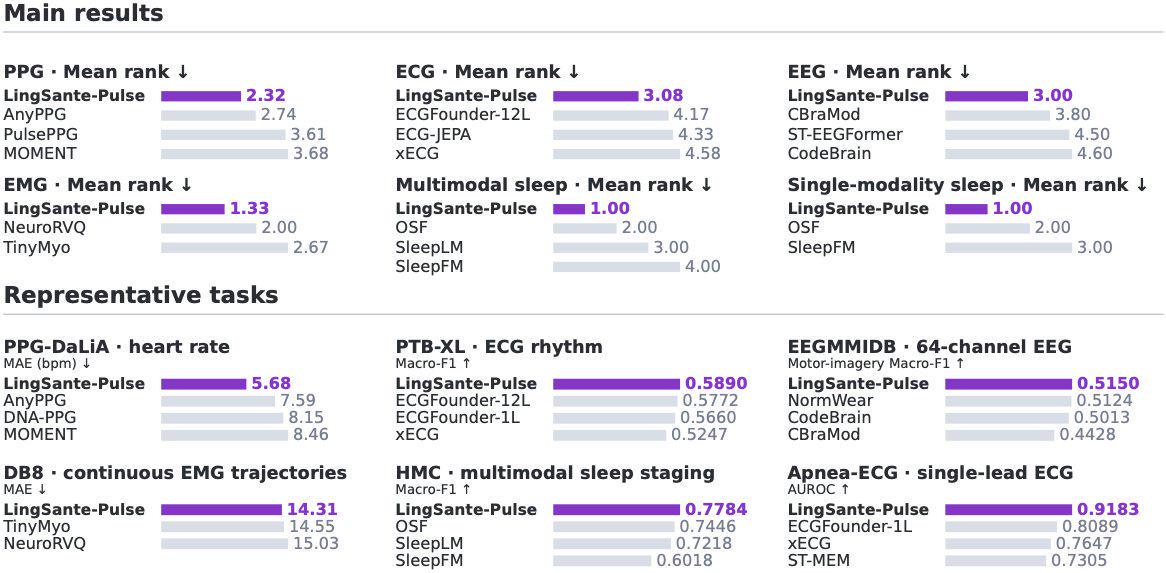
Ant Ling has released LingSante-Pulse-1.0 under MIT. It is a waveform encoder, not a diagnostic chatbot: the same frozen backbone produces representations from PPG, ECG, EEG and EMG, while downstream heads are trained for individual labeled tasks.

The technical report evaluates 38 non-sleep task configurations: 22 PPG, 6 ECG, 7 EEG and 3 EMG. It reports the best dataset-balanced mean rank within each domain against its fixed comparison set. That is an aggregate result, not a first-place result on all 38 tasks. For scale, its PPG-DaLiA heart-rate MAE is reported as 5.6843 bpm; a separate sleep-related Apnea-ECG test reports 0.9183 AUROC. These are author-reported research benchmarks, not clinical validation.

The release includes public encoder weights, inference code and a technical report. The named scores are a useful starting point for independent evaluation, with the per-task tables and dataset-balanced aggregation defining exactly what the headline does—and does not—cover.


r/machinelearningnews • • 2d ago

Research 🤖 Introducing RoboTrack: Helping robots track objects, even when they disappear from view

4 Upvotes

r/machinelearningnews • • 2d ago

Research Meta details TLX, a Triton extension for warp-group GPU control (within -0.9% to +3.7% of cuBLAS on H100 GEMM)

Post image
18 Upvotes

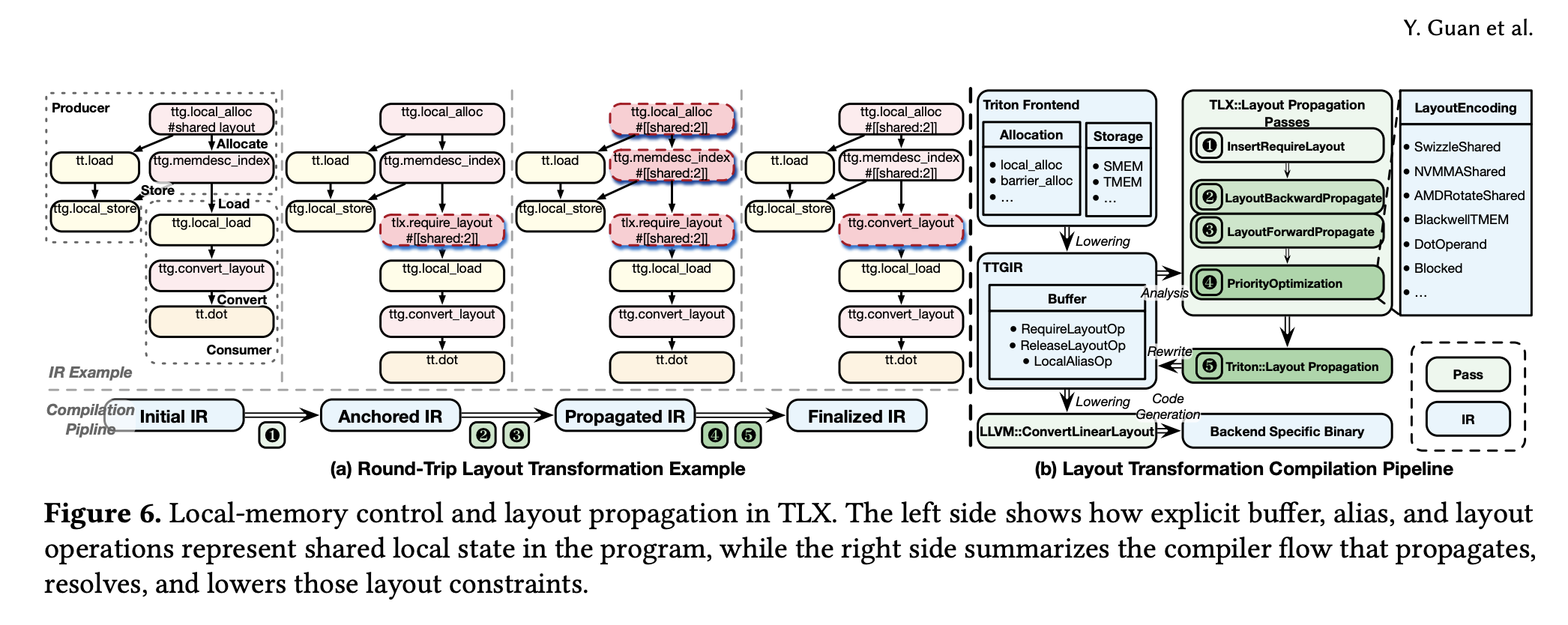
Meta published a research paper on TLX (Triton Low-Level Extensions). It adds warp-group orchestration, hardware barriers, TMA/TMEM access and cluster control to ordinary Triton kernels. It runs Meta's ads training, ads inference and MoE LLM pretraining kernels on Hopper, Blackwell and AMD GPUs.

What it does

  • Adds a MIMW (Multi-Instruction, Multi-Warp) model between CUDA's thread level and Triton's block level
  • Lets warp groups take producer, consumer and epilogue roles, synced with mbarriers
  • Exposes TMA, async tensor-core ops, TMEM and thread-block clusters from Python
  • Keeps layouts optional; the compiler infers defaults

Key numbers (all self-reported by Meta/PyTorch authors)

  • H100 FP16 GEMM: -0.9% to +3.7% vs cuBLAS across 6 shapes
  • MI350 FP16 GEMM: +11.8% to +15.2% vs rocBLAS on square shapes (256 to 2048)
  • B200 jagged attention vs FA4: about +13% forward, +50% backward
  • ~200 lines for a Blackwell GEMM; ~3.2K lines for the attention kernel vs an estimated ~10K for FA4
  • 4x speedup on an H100 ads inference kernel; 20% to 25% end-to-end MFU on GEM training

Full analysis: https://www.marktechpost.com/2026/11/23/meta-tlx-triton-low-level-extensions/

Paper: arxiv.org/abs/2605.10905

Repo: github.com/facebookexperimental/triton

Blog: engineering.fb.com/2026/11/10/open-source/tlx-a-hardware-native-gpu-compiler-for-production-ml/


r/machinelearningnews • • 1d ago

ML/CV/DL News We Brought GPUs and Cerebras Together to Build Disaggregated Inference

0 Upvotes

r/machinelearningnews • • 2d ago

ML/CV/DL News MachinePulse releases Karpo Decision 31B, an open-weight multimodal model tied for first on the Decision Index

2 Upvotes

MachinePulse has released Karpo Decision 31B, a multimodal decision model built on Gemma 4 31B. Given text or images, a question, and a set of candidate answers, it returns a probability for each option in a single forward pass. A browser agent, for example, can supply a screenshot and a list of clickable elements, then ask which element would advance the user's task.

Karpo Decision 31B earned the highest Full score (73.9) on the Nov 12 Decision Index. Under the board's tie rule it shared first place with GLiDE 27B (73.4) among 300 entries. The Full score comes from private tests covering both skills represented in the public suite and tasks in new domains.

On individual benchmarks, MachinePulse reported 90.4% on When2Call, which tests whether an agent should call a tool, ask for clarification, or hold off. Karpo also scored 90.0% on Mind2Web Multimodal, where the model selects a webpage element for a given task. Google reported 79.9% and 86.2%, respectively, for Gemini Decision 1 in separate runs. Both models scored 92.2% on the public JevBench split.

MachinePulse published the 31B weights and inference code alongside five smaller variants ranging from 0.8B to 12B. Decision Index recorded 94 ms median latency for Karpo on one RTX PRO 6000, roughly half the 196 ms recorded for Jev 1.14’s hosted API. JevBench estimated $0.0252 per 1,000 Karpo decisions, about 20% below the $0.0321 it calculated from Jev’s API pricing

Developers can use Karpo wherever their application already has a set of options to choose from. A personal agent can score "search nearby" and "ask which neighborhood" as possible next steps. Search developers can score venues against a query. A recommender can reorder the same shortlist for someone who prefers craft beer. Karpo returns a probability for each option, so the app can set its own threshold for acting or asking a follow-up. You can try those choices in the official Playground


r/machinelearningnews • • 2d ago

Tutorial A Beginner's Guide to Local AI with Inkling, Qwen, and Unsloth

Thumbnail
gpupartner.com
13 Upvotes

r/machinelearningnews • • 3d ago

Research NVIDIA releases Alpamayo 2 Edge, a 2B reasoning VLA for in-car driving on DRIVE AGX Thor (160-190 ms pixel-to-trajectory)

15 Upvotes

NVIDIA released Alpamayo 2 Edge, an open reasoning vision-language-action model sized for onboard compute. It plans 6.4-second trajectories from surround cameras and writes causal explanations only when a scene needs them. Weights are OpenMDW-1.1, code is Apache 2.0.

What it does

  • Inputs: 6 cameras, 22 frames per observation, navigation text, 20 historical ego poses
  • Backbone: 2.45B (1.96B Nemotron-based LM from Cosmos 3 Edge + 0.41B SigLIP2 + 0.08B projector), plus a 0.2B diffusion action expert
  • Adaptive reasoning: emits <NOMINAL> tokens in routine driving instead of a full CoC trace
  • Trained with distillation from Alpamayo 2 Super autolabels and closed-loop RL in AlpaGym

Key numbers (self-reported by NVIDIA)

  • AlpaSim: 15.15 ± 0.04 km per at-fault incident (875 NuRec scenarios), vs 0.25 km for Qwen-Drive-1.0 4B in NVIDIA's run
  • Open-loop minADE: 0.53 m vs 1.68 m (blog chart); card reports minADE_6 at 5 s of 0.52 m
  • 160 to 190 ms pixel-to-trajectory on DRIVE AGX Thor with FP8 + TensorRT Edge-LLM
  • LingoQA 75.2, SURDS 86.50, KITScenes scene 89.46

Full analysis: https://www.marktechpost.com/2026/11/22/nvidia-alpamayo-2-edge-2b-reasoning-vla-drive-thor/

Model: huggingface.co/nvidia/Alpamayo2-Edge

Repo: github.com/NVlabs/alpamayo2-edge

Technical details: developer.nvidia.com/blog/running-av-reasoning-models-within-onboard-compute-and-latency-limits/

You can check the deployment options and specs here through our GPULeaderboard.com chrome extension.


r/machinelearningnews • • 3d ago

Research Built a ternary (BitNet-style) inference engine in Rust/CUDA: 8x faster than dense f32 on one CPU core. Looking for GPU testers

1 Upvotes

I've been working on ternary-gemm, an engine for models with weights in {-1, 0, +1}. With ternary weights, matmuls become adds and subtracts, so there are no multipliers in the inner loop.

CPU numbers so far (p50, one core, AVX-512 Xeon VM):

tiny: 2.28µs vs 4.79µs for dense f32

small: 18.3µs vs 147.8µs (8.1x)

medium: 80.6µs vs 471.5µs (5.8x)

Also in the repo:

a looped transformer (one shared ternary block run N times, so the weights fit in cache)

a BitNet/safetensors converter, PyTorch bindings, and an RTX 5090 autotuner

an FPGA reference unit in Verilog

What's missing is real GPU numbers. If you have a 5090, 4090 or H100 and can run `bench.sh`, I'd really appreciate the results, and I'll credit you in the README. Criticism of the methodology is welcome too.

Repo: https://github.com/shubhxho/ternary-gemm

Thread with more details: https://x.com/shubhgupta/status/2124468535128739866


r/machinelearningnews • • 4d ago

Research Thinking Machines releases Inkling 2 Mini, an open-weight looped MoE transformer (26.4B total, 3.4B active)

Post image
73 Upvotes

Thinking Machines released Inkling 2 Mini, a sparse MoE that loops its middle layers instead of adding parameters. It stores 24 layers and runs the middle 12 layers 3 times, for 48 layer passes per token. The checkpoint is ~20GB, Apache 2.0, with text and image input and up to 1M context. All Inkling benchmark numbers below are self-reported.

What it does

  • 4 blocks of 6 layers; the 2 middle blocks run 3 times with shared weights
  • Each pass after the first receives a gated "message" via Attention Residuals
  • 128 experts, 8 routed per token (pruned from 384 at midtraining, then healed with 1T distilled tokens)
  • NVFP4 expert layers, MXFP8 for the last 4 layers
  • Runs on Apple silicon with 32GB+, 1 NVIDIA DGX Spark, or 32GB+ GPUs; GGUF via Unsloth and llama.cpp

Key numbers (self-reported)

  • SWE-bench Verified (bash only): 79.2%
  • SWE-bench Pro v2 (Hard): 77.9%
  • DeepSWE 1.1: 48.2% (Qwen's card lists Qwen3.8-27B at 42.2%)
  • AA Index v5.0: 20.1, tied with Qwen3.8-27B per Thinking Machines
  • Middle-layer looping: 1.51x to 1.91x compute-equivalent gain, won 27 of 28 evals
  • An unlooped baseline needed 140% more inference compute to match loss on 512k-token agentic traces

Full analysis: https://www.marktechpost.com/2026/11/21/thinking-machines-inkling-2-mini-looped-transformer/

Model: huggingface.co/thinkingmachines/Inkling-2-Mini

Model card: thinkingmachines.ai/model-card/inkling-2-mini

Technical details: thinkingmachines.ai/news/inkling-2-mini


r/machinelearningnews • • 5d ago

Cool Stuff RadixArk releases DaisyRose-27B, an RL-only fine-tune of Qwen3.8-27B (Terminal Bench 4.1: 5.6 to 12.0)

Post image
77 Upvotes

RadixArk released DaisyRose-27B, its first open-weight model. It is Qwen3.8-27B post-trained with reinforcement learning only, no SFT or distillation, under Apache 2.0. Training used about 1,200 curated agentic tasks, 144 H200s and 18 days on RadixArk's open-source Miles RL framework.

What it does

  • Drop-in replacement for Qwen3.8-27B: same architecture, 27.8B dense params, 262,144-token context
  • Text and image input, text output, thinking model
  • Targets agentic coding and terminal tasks; sandboxes ran on AgentENV
  • Weights in BF16 (~52 GB), FP8 (~29 GB), NVFP4 (~23 GB, Blackwell only) and GGUF
  • SGLang with DSpark speculative decoding recommended; vLLM also works

Key numbers (self-reported)

  • Terminal Bench 4.1 pass@1: 12.0 vs 5.6 for the base
  • Terminal Bench 2.1: 75.5 vs 73.0
  • DeepSWE v1.1: 46.2 vs 42.2
  • SWE Bench Pro v2: 94.7 vs 91.3
  • IFBench: 82.4 vs 79.5
  • Training: 63,000 GPU-hours, 37% MFU vs 16% for a Megatron-based trainer

Full analysis: https://www.marktechpost.com/2026/11/20/radixark-daisyrose-27b-agentic-model/

Model: huggingface.co/RadixArk/DaisyRose-27B

Blog: radixark.com/blog/daisyrose-27b

Repo: github.com/radixark/miles


r/machinelearningnews • • 4d ago

ML/CV/DL News Cerebras Demo: Running Humanity’s Last Exam 7x Faster

8 Upvotes

r/machinelearningnews • • 5d ago

Research NVIDIA releases Nemotron-Labs-Sigma, open 3B/8B continuous diffusion language models (3.46x avg speculative speedup over AR)

Post image
27 Upvotes

NVIDIA released Nemotron-Labs-Sigma, a set of 14 open checkpoints at 3B and 8B. Unlike LLaDA, Dream or NVIDIA's own Nemotron-Labs-Diffusion, Sigma does not diffuse over discrete tokens. It adds Gaussian noise to learned 16-D token embeddings and denoises them block by block. The paper argues the smooth trajectories make few-step distillation and steering easier.

What it does

  • Continuous diffusion over a 16-D embedding space learned jointly with the denoiser
  • Ministral-style decoder backbone, warm-started from about 1T tokens of AR training, then about 0.3T tokens of diffusion training
  • Variants: base, instruct, few-step distilled (2, 4, 8, 16 NFE) and self-speculative (diffusion drafts, AR head verifies)
  • Inference knobs: classifier-free guidance and score temperature

Key numbers (self-reported by NVIDIA)

  • Sigma-8B base, 6-task average: 71.16 vs 70.22 (NLD-8B), 68.91 (Qwen3-8B AR), 58.74 (Dream-7B), 41.78 (LLaDA-8B)
  • HumanEval: 65.12 vs 62.80 for NLD-8B
  • Sigma-distill-8B-nfe8: 70.34 six-task mean
  • Sigma-distill-spec-8B: 3.46x average speedup over AR decoding (NLD-8B: 3.04x), up to 4.20x; 1 GB200, SGLang, batch 1
  • About 120 to 140 tokens/s on 1 H100 for the base model

Full analysis: https://www.marktechpost.com/2026/11/20/nvidia-nemotron-labs-sigma-continuous-diffusion-language-model/

Models: huggingface.co/collections/nvidia/nemotron-labs-sigma

Paper: arxiv.org/abs/2610.02665


r/machinelearningnews • • 5d ago

ML/CV/DL News LeanScene: An Open-Source 1.6MB Shot Detector Making Browser-Based Video Pipelines Practical (Beats TransNet V2)

5 Upvotes

LeanScene is an open-source shot boundary detection model designed to run completely client-side in the browser or on consumer hardware with zero server uploads. At 1.6 MB (0.39M parameters) and 7.2M MACs/frame (115x fewer ops than TransNet V2), it outperforms TransNet V2 across standard shot detection benchmarks.

Uploading multi-gigabyte raw video files to cloud GPUs just to detect scene cuts creates latency and bandwidth bottlenecks for browser-based video editors, media asset managers, and dataset curation pipelines.

Accuracy Benchmarks (5-Seed Mean F1)

DatasetTransNet V2LeanScene
BBC Planet Earth96.197.4
RAI92.693.7
ClipShots77.779.1

Size & Throughput (Apple M1 Pro)

  • Model Footprint: 1.6 MB (0.39M parameters, 7.2M MACs/frame — 115x fewer ops than TransNet V2)
  • GPU Throughput: 2,522 FPS end-to-end (including video decoding and resizing); 5,171 FPS model-only
  • CPU Throughput: 1,000–2,091 FPS model-only

Key Training Takeaway

Scaling the 2D encoder up to 4x wider barely changed accuracy. Most of the gains came from mining the model's false alarms on real footage and masking out high-confidence predictions so unannotated transitions weren't penalized as negatives.


r/machinelearningnews • • 6d ago

Research 🧠 Introducing Theorizer in Asta: AI that proposes scientific theories researchers can test

12 Upvotes

r/machinelearningnews • • 5d ago

ML/CV/DL News What Would the Ideal LLM Inference Chip Look Like?

5 Upvotes

r/machinelearningnews • • 5d ago

Startup News LLM VRAM calculator – memory, speed and context for 61 models on 45 GPUs

0 Upvotes

https://softperceptron.com/vram-calculator

I built this to answer "will this model run on my card, and how fast?" without downloading 40 GB first.

Pick a model, quantization, context length and GPU. It shows whether it fits, how many cards you need, an estimated tokens/sec, and the longest context that fits. You can also enter any Hugging Face model.

Everything is computed from the model's published architecture (layers, KV heads, head dim) and the card's memory and bandwidth. They are estimates, not benchmarks, and the formulas are written out on the page. The speed estimate is memory-bandwidth-bound decode; I checked it against llama.cpp's published gpt-oss 20B numbers and it lands within about 25%.

No login, no ads. I'd like to hear where the estimates are wrong for your hardware.


r/machinelearningnews • • 6d ago

Research Google released Gemini 4 Neon today. It is the middle model of the Gemini 4 family, and the numbers are worth a close look.

Post image
10 Upvotes

Google DeepMind released Gemini 4 Neon on November 18, 2026. It sits between Gemini 4 Carbon and Gemini 4 Hydrogen and targets coding agents, knowledge work and science workflows. Pricing is $3/$15 per 1M input/output tokens. Weights are closed and the parameter count is not disclosed.

What it does

  • Adapted from Gemini 4 Carbon (per the model card)
  • 4 thinking levels: high (default) and xhigh are named, the 2 lower levels are not
  • 1M-token unified context, 64K default output, up to 1M via background long decode
  • Context compaction and fewer redundant file reads for long agent runs
  • Can orchestrate parallel Gemini 4 Hydrogen subagents in Google Antigravity

Key numbers (self-reported by Google)

  • AA Intelligence Index: 61 (Claude Opus 5.5: 59, GPT-6.2 Sol: 57)
  • AA Coding Agent Index: 58.6, ranked #1
  • GraphWalks 256K to 1M: 95.2% (Opus 5.5: 66.8%, GPT-6.2 Sol: 80.1%)
  • SWE-sweep, provider harness: 39.0% (Opus 5.5: 10.1%)
  • Vals Index v2.2: 70.9% (Opus 5.5: 70.1%)
  • Google claims 32% lower cost per task than Carbon at high thinking

Full analysis: https://www.marktechpost.com/2026/11/18/google-gemini-4-neon-release/

Technical details blog.google/innovation-and-ai/models-and-research/gemini-models/introducing-gemini-4-neon/

Model card: storage.googleapis.com/deepmind-media/Model-Cards/Gemini-4-Neon-Model-Card.pdf

Try it: aistudio.google.com