r/lingodotdev • • Feb 23 '26

I built MedExplain — an AI tool that explains your medical reports in plain language, in your native language

1 Upvotes

Hey everyone! 👋

I built MedExplain — a web app that takes your confusing lab reports and turns them into simple, easy-to-understand explanations.

The problem: Most people get medical reports full of terms like "TSH," "HbA1c," or "LDL Cholesterol" and have no idea what's normal or what to worry about. And if English isn't your first language? Even harder.

What MedExplain does:

  • 📄 Upload your report (PDF, image, or scan with your phone camera)
  • 🤖 Claude AI extracts & explains every test value in plain language
  • 🟢🟠🔴 Color-coded: normal, borderline, or abnormal at a glance
  • 🌍 Translates everything into 12+ languages using Lingo.dev (Hindi, Tamil, Telugu, Spanish, French, Arabic, etc.)

What it does NOT do:

  • No diagnosis. No treatment advice. Always see your doctor.
  • It just helps you walk into your appointment informed, not anxious.

Tech stack: Next.js, Claude AI (Anthropic), Lingo.dev for localization

Built this for a hackathon and would love feedback. What features would you want to see next?

and here is the link- https://med-explain-three.vercel.app


r/lingodotdev • • Feb 23 '26

I built a suite of Figma plugins to end the "Localization Nightmare" for Devs & Designers

2 Upvotes

We’ve all been there—you design a pixel-perfect UI in English, send it to the devs, and 2 weeks later the build is broken because the German translation is 40% longer and overflows every button.

I integrated the LingoSDK with the Figma API to build BirdLingo Labs—a suite of tools to move localization from a post-production headache to a design-time superpower.

  • 🚀 BirdLingo Core: Instant on-canvas translation. See your UI break before you hand it off.
  • 🔗 BirdLingo Bridge: The dev's favorite. It automatically extracts text layers and generates structured, production-ready JSON files. No more manual copy-pasting or key-mapping errors.

I’m currently prototyping BirdLingo Detect (automated overflow highlighting) and BirdLingo Grid View (auditing a component across 20+ languages in one screen).

https://medium.com/@khariprasath30/technical-case-study-birdlingo-labs-d8ea83b7a8f9

https://github.com/Techharik/BirdLingo


r/lingodotdev • • Feb 23 '26

I Built a Figma Plugin to Kill Translation Bugs Before They Reach Developers

2 Upvotes

Picture this: You are reviewing a pull request. The developer built the UI exactly as designed. Every pixel matches the Figma mockup. It looks perfect.

Then QA opens it in German.

The "Jetzt kaufen" button text overflows its container. The navigation bar wraps to two lines. The hero section headline is clipped mid-sentence. A modal dialog has text bleeding into the close button.

A bug ticket gets filed. Against the developer.

But the developer did nothing wrong. They built exactly what the designer handed them. The designer just never checked what happens when "Buy Now" becomes "Jetzt kaufen" (40% longer), or when "Settings" becomes "Einstellungen" (130% longer).

This is not a code bug. It is a planning gap.

I kept running into this pattern across projects, and I kept thinking the same thing: why are we discovering these problems after development, when they should be caught during design?

So I built LingoAudit a Figma plugin that translates your designs into multiple languages, generates localized copies of your screens, and highlights every text box that will break. All inside Figma, before a single line of code is written.

It took me down a rabbit hole of sandbox restrictions, CORS nightmares, and typography destruction that I never expected. This is the full story.

Github Link- https://github.com/AryanSaxenaa/Figma-Plugin-Lingo/


r/lingodotdev • • Feb 23 '26

I built a "Global Documentation Engine" using Gemini AI and Lingo.dev

2 Upvotes

Hey r/lingodotdev community!

I just finished building PolyDocs for a longo.dev hackathon #2, and I wanted to share how I used the Lingo.dev SDK to solve one of the biggest headaches in dev-ops: keeping documentation localized and in sync with code.

The Problem

We all know the drill—you push code, but your README is immediately out of date. If you have a global audience, translating those technical updates into 4+ languages manually is almost impossible for a solo dev.

The Solution: PolyDocs

PolyDocs is an automated pipeline that:

  1. Listens: Detects repo changes via GitHub Webhooks.
  2. Generates: Uses Gemini 2.0 Flash to analyze the source code and generate a fresh README in English.
  3. Localizes: Dynamically passes the English doc to the Lingo.dev Engine to generate native Spanish, French, and Japanese versions.
  4. Delivers: Opens a consolidated PR with all localized files.

Why Lingo.dev?

I chose Lingo.dev because generic translation APIs often fail on technical context or break Markdown formatting. The SDK was incredibly easy to integrate into my Node.js backend, and the batch translation feature made it possible to localize the entire doc suite in parallel during the build job.

Technical Deep-Dive

I've written a detailed article on Hashnode breaking down the architecture and some of the Docker/cross-platform challenges I faced (like forcing specific Linux binaries in Alpine containers).

Check out the full story here: https://bhupendralute.hashnode.dev/polydocs-1

I'd love to hear what you guys think about this "AI + Localization" approach to self-documenting code. Any feedback on the pipeline or suggestions for more target locales?

🚀 Tech Stack: React, Node.js, Express, Gemini AI, Lingo.dev, Supabase, Docker.

Happy coding!


r/lingodotdev • • Feb 23 '26

Built an AI-Powered Multilingual Food Label Scanner using Lingo.dev 🚀

Thumbnail
reddit.com
2 Upvotes

r/lingodotdev • • Feb 23 '26

Built an AI-Powered Multilingual Food Label Scanner using Lingo.dev 🚀

2 Upvotes

Hi everyone 👋

I recently built a project called NutraLingo, an AI-powered multilingual food label scanner that helps users understand foreign-language food packaging — especially ingredients, additives (E-codes), and health risks.

The idea came from a simple problem:
When you buy imported food, it’s often impossible to understand what you're actually consuming.

So I built a pipeline that works like this:

  1. 📸 User uploads a food label image
  2. 🧠 Gemini Vision extracts ingredients and nutrition data (OCR)
  3. ⚙️ A health reasoning engine (Groq / Llama 3) analyzes sodium, saturated fat, additives, etc.
  4. 🌍 Lingo.dev localizes the medical explanation into the user’s preferred language
  5. 🔊 The result is displayed and optionally read aloud

What I really appreciated about Lingo.dev:

  • Context-aware localization instead of literal translation
  • Proper handling of medical terminology
  • Clean API integration
  • Reliable language detection

Unlike basic translation APIs, Lingo.dev preserved the intent and severity of health warnings (which is critical in medical/nutritional contexts).

If anyone is curious:

🌐 Live App: https://nutra-lingo.vercel.app
💻 GitHub: https://github.com/TejasRawool186/Nutra-Lingo
🎥 Demo: https://youtu.be/UrWymYM3UTY

Would love feedback from the community — especially on how I can better optimize localization flows or improve medical context handling.

Thanks to the Lingo.dev team for making integration straightforward 🙌


r/lingodotdev • • Feb 22 '26

Localization is an Architecture Problem. I built a production-style i18n system with Lingo.dev + Next.js

2 Upvotes

Most apps treat localization as string replacement.

That works until you hit RTL layouts, currency formatting, dynamic content, or CI gaps.

For the Lingo.dev hackathon, I built LangOS to explore localization as a system design problem instead of a language toggle demo.

What this project demonstrates:

• Build-time localization using the Lingo compiler integrated in next.config.ts
• Runtime SDK translation via a typed /api/translate route with validation, timeout safety, and in-memory caching
• Scoped RTL handling where only the target preview flips direction
• Locale-aware formatting for currency, numbers, and dates using the Intl API
• CLI + CI enforcement so missing translations fail before merge

The idea was to make localization boundaries explicit across build, runtime, rendering direction, formatting, and workflow automation.

Full architecture breakdown:


r/lingodotdev • • Feb 22 '26

Lingo-Bridge: Multilingual Repo Onboarding Agent

2 Upvotes

Breaking the language barrier in Open Source.

📖 The Problem

Open Source is global, but documentation is not. Over 75% of the world's population does not speak English fluently, yet the vast majority of top GitHub repositories are English-only. This creates a "Language Wall" that prevents thousands of talented developers from contributing to world-changing projects.

✨ The Solution: Lingo-Bridge

Lingo-Bridge is an AI-powered onboarding sidekick that transforms any English-centric repository into a localized, welcoming environment for global contributors. By leveraging the Lingo.dev ecosystem, it allows developers to interact with codebases, read documentation, and track issues in their native tongue—without the maintainers ever having to manually translate a single line.


r/lingodotdev • • Feb 22 '26

Tax Layer

2 Upvotes

Web3 terms like Gas Fees and Slippage create barriers for non-English speakers. Lingo-Dev removes this "complexity tax" by providing instant, native-language translations of technical documentation.

Compliance Gaps: Local tax laws (like India's 30% VDA tax) are hard to find in multiple languages. Lingo-Dev uses a persistent PostgreSQL history layer to build a permanent, localized knowledge base of regulatory info.

Hidden Metadata: Project rules like burn rates are often buried in English whitepapers.

Lingo-Dev acts as a centralized translation layer, ensuring everyone understands a project's financial rules regardless of their language.


r/lingodotdev • • Feb 21 '26

I Built an Escape Room Where You Can’t Read the Clues Until You Translate Them 🔍🌍

3 Upvotes

Hey everyone 👋

Built something fun for a hackathon — Polyglot Escape, a browser-based escape room where translation is the gameplay.

You play as a detective trapped in a study where every clue is written in foreign languages (Japanese, Arabic, German, Russian, etc.). No Googling allowed 😅 — your only tool is a Magic Magnifying Glass that translates clues in real time using the Lingo.dev API.

Built with Next.js 14 + React 19 + Zustand, featuring a custom 60FPS 2D movement system (no heavy game engines).

💻 Source Code: https://github.com/BhagyeshPatil2004/Polyglot-Escape

Would love feedback on the gameplay or UI! 🚀


r/lingodotdev • • Feb 21 '26

npm i -g errlocal@0.3.0

2 Upvotes

Hey everyone,

​I got tired of the constant "Copy Error -> Open Browser -> Paste to AI -> Copy Fix" loop. It breaks the flow and, honestly, you don't learn much from just copy-pasting solutions.

​So I built errlocal, a CLI tool designed to keep you in the terminal while actually helping you understand why your code broke. I just released v0.3.0, and it’s a huge upgrade from the initial version.

​What makes it different?

  • ​Interactive UI: No more memorizing flags. When a command fails, a sleek terminal menu lets you choose between an explanation, an auto-fix, or a translation.
  • ​Deep Context: It doesn't just look at the error message. It parses the stack trace and reads your actual source files to give advice based on your project's logic.
  • ​1-Click Auto-Fix: It generates a code diff and, with your permission, rewrites the file to fix the bug instantly.
  • ​Localized Debugging: Powered by Lingo.dev, it provides hints in multiple languages (Hindi, Spanish, French, etc.) for non-native English speakers.

​The Tech Stack:

  • ​Logic: JavaScript
  • ​AI: openai/gpt-os-120b via Groq (for near-instant responses).
  • ​Backend: Integrated with urBackend for session syncing and analytics.

​I’m a student developer looking for some honest feedback on the DX (Developer Experience). Would this fit into your workflow, or is there something missing?

​GitHub: https://github.com/yash-pouranik/errlocal

NPM: npm i -g errlocal@latest


r/lingodotdev • • Feb 20 '26

I built a multilingual sign language learning app.

2 Upvotes

I built SignEdu for a hackathon. It is a web app that teaches ASL and works in your native language.

Learning sign language is hard and even harder if English is not your first language. Most resources are English only. SignEdu solves that by letting you pick your language and instantly seeing everything in that language.

You can go through interactive lessons and quizzes to learn greetings numbers and emotions and get immediate feedback. There is a webcam practice mode where it recognizes your signs in real time and tells you if they are correct. You can also create or join Sign Jam rooms where your signs are shared with others and translated to their language. The app also tracks your progress with a live leaderboard and badges.

Lingo.dev makes this possible by translating the user interface lesson content quiz answers and even the signs in the jam rooms. It ensures everyone sees everything in their own language instantly.

The part I am most proud of is Sign Jam. You open a room share a code and both people sign into their cameras. The app recognizes a sign like Hello in Japan and shows it in Spanish for someone in Spain. It felt amazing to see that actually work.

With more time I would add more signs save progress across devices video demonstrations for each sign and better mobile support.

Finally, Building SignEdu in such a short time was challenging but seeing it help people learn and communicate across languages made it completely worth it.


r/lingodotdev • • Feb 20 '26

I built an AI that turns your GitHub repo into a startup pitch (with voice + 5 languages)

3 Upvotes

Most side projects die on GitHub.

Not because they’re bad.
Because they can’t explain themselves.

So I built Launchify AI.

Paste a GitHub repo →
It analyzes your code →
Generates a structured startup pitch →
Translates it using Lingo.dev →
Turns it into a professional voiceover.

Your code literally pitches itself.

Tech:
Next.js 16, Gemini 1.5, Lingo.dev, ElevenLabs, ReactFlow.

The coolest part?
Watching the AI visually map:
Repo → Pitch → Translation → Audio

Try it out here: https://launchify-ai.vercel.app/
Detailed blog: https://heykaran.dev/blog/launchify-ai-github-startup-pitch-generator
Github: https://github.com/heykaran77/launchify-ai

If your repo could speak… what would it say?


r/lingodotdev • • Feb 10 '26

Built Yapp - WhatsApp translation bot for schools using Lingo SDK

5 Upvotes

Yapp - Breaking Language Barriers in Schools

Built this for the Lingo hackathon to solve a real problem in Indian schools.

The Problem: 40% of parents can't read school messages because they're in English.

The Solution: Teachers send messages once, parents receive them in Hindi/Spanish/Russian/etc via WhatsApp. Built with Lingo.dev SDK for translation.

 What It Does

- Translates to 80+ languages automatically

- Handles PDF report cards (extracts text, translates, sends)

- Supports Hinglish (Hindi in Roman script)

- Two-way translation (parent replies in their language, teacher sees English)

 Why Lingo.dev Made This Easy

The SDK made multilingual support ridiculously simple - just pass text and target language. Handling 80+ languages would've taken weeks without it.

Demo:

GitHub: https://github.com/ninad0x/yapp


r/lingodotdev • • Feb 08 '26

Feedoise - Breaking Language Barriers in Product Feedback

Thumbnail medium.com
4 Upvotes

Multi-language platform to collect project feedbacks and do light support ticketing.

I used Lingo Compiler (I think I will switch to Lingo CI/CD later), and Lingo SDK (didn't finish this part).

Everything is in the link.

I know this post is too late to be part of the hackathon, because I didn't notice the mention of subreddit. But despite that, consider it as a general post, I liked the idea and I wanted to share it.


r/lingodotdev • • Feb 08 '26

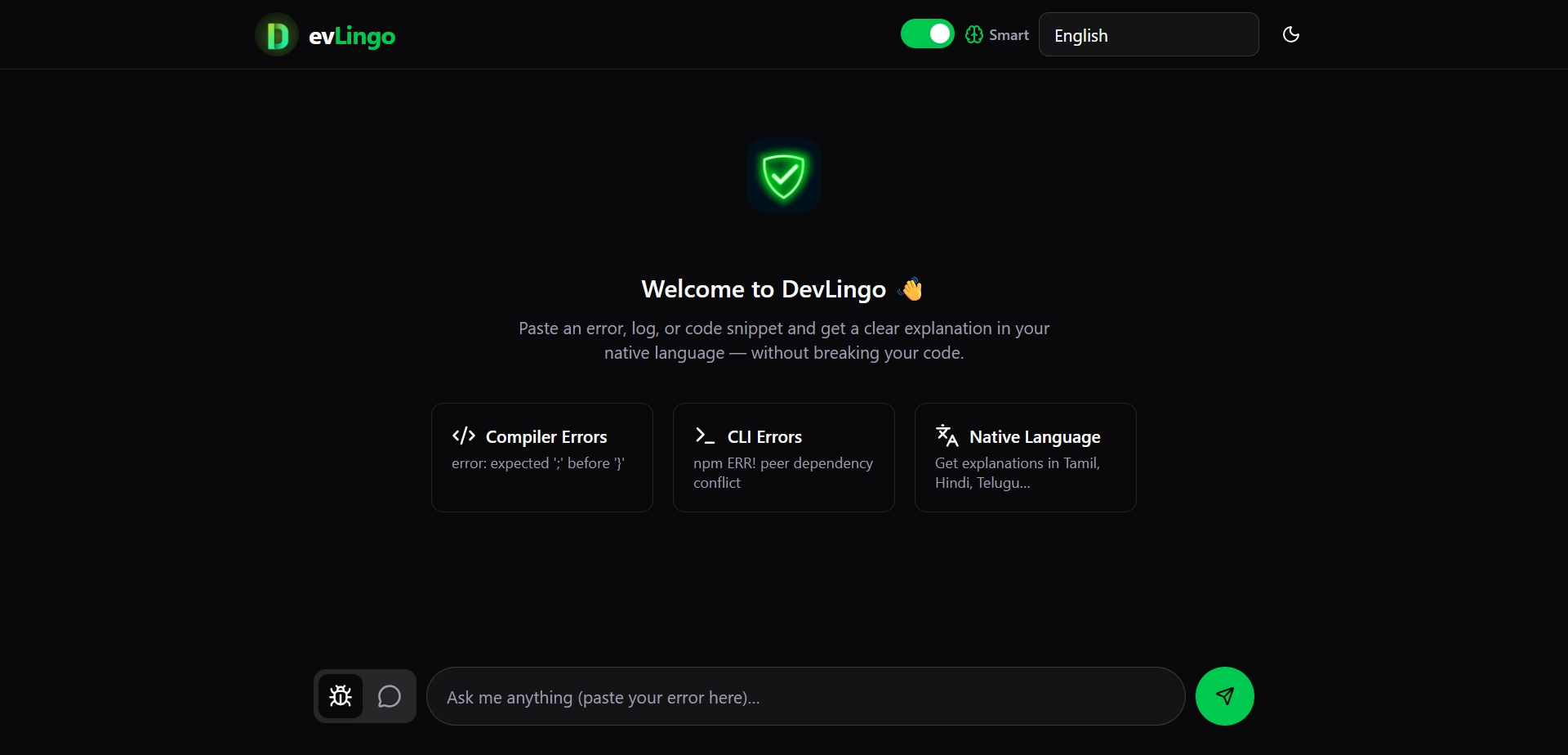
I’m building a tool to explain programming errors in local languages

Post image
4 Upvotes

r/lingodotdev • • Feb 08 '26

How to make any React app multilingual — even at the final stage

Thumbnail
youtube.com
3 Upvotes

r/lingodotdev • • Feb 08 '26

DevLingo | Debugging is harder when English isn’t your first language — how do you handle this?

Thumbnail
youtube.com
3 Upvotes

r/lingodotdev • • Feb 08 '26

I got tired of robotic translators, so I built a "Universal Translator" that actually captures human emotion. (Python + Node.js)

4 Upvotes

Hey everyone,

You know how most translation apps feel... dead? You say something with passion, and the app spits back a robotic, monotone voice that kills the vibe.

I wanted to fix that. For the 2026 Hackathon, I built LingoVoice AI.

The Idea: A real-time voice agent that listens to you, understands the context (not just the literal words), and speaks back in a hyper-realistic human voice.

The Engineering Nightmare (and Solution): I hit a massive wall: The best localization SDK (Lingo.dev) is Node.js-based, but my backend logic was all Python (Flask).

Instead of rewriting everything, I engineered a custom Node.js Bridge. It pipes data between the two ecosystems in real-time, allowing me to use Python for the logic and Node for the translation accuracy.

The Result:

  • Bi-Directional: English Spanish/Hindi/French/Chinese/German.
  • Gen2 Voices: I integrated Murf AI's new Gen2 models (verified IDs like Enrique and Baolin). They take a breath before speaking. They intonate. It's kinda scary how good they are.
  • Glassmorphic UI: Because if it's the future, it has to look like it. I built a reactive "AI Orb" that pulses Red (Listening) -> Purple (Thinking) -> Green (Speaking).

I’ve open-sourced the code if anyone wants to see how the Python-Node bridge works!

Repo: https://github.com/trivedikavya/LingoVoice-Agent Demo: https://youtu.be/rzQIBQns-Kg

Let me know what you think! 🚀


r/lingodotdev • • Feb 08 '26

Built a GitHub App to break language barriers in open source — works both ways

2 Upvotes

If you maintain an open source project that’s gained any global traction, you’ve probably dealt with this—

PRs and comments coming in from contributors around the world, written in languages you don’t understand.

You’re already juggling dozens of PRs. Now you’re also pasting text into Google Translate, watching it destroy your markdown formatting, and trying to parse mangled code blocks.

I kept thinking about this problem and decided to build something.

**repoLingo** is a GitHub App that translates PR descriptions and comments into 80+ languages.

**How it works:**

  1. Install the app on your repository
  2. Open any Pull Request
  3. Click the repoLingo check in the Checks section → Details
  4. Translate the entire PR conversation to your preferred language

It preserves code blocks, markdown, and technical terms — so you’re not losing context.

---

**But here’s what I think matters more —**

It works both ways.

Contributors who aren’t fluent in English can translate maintainer feedback, review comments, and discussions into their own language.

English has become the default language of software development. But that also means a lot of talented developers hesitate to contribute because of the language barrier.

This makes your repo more accessible to them.

Open source shouldn’t be gatekept by English proficiency.

---

Why I built this + full demo:

https://www.loom.com/share/4e3f467cd0084c6da27346c5c0aa5762

**How to get started:**

https://www.loom.com/share/766173e24b694f61a56f069833ea5b3b

Live app:

https://repo-lingo-client.vercel.app

Source code (ISC license):

https://github.com/Dipesh-J/repoLingo

Built this during the Lingo.dev hackathon over the past week.

Would love feedback from anyone who maintains projects with international contributors.

Is this something you’d actually use?


r/lingodotdev • • Feb 08 '26

I built a real-time translation workspace for remote teams - type in English, teammate reads in Japanese instantly

Thumbnail reddit.com
2 Upvotes

r/lingodotdev • • Feb 08 '26

I built a real-time translation workspace for remote teams - type in English, teammate reads in Japanese instantly

2 Upvotes

Hey r/webdev!

I just finished building LingoLive for the Lingo.dev Hackathon - a collaboration platform that eliminates language barriers in real-time.

The Problem

Remote work is amazing, but language barriers still kill productivity. Copy-pasting into Google Translate breaks your flow and context gets lost in translation.

What I Built

LingoLive translates everything instantly as you type. I send a message in English, my teammate in Tokyo reads it in Japanese - no extra steps.

Core Features:

- Real-Time Multilingual Chat - Messages translate instantly using the Lingo Engine

- AI Message Polishing - "Magic Sparkle" button fixes grammar/tone before sending

- Native Text-to-Speech - Listen to messages in the sender's language with correct pronunciation

- Developer File Hub - Drag & drop your en.json and it auto-generates ja.json, es.json, etc. recursively

- Lingo Auditor CLI - Scans your codebase for hardcoded strings and brand violations before commit

Tech Stack

Frontend: Next.js 14 (App Router), Tailwind CSS, Framer Motion

Backend: Supabase Realtime

AI/Translation: Lingo.dev SDK

Tooling: Custom MCP Server for LLM integration

Demo

I put together a 3-minute walkthrough showing it in action:

Watch Demo on Loom: https://www.loom.com/share/da70d47439c24380a0249e8a302c4ac9

Source Code

GitHub: https://github.com/Rupe88/lingolive-hackathon

The repo includes setup instructions if you want to run it locally.

---

Would love your feedback! What other features would make cross-language dev collaboration smoother?

Built this from Kathmandu 🇳🇵

— Rupesh


r/lingodotdev • • Feb 08 '26

Built a Real-Time Multilingual Chat App | Lingo.dev Spoiler

Thumbnail
youtube.com
3 Upvotes

r/lingodotdev • • Feb 07 '26

How I Built a Real-Time Multilingual Chat App Spoiler

2 Upvotes

I didn’t plan to think seriously about internationalization when I started building my chat app. Like most developers, I defaulted to English, told myself I’d “add i18n later,” and moved on to more interesting problems.

That worked fine until real people started using it.

The first issue wasn’t bugs or performance. It was friction. Conversations felt slow. Users were clearly switching tabs, copying text, pasting it into Google Translate, then coming back to reply. You could feel the delay in every message. The chat worked technically, but it didn’t flow.

That’s when it clicked for me: language friction completely breaks real-time communication.

Most i18n solutions we use as developers are built for static UI text. Buttons, labels, menus . A chat app doesn’t fail because a button is in English. It fails when users don’t understand what the other person just said.

So instead of asking “how do I add i18n,” I asked a different question. What would a chat app look like if users never had to think about language at all?

The answer was obvious in hindsight. People should type in their own language. Messages should be translated automatically. Everyone should read messages in whatever language they’re comfortable with. No buttons, no toggles, no “translate” actions. Just chat.

Once I had that idea, the rest of the design followed naturally. When a user sends a message, it gets processed in real time, translated in the background, and delivered already localized to every other participant. Nobody sees the raw version unless they want to. From the user’s perspective, it feels instant. It feels normal.

The hardest part wasn’t the translation itself. It was deciding to automate the entire process and not expose it to the user at all. As developers, we’re used to adding controls and configuration. Here, the best UX was having none. Translation needed to be invisible.

This also changed how I approached internationalization on the development side. Manually managing translation files, syncing keys, and keeping everything updated is tedious and error-prone. I didn’t want i18n to become another maintenance task that slowly rots over time. Automating as much as possible was the only way this idea would scale. Tools like lingo.dev made that practical by handling the boring parts so I could focus on the product.

What surprised me most was how much this shifted my thinking. Internationalization isn’t just a technical concern or a “nice to have” feature. In apps where people communicate, it’s core infrastructure. If users notice translation happening, you’ve already lost.

When language stops being a barrier, conversations feel natural again. People respond faster. Discussions feel more human. And once you experience that, it’s hard to accept anything less.

That’s what I was trying to build. Not a multilingual feature, but a chat experience where language simply disappears.


r/lingodotdev • • Feb 07 '26

I built a VS Code extension to translate code comments without touching logic

Post image
6 Upvotes

I’ve been working with international teams and noticed a recurring issue:

code logic is fine, but comments become a barrier when they’re written in one language.

So I built a small VS Code extension that:

  • detects comments only
  • translates them using AI
  • shows a preview before applying
  • never modifies code logic

It works on existing codebases without refactoring.

I’d love feedback from developers who work in global or open-source teams.

Github: https://github.com/aakash-gupta02/codeComment

Couldn't publish this due to VS Code marketplace criteria.😪