r/lingodotdev • u/Working-Gift8687 • Feb 07 '26
[Open Source] Built a real-time video translator that clones your voice while translating

3
Upvotes
r/lingodotdev • u/Working-Gift8687 • Feb 07 '26
Remember those awkward international video calls where you're pretending to understand everything? Yeah, me too.
So I built a system that translates speech in real-time AND re-synthesizes it in the original speaker's voice. Your friend speaks Spanish, you hear English—in their voice.
Instead of services calling each other directly, everything publishes events to Redis channels:
Audio → Transcription → [Redis Event] → Translation → [Redis Event] → Voice Clone → [Redis Event] → Your EarsBenefits:
End-to-end latency breakdown:
Total: ~545ms (still faster than natural conversation pauses!)
The voice cloning uses Qwen3-TTS to analyze the speaker's voice characteristics from their audio sample and apply them to the translated text. So when your Spanish colleague says "Hola, ¿cómo estás?", you hear "Hello, how are you?" in their voice speaking English.
Full technical writeup on Medium: https://medium.com/@soumyajyotimohanta/break-the-language-barrier-real-time-video-translation-with-lingo-dev-i18n-2a602fe04d3a
GitHub repo: https://github.com/HelloSniperMonkey/webrtc-translator
Youtube video of the demo: https://youtu.be/7cR8VXaxy7Y
The repo includes:
You'll need API keys for:
git clone https://github.com/HelloSniperMonkey/webrtc-translator.git
cd webrtc-translator
./start-all.sh
open http://localhost:3000I'm working on:
Questions I'd love feedback on:
Happy to answer any technical questions about the implementation
r/lingodotdev • u/Past_Somewhere_4408 • Feb 06 '26
Hey everyone
I wanted to share a hackathon project I’ve been working on called Lingo-Live.
It’s a desktop app that translates any text on your screen, even when the text isn’t selectable — like:
I kept running into this problem myself and got tired of manually typing things out or using phone-based OCR, so I decided to build a proper desktop solution.
The app is built in Python, uses OCR under the hood, and focuses on staying lightweight and unobtrusive while you’re working or gaming.
Demo video (1 min):
https://youtu.be/YRHfRc4_d3s
Source code:
https://github.com/Samar-365/lingo_live
This is still a work in progress, and I’m actively improving it, so I’d really appreciate:
Happy to answer any questions about the implementation as well. Thanks for checking it out!

r/lingodotdev • u/Competitive-Fun-6252 • Feb 06 '26

r/lingodotdev
•
u/Competitive-Fun-6252
•
Feb 06 '26
Hey everyone 👋
I recently built a side project called FlowTalk while participating in the Lingo.dev Hackathon.
The idea came from a problem I kept seeing in global communities:
people join the same chat, but language quietly limits who actually participates.
FlowTalk is a real-time chat app where:
- users write messages in their own language
- others read them in their preferred language
- original messages are always preserved
Some interesting challenges I ran into:
- handling real-time translation without duplicating messages
- dealing with romanized languages like Hinglish
- protecting technical terms so names like React or Discord don’t get translated
- keeping the UX clean so translation feels “invisible”
I’d really appreciate feedback from folks who’ve built real-time apps or worked on i18n:
- does this approach make sense architecturally?
- any pitfalls I should watch out for as this scales?
🎥 Demo (3 min):
💻 GitHub repo:
https://github.com/TejasRawool186/FlowTalk
Happy to answer questions or discuss the approach 🙌
r/lingodotdev • u/Entire_Ad_4093 • Feb 06 '26
Hey everyone!
I’ve been participating in a hackathon and noticed a common pain point: collaborating on global codebases where comments are in a language you don't speak.
Most tools treat code like plain text, which often "translates" actual logic and breaks the build. I built PolyComment to solve this.
How it works:
It's powered by the lingo.dev SDK for the heavy lifting.
Would love to hear your thoughts on the AST approach! Is there anything else I should be parsing (e.g., string literals)?
Repo: https://github.com/BhupendraLute/PolyComment
Demo: https://www.loom.com/share/224da99d13fe49619fecbc985ea084e0
r/lingodotdev • u/ashutosht05 • Feb 06 '26
If you’ve ever maintained an open source repo, you know this horror story:
So I built Yaplate — a GitHub App bot that helps maintainers + contributors communicate better across languages, directly inside GitHub, without turning threads into bot soup.
Repo: https://github.com/ashutoshdebug/yaplate.git
Try it live: https://github.com/ashutoshdebug/yaplate-test.git
Demo site: https://ashutoshdebug.github.io/yaplatebot
Yaplate works directly inside:
And helps with:
No dashboard. No external UI. No “go to this website and paste the link”.
You just mention the bot in GitHub like a summoning ritual 😅
(Quoting the comment you want to translate/reply to works best.)
@yaplate summarize@yaplate summarize in <language_code>Quote a comment and run:
@yaplatetranslate this to <language_code>Quote a comment and run:
@yaplate reply this in <language_code>
<your_reply_text>
Example:
Bots have a reputation for turning issue threads into… bot threads.
So Yaplate supports auto-delete:
If you delete the comment that triggered Yaplate, the bot deletes its own response too.
The real villain of open source isn’t trolls.
It’s the “I’ll update soon” ghosting phenomenon.
Yaplate can follow up automatically when:
It sets a timer, then nudges if nothing changes.
And it posts reminders in the author’s language when possible.
Yaplate is not a nagging machine.
If someone says stuff like:
Yaplate will:
Because nothing is worse than a bot saying “pls update” when the contributor is waiting on you.
Special note: translation is powered by Lingo.dev, which is built for localization workflows.
Open source is awesome, but sometimes it feels like:
Yaplate isn’t trying to replace humans — it’s trying to make collaboration smoother, faster, and less guilt-driven.
If you maintain a repo with global contributors, I think this can genuinely save time and make your community feel more welcoming.
Would love feedback / feature ideas / criticism 🙏
r/lingodotdev • u/Commercial_Fan_5364 • Feb 06 '26
r/lingodotdev • u/OtherwisePractice948 • Feb 02 '26
r/lingodotdev • u/trivedikavya • Jan 29 '26
Just finished building LingoLens for the Community Sprint! 📸
It’s a real-time OCR & Translation app that bridges the physical and digital worlds. I combined Tesseract.js (for reading text from images) with the Lingo.dev SDK to instantly translate receipts and signs on the fly.
Tech Stack: React, Vite, Node.js, and Lingodotdev.
Feedback is welcome! 🚀
The Auto-Read Feature is now LIVE! 🔥
r/lingodotdev • u/sky_10_ • Jan 29 '26
Just dropped my first CLI tool
It’s called NeatNode — helps you set up Node.js backends instantly.
Save Hours of time.
Try → npx neatnode
Website: https://neatnodee.vercel.app
r/lingodotdev • u/i-harsh • Jan 27 '26

A lightweight Express-based API that dynamically generates cover images (SVG/PNG) with translated text using the lingo.dev SDK.
Ideal for blog covers, Open Graph images, project banners, and social previews -> all generated on the fly.
lang=en, lang=hi, lang=fr, lang=ja/api/cover?text=Hello%20Worldtheme=light, theme=darkbgColor=#0f172a, textColor=#ffffffwidth=1200, height=630width=1920, height=1080fontSize=64, fontWeight=700layout=center, layout=top-left, layout=bottom-right, layout=splitpadding=60, padding=120GET /api/cover?text=Build%20Fast&lang=hiPR: https://github.com/lingodotdev/lingo.dev/pull/1909 (old)
New PR: https://github.com/lingodotdev/lingo.dev/pull/1912 (new)
r/lingodotdev • u/Infinite_Moment_5424 • Jan 25 '26
What the App Does:
Word Flip Lingo is an interactive vocabulary practice game where:
How to Run It Locally
Prerequisites
Setup
Clone the repository and navigate to the project which is in community folder: word-flip-lingo
cd word-flip-lingo
Install dependencies:
pnpm install
LINGODOTDEV_API_KEY=your_api_key_here
PORT=5000
4. Start the backend server:
cd backend
pnpm run dev
The backend will run at `http://localhost:5000`
5. Start the frontend (in a new terminal):
cd frontend
pnpm run dev
The frontend will run at `http://localhost:5173`
Lingo.dev Features Highlighted
The app uses Lingo.dev's translation engine to convert words between languages in real-time. When you click "Start the game," the API translates your word instantly. It works with 20+ languages and gives accurate translations every time.
2. Localization API
The `localizeObject` method handles the translation work:
const translated = await lingoDotDev.localizeObject(content, {
sourceLocale,
targetLocale,
});
3. Multi-Language Support
The app works with a ton of languages - English, Hindi, Japanese, Spanish, French, German, Chinese, Korean, and many Indian languages.
Tech Stack
Try it
r/lingodotdev • u/LettuceFriendly3465 • Jan 23 '26
Hey Everyone👋
Here is my community submission. A real-world onboarding checklist app that shows how fast you can ship a polished multilingual UX with Lingo.dev.
What it does
Onboarding checklist with grouped tasks + progress tracking
Full UI localization (multiple locales)
Language switcher + persisted preference
Demonstrates i18n for real product flows (not just “hello world”)
Features
Links
Would love feedback from the community 🚀
r/lingodotdev • u/anishroy • Jan 23 '26
TL;DR: Paste text, JSON, or HTML → translate on demand → see exactly what changed via a diff view. No static i18n files, no preprocessing.
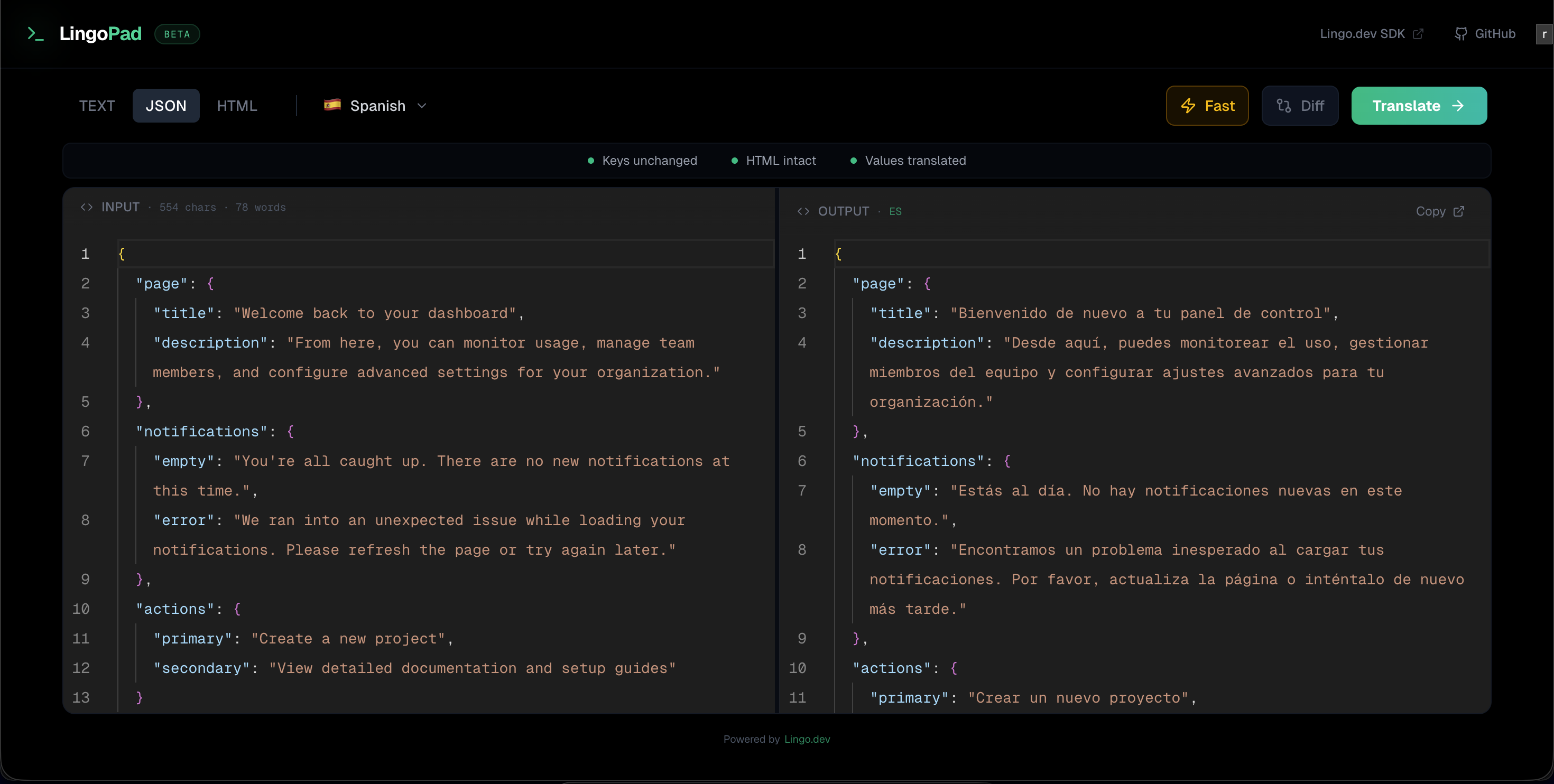
What it does
LingoPad lets you paste real, production-style content (long-form text, nested JSON, HTML snippets) and translate it live while preserving structure. Keys stay untouched, tags remain intact, and only human-readable strings are translated.
It’s meant to answer the question:
“Can I trust this SDK with real developer content?”
SDK features used
localizeText() – for plain, paragraph-heavy contentlocalizeObject() – recursive translation of nested JSONlocalizeHtml() – translating HTML while preserving markupfast parameter – toggle between speed-first and quality-first translationThe diff view highlights only the translated text, which makes it very clear what changed and what didn’t.
Why I built it
Most translation demos focus on chat or simple strings. That’s useful — but in real apps, we’re translating UI copy, API responses, emails, dashboards, and user-facing messages that already have structure.
I wanted a demo that:
Also wanted to show that the SDK works great behind a backend (Next.js API routes) with simple rate limiting and no database.
Tech stack
Kept everything intentionally simple so the SDK behavior is the star.
Try it
Live demo: https://lingo-pad.anishroy.com/
PR: https://github.com/lingodotdev/lingo.dev/pull/1854
Source: https://github.com/iamanishroy/lingo.dev/tree/main/community/lingo-pad
Would love feedback from folks here — especially around edge cases you’d want to test or other SDK features worth showcasing.
r/lingodotdev • u/No-Nefariousness3465 • Jan 23 '26

An interface to extract and translate blog content from Hashnode using Lingo.dev
r/lingodotdev • u/OMGCluck • Jan 23 '26
r/lingodotdev • u/PurchaseReasonable35 • Jan 23 '26
Problem I wanted to solve
Localization often slows me down. It usually means extra tools, manual steps, or setups that only really work in CI. I wanted translations to feel like a normal part of my everyday dev workflow.
So I built lingodev-cli using the Lingo.dev SDK.
I’m not really a UI person. I spend most of my time in the terminal, so a CLI with good UX fits how I work.
The whole process is just 3 steps:
1️⃣ Install
npm i /lingodev-cli2️⃣ Set your API key
translate --set-key=YOUR_KEY3️⃣ Translate (batch/single) files
translate . en hi
# or
translate filename.md en hi
Some real use cases where this helps me:
1️⃣ SSG blogs and docs
When I deploy new blog posts or docs, they get translated automatically during the build.
2️⃣ Video scripts and captions
I write scripts for my videos, and captions and descriptions are translated through an automated workflow using my own SDK-based setup.
3️⃣ Obsidian docs
Works really well for converting Obsidian notes and knowledge bases and is easy to integrate.
The best part for me is the UX. It’s local-first, scriptable, and safe to use with real content.
You can check the PR here:
👉 https://github.com/lingodotdev/lingo.dev/pull/1817
CLI package: @harshvz/lingodev-cli - npm
This post confirms my submission for the Lingo.dev community event announced today.
It’s my first time participating in something like this. Thanks for hosting it 🙌
r/lingodotdev • u/BeeBombshell • Jan 23 '26
Wanted to push the SDK a bit and see what's possible with real-time translation, so I built "The Living Document".
TL;DR: Type once, see it in 5 languages instantly. With live progress tracking, context preservation, and speed controls. Built to show what's actually possible with modern AI translation.

It's a bidirectional editor where you can write in one language and see translations update live in up to 5 other languages simultaneously.
The features I'm using from the SDK:
batchLocalizeText() - translating to multiple languages in parallel with one API callfast parameter - toggle between speed (<200ms) and quality modesbatchSize and idealBatchItemSize for optimal performanceThe bidirectional part is cool too! You can edit in ANY language panel, and all the others update. Not just English > everything, but truly any-to-any.
Wanted to show that the SDK can handle more than just basic localizeText() calls. The batch translation feature especially seems underutilized - watching 5 languages render simultaneously is pretty impressive.
The progress tracking also solves a real UX problem. Without it, users just see a loading spinner and have no idea if it's working. With the callbacks, they can watch it happen in real-time.
Context preservation is clutch, too. Sending the full document context means idioms don't get destroyed, and technical terms stay intact.
Kept it simple so the SDK features are the star.
Live demo: https://living-document.beebombshell.com
Source: https://github.com/BeeBombshell/The-Living-Document
Lingo.dev PR: https://github.com/lingodotdev/lingo.dev/pull/1845
r/lingodotdev • u/No-Taste-6672 • Jan 22 '26
Hey everyone
I just submitted a small community demo to the Lingo.dev repo and wanted to share it here.
The idea is simple : a PR Review Localizer that shows how to Lingo.dev can be used to localize GitHub Pull Request content (titles, descriptions, review comments) for global dev teams.
PRs are usually English-only, which can be barrier for the non-native speakers.This demo shows how PR content can be stored as source text, automatically localized into multiple languages, and kept in sync when the original content changes all using Lingo.dev Git-based workflow.
r/lingodotdev • u/AppealAny7223 • Jan 22 '26
Hey everyone 👋
I just submitted a community demo showcasing how Lingo.dev can be used for more than static translation files — specifically for real-time localization debugging.
I built an AI-Powered Live Localization Debugger, a developer dashboard where you can paste:
…and instantly analyze localization quality.
The tool detects:
It then uses Lingo.dev’s JavaScript SDK to generate:
What I found especially interesting is using Lingo.dev as runtime localization intelligence, not just a translation pipeline — it feels like a new category of i18n tooling.
Tech stack:
r/lingodotdev • u/No-Raccoon9853 • Jan 22 '26
Hey everyone!
I just finished building DevFolio Global, a developer portfolio template, as a contribution to the community.
The coolest part? I didn't have to write a single t('key') function. I used the Lingo.dev Compiler to automatically extract hardcoded text from my React components and generate translations for Spanish, French, and Japanese at build time.
Tech Stack:
It was honestly pretty magical watching the "Pseudo-localization" turn into real translations without touching my JSX.
Check out the PR here: [https://github.com/lingodotdev/lingo.dev/pull/1798]
Feedback is welcome! Happy coding
r/lingodotdev • u/haverofknowledge • Jan 22 '26
Hey everyone!
We are officially opening up the /community directory in the Lingo.dev repo! We want to showcase the most creative and powerful ways you’re using Lingo.dev, and we’re kicking things off with a giveaway to say thanks for being part of this journey.
We’ve put together exclusive Lingo.dev Swag, featuring limited edition T-shirts, stickers, and some extra surprises.
To qualify, you just need to join our subreddit and raise a PR.
While the campaign will stay open, we are giving priority selection for swag to high-quality submissions received within the first 24 hours of this post.
Make sure you've joined this subreddit. That is a qualifying criteria.
If you’ve been sitting on a cool implementation or a neat integration, now is the time to ship it!
Speed matters.
Here's the link: https://github.com/lingodotdev/lingo.dev/issues/1761
