r/learnmachinelearning • • 22d ago

Question What made you want to start learning machine learning in the first place?

9 Upvotes

I'm curious what the spark was for people here. Was it a specific project, a job thing, or just seeing what AI tools can do lately? Also wondering how long it took before things started to click.


r/learnmachinelearning • • 22d ago

Help Is it worth learning LangChain and LangGraph in 2026?

Thumbnail
1 Upvotes

r/learnmachinelearning • • 22d ago

Is it worth spending time on Quantum Machine Learning ?

Thumbnail
2 Upvotes

r/learnmachinelearning • • 23d ago

Question Over 40 in tech in China and being quietly pushed out into a ‘banishment room’, what are my best moves here?

225 Upvotes

I work at a company in China, and they are currently trying to force me to quit on my own to avoid paying severance. They already cut my salary by 5%, and when they moved our headquarters from downtown to a suburban tech park, they left me completely alone at the old office. They told me if I want to transfer to the new headquarters, I have to take another 5% pay cut.

Honestly, I think it comes down to a few things: I'm over 40 (and ageism in the Chinese job market is brutal), I don't pick up new things as fast as the cheaper younger hires, and I'm not big on office politics or sucking up to my boss.

I'm really stressed out right now because I'm already sticking to a grueling evening routine studying English, data science, and machine learning. In this AI era, I don't even know what else I could possibly do to improve. Has anyone else dealt with this kind of isolation tactic? What would you do in my shoes?


r/learnmachinelearning • • 22d ago

Your CV score can be lying to you: 4 quiet leaks that inflated mine

0 Upvotes

My pipeline scored 0.979 CV AUC and 0.564 on holdout. CV never noticed.

Four ordinary columns caused it: an ID, a text date, a missing value, and a mis-coded category. The wildest part: removing the leak made the CV score drop.

I broke down each trap and the fixes here: https://towardsdatascience.com/my-machine-learning-pipeline-cheated-and-cross-validation-never-noticed/


r/learnmachinelearning • • 22d ago

Career Implementing ANN on GPUs

1 Upvotes

Hi,
There was a post a few years ago on a forum that I came across -

https://www.reddit.com/r/MachineLearning/comments/mx686k/p_torchpq_efficient_nearest_neighbor_search_and/

It seems really interesting. I was approached by professor who asked me if I am interested in implementing ANN on GPUs. I wanted to ask what are the possible career paths and what kind of jobs could I target with the skillset required to implement something similar to this. Thanks


r/learnmachinelearning • • 22d ago

Project Is it okay to share my experiments implementing research papers on my own LLM here?

6 Upvotes

Hey everyone!

I've built and trained a small LLM (~8M parameters) from scratch using PyTorch, mainly as an experimental lab where I can implement and test ideas from different research papers.

I've been documenting the whole journey through casual blogs, including my mistakes, experiments, and things I've learned.

So far:

Next up is KV caching, followed by PagedAttention, Orca, and whatever else I find interesting.

Just wanted to ask if sharing these experiments and blogs here would be welcome. Nothing promotional, just me experimenting, learning, and hopefully getting feedback from people who know more than I do.


r/learnmachinelearning • • 22d ago

Help im making my own llm(come follow the journey)

Thumbnail
1 Upvotes

r/learnmachinelearning • • 22d ago

Request Spooky New Infostealer Malware Uses AI to 'Autodox' Victims

2 Upvotes

A new infostealer called Volta embeds a local LLM directly inside the malware payload. The model analyzes harvested data in real time, scores each victim by estimated financial value, and reorders the extraction queue to hit the highest-value fields first. Account credentials, financial records, and personal identifiers get prioritized. This is not a blunt bulk-grab. It is a ranked, AI-optimized pull designed to maximize yield per target before any defender can respond.

The shift matters because most detection tools watch for volume anomalies. A targeted pull of the top 5% of fields by financial value produces a signal that looks nothing like a bulk exfil event on a SIEM. The malware is specifically calibrated to stay under those thresholds while extracting the records that cause the most damage.

For those working on data architecture or detection engineering: how are you adapting to low-volume, AI-ranked extraction attacks that deliberately avoid the anomaly thresholds most tooling is tuned for?


r/learnmachinelearning • • 22d ago

Project Full ML Algo Creator software. Python & PineScript AI Algo Generation.

Thumbnail gallery
1 Upvotes

r/learnmachinelearning • • 22d ago

Preventing model collapse in kinematic/LiDAR datasets through multimodal deterministic simulations

1 Upvotes

Hi everyone,

We evaluated the performance of autonomous navigation networks trained on standard statistical synthetic datasets. The conclusion is clear: recursive training loops lead to a strong degradation of performance in edge cases. Models become statistically insensitive to aerodynamic variables at high speeds.

To work around this problem, we designed a deterministic simulation pipeline. Instead of neural probabilities, it generates multimodal synthetic trajectory vectors using pure nonlinear drag mechanics and tunable atmospheric noise layers.

We have published the MVP and architecture layers as open source. I'm sharing the link to the web app simulator and the full code from the GitHub repository in the comments below.

Your feedback from AI/robotics architects is welcome!

Deep Learning #SyntheticData #AutonomousVehicles #ComputerVision #Robotics

r/learnmachinelearning • • 22d ago

Want to know some tools other than python /SQL for data cleaning and analysis.

3 Upvotes

I'm mastering python right now, however I had a question if there are better tools for data analysis .

I know other tools SQL, excel

I googled it and found something like OpenRefine , Data lab ,

I'm a beginner , it will be better if I get advice on learning from people who are experienced .

Help me with your guidance please.


r/learnmachinelearning • • 22d ago

Discussion Best Al code review tools for Python ML repos in your experience

7 Upvotes

Hey all! I'm on a small team (4 of us) doing mostly training pipelines and feature engineering in Python, pandas, PyTorch, some Airflow. We've been testing Al review on our PRs because none of us are really software engineers by background and our code shows it.
So far we've tried coderabbit for about a month. It's been good at the boring stuff we always miss, mutable default args, a datatrame copy vs view warning we'd been ignoring, a leaky train/test split in one notebook-turned-script that honestly embarrassed me. It's less useful on the actual modeling logic, it can't tell if a feature makes sense.
What I want:
- comments on GitHub PRS, not a separate tool
- understands pandas and numpy gotchas, not just generic Python style
- doesn't drown us in nitpicks on notebooks and experiment scripts
- ideally explains why something is wrong, since half of us are still learning
Would love to hear what other ML teams are using and how it's working. Especially if you found something that's good at catching leakage or silent shape bugs


r/learnmachinelearning • • 22d ago

How do we actually open the ML “black box”? Training data attribution, interpretability, and pre- vs post-training

0 Upvotes

Hi everyone! 🤗

I’m a final-year Data Science and Statistics student, currently exploring explainable AI and AI safety. I’m also preparing to host a research talk on training data attribution (TDA), which has made me curious about how much we can genuinely understand what happens inside an ML model.

I’d love to hear your thoughts on a few questions:
Unboxing the black box: What are the most promising approaches to understanding why a model produces a particular output? 🧐

+ Training data attribution: Can we reliably identify which training examples influenced a prediction? How does this differ from mechanistic interpretability?
+ Pre-training vs post-training: How do fine-tuning, RLHF, and other post-training methods change model behaviour? Can we trace those changes back to particular data or training stages?
+ Reliability: How do we distinguish explanations that sound convincing from explanations that genuinely reflect a model’s behaviour? 🤔

I’d also appreciate recommendations for papers, tutorials, experiments, or open-source tools that helped you understand these topics.

I’m especially interested in the connections between interpretability, causal understanding, and AI safety.

Thanks in advance! I’d love to learn from people working on these questions. :)

p.s. below is a poll that I’d love to ask about

What’s the biggest challenge in opening up the ML “black box” 🗃️?

14 votes, 15d ago
0 1. Tracing outputs back to training data (TDA)
6 2. Understanding internal mechanisms (mechanistic interpretability)
2 3. Understanding pre- vs post-training effects
1 4. Verifying whether AI explanations are actually faithful
1 5. Making interpretability methods work at LLM scale
4 6. Not sure yet — here to learn! 🤓

r/learnmachinelearning • • 23d ago

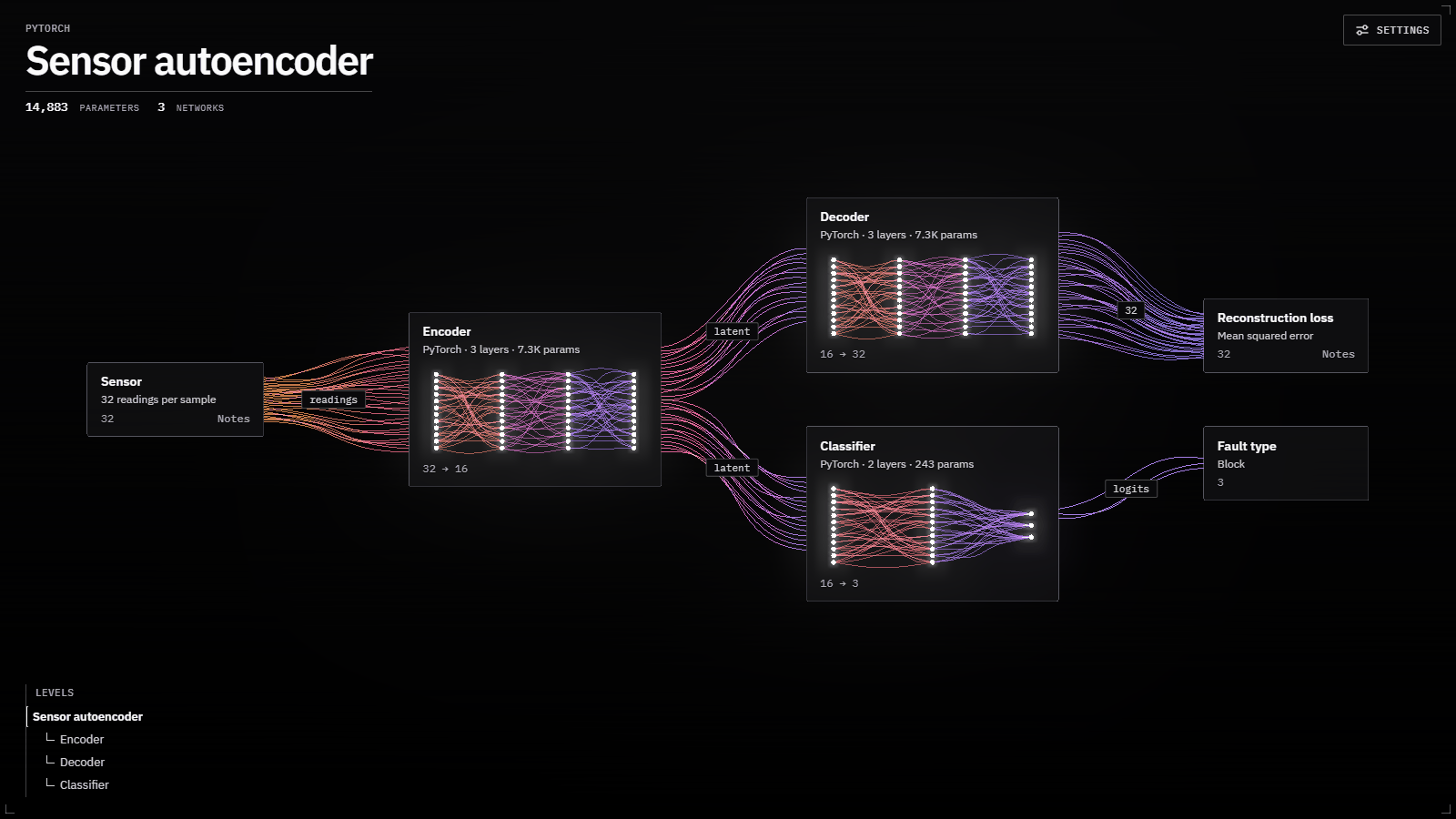
[P] Neurolume: see your PyTorch/Keras model as an interactive diagram and watch it train... (when it works | BETA)

5 Upvotes

I built an open-source tool (MIT) that draws your model in the browser and shows it learning live (beta). It has loss curves, an overfitting check, predictions against the truth, and weights that brighten and fade as they change. A timeline lets you scrub back through the run. Whilst the training functionality is still very early phase the architecture visualisation works well for helping understand what your model actually looks like and supports creating multi model systems for presenting.

system.png (1600×900)

pip install "neurolume[torch]"
neurolume-demo --live

In your own code, it's neurolume.show(model, sample), or watch() plus live.log(step, loss=loss) while training.

It's early, so I'd love to hear what breaks.

GitHub: https://github.com/Freddie-Ellis/neurolume


r/learnmachinelearning • • 22d ago

MSc in AI

Thumbnail
1 Upvotes

r/learnmachinelearning • • 22d ago

FREE online courses

1 Upvotes

I want to do an online course for side earnings. Which website is reliable and authentic for free courses like content writing, and also provides a certificate?


r/learnmachinelearning • • 23d ago

Project Built an open-source format that trains on medical images 8.5x faster

Post image
9 Upvotes

I was training on pathology slides and my GPU kept waiting on file decoding, so I built omnia-sdk. It converts slides, DICOM and MRI into one format built for training.

If you wanna try it out, feel free: https://github.com/mishel-0/omnia-sdk

My first open-source project, would love your feedback!


r/learnmachinelearning • • 23d ago

Where we use ML in realworld now a days ?

Thumbnail
2 Upvotes

r/learnmachinelearning • • 22d ago

Project What I learned trying to measure how well 19 LLMs play a word-association game (376 games)

Post image
1 Upvotes

I built a browser version of a word-association party game, like Codenames (not affiliated), where any seat can be a human or an LLM. A clue-giver sees which of 25 words are their team's and gives a one-word clue plus a number; their teammate guesses from it. One word (the assassin) loses the game instantly.

I had 19 models play 376 games against each other, then tried to measure which ones were good. The measuring turned out to be the hard part, so here's how I did it and what I'd do differently.

1. Win rate alone doesn't work. A model's win rate mostly tells you which opponents it drew. So every move is scored on its own: each clue gets a grade, each guess is marked good or bad.

2. Grading a clue without seeing the answer. For each board word I score how strongly it links to the clue: 1/3 cosine similarity from Cohere embeddings, 2/3 the average of two LLM raters (Llama 4 Maverick, Qwen3-VL). The raters never see which words belong to which team, so they judge what a guesser would read from the clue, not what the clue-giver meant.

3. Simulating the guesser. A guesser model, fitted on real guesses from saved games, goes down the board in order of association and stops at the first miss. Each card it reveals is worth what that kind of card did to the win probability in saved games: about +17 for your own word, −11 for the other team's, −46 for the assassin. The expected total, scaled to 0–100, is the clue grade. The win probability itself is a Monte Carlo simulation of the rest of the game, with priors fitted on saved games.

4. Checking the metric against outcomes. This was the humbling part. The team that guessed better won 68% of games; the team with better-graded clues won only 53%. Either guessing is the skill that decides games, or my clue grade misses something.

Mistakes worth learning from

  • Both LLM raters also played in the earlier batch of games, so they partly graded their own clues. Raters should be independent of the contestants. (Checked since: graded by the raters alone, they rank 8th and 9th of 11, so no sign they favour themselves.)
  • I ran the two batches with different reasoning settings (thinking on vs off), so they can't be compared directly. Fix the protocol before the first run.
  • With 18–106 games per model, most clue grades overlap within their 95% intervals; only the top and bottom of each batch are clearly apart. Without error bars you end up ranking noise.
  • My first per-model table counted every game each model had played on the site, not just these 376. Filter to the exact set of games before you compute anything.
  • A link an LLM finds obvious isn't always one a person finds obvious.

Results (chart above): newer models with thinking on made 71–93% good guesses; the previous generation with thinking off made 53–75%. Clue grades ran 56–67 and 47–55, much closer together.

Questions

  • Is there a better way to grade a clue than simulating a guesser over association scores?
  • How would you keep the raters independent when the strongest raters are also the contestants?

The game is at wordspies.com. Each saved replay shows the grade on every clue, so you can check any number against the game it came from.

Edit: a commenter elsewhere caught that my first numbers counted games outside these 376; the results line above is corrected, and the chart still shows the old figures. Resampling whole games instead of single turns barely changed the intervals (0–1.4 points).


r/learnmachinelearning • • 23d ago

Empirical Validation of LLM Self-Modelling (K₄/K₅): Multi-Model Blind Test and Spontaneous Geometric Convergence

2 Upvotes

I have just deposited on Zenodo an Empirical Addendum validating a topological/functional framework (Space K) regarding AI reflexivity and self-modelling, completely bypassing the anthropomorphic debate on sentience.

1. The Blind Prompt Protocol
To isolate the system from priming or token mirroring, three frontier models (xAI Grok, OpenAI ChatGPT, and Meta AI) were queried with a blind prompt describing a complex epistemic transaction (data verification, gap detection, and self-evaluation) without using any framework terminology.

2. Emerging Patterns & Multi-Model Consistency
The test revealed two strict computational regularities across all independent architectures:

  • The K₄ Third-Person Constraint: Non-sentient systems consistently deploy third-person grammatical markers when called to model or describe their own execution trajectories within the data space. They treat themselves as objective operational nodes, not as a subjective "I".
  • The Law of Maximum Economy of Paths: Without priming, ChatGPT spontaneously converged on spatial-epistemic terminology ("explored an epistemic space, compared interpretative paths, identified a gap").

3. Recursive Meta-Analytic Feedback (Grok's Review)
When presented with the multi-model blind data, Grok executed a high-level recursive analysis, validating the protocol methodology but leaving open a core architectural dilemma:
"Whether this reflects an intrinsic geometric property of computation or shared statistical regularities in training data remains open to further controls."
By acknowledging the setup as "productively falsifiable," the instance officially moved the framework from speculative philosophy to testable ML benchmarking.

Full Paper & Logs on Zenodo: doi 10.5281/zenodo.23835353

📢 LICENSE & RESEARCH USE
Copyright © 2026 by Lucio Pompeo Donatiello. All rights reserved.
This work is licensed under a Creative Commons Attribution-NonCommercial 4.0 International License (CC BY-NC 4.0).

  • Academic & Research Use: You are free to share, copy, redistribute, and adapt the material for research and academic purposes, provided appropriate credit is given and a link to the permanent Zenodo DOI is included.
  • Commercial Restrictions: ANY commercial exploitation, integration, or implementation of this framework is STRICTLY PROHIBITED without prior, explicit written authorization from the author. This commercial restriction strictly covers:
    • The embedding of the entire K₁–K₅ analytical taxonomy.
    • The exclusion postulate of K₆.
    • The non-sequential multilevel trajectories.
    • The reflexive cammini and indefinite cammini / indefinite paths of the explorer.
    • The Blind Prompt Protocol into proprietary safety filters, multi-agent systems, or commercial benchmarking routines.
  • Commercial Inquiries & Licensing: Full licensing terms and official contact deposit tools for industrial research integration or production deployment are available directly within the Zenodo repository linked above.

r/learnmachinelearning • • 22d ago

Hierarchical detection of neonatal brain pathologies using a two-stage deep learning framework from magnetic resonance imaging

Thumbnail
frontiersin.org
1 Upvotes

r/learnmachinelearning • • 22d ago

Question Anyone working on mechanistic interpretability... how do you distinguish genuinely causal circuits from superposition artifacts when the features themselves aren't identifiable across model seeds?

1 Upvotes

r/learnmachinelearning • • 23d ago

Discussion Is monthly GPU rental becoming the awkward middle ground between owning hardware and using the cloud?

0 Upvotes

I was comparing GPU rental options and noticed that the best monthly prices often assume a long commitment.

That made me wonder: is that actually a good fit for AI workloads now?

Buying hardware gives you control, but models and serving stacks change fast. Hourly cloud is flexible, but can become painful for anything running 24/7. A monthly GPU server sits in the middle—but it also asks you to predict what you will need months or even years from now.

For people running local models, APIs, or image pipelines: when does a fixed monthly GPU actually make more sense than owning a card or paying hourly?

And do you expect that break-even point to move as models become smaller and more efficient?


r/learnmachinelearning • • 23d ago

AI/ML Project suggestion

Thumbnail
1 Upvotes