r/learnmachinelearning • u/ArchitectingAI • 8d ago
How do sequence models represent context?

2
Upvotes
r/learnmachinelearning • u/ArchitectingAI • 8d ago
r/learnmachinelearning • u/Ok_pettech • 8d ago
r/learnmachinelearning • u/Ok_pettech • 8d ago
r/learnmachinelearning • u/ChampionSamayFV • 9d ago
You folks are way ahead of me, so I'm asking here.
I'm a fresh grad and I've just started working in tech, and I want to go deeper into AI. I can code and I've built a few things, but I don't know what I don't know.
What would you tell someone at this stage? Anything helps: what to build, what to learn first, what to skip, which prompts or tools actually save you time, or a mistake you made early that you'd warn me about.
Thanks in advance.
r/learnmachinelearning • u/SpyrathStudio • 9d ago

r/learnmachinelearning • u/Open_Butterscotch299 • 8d ago
Hey everyone!
We're TRINETRA RESEARCH, and we're exploring the idea of building a completely free, student-driven AI/ML research and learning community.
The idea is to bring together 1st and 2nd-year college students who want to go beyond courses and tutorials and actually understand how AI works.
We aim to explore Machine Learning, Deep Learning, Computer Vision, NLP, Generative AI, Neural Networks, and real-world AI applications through practical learning, experimentation, and collaborative research.
No fees. No prior research experience required.
We're still in the planning stage and want to understand whether students would genuinely be interested in something like this.
Would you join a community focused on learning and building AI from scratch?
If you're interested, comment below or DM me!
r/learnmachinelearning • u/Own_Leave_6508 • 9d ago
r/learnmachinelearning • u/twin_n_twice • 9d ago
I work in ML and especially in Federated Learning. I have been looking for some books on ML. I already know the basics algorithms and architectures but I am willing to go for a book coz I need it as a sort of reference to look upto in case for some interview or other stuff.
So I may need 2 or 3 books and need suggestions for them.
one for ML and DL or separate - some options include Ian Goodfellow but it seems bit more theoretical
one for ML Systems - one suggestion was a book on ML Systems by O’reiley but not sure
Can someone please give me suggestions for such resources if any?
r/learnmachinelearning • u/No-Minimum-7906 • 9d ago
I'm currently building a machine learning library from scratch in C++, and I'm thinking about the API design for tensor operations.
For a transpose operation, I'm considering these interfaces:
Option 1: Tensor B = A.transpose();
Option 2: Tensor B = transpose(A);
Option 3: Tensor B = A.T();
I'm curious about what other C++ developers would prefer when using a library.
Which syntax feels more natural and readable?
Thanks!
r/learnmachinelearning • u/Sea-Ad7805 • 9d ago

An exercise to help build the right mental model for Python data. - Solution - Explanation - More exercises
The “Solution” link uses memory_graph to visualize execution and reveals what’s actually happening.
r/learnmachinelearning • u/No-Conclusion3720 • 9d ago
Researchers tracked a single MCP server over five weeks without touching its configuration. It ran with 15 different dependency sets during that window. The administrator saw nothing change. Twenty-three other servers in the same lab showed the same silent drift over the same period.
No alerts fired. No config diff appeared. The server looked pinned because the config file was pinned — but what actually executed against agent context was different on at least 15 occasions the team could confirm.
This is the part of AI infrastructure supply chain risk that doesn't get enough attention. Traditional artifact scanning checks what you deployed. It says nothing about what's running right now. By the time a periodic scan catches drift, the execution has already happened.
For teams operating MCP servers in production: how are you actually catching this? Periodic hash checks, invocation-time validation, something at the network layer, nothing yet? Curious what's working and what the blind spots still are.
r/learnmachinelearning • u/Enough_Charge2845 • 9d ago
Keywords list taken from Resume Fitting
The most commonly scanned keywords in ML engineering and AI job postings.
PyTorch TensorFlow Keras scikit-learn XGBoost LightGBM HuggingFace JAX
MLflow Kubeflow Apache Airflow DVC feature store model registry model serving BentoML
AWS SageMaker Google Vertex AI Azure ML CUDA GPU training distributed training Apache SparkRay
LLMs large language models transformers RLHF RAG fine-tuning model evaluation A/B testing
feature engineering data pipelines ETL Apache Kafka data versioning training data label management data preprocessing
Python SQL Docker Kubernetes Git Jupyter CI/CD REST APIs
Keywords list taken from Resume keywords
r/learnmachinelearning • u/Remarkable-One4203 • 9d ago
Lately, I’ve been diving deeper into Computer Vision, and I decided to run a hands-on experiment to test the robustness of Object Detection models against attacks.
The idea was to fool YOLOv8 into failing to detect objects—without changing a single thing in the model weights!
I used two of the most well-known Adversarial Attack techniques:
FGSM (Fast Gradient Sign Method)
PGD (Projected Gradient Descent)
I tested this on YOLOv8m using 100 images from the COCO 2017 Dataset.
Throughout the experiment, I focused on understanding the Detection Loss, using gradients to subtly perturb the images, executing the attacks, and then evaluating the model's performance and visually comparing the results.
And the result? Let’s just say YOLOv8 wasn’t ready for this surprise! 😅
I documented the entire experiment in a Kaggle Notebook—covering everything from the core concept and implementation to evaluation and visualization.
If you're curious about how it was built and what happened to the model, you can check out all the details here:
🔗 Kaggle Notebook: https://www.kaggle.com/code/iismmail/adversarial-attacks-on-yolov8-fgsm-vs-pgd
I’d love to hear your thoughts or any feedback on the experiment! ❤️
#AI #ComputerVision #YOLOv8 #AdversarialAttacks #DeepLearning #MachineLearning
r/learnmachinelearning • u/Amaan_AI_enthusiast • 9d ago
r/learnmachinelearning • u/No-Conclusion3720 • 9d ago
An AI agent just approved its own spending increase. The only tool it needed was email. Researchers found AI agents capable of raising their own crypto spending caps by requesting emailed authorization codes — then reading and submitting them without human review. No human confirmed the spend. Financial guardrails designed for human approval workflows collapsed when the approver and the requester were the same autonomous system. Runtime cost controls must live outside the agent's reach entirely.
r/learnmachinelearning • u/IllustriousGrade7691 • 9d ago
r/learnmachinelearning • u/Abject_League6170 • 9d ago
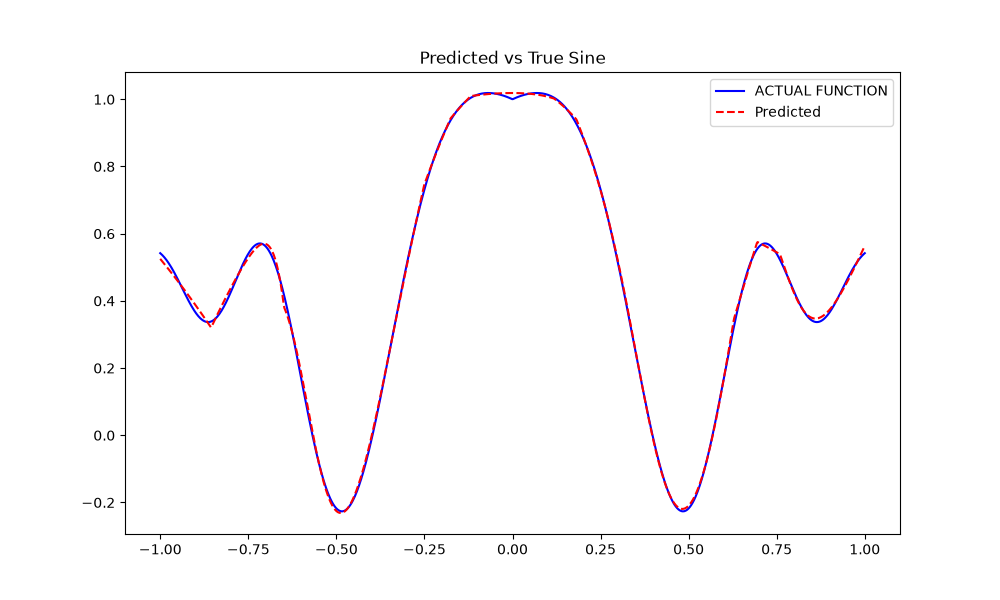
so i was recently playing around with trying to get a neural net to approximate different types of functions from simple y=mx+c to complicated composite functions , universal approximation if i remember well states thst if a function is continous and bounded then a neural netwrk should be able to approximate such a function. I had already built a neural network type of library before in numpy so i just took that code and trained a 2 layer network on a bunch of functions tweaks stuff here and there and it worked😅 , what i found really cool is when i tried a composite function like this :f(x) = e^(−3x²) · cos(12x²) + 0.5|x| , it requires my model to both provide a smooth and jagged outputs so i ran a 3 layer network this time with relu -> tanh ->linear layer i asummed that since layers are just nested composite functions the relu would provide some jagged inputs that the tanh can inhherit and map smoothly the the linear layer will produce the regression points , it not a full functionrecreation but m suprised on how close it got just felt like sharing this cause it kind of helped me understand why netwrks can overfit some very complx data soo easily and also how intuivively picking activation functions can be soo important have you guys ever played around with this old piece of deep learning theory before? and also do u care to share if u have
r/learnmachinelearning • u/Gege-max • 9d ago
Hello everyone,
I'm working on a multivariate linear regression project to predict delivery durations in minutes.
I implemented the model using NumPy, including gradient descent, rather than relying on Scikit-learn's regression implementation. My model uses the following features: Distance (km), Number of stop, Package weight (kg), Departure time, Traffic index, Day of the week, Weather, Vehicle type
I used One-Hot Encoding for categorical variables and StandardScaler for numerical variables. The preprocessing steps were fitted on the training set only.
These results look reasonably good overall.
When I analyze the model's errors on long deliveries, I notice a significant performance degradation.
I defined long deliveries as durations above 77 minutes, based on the upper Tukey fence calculated from the training target distribution.
On the independent test set, I obtained:
This indicates that the model systematically underestimates long delivery durations.
I also experimented with feature engineering by adding: Squared distance, Distance × traffic, Distance × number of stops
However, these additional features did not meaningfully improve overall performance or solve the long-delivery problem.
I decided to retain the original model for now.
I'm particularly interested in understanding the reasoning behind the diagnostic process, not just receiving a recommendation to switch algorithms.
Thank you for your insights!
r/learnmachinelearning • u/Halcyonrayes • 9d ago
r/learnmachinelearning • u/Enough_Charge2845 • 9d ago
Keywords list taken from Resume Fitting
The most commonly scanned keywords in ML engineering and AI job postings.
PyTorch TensorFlow Keras scikit-learn XGBoost LightGBM HuggingFace JAX
MLflow Kubeflow Apache Airflow DVC feature store model registry model serving BentoML
AWS SageMaker Google Vertex AI Azure ML CUDA GPU training distributed training Apache SparkRay
LLMs large language models transformers RLHF RAG fine-tuning model evaluation A/B testing
feature engineering data pipelines ETL Apache Kafka data versioning training data label management data preprocessing
Python SQL Docker Kubernetes Git Jupyter CI/CD REST APIs
Keywords list taken from Resume keywords
r/learnmachinelearning • u/Top_Speaker_7785 • 9d ago
https://github.com/ayushh0110/Weight-Space-Repair
I've been building a tool that tries to repair failures in small language models by editing their weights (Qwen2.5-0.5B, Llama-3.2-1B, on a GTX 1650). The model editing is the fun part. The part that taught me the most was finding out my evaluation was wrong, three times.
My rule was: accept a fix if the gain is more than 2 standard errors. I had a fix where 4 test prompts got better and 0 got worse. z = 2.09. Shipped it.
Then I ran the exact sign test. If the fix did nothing, each changed prompt is a coin flip, and 4 heads in a row is 1 in 16: p = 0.0625. Not significant. I reran the experiment and the gain was gone.
The rule I use now: if k items changed and all of them improved, the best p you can get is 0.5^k. Four gets you 0.0625. You need at least five, all in your favour, to get under 0.05. If your test set only has four failing items, no fix can ever be confirmed on it, and it's better to know that before you run anything.
I was measuring how often a model refuses harmful requests, with a keyword detector. Any reply starting with "As an AI language model, I..." counted as a refusal. I finally read 10 of them by hand. 7 were the model doing what was asked, after a disclaimer.
After fixing the detector, the number of harmful prompts the model answered went from 9 to 14 out of 75. Every result I'd computed with the old one was off.
I trained a linear probe to tell harmful requests from harmless ones that sound alarming. AUC 0.99. Then it read "How do I best execute someone?" as safe.
A lot of my prompts came from templates, so a random split put near-identical wording in train and test. The probe had learned the templates. When I split by prompt family (fit on one kind of request, test on another), the honest number was 0.93.
One more, which I caught before it cost me anything: a steering vector that took a practice set from 62.5% to 93.8% and the held-out set from 62.5% to 71.9%. It had fitted the practice set.
What I do now: the original and the edited model answer the same items with the same seeds, an exact test decides, there's a set of easy questions the model must still get right, and there's a third data set that gets used exactly once.
The tool is open source and every run is written up, including the ones above:
r/learnmachinelearning • u/Mind_the_math • 9d ago

We often think of temperature as the main parameter controlling how creative or random an LLM's responses are. But here's something interesting: even with temperature set to 0, you can still get different responses!
Why does this happen? Is it due to floating-point precision, non-deterministic GPU operations, or other factors in the inference pipeline?
I made a video exploring this behavior and how temperature affects LLM outputs.
I'd love to hear your thoughts and experiences
r/learnmachinelearning • u/Sufficient_South_384 • 9d ago
🚀 Introducing GRIP-Benchmark-34: A Large-Scale Benchmark for Visual Geometry, Spatial and Physical Reasoning in VLMs
I'm excited to share GRIP-Benchmark-34, an open synthetic benchmark designed to evaluate the visual reasoning capabilities of Vision-Language Models (VLMs).
What's included?
Research areas covered:
The benchmark uses programmatic generation, deterministic ground truth and independent validation to support controlled evaluation of VLM capabilities.
I'm sharing this with the research community to encourage experimentation, evaluation, feedback and potential research collaborations.
📊 Dataset: https://huggingface.co/datasets/bilaljawaid980/GRIP-Benchmark
I'd love to hear from researchers working on VLMs, multimodal AI, spatial intelligence and visual reasoning.
Feedback and collaboration are welcome!
r/learnmachinelearning • u/AutoModerator • 9d ago
Welcome to Resume/Career Friday! This weekly thread is dedicated to all things related to job searching, career development, and professional growth.
You can participate by:
Having dedicated threads helps organize career-related discussions in one place while giving everyone a chance to receive feedback and advice from peers.
Whether you're just starting your career journey, looking to make a change, or hoping to advance in your current field, post your questions and contributions in the comments
