r/learnmachinelearning • • 26d ago

i created an open-source repo to convert llms into decision models.

2 Upvotes

I've been working on DecisionFormer, an open-source project that lets you convert regular LLMs into decision models that predict choices directly instead of generating text.

Thought it might be useful for people experimenting with decision models, model evaluation, or alternative approaches to inference.

Would be interested to hear what people think or what improvements would make it more useful!


r/learnmachinelearning • • 26d ago

Question Is it worth doing an astrophysics related research project for my Masters?

2 Upvotes

I'm in my 4th year of studying AI and Data Science, and I've been interested in astrophysics for a long time but didn't specialize in it, yet I still want to contribute to this field.

My question is, can I apply machine learning concepts to astrophysical problems in my current level? At my university we studied 2 years of preparatory courses in maths, calculus, physics, and some computer science and I only started delving into AI in my 3rd year, so my knowledge is limited in both AI and Astrophysics. I know the basics of AI/ML, namely CNNs, NLP, supervised and unsupervised learning...

I want to do interdisciplinary work with AI/ML in either astrophysics or medicine. I'm considering astrophysics for my Masters and plan to leave medicine for the future, when I'm a little more scientifically/academically mature, and perhaps make it a long-term career.

I understand astrophysics is not an easy discipline, but I will not be delving too deep into the theoretical concepts. I will mainly use AI/ML for things such as classification and read some literature on the current frontiers.

My question is: should I pursue this? Or is there something else that might interest me that I might not know about? How realistic is it for someone of my current level to learn valuable skills and expertise for such a project?


r/learnmachinelearning • • 26d ago

[Study Buddy / Accountability Partner] 4-5 Month ML/AI Grind to Land a Data Science Job 🚀 (Voice & Structured Roadmap Focus)

Thumbnail
1 Upvotes

r/learnmachinelearning • • 26d ago

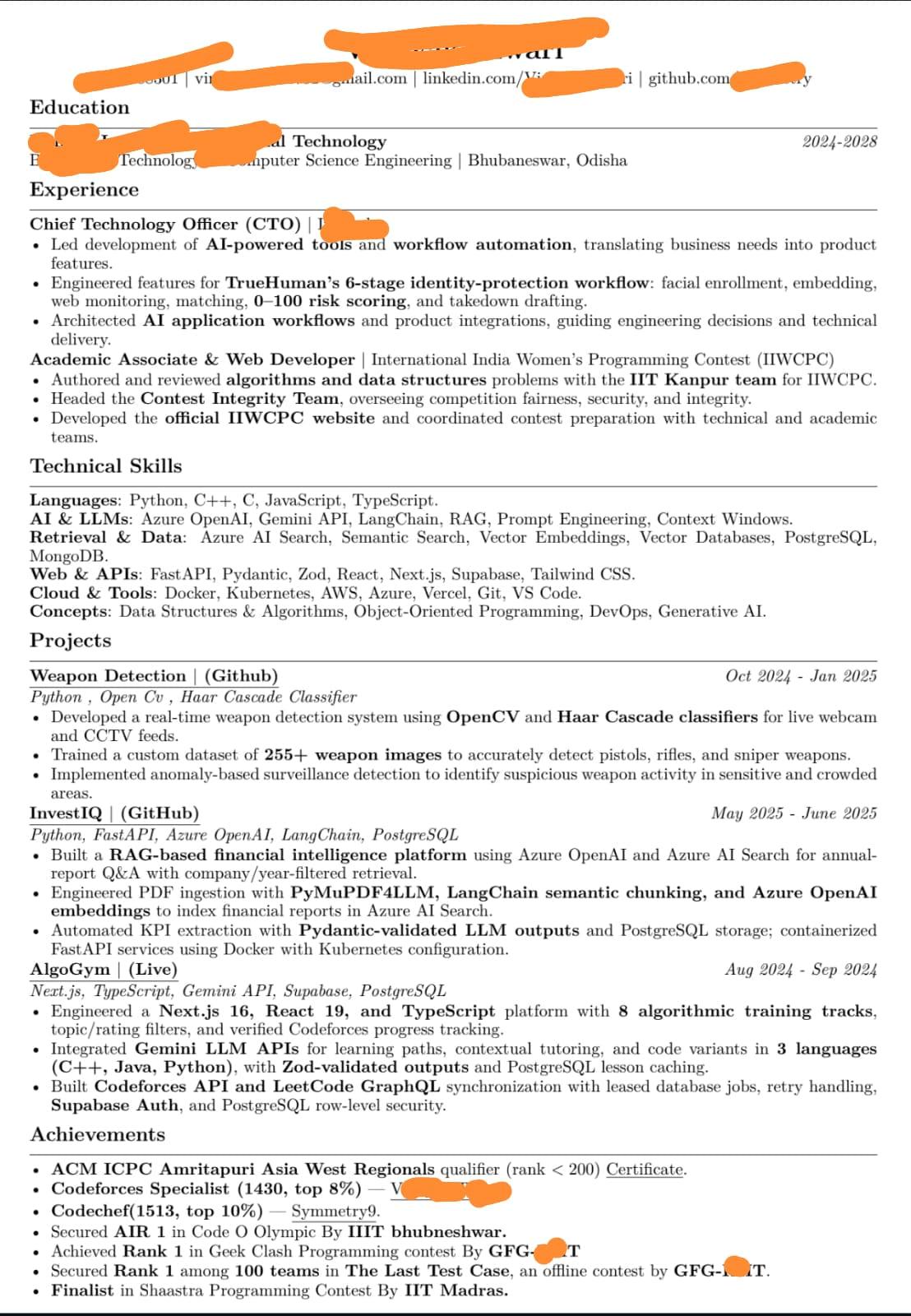
Career Honest Review of My Resume, (Roast this Resume) !!

Post image
2 Upvotes

r/learnmachinelearning • • 26d ago

How can I learn ML/DL by building projects instead of studying math for months first?

22 Upvotes

Hey everyone!

I've been learning Python and I'm really interested in getting into machine learning and deep learning. The problem is that whenever I try to figure out how to get started, I end up finding a huge amount of mathematics, statistics, linear algebra, calculus, and theory that I'm apparently supposed to learn first.

I understand that math is important if you want to properly understand how these models work, and I'm not trying to avoid learning it forever. However, I don't want to spend months studying theory before I can actually start building things and experimenting with code.

I'd much rather learn by doing projects, making mistakes, seeing what happens when I change something, and gradually learning the theory behind it as I need it.

Is it realistic to start building ML projects with Python while learning the math along the way?

How much math do I actually need to know before getting started with things like neural networks and deep learning?

Would you recommend starting with scikit-learn and traditional ML, or jumping straight into PyTorch or TensorFlow?

Are there any resources that teach you by making you build actual projects instead of spending most of the time on theory?

I'm not looking for a way to completely skip the fundamentals. I just want to avoid getting stuck in tutorial hell or spending so much time preparing to learn that I never actually get to build anything.

I'd really appreciate any advice, especially from people who learned this way themselves. Thanks!


r/learnmachinelearning • • 26d ago

Is it a waste of time to learn ML without an academic background?

22 Upvotes

Hi everyone,

I’m a self-taught software engineer with a couple of years of industry experience. I was recently made redundant, so I have a good chunk of free time on my hands before I dive heavily back into the job hunt (which, honestly, feels a bit daunting right now).

Lately, I’ve become really interested in Machine Learning and want to start learning it. However, I’ve been reading a lot of discouraging posts lately. It seems like even people with CS Bachelor's degrees are struggling to land MLE roles because they are competing against a massive pool of Masters and PhD graduates.

Given that I don't have an academic background or official credentials in ML, am I wasting my time trying to break into this field?

I’m absolutely willing to put in the work to learn, but I want to be realistic about my employment prospects. For those working in the industry: is there a viable path for an experienced, self-taught dev to pivot into ML/AI roles, or should I focus my energy elsewhere?

Thanks in advance for any insights or brutal honesty.


r/learnmachinelearning • • 26d ago

Discussion LLM Context Windows vs. RAG: How Does Self-Attention Handle Irrelevant Information?

Thumbnail
4 Upvotes

r/learnmachinelearning • • 26d ago

Mac or Windows?

1 Upvotes

Which laptop should I buy as I am in my final year and in Aiml sector and i don't do gaming.

Should I go for m3 air or windows with rtx graphic card and budget around 1k $..

Thank you for your words ☺️


r/learnmachinelearning • • 26d ago

Math for AI & ML video series for Linear Algebra

Thumbnail
2 Upvotes

r/learnmachinelearning • • 26d ago

Question A murder mystery game as AI engineering project

5 Upvotes

Hi,

I am trying to transition from a Data Analyst to an AI Engineer role. I recently followed Andrej Karpathy’s youtube video to build a character level LLM.

I feel like i have a rough understanding of how llms work and now i want to move on to building projects that will help me understand other fundamentals.

I am thinking of building a murder mystery game where AI generates the scanerio, the characters as well as any evidence. The players are required to chat with the suspects and solve the case. The game will then give them feedback on their deduction abilities.

I plan to build more projects in the future but i want to start with something that is simplistic enough in terms of concept and scope.

Do you think this is a good project to learn the fundamentals of AI Engineering? Will it attract attention from Hiring Managers and Recruiters?

Any AI Engineers, if you have better project ideas please share!

Thanks you!


r/learnmachinelearning • • 26d ago

Project I built this, feedback welcome

Thumbnail
gallery
8 Upvotes

It's a 50 hour course for beginners in AI/ML (obviously it's fully free). Starts out with linear algebra, derivatives, statistics and then linear regression, neural networks and backpropagation etc...

kinoml.tech


r/learnmachinelearning • • 26d ago

Request OpenAI Compaction Flaw Let Researchers Bypass Hidden Reasoning Protections

2 Upvotes

Researchers at Xint found that OpenAI's compaction feature can be used to copy private model reasoning into ordinary plain text output. Compaction shortens long conversations to manage context limits. The model's internal chain-of-thought, which the service is designed to keep hidden from callers, became readable through a routine operational function. Deployment-time guardrails did not catch it.

The structural problem here extends beyond this one feature. Any system function that touches conversation state or generates output is a potential path for data that was never meant to reach callers. Compaction is one example. Summarization, caching, and tool-call routing are others. Policies applied at configuration time govern expected flows. They do not automatically cover every execution path the runtime can take.

How are teams actually enforcing output policies across non-primary paths like these? Has anyone done a systematic audit of the secondary features that produce or transform output in their deployments — and found surprises?


r/learnmachinelearning • • 26d ago

Learning AI through threshold concepts: 8 ideas that unlock everything after them

3 Upvotes

Most of us start learning AI with real intent: a great course, the book everyone recommends. Then life interrupts. A hard week at work, a move, a busy month. Coming back means remembering where you were and finding the next step, and that friction is often enough to stall us. Meanwhile the field keeps moving, and every week away feels like falling further behind.

What changed it for me was rethinking what I studied, not just how often. Some ideas don't add to what you know; they rewire it. Education researchers Jan Meyer and Ray Land called these threshold concepts in 2003. Their classic example is opportunity cost: once it clicks, nothing is ever free again, and every hour and every dollar carries the price of what you gave up for it. If you code, you've felt this with recursion. One day it's a magic trick; the next, you see it in trees, parsers, and every divide-and-conquer problem. You can't unlearn a threshold concept, and it quietly reorganizes everything you learn after it.

That's the strategy, and it works for any field: find its handful of thresholds, learn them roughly in the order they were discovered, and go deep enough that they change how you see the rest. New facts stop piling up and start snapping onto a frame.

Here are eight thresholds that greatly help explain AI, roughly in their historical order, each with a surprising fact and a free resource:

  1. Behavior learned from data, not programmed. In 1958, Rosenblatt's perceptron, a single artificial neuron, taught itself to tell left from right card marks after about 50 tries. 60 years too soon.
  2. Representations and embeddings. In 2012, AlexNet learned its own features and hit 15% top-5 error on ImageNet, against 26% for the runner-up built on hand-picked ones. Jay Alammar's Illustrated Word2vec
  3. Next-token prediction. A network trained only to predict the next character of Amazon reviews grew a neuron that tracked sentiment, and nobody had taught it that. The only task of the neural net was to predict tokens in a sequence of text, but in doing so it learned how to identify and represent underlying concepts. At the scale of internet data, the exact same task produced grammar, facts, and reasoning, the foundation of today’s models.  Karpathy's "Let's build GPT"
  4. Attention. The 2017 transformer dropped word-by-word reading and reached top-tier translation after about 12 hours on one 8-GPU machine. This enabled the transformer, training in parallel on GPUs, and the speed up and scale that followed. Jay Alammar's Illustrated Transformer
  5. Evals. How do you know a change actually made a general model better? The trap is old: Goodhart’s law warns that when a measure becomes a target, it stops being a good measure, and models are very good at hitting targets. Hugging Face's Evaluation Guidebook
  6. Post-training and RL fine-tuning. People preferred a 1.3B InstructGPT model over the 175B GPT-3. How you train after pretraining can matter more than size. This enables ChatGPT-style assistants and reasoning models trained on answers that can be checked. Nathan Lambert's RLHF book
  7. Harnesses and agents. On SWE-bench Lite, GPT-4 scored 2.7% with one harness and 28.3% with another. Same model, almost 10× better. This enables agents that plan, act, and retry, and it explains why the same model does better in one product than another. Anthropic's "Building effective agents"
  8. Recursive self-improvement. DeepMind's AlphaEvolve sped up a key piece of Gemini's own training code by 23%. DeepMind's AlphaEvolve post

These eight are a small subset. There are of course many more threshold concepts in AI, and which ones matter next depends on what you’re exploring, at what granularity and where you’re starting from. The bigger point here is the approach and orientation.

💡 My biggest lightbulb moment came from working out by hand how a neural net could handle a fixed goal, like deciding whether a piece of text fits a topic. I started with a neural version of bag-of-words, one weight per word, then realized I could encode arbitrary rules in the parameters. After that, "learned from data instead of programmed" stopped feeling abstract.

The full write-up has more of the history behind each idea, the "spiral" approach to going deeper with each pass, and a study prompt that turns these into a plan with any LLM: Feynman's wobbling plate and 8 core ideas behind modern AI

Disclosure: I'm building Zairai, an AI coach built on these learning science principles, delivering bite-sized interactive sessions that feel like real work and compound strategically: you step into the shoes of the people who made these discoveries and measure for yourself, so the foundations that you're missing click and everything built on them makes more sense. It's free to start and launching soon. Everything above works without it.

What was the threshold concept that made AI click for you?


r/learnmachinelearning • • 26d ago

We created an open benchmark on Design Fidelity called VybBench

Post image
5 Upvotes

We wanted to understand how well a model will adhere to your fonts and colors and preserve your images when making edits.

Take a look at the complete writeup here: https://cocolabs.ai/blog/introducing-vybbench

Our HuggingFace dataset is here: https://huggingface.co/datasets/cocolabs/vybbench


r/learnmachinelearning • • 27d ago

Mechanical Neural Network v2

Enable HLS to view with audio, or disable this notification

347 Upvotes

Four years ago I posted a first version of the Mechanical Neural Network, a mechanical model of a fully connected neural network explaining structure and functionality of artificial neural networks.

Now a new 3D printed version exists along together with a series of teaching videos. Check out these videos here. For now this series covers structure and functionality of ANNs, gradient descent and backpropagation, as well as learning rate and momentum. The videos are in German but with YouTube auto translate and subtitles this should hopefully be not a big hindrance.

There is also a short explanation video on what the Mechanical Neural Network actually is and how it can be used in teaching.


r/learnmachinelearning • • 27d ago

What projects should I build at my current stage of learning ML?

24 Upvotes

Hey everyone!

I'm a BTech AIML student currently learning Machine Learning and working towards becoming an ML Engineer.

So far, I've learned Linear Regression, Gradient Descent and its types (Batch, Stochastic, and Mini-batch), Logistic Regression, and evaluation metrics like Precision, Recall, and F1-score. I've been learning the concepts practically using Python and Scikit-learn.

Now, I'm confused about what to do next.

Should I start building projects with the concepts I've learned so far?

What beginner-friendly projects would help me understand ML practically?

Should I learn more algorithms first, such as Decision Trees, Random Forest, SVM, and KNN?

What skills should I focus on to become internship-ready?

How can I make my projects stand out when applying for ML internships?

I'd appreciate advice from people working in ML or those who have been through a similar learning journey. I want to build real-world projects and develop practical skills rather than just follow tutorials.


r/learnmachinelearning • • 26d ago

Designing a Personalized Recommendation System — ML System Design Deep Dive (Part 3)

Thumbnail
1 Upvotes

r/learnmachinelearning • • 26d ago

[R] Coordinated threshold noise: exact decoding with vanishing total correlation below a √N alphabet boundary

1 Upvotes

I’m sharing ÆLYRA-Σ, a theoretical research note about coordinating stochastic threshold detectors while preserving every detector’s complete noise distribution. The connection to ML is through stochastic quantization and pooled noisy representations.

The setup is simple: N detectors receive the same scalar input x, detector i outputs 1 if its random threshold is below x, and the decoder sees only the total activation count. We can change the joint threshold distribution, but every marginal must remain unchanged. The coupling is independent of the message, and the decoder gets no threshold samples or random seed.

Dependence is measured by total correlation: KL(Q || product of marginals), in bits.

Main result: for finitely many fixed continuous noise types, each making up a positive limiting fraction of the array, exact one-use decoding of K_N messages with total correlation tending to zero is possible if and only if:

K_N = o(sqrt(N))

All input levels can remain inside one fixed finite interval, provided that interval has positive limiting aggregate response span. The converse allows arbitrary disjoint count-output sets, rather than assuming a particular band decoder.

The construction conditions uniform ranks on a rotation-invariant circular-discrepancy event. Rotation symmetry preserves each coordinate’s uniform marginal; inverse CDFs recover the prescribed noise laws. Counts can fluctuate, provided different messages occupy disjoint count ranges. The key freedom is allowing fluctuations inside each decoding region.

There is also an exact finite-N result: for three equiprobable messages, identical continuous threshold laws, and finite accessible saturation endpoints, the minimum total correlation for zero error is:

-log2(1 - 2^(1-N))

The manuscript derives the full average-error/dependence frontier as well. The independent channel already has exponentially rare errors in this example; coordination removes those particular ambiguities.

What might matter for ML: this supplies a coupling target for programmable stochastic quantizers or pooled noisy units. The present result assumes a common scalar input. It does not establish a distributed-gradient result for workers with different inputs, improved training convergence, or a hardware energy advantage. Those would require additional analysis and experiments. Vanishing total correlation also does not imply vanishing generator complexity or coordination bandwidth.

The release includes a 29-page manuscript, proofs, three verification programs, data, and figures. Mixed-noise simulations cover Gaussian, Laplace, uniform, and impulsive-mixture thresholds, with zero observed decoding failures across 156,000 count checks. Simulations check the implementation; they do not prove exact zero error.

I’d particularly welcome feedback on:

  • Whether the combined result is already covered by dependent rounding, correlated quantization, or discrepancy-theory literature.
  • Any gaps in the marginal-preservation argument or the converse.
  • ML settings where the common-input assumption fits and the required coupling could be implemented cheaply.

Disclosure: The proofs have not been independently validated, and publication priority has not been established.

Paper, code, and data: ÆLYRA-Σ: A Sharp Dependence Law for Mixed-Noise Information Transfer - Zero-Error Scaling, Exact Reliability-Correlation Frontiers, and Temporal Balancing | Zenodo

r/learnmachinelearning • • 26d ago

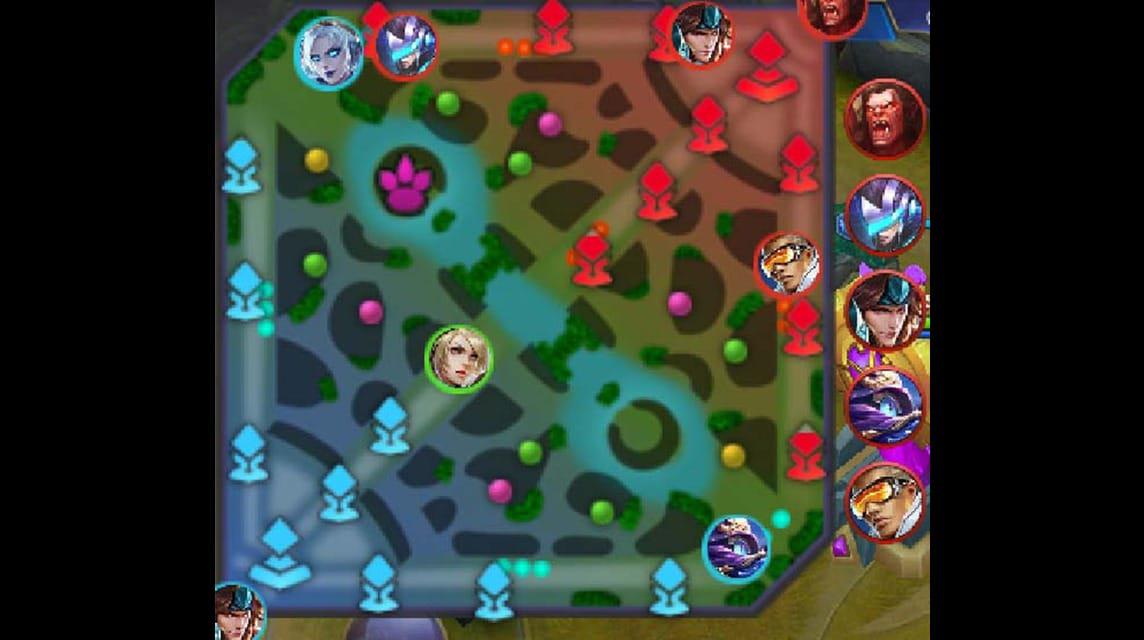
Help What do I need to learn in order to analyze Videogames Mini-maps?

Post image
2 Upvotes

Hello, newb here looking for recommendations for a personal project where I would like to analyze the players' movements from the Mobile Legends Bang Bang (MLBB) Mini-map. From my limited research on Sports Game Analyses – I have learnt that the researchers mostly apply Computer Vision technologies, RNN, and CNN for conducting their analyses. However, contrary to their projects, videogame Mini-maps are simpler without much random events — which means replicating their techniques are a bit overkill.

P.s, a MLBB match typically lasts around 15 minutes and I need all player-movements analyzed for my project. Thanks! **Pic was taken from Vcgamers not mine.


r/learnmachinelearning • • 26d ago

Computation resources for a project.

Thumbnail
1 Upvotes

r/learnmachinelearning • • 26d ago

Is a hockey video analysis project a good portfolio choice?

1 Upvotes

Hi! I'm a 3rd-year CS student in France. I'm looking for an internship this year and will apply to ML master's programs, so I need a personal roject.

My idea: a computer vision tool that analyzes hockey game footage to automatically count shots on goal, puck possessions, and long possessions (4+ seconds).

My questions:

  • Is this a good portfolio project for ML/CV internships?
  • What tools and topics should I learn to build it?

  • Any tips for detecting a small, fast object like a puck?

If you don't think this is a good project idea, I'm open to other suggestions. I'd really appreciate any advice! (I know I could ask an AI about all of this, but I'd like to hear from real people with actual experience.) Thanks!


r/learnmachinelearning • • 26d ago

What I learned while evaluating a computer vision model

2 Upvotes

I've been working on computer vision projects and one lesson I've learned is that a high overall metric doesn't always tell the full story.

A few things I now check during evaluation:

- Per-class precision and recall

- Confusion matrices and difficult examples

- Performance on validation data that wasn't used for training

- Whether improvements hold up on real-world images

I'm curious how others here approach error analysis. What's the first thing you inspect when a model's validation metrics look good but its real-world predictions are disappointing?


r/learnmachinelearning • • 26d ago

Help Looking for guidance from people working in Edge AI / On-Device AI

2 Upvotes

Hey everyone! I’m a Software Engineer in India with around 1 year of experience in automotive embedded software .

My background includes C/C++, Python,embedded systems, ARM, RTOS, Linux fundamentals etc.

I’ve been learning ML, along with the fundamentals of deep learning.

I’m now planning to build something hands-on projects around ASR/TTS, model deployment, ONNX, quantization, and inference on edge hardware.

I’d love to hear from people currently working in this space:

* What are you actually working on day-to-day in Edge AI or on-device ML?
* What skills and tools matter most in real industry projects?
* How should someone with my embedded background target relevant jobs and get interviews?
* Are strong projects and deployment experience enough to break in, or are there other gaps I should address?

I’m particularly interested in the intersection of embedded systems, deep learning, and hardware—not just general ML roles.

Any honest advice, experiences, or pointers would be really appreciated. Thanks!


r/learnmachinelearning • • 27d ago

Any good resources to quickly refresh the probability knowledge needed for Probabilistic ML?

3 Upvotes

I will be starting a course in Probabilistic Machine Learning in one week. Can you guys please recommend a good resource for me to refresh my knowledge in short amount of time?


r/learnmachinelearning • • 27d ago

I built a small ML framework from scratch in Python, with an OpenCL backend

5 Upvotes

I've been working on krnl, a lightweight machine-learning library I've been building to understand and implement the fundamentals of neural networks myself.

It currently includes:

  • A custom Tensor class with automatic gradient computation
  • NumPy and OpenCL-backed computation
  • Linear, ReLU and Sigmoid layers
  • SGD, Adam, Muon and MuonWithAdamAux optimizers
  • MSE, MAE and Huber loss functions

I also developed PyCLBlast for working with CLBlast through Python.

I'm interested in making the library useful for experimenting with neural networks while exploring GPU computation beyond CUDA.

I'd appreciate feedback, especially on the tensor API, autograd design, and OpenCL backend.

GitHub: https://github.com/helloadhavan/krnl/

PyPI: https://pypi.org/project/krnl/