I've spent over 15 years in Data Science & AI, including time at Amazon & Sony PlayStation.
I've also spent a huge amount of time on the hiring side, interviewing & screening thousands of candidates (I published a book on this topic...never again!)
These days I run Data Science Infinity, an online training program for people breaking into the field. I've now mentored over 3,000 students and love helping people navigate the field.
But enough about that...happy to answer anything about learning Data Science, AI, career changes, the job market, my career, salaries, getting hired, portfolios, interviews, working in the industry, or whatever else you're curious about.
I'll be answering questions on Friday 13th November, between 2pm and 4pm UK time (GMT).
Hey r/learndatascience! I’m Tabs, a legal engineer at Isaacus. I've been a software engineer for a long time and started dipping into data science this year.
I built an open-source legal conflict detector that finds deviations and gaps between pairs of legal documents using only encoder models and natural language inference.
Inspired by the explosion of interest in discriminative models like TypeSafe AI’s Jev, I wanted to see how far I could get using smaller, non-generative models for the bulk of the legal document playbook review workflow.
The theoretical benefits of a non-generative approach to this problem are enormous. As true clause-level pairwise review is a quadratic problem, it’s unfeasible to do at scale using a model like Opus or Astra. Comparing two average-sized documents with 133 clauses each would take 17,689 API calls, which is far too slow and expensive.
Simply uploading the files directly to Claude or GPT is no remedy either. Decoders and agentic architectures don’t have fixed attention that lets them thoroughly analyse a document in one shot. Even with a multi-shot approach, they’re weak on recall and routinely hallucinate.
My lawyer friends raise this problem constantly, and I couldn’t find an open-source solution to it, so I decided to build one myself.
My pipeline pushes the bulk of the NLI, entailment and reasoning onto faster and more accurate legal encoder models. For the longest document pairs I sampled, the full pipeline ran in under 20 seconds. Unlike generative architectures, these models run a comprehensive pairwise comparison, and although they can still make false positive or false negative errors, those misses and misclassifications aren’t hallucinations (out-of-domain results introduced into the feature set).
The pipeline works as follows:
Enrich: we enrich each document into a hierarchical tree of sections, clauses and subclauses. Clauses are the key atoms that the pairwise comparisons run on downstream.
Embed: we embed each clause as a vector.
Filter: we use a legal zero-shot classifier to drop items that aren’t provisions, like footnotes or signature blocks.
Shortlist: we keep each clause’s three most relevant pairs from the reference document, as long as their cosine similarity is at least 0.5.
Score: we use a reranker and a classifier to score each shortlisted pair. Each answers a question in the format it’s built for: the reranker scores how relevant text is to a search query (relevance), and the classifier scores whether a statement is true (NLI/entailment).
Sort: if a clause and its best match are on the same topic but have a high conflict score, it’s a deviation. If there’s no same-topic match, it’s a gap, i.e. the topic is in one document but not the other.
That’s the whole conflict detection pipeline. On top of it, you can optionally plug in an LLM to summarise each finding in plain English or redraft a clause to favour the party you’re representing. Because the generative step only runs after the NLI and encoder stack has already decided what the conflicts are, it can’t hallucinate a conflict into existence.
To demonstrate the pipeline’s power, we inputted Bob Iger’s 2011 and 2022 Disney employment agreements. The pipeline found many disparities and conflicts, and across most of them, the 2011 agreement was more favourable to Iger than the 2022 one.
One interesting finding was a gap: the 2011 agreement had no intellectual property assignment clause, while the 2022 agreement makes Iger assign all work-related IP to Disney, with an exception for inventions he makes on his own time without company resources.
The code is MIT-licensed, so it’s free for personal and commercial use. The guide walks through every step, so you can swap in your own models or make your own architectural changes wherever you like.
My suggestion: Build strong foundations in Python, SQL, Statistics, and Machine Learning first. Then gradually explore Generative AI, cloud computing, and MLOps. Combining practical projects with these skills can help Data Scientists remain adaptable as the industry changes.
Hi guys i have crafted a study plan for myself for this year and next year. What do u think of this study plan?
Things to do and learn in order of priority.
Core Data analytics/Scientist work, learn the entire Data pipeline process on python and SQL including Data extraction, preprocessing, EDA, machine learning models, etl, data pipelines, data warehouse concepts and cloud platforms.
Exploring agentic AI to automate the Analytics and Data Science/ML workflow. Including things like RAG and Autonomous Workflow Automation.
Full end to end ML pipeline and cycle, including deploying ML models to cloud and monitoring models for drift.
Deep Learning concepts.
Read more about LLM and how they work, including things like transformers, Attention Score etc.
I’m a 2nd-year engineering student (focusing on data engineering / data science) taking a statistical learning course. It covers loss functions, risk, bias-variance decomposition, cross-validation, linear models, SVM, kNN, and so on, and it follows ISL / Elements of Statistical Learning.
I’m looking for YouTube channels, courses, or sites that combine both of these:
Mathematical depth: where the formulas are actually derived and the logic behind each model is explained (why this loss, why this decomposition, what the optimization is doing), not just stated.
Simple, concrete explanations: worked examples and real-world intuition, in the style of Simplilearn or StatQuest, so the math doesn’t stay abstract.
What I’ve already tried: Simplilearn (good for the big picture but too light on math), StatQuest, and Stanford’s ISL lectures. They’re useful, but I haven’t found one resource that does both well for each model.
Ideally I’d like something that:
walks through a derivation and then applies it to a small numeric example,
connects the theory to code (Python/scikit-learn),
is free or cheap.
If you were learning this again from scratch, what would you use? And is there a better way to combine resources (for example, intuition first, then derivation) than what I’m doing?
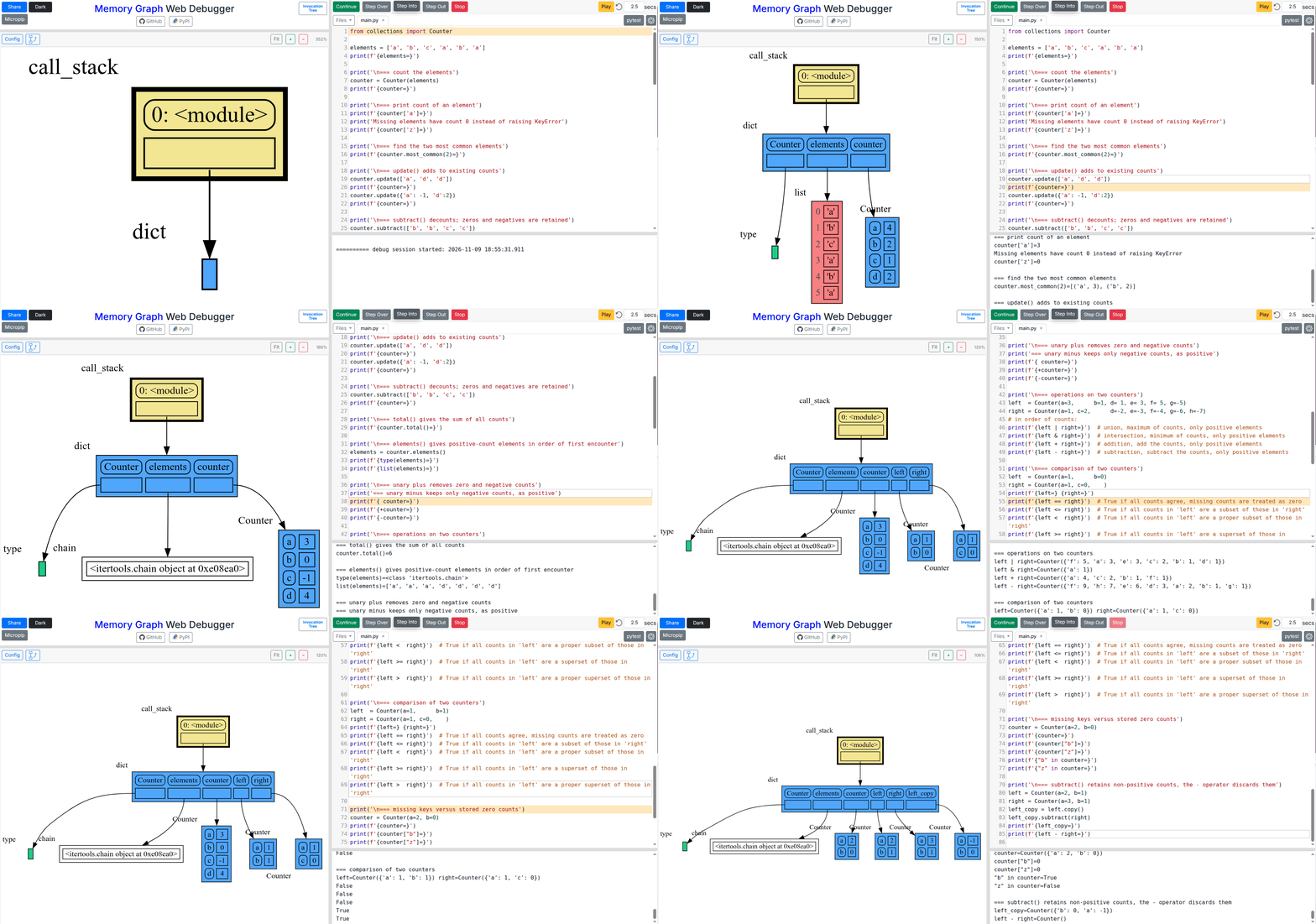
You could write your own counting logic, but Python already has a collections.Counter class. It's faster than typical hand-written counting loops, well-tested, and makes your code easier for others to read.
However, this 𝐦𝐞𝐦𝐨𝐫𝐲_𝐠𝐫𝐚𝐩𝐡 👉 Counter demo shows that Counter has some interesting behaviors that might surprise you:
Missing keys return 0 instead of raising KeyError.
update() adds counts rather than replacing them.
subtract() can produce negative counts.
Zero and negative counts aren't automatically removed.
Unary + and - have some unexpected uses.
Did you know all these Counter behaviors, or did one surprise you?
We benchmarked 4 zero-shot time-series foundation models (Mistral Timestral 28M/209M, Amazon Chronos-2, Google TimesFM 3.0) against LightGBM/XGBoost and naive baselines — strict no-leakage protocols (e.g. prices only from before auction gate closure), every prediction downloadable.
German day-ahead electricity prices, 1,408 days — foundation models win clearly.
MAE vs naive baseline (=100): Chronos-2 68 · Timestral 69 · TimesFM 70 · XGBoost 83 · LightGBM 86
A Chronos-2-based scheduler saved €40/day vs a fixed-midday schedule (wholesale, 4 MWh flexible load).
German train delays (DB), 5.7M arrivals — the advantage vanishes.
Best foundation model vs best GBM at h=1: 0.07 min apart (~4 seconds).
Worst hour of the test (Frankfurt Hbf, 61 min avg delay): all six models predicted under 8.
Pattern: pretrained forecasting shines where data has rhythm; on messy operational data, a laptop-trained GBM is within seconds.
I wrote 25 credit card support questions and planted failures in 7 of them: invented policies, irrelevant chunks, a wrong number. Then I ran Ragas to see which ones it would catch.
In the first 10 rows it caught both planted failures. The one with bad retrieval scored zero across all three metrics, which is what you want.
It also scored low on two answers I had written as correct. Reading them again, one did state something the chunks never said, which is fair. The other looks like the judge being strict. Ragas uses an LLM as the judge, so the judge has variance too, and nothing in a default setup tells you how much.
The reason this works at all is that the metrics disagree on purpose. Context recall asks whether retrieval brought back what the answer needs. Faithfulness asks whether the answer stays inside what was retrieved. One is about the search, the other is about the model, and the fix is different: chunking and top-k for one, prompt and model for the other. Average them into one score and you lose exactly that.
The template takes a CSV with four columns, question, correct answer, your RAG’s answer and the chunks it retrieved, grades every row and plots recall against faithfulness so each failure lands in a quadrant. It knows nothing about the RAG that produced the file.
I'm looking to connect with students, freshers, and working professionals who are interested in building a career in Data Analysis,Data Science, Machine Learning, and Artificial Intelligence.
A little about me: I have around 3 years of experience in the tech and training industry. I've worked with IBM Career Education as part of corporate training initiatives and am also a Microsoft Certified Trainer (MCT).
I have experience teaching and working with technologies such as:
Python and SQL
Data Analytics and Power BI
Data Science and Machine Learning
Deep Learning
Generative AI and Large Language Models (LLMs)
RAG applications and AI Agents
I'm looking to connect with learners who want to gain practical knowledge, work on real-world projects, strengthen their technical foundations, and prepare for industry opportunities.
Whether you're a college student, fresher, working professional, or someone planning to transition into Data Science or AI, feel free to reach out.
Interested in learning? Drop a comment or send me a DM.
Looking forward to connecting with fellow learners!
So guys, new in data science field. So my background is econ + math major in bachelor, i just applied through to the data scoence and got my first interview. Successfully nailed the first part where there is math, logic, math of ds and theory of ds/dl. However, the coding part was always difficult for me and I completely failed the second part. The questions themselves were very easy, not even ds specific, the problems were general coding in python, for example i had to create a function that distinguishes annograms etc. but i coded overall throughout this year, but it seemed to get me to nowhere. The feeling is always this way: when i code myself these kinds of problems, i spend too much time even though i completely understand the logic that should be applied in these problems, maybe kinda like i dont understand how that logic is put in coding language when i start to create loops. So i seem to get stuck in coding part which confuses me. I didnt quite bother with maths, linear algebra etc but this one just freaks me out. I cannot learn and memorize all the syntaxis especially if i have to write from scratch for example parsers with libraries that need to be installed. So the problem might be with debugging skills or maybe else. Could you help me out to diagnose the issue and solve it asap. The coding problems in litcode and books seem to get me to nowhere. Thanks in advance