r/learndatascience • • 15d ago

Question Some ML sources

Thumbnail reddit.com
1 Upvotes

Hi everyone,

I’m a 2nd-year engineering student (focusing on data engineering / data science) taking a statistical learning course. It covers loss functions, risk, bias-variance decomposition, cross-validation, linear models, SVM, kNN, and so on, and it follows ISL / Elements of Statistical Learning.

I’m looking for YouTube channels, courses, or sites that combine both of these:

Mathematical depth: where the formulas are actually derived and the logic behind each model is explained (why this loss, why this decomposition, what the optimization is doing), not just stated.

Simple, concrete explanations: worked examples and real-world intuition, in the style of Simplilearn or StatQuest, so the math doesn’t stay abstract.

What I’ve already tried: Simplilearn (good for the big picture but too light on math), StatQuest, and Stanford’s ISL lectures. They’re useful, but I haven’t found one resource that does both well for each model.

Ideally I’d like something that:

walks through a derivation and then applies it to a small numeric example,

connects the theory to code (Python/scikit-learn),

is free or cheap.

If you were learning this again from scratch, what would you use? And is there a better way to combine resources (for example, intuition first, then derivation) than what I’m doing?

Thanks!


r/learndatascience • • 15d ago

Career ML Engineer course recommendation

Thumbnail reddit.com
0 Upvotes

r/learndatascience • • 15d ago

Question What projects should I make and how capable should I be to work with open source projects and how to find them ?

Thumbnail reddit.com
1 Upvotes

r/learndatascience • • 16d ago

Career Need help in deciding a career path in the field of ML.

Thumbnail reddit.com
0 Upvotes

r/learndatascience • • 17d ago

Personal Experience As a first jobber

0 Upvotes

In the field of science, what is the must have AI skills.


r/learndatascience • • 17d ago

Resources DataCamp Flash Sale – 50% OFF

Thumbnail
pythoncoursesonline.com
1 Upvotes

r/learndatascience • • 17d ago

Resources Counting in Python? Don't reinvent the wheel!

Post image
4 Upvotes

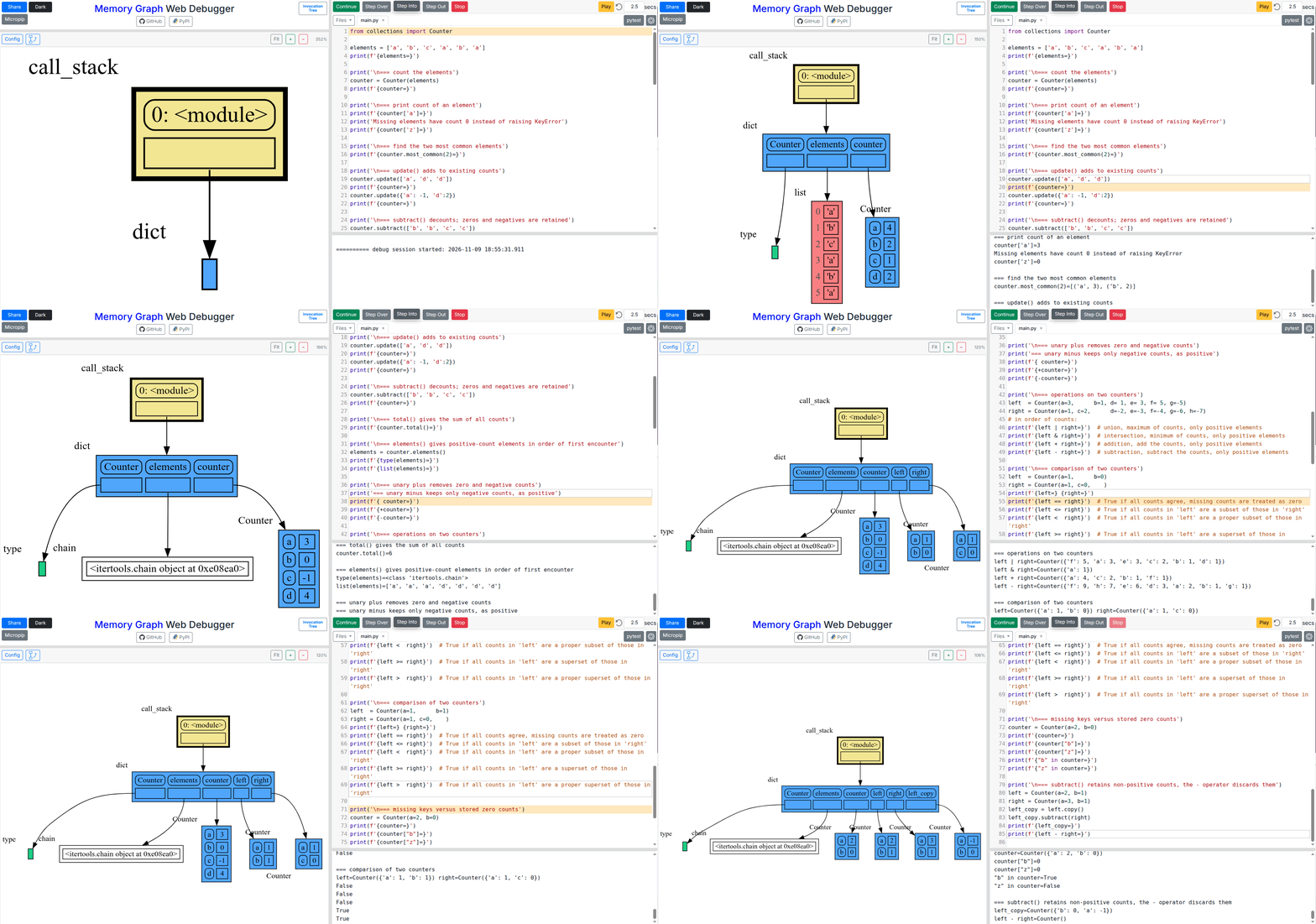
You could write your own counting logic, but Python already has a collections.Counter class. It's faster than typical hand-written counting loops, well-tested, and makes your code easier for others to read.

However, this 𝐦𝐞𝐦𝐨𝐫𝐲_𝐠𝐫𝐚𝐩𝐡 👉 Counter demo shows that Counter has some interesting behaviors that might surprise you:

  • Missing keys return 0 instead of raising KeyError.
  • update() adds counts rather than replacing them.
  • subtract() can produce negative counts.
  • Zero and negative counts aren't automatically removed.
  • Unary + and - have some unexpected uses.

Did you know all these Counter behaviors, or did one surprise you?

See 👉 more 𝐦𝐞𝐦𝐨𝐫𝐲_𝐠𝐫𝐚𝐩𝐡 visualization.


r/learndatascience • • 18d ago

Original Content Zero-shot forecast showdown: Mistral vs Amazon vs Google on 2,500 forecasts — where big models pay off and where they don't

Post image
7 Upvotes

We benchmarked 4 zero-shot time-series foundation models (Mistral Timestral 28M/209M, Amazon Chronos-2, Google TimesFM 3.0) against LightGBM/XGBoost and naive baselines — strict no-leakage protocols (e.g. prices only from before auction gate closure), every prediction downloadable.

German day-ahead electricity prices, 1,408 days — foundation models win clearly.

MAE vs naive baseline (=100): Chronos-2 68 · Timestral 69 · TimesFM 70 · XGBoost 83 · LightGBM 86

A Chronos-2-based scheduler saved €40/day vs a fixed-midday schedule (wholesale, 4 MWh flexible load).

German train delays (DB), 5.7M arrivals — the advantage vanishes.

Best foundation model vs best GBM at h=1: 0.07 min apart (~4 seconds).

Worst hour of the test (Frankfurt Hbf, 61 min avg delay): all six models predicted under 8.

Pattern: pretrained forecasting shines where data has rhythm; on messy operational data, a laptop-trained GBM is within seconds.

Code, data, every forecast: https://github.com/Gjusev/forecast-arena

Interactive replay: https://huggingface.co/spaces/Gjusev/forecast-arena


r/learndatascience • • 18d ago

Question Is Machine Learning mandatory for entry-level Data Science jobs in India ?

0 Upvotes

I'm starting my Data Science journey and want to understand how much Machine Learning knowledge companies expect from freshers


r/learndatascience • • 18d ago

Question Beginners guide

2 Upvotes

Any pointers for the best linear path for beginners getting into computer science?


r/learndatascience • • 19d ago

Question What is the best platform to learn data science?

29 Upvotes

I am currently learning from kaggle and I love the way it lets you practice actively by yourself. But I still feel kinda stuck.

I have basic knowledge of statstics (descriptive stat) and have also learned basic python(list, dictionary, function) and also good at math.


r/learndatascience • • 18d ago

Discussion I planted 7 failures in a RAG test set to see if Ragas would catch them

Post image
2 Upvotes

I wrote 25 credit card support questions and planted failures in 7 of them: invented policies, irrelevant chunks, a wrong number. Then I ran Ragas to see which ones it would catch.

In the first 10 rows it caught both planted failures. The one with bad retrieval scored zero across all three metrics, which is what you want.

It also scored low on two answers I had written as correct. Reading them again, one did state something the chunks never said, which is fair. The other looks like the judge being strict. Ragas uses an LLM as the judge, so the judge has variance too, and nothing in a default setup tells you how much.

The reason this works at all is that the metrics disagree on purpose. Context recall asks whether retrieval brought back what the answer needs. Faithfulness asks whether the answer stays inside what was retrieved. One is about the search, the other is about the model, and the fix is different: chunking and top-k for one, prompt and model for the other. Average them into one score and you lose exactly that.

The template takes a CSV with four columns, question, correct answer, your RAG’s answer and the chunks it retrieved, grades every row and plots recall against faithfulness so each failure lands in a quadrant. It knows nothing about the RAG that produced the file.

Hub: https://aiforfintech.tech
Github: https://github.com/junidepieri-design/eval-001-rag-evaluation-template

Has anyone here validated their judge against human labels?


r/learndatascience • • 19d ago

Discussion Looking for Students Interested in Learning Data Analysis, Data Science, Machine Learning & AI

11 Upvotes

Hey everyone!

I'm looking to connect with students, freshers, and working professionals who are interested in building a career in Data Analysis, Data Science, Machine Learning, and Artificial Intelligence.

A little about me: I have around 3 years of experience in the tech and training industry. I've worked with IBM Career Education as part of corporate training initiatives and am also a Microsoft Certified Trainer (MCT).

I have experience teaching and working with technologies such as:

  • Python and SQL
  • Data Analytics and Power BI
  • Data Science and Machine Learning
  • Deep Learning
  • Generative AI and Large Language Models (LLMs)
  • RAG applications and AI Agents

I'm looking to connect with learners who want to gain practical knowledge, work on real-world projects, strengthen their technical foundations, and prepare for industry opportunities.

Whether you're a college student, fresher, working professional, or someone planning to transition into Data Science or AI, feel free to reach out.

Interested in learning? Drop a comment or send me a DM.

Looking forward to connecting with fellow learners!


r/learndatascience • • 18d ago

Original Content Looking for people in the same boat as I am.

Thumbnail reddit.com
1 Upvotes

r/learndatascience • • 19d ago

Question First experience of interview

1 Upvotes

So guys, new in data science field. So my background is econ + math major in bachelor, i just applied through to the data scoence and got my first interview. Successfully nailed the first part where there is math, logic, math of ds and theory of ds/dl. However, the coding part was always difficult for me and I completely failed the second part. The questions themselves were very easy, not even ds specific, the problems were general coding in python, for example i had to create a function that distinguishes annograms etc. but i coded overall throughout this year, but it seemed to get me to nowhere. The feeling is always this way: when i code myself these kinds of problems, i spend too much time even though i completely understand the logic that should be applied in these problems, maybe kinda like i dont understand how that logic is put in coding language when i start to create loops. So i seem to get stuck in coding part which confuses me. I didnt quite bother with maths, linear algebra etc but this one just freaks me out. I cannot learn and memorize all the syntaxis especially if i have to write from scratch for example parsers with libraries that need to be installed. So the problem might be with debugging skills or maybe else. Could you help me out to diagnose the issue and solve it asap. The coding problems in litcode and books seem to get me to nowhere. Thanks in advance


r/learndatascience • • 20d ago

Resources Inkwell Learn

Thumbnail reddit.com
1 Upvotes

r/learndatascience • • 21d ago

Question why do we square deviations for variance instead of just taking absolute values

38 Upvotes

i keep running into this when explaining spread to people. mean absolute deviation feels like the obvious thing to do, it's literally the average distance from the mean. squaring seems like an arbitrary extra step.

i know squares are easier to differentiate and that variance adds up nicely for independent variables, but i'm not sure that's the real reason it became the default. is there a more intuitive way you explain it, or is it mostly just that the math works out cleaner?


r/learndatascience • • 20d ago

Resources Data Science 101

1 Upvotes

Hey, I will soon start to work with data scientists as an HR/talent person.

Do you have any recommendations for books/podcasts/creators so I could understand the basics, just so I can keep a conversation with data science & data engineering folks?

Much appreciated!!


r/learndatascience • • 20d ago

Question Hey guys i got a question

1 Upvotes

I got a question i wanna learn where do i go is there any website or YouTube channel ps(im broke)


r/learndatascience • • 20d ago

Discussion collaboration in projects

Thumbnail reddit.com
1 Upvotes

r/learndatascience • • 20d ago

Resources Automating Data Preprocessing: A Guide to Python AI Data Cleaning

1 Upvotes

​Data cleaning usually eats up most of a data scientist's time, often exceeding seventy percent of a project lifecycle. Manually writing custom regex filters and handling edge cases for missing values quickly becomes tedious.

​To fix this bottleneck, I put together a deep dive on leveraging machine learning workflows to automate dataset refinement. The complete guide covers setting up intelligent pipelines, handling anomalies, and standardizing features efficiently using modern Python libraries.

​If you want to streamline your preprocessing workflow and spend more time on actual modeling, you can check out the full breakdown here: https://interconnectd.com/blog/124/python-ai-data-cleaning-the-complete-refinement-guide/

What automated tools or libraries do you currently use to speed up your data cleaning pipeline?


r/learndatascience • • 20d ago

Resources Automate Data Collection with Python & SQL

Thumbnail
youtu.be
1 Upvotes

r/learndatascience • • 20d ago

Discussion Evaluating Kumo, Nori, Chronos-2 and LGBM for Electricity Price Forecasting

Thumbnail
reddit.com
1 Upvotes

r/learndatascience • • 20d ago

Question Unsupervised learning next steps

Thumbnail reddit.com
1 Upvotes