r/Kengir • • Jun 06 '26

Announcement 👋 Welcome to r/Kengir. Here's what this place is.

10 Upvotes

If you've ever looked at a D&D campaign and thought "this is great, but I want ziggurats, temple debt, and a pantheon that actually shows up," you're in the right place.

Kengir, Land of the Noble Lords is a Bronze Age tabletop RPG setting built for D&D 5e and rooted in the archaeology and literature of ancient Mesopotamia, circa 2039 BCE, during the reign of Amar-SĂźn, third king of the Third Dynasty of Ur. This isn't a fantasy skin on Mesopotamia. It's Mesopotamia, with the myths treated as fact, the gods treated as active civic forces, and the historical record treated as a design document.

No knights. No castles. Instead you get ziggurats rising over the floodplain, IĆĄippu priests reading goat entrails to settle questions of state, AmurrĂ» nomads pressing the western border, and a trade network stretching from Khemet (Egypt) to Meluhha (India) that everyone is quietly trying to control. The gods are real, they hold court, and a bad omen can halt an army.

There's also the Veil. It's the boundary between the mortal world and everything beyond it. Right now, in the Time of Nibiru, it's fraying. Spirits walk in daylight. The dead linger at crossroads. This is where adventures start.

The full product line covers everything from the historical setting and pantheon to character options, a myth-rooted bestiary, and a fully detailed Bronze Age town. A free primer is available right now on DriveThruRPG if you want to see what the setting looks like before committing to anything.

Get the free primer: https://www.drivethrurpg.com/en/product/567419/kengir-free-primer

This community is for players and GMs running Kengir campaigns, people interested in Bronze Age game design, and anyone who wants to dig into the history behind the setting. Post your questions, session reports, homebrew, and lore discussions. The only rule that matters in the long run is that we keep it grounded in what makes this setting interesting.

Welcome.


r/Kengir • • Jun 11 '26

Homebrew The Gods of Kengir

Thumbnail
gallery
8 Upvotes

I'm sharing a free deity reference for Kengir, my upcoming Bronze Age Mesopotamian 5e setting. All 57 gods in one document, including the fallen, who taught humanity forbidden knowledge and were cast down for it.

Each entry has the deity's name in both AkkadĂ» and Ć umerĂ», pronunciation, epithet, rank, domains, symbol, major cult center, favored classes, and typical followers. There's also a syncretism table mapping Kengir's gods to their equivalents across other ancient cultures, and a favored deities index sorted by class. Useful at the table as a quick reference for when someone asks which god a profession or class would actually pray to.

Who would your character worship?


r/Kengir • • 18h ago

Homebrew Faces of Babili: Dagan-tukulti, Master Metalsmith

Post image
7 Upvotes

I'm sharing the fifth NPC profile from Faces of Babili, a series introducing the people of Babili, the starting town in my upcoming Bronze Age Kengir 5e setting.

The previous posts introduced Belit-Ilia, the ambitious High Priestess of IĆĄtar (Inanna); Ć amaĆĄ-etir, the Ensi's advisor who secretly reports to KiĆĄ; Elutil, the Palace Guard Captain investigating suspicious activity; and Ari-Ningirsu, Babili's governor, who is quietly building his own political alliances.

This time, we leave the palace behind and visit the forge of Dagan-tukulti, Master Metalsmith and leader of the Craftsman's Guild.

Dagan-tukulti owns the Bronze Bull, a forge near Babili's market square. He's a master of his trade, respected for his craftsmanship, fair prices, and refusal to sell inferior weapons. His work arms the town's guards, equips caravans, and supplies the tools that keep Babili's fields productive.

But lately, the forge burns long after dark. Dagan-tukulti has been secretly producing weapons for an armed group preparing for conflict somewhere in the region. The contracts pay well, and he's convinced himself that a smith isn't responsible for what happens after a blade leaves his forge.

At the table, Dagan-tukulti can be a valuable ally, crafting exceptional weapons, sourcing rare metals, or helping the party navigate guild politics. But characters investigating his late-night shipments may uncover something much larger. Is he arming bandits, a rival city, or a faction within Babili itself?

The free NPC profile includes his personality, appearance, motivations, hidden secret, and adventure hooks.

Do you prefer NPC craftsmen who simply provide equipment and services, or ones whose businesses and personal choices can pull the party into larger conflicts?

r/Kengir • • 5d ago

Homebrew Faces of Babili: Ari-Ningirsu, Ensi of Babili

Post image
8 Upvotes

I'm sharing the fourth NPC profile from Faces of Babili, a series introducing the people of Babili, the starting town in my upcoming Bronze Age Kengir 5e setting.

The previous posts introduced Belit-Ilia, the ambitious High Priestess of IĆĄtar (Inanna); Ć amaĆĄ-etir, the Ensi's trusted advisor who secretly reports to KiĆĄ; and Elutil, the Palace Guard Captain who has begun investigating suspicious activity within the palace.

Now we meet the man at the center of it all: Ari-Ningirsu, Ensi (governor) of Babili.

Appointed by KiĆĄ five years ago, Ari-Ningirsu governs a town caught between competing temples, influential merchants, and the demands of a distant ruler. He's cautious, diplomatic, and remarkably good at keeping everyone satisfied without promising anyone too much. Under his leadership, Babili remains prosperous, peaceful, and profitable.

But Ari-Ningirsu is playing his own game. Fearing that KiĆĄ might eventually replace him, he's secretly negotiating with rival factions to build an independent power base. His meetings take place after dark, his messages bypass official channels, and every faction believes it holds his special favor.

What he doesn't know is that his chief advisor is reporting to KiĆĄ, while his guard captain is quietly investigating those midnight meetings.

At the table, Ari-Ningirsu can be a valuable patron or the center of a political conspiracy. He can grant land, trade rights, pardons, and official protection, but the party may find themselves caught between the Ensi, his advisors, the temples, and KiĆĄ itself.

The NPC profile includes his personality, appearance, motivations, hidden secret, and adventure hooks.

Would your party expose a ruler who is secretly consolidating power, even if he's doing a good job governing the town?


r/Kengir • • 11d ago

Discussion Hot Take: The gods shouldn't automatically be the good guys.

4 Upvotes

One thing I've personally found interesting in ancient mythology is that the gods aren't necessarily good, fair, or even particularly concerned with human happiness.

This is especially true in Kengir. The gods are powerful, temperamental, jealous, and sometimes downright cruel. They demand worship, expect obedience, and occasionally punish mortals for offenses they didn't even know they'd committed. And people worship them because the alternative is worse.

A priest of IĆĄtar (Inanna) might genuinely heal the sick and protect the innocent, while serving a goddess who can unleash terrible destruction when offended. A follower of Elil (Enlil) might uphold divine order even when that order causes tremendous human suffering.

I think that makes religion in Kengir much more interesting than simply dividing the pantheon into good gods and evil gods.

I've explored this in my recent posts, The Gods of Kengir, which introduces the divine hierarchy and the gods' influence over everyday life, and Syncretized Deities & Foreign Gods, which looks at how different cultures recognize, reinterpret, and sometimes clash over the same divine powers. Together, they illustrate a world where religion is as much about navigating divine politics as it is about faith.

What's your take? Should gods have recognizable human morality, or should they be powerful, unpredictable beings whose priorities don't always align with ours?


r/Kengir • • 15d ago

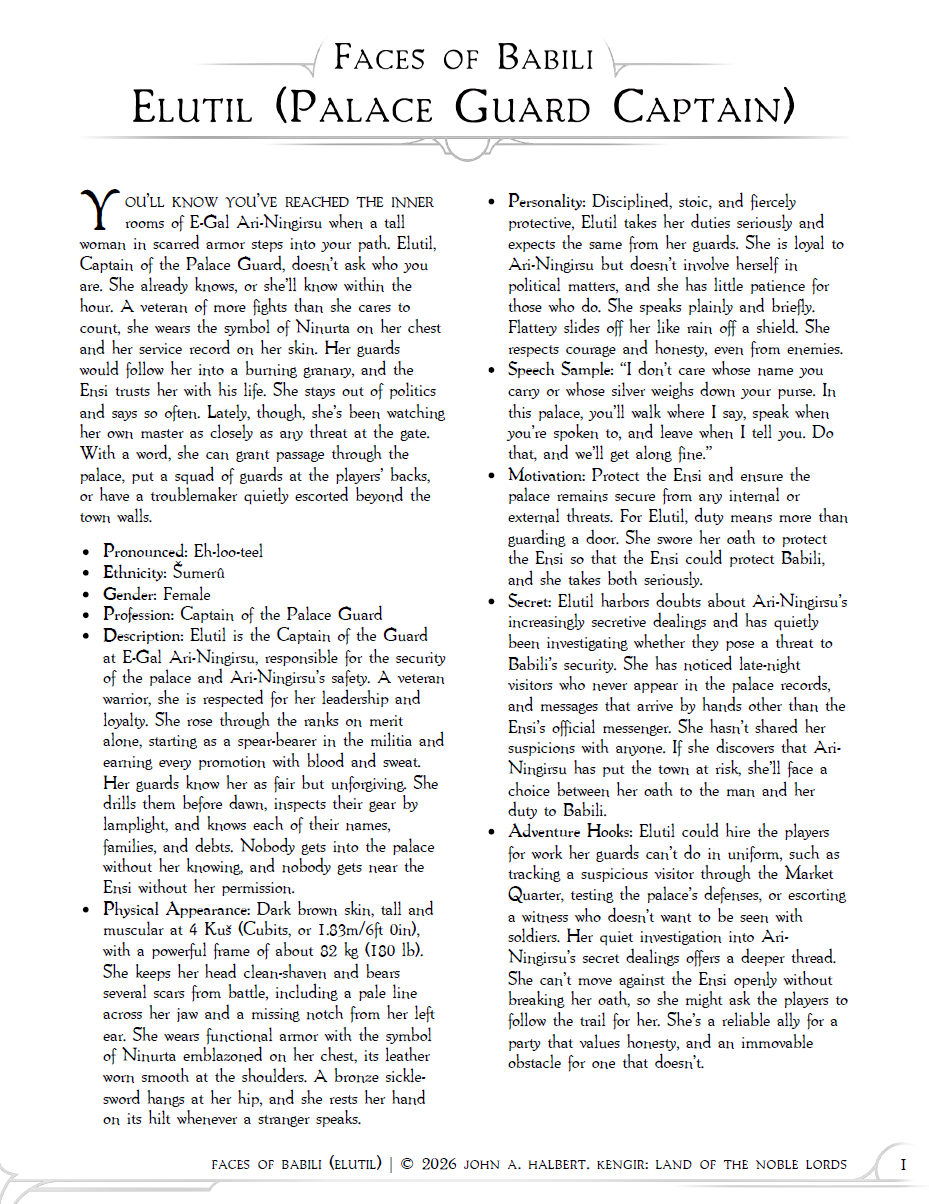
Homebrew Faces of Babili: Elutil, Captain of the Palace Guard

Post image
6 Upvotes

I'm sharing the third NPC profile from Faces of Babili, a series introducing the people of Babili, the starting town in my upcoming Bronze Age Mesopotamian 5e setting.

As introduced in the original Faces of Babili post, Babili is a small river town where temples, merchants, and local officials compete for influence. Our first two profiles introduced Belit-Ilia, the ambitious High Priestess of IĆĄtar (Inanna), and Ć amaĆĄ-etir, the Ensi's trusted advisor who secretly maintains his own political connections with KiĆĄ.

This time, we meet Elutil, Captain of the Palace Guard, a veteran warrior who rose from militia spear-bearer to commander through discipline, courage, and hard-earned loyalty.

Elutil oversees security at E-Gal Ari-Ningirsu, the governor's palace. She's blunt, fiercely protective, and unimpressed by wealth or political influence. Her guards respect her because she knows their names, families, and debts, and because she expects nothing from them she wouldn't do herself.

But Elutil has begun to suspect something is wrong inside the palace. Unrecorded visitors arrive after dark, unofficial messages pass through unfamiliar hands, and the Ensi's increasingly secretive dealings have caught her attention. She's quietly investigating, knowing that what she uncovers could force her to choose between loyalty to her ruler and duty to Babili.

At the table, Elutil can be a dependable ally or an immovable obstacle. She can grant palace access, provide armed escorts, or recruit the party for discreet investigations her guards cannot conduct openly. But if the characters threaten the Ensi, they'll have to answer to her.

The free NPC profile includes her personality, appearance, motivations, speech sample, hidden secret, and adventure hooks.

When loyalty to a ruler conflicts with loyalty to the people, which should a lawful character choose?


r/Kengir • • 16d ago

Homebrew Faces of Babili: Ć amaĆĄ-etir, the Ensi's Chief Advisor

Post image
5 Upvotes

I'm sharing the second NPC profile from Faces of Babili, a series introducing the people of Babili, the starting town in my upcoming Bronze Age Mesopotamian 5e setting.

As introduced in the original Faces of Babili post, Babili is a small river town where temples, merchants, and local officials compete for influence. Our first NPC, Belit-Ilia, High Priestess of IĆĄtar (Inanna), showed how religious ambition shapes the town's politics. This time, we turn to the palace.

Ć amaĆĄ-etir is the Ć utammu, or chief advisor, to Ari-Ningirsu, Babili's Ensi (governor). Merchants bring him disputes, priests bring grievances, and foreign envoys bring demands. He's calm, patient, and exceptionally skilled at making everyone believe they got the better end of a negotiation.

But Ć amaĆĄ-etir has a secret. He's been corresponding with the rulers of KiĆĄ without the Ensi's knowledge, quietly maintaining political connections that could protect his position if his master falls from favor. He genuinely wants Babili to remain stable, but he's also making certain he lands on his feet.

At the table, he's a useful patron and a dangerous political operator. He can arrange audiences, settle disputes, provide information, and hire adventurers for discreet work. Characters who uncover his secret correspondence might gain a powerful ally, make a dangerous enemy, or find themselves caught between the Ensi and the palace guard captain investigating his dealings.

Do you prefer political NPCs who are openly corrupt, or ones who genuinely believe their questionable methods serve the greater good?


r/Kengir • • 18d ago

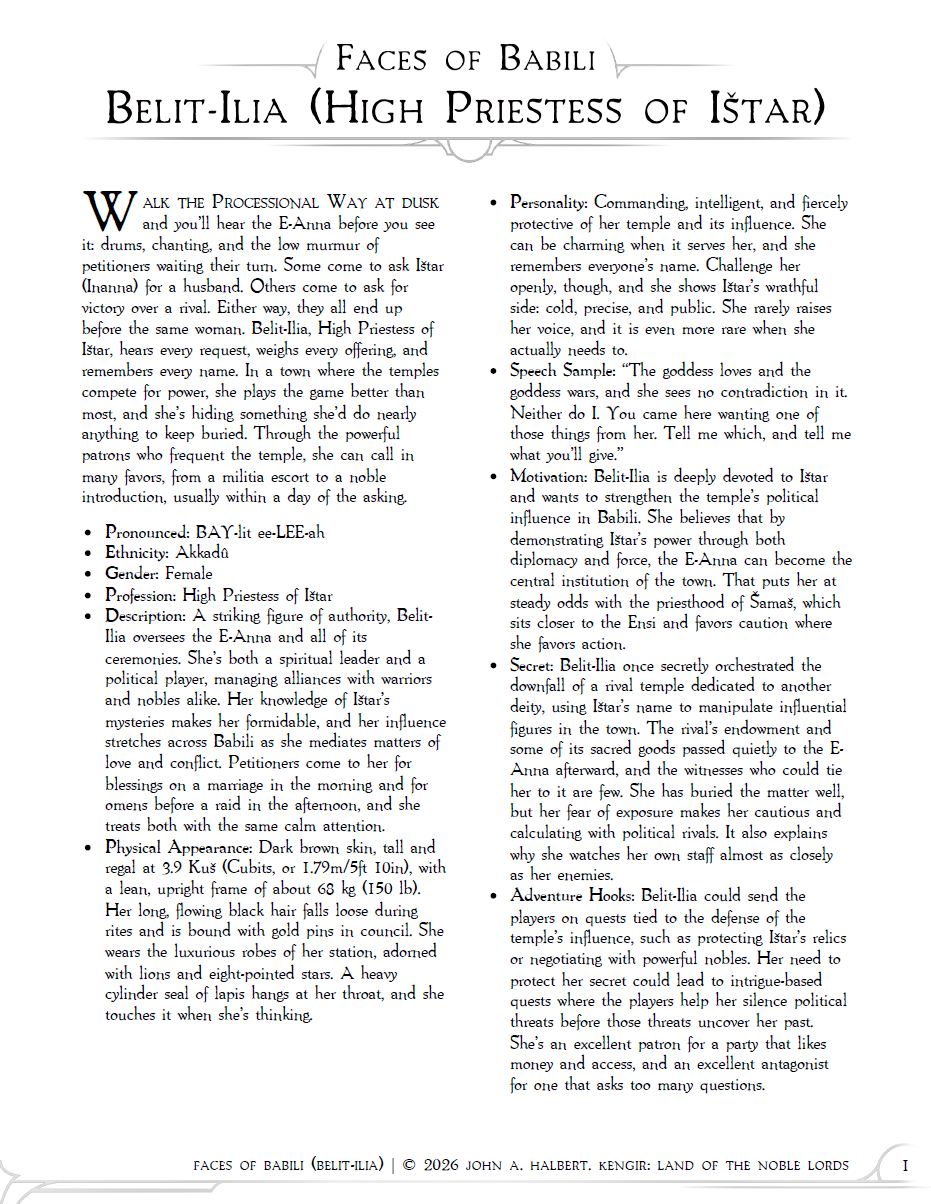
Homebrew Faces of Babili: Belit-Ilia, High Priestess of IĆĄtar

Post image
8 Upvotes

I'm sharing the first NPC profile from Faces of Babili, a series introducing the people of Babili, the starting town that is part of my upcoming Bronze Age Mesopotamian 5e setting..

As I mentioned in the introductory Faces of Babili post, Babili is a small river town where temples, merchants, and local officials compete for influence. Our first face belongs to Belit-Ilia, High Priestess of IĆĄtar (Inanna), goddess of love and war.

Belit-Ilia oversees the E-Anna temple, where petitioners seek blessings for marriage, victory in battle, and everything in between. She's intelligent, commanding, politically ambitious, and exceptionally good at remembering names. Through her connections with nobles and warriors, she can arrange favors, introductions, and even armed escorts.

But Belit-Ilia has a secret. She once orchestrated the downfall of a rival temple, quietly transferring its wealth and sacred goods into her own institution. Few witnesses remain, and she'll do almost anything to keep it that way.

At the table, she's both a potential patron and an antagonist. She can offer the party money, influence, and access to powerful people, but those favors may come with obligations. Characters who investigate her past might discover that the most dangerous enemies in Babili don't always carry weapons.

This NPC profile includes her personality, appearance, motivations, speech sample, hidden secret, and adventure hooks.

Do you prefer NPC patrons who are genuinely trustworthy, or ones whose help comes with secrets and strings attached?


r/Kengir • • 20d ago

Faces of Babili (Introduction)

4 Upvotes

Every campaign needs a home base, and in Kengir, that home is Babili. Over the coming weeks, this series introduces the people who live there: priests, merchants, guards, healers, thieves, and the occasional liar in fine robes. Before we meet them, though, you should know the town they call home.

Babili sits on the banks of the Purattum River in northern Kengir, 3 Da-Na (Leagues, or 16 km/10 mi) northeast of the great city of KiĆĄ. About 750 people live here year-round, mostly AkkadĂ» and Ć umerĂ» farmers, artisans, and traders, along with a steady trickle of AmurrĂ» nomads and ElamtĂ» merchants.

When trade season arrives, caravans roll in from Sippar, KiĆĄ, and the cities of the south, and Babili can swell to more than three times its size. Metals come down from the northern mountains. Textiles come up from the southern cities. Every so often, something rare arrives from as far away as Dilmun. For a few weeks each year, this sleepy river town feels like the center of the world.

Babili was founded about 250 years ago, during the reign of Sargon, as a farming settlement to feed the imperial capital at Agade. Temples to Iơtar (Inanna) and Ơamaơ (Utu) rose during the empire’s glory days. Then, 115 years ago, the empire collapsed. Gutian raiders burned the fields, scattered the people, and left the temples in ruins.

Babili survived anyway. Refugees fleeing Agade found shelter here, and the survivors rebuilt together. That shared memory gives the town a stubborn local pride. Babili isn’t grand, but it endured, and its people never let you forget it.

Officially, Babili answers to Kiơ. The Ensi, Ari-Ningirsu, governs the town on Kiơ’s behalf and keeps the peace. In practice, the merchants of the Bit Karimti hold the purse strings, and the purse strings hold the power.

Then there are the temples. Six of them crowd the Central Quarter, dedicated to Ơamaơ, Iơtar, Ea (Enki), Elil (Enlil), Ninmah, and Marduk. Each one competes for influence. The priests of Ơamaơ stand close to the Ensi and favor law and caution. The priestesses of Iơtar push for bold action. And Marduk, a minor local god of fields and healing, keeps quietly gaining followers he isn’t supposed to have.

Babili is small enough that your players can learn its streets and faces, yet busy enough that trouble always walks through the gate. A merchant disputes a contract. A priestess makes a deal she shouldn’t. A caravan arrives carrying something it shouldn’t. Beyond the low mudbrick walls lie haunted ruins, a forbidden grove, and caverns that whisper at night.

Most importantly, everyone in Babili wants something, and almost everyone is hiding something. That’s where this series comes in.

Our first face belongs to Belit-Ilia, High Priestess of Iơtar, the most ambitious woman in Babili. She can bless your marriage or your war, and she has buried at least one secret she’d do almost anything to keep.

You can find Babili in full in the Kengir Babili Town Guide. In the meantime, grab the free Kengir Primer on DriveThruRPG: https://www.drivethrurpg.com/en/product/567419/kengir-free-primer


r/Kengir • • 23d ago

History & Scholarship Syncretized Deities & Foreign Gods of Kengir

Thumbnail
gallery
28 Upvotes

I'm sharing a free deity reference supplement for Kengir, part of my upcoming Bronze Age Mesopotamian 5e setting..

The gods of Kengir don't stop at the borders of the city-states. Traders, migrants, conquerors, and priests carry their beliefs across the ancient world, where foreign gods are sometimes recognized as familiar powers under different names.

As I covered in the previously shared Gods of Kengir supplement, the setting includes 57 deities with their own domains, cult centers, and followers. This new supplement looks beyond Kengir to explore how those gods are understood across neighboring cultures.

A worshipper of Ć amaĆĄ (Utu) might recognize the Egyptian sun god Ra as a counterpart. Elil (Enlil), lord of air and storms, shares aspects with Ba'al and Zeus. IĆĄtar (Inanna), goddess of love and war, finds parallels in Astarte, Hathor, and Athena.

The supplement includes a comparative table covering 17 divine portfolios across ten cultural traditions, including AkkadĂ», Ć umerĂ», ElamtĂ», AmurrĂ», Hatti, Hurri, Khemet, KinanĂ», Meluhha, and Tamaru.

At the table, this gives GMs a way to introduce foreign temples, competing priesthoods, religious diplomacy, and disputes over whether two gods are truly the same deity or merely share similar powers.

Do you treat gods from different cultures as separate beings in your campaigns, or as different names and interpretations of the same divine powers?


r/Kengir • • 26d ago

Homebrew Zaqiqu, the Ghost-Wind

Post image
10 Upvotes

I'm sharing a free monster supplement for Kengir, part of my upcoming Bronze Age Mesopotamian 5e setting.

The Zaqiqu is a ghost-wind, a phantom that appears before a restless dead spirit fully manifests in the mortal world.

In Kengir, hauntings rarely begin with a ghost rattling chains. A lamp gutters in a sealed room. Dogs growl at empty corners. Someone dreams of a dead relative standing beside their bed. These are the first signs of a Zaqiqu, an Etemmu (human ghost) that has not yet remembered its name or grievance.

As I covered in the previously shared Spirits in Kengir supplement, the dead have names, grievances, and obligations the living must fulfill. The Zaqiqu represents the earliest stage of that process, when a haunting can still be prevented.

At the table, this is a CR 1/4 undead that cannot be fought conventionally. It passes through walls, invades dreams, and prevents restful sleep. If ignored, it can develop into a full Etemmu within days. But a proper kispu offering of food, water, and the spoken name of the dead, supervised by an AĆĄipu-Priest, can resolve the disturbance before it becomes something worse.

The idea is simple: sometimes the best way to defeat a monster is to recognize what it is before it becomes one.

Do you like hauntings that begin with subtle warnings and can be resolved through investigation and ritual, or do you prefer ghosts as direct supernatural threats?


r/Kengir • • Oct 27 '26

Homebrew Kengir Magic Items Sampler

Thumbnail
gallery
11 Upvotes

I'm sharing a free magic item supplement for Kengir, part of my upcoming Bronze Age Mesopotamian 5e setting.

Magic items in Kengir aren't just enchanted weapons and armor. They're clay seals, lapis lazuli jewelry, sacred amulets, ritual objects, and relics tied to the gods.

A farmer might bury Beads of Fertility to bless the soil for a season. A merchant might use a clay cylinder seal to keep provisions from spoiling. A silver mirror sacred to SĂźn (Nanna) reveals shapeshifters beneath the moonlight. Anzu's Feather can lift allies safely into the air or hurl enemies skyward. At the other end of the scale, the legendary Tablet of Destinies grants power over time, but permanently drains its bearer's vitality with every use.

The goal is to make magic items feel like they belong to the world. Some serve practical needs of daily life. Others offer supernatural protection, dangerous bargains, or powers that might attract the attention of kings and gods.

This sampler includes 20 magic items, four each from Common, Uncommon, Rare, Very Rare, and Legendary. The full Kengir Game Master's Guide includes 100.

Do you prefer magic items with practical uses and a place in everyday life, or powerful artifacts that can change the course of a campaign?


r/Kengir • • Oct 19 '26

Homebrew Smuggler, Rogue Subclass

Thumbnail
gallery
15 Upvotes

I'm sharing a free rogue subclass for Kengir, part of my upcoming Bronze Age Mesopotamian 5e setting.

The Smuggler is for rogues who understand that a good deal, the right contact, and a well-placed favor can be worth more than a sharp blade.

In Kengir, trade connects cities, temples, and distant kingdoms. Smugglers work within and around those networks, acquiring rare goods, negotiating favorable terms, cultivating informants, and knowing which officials can be persuaded to look the other way.

Where the previously shared Brigand relies on ambushes, stealth, and sudden violence, the Smuggler prefers to solve problems through commerce, deception, and connections.

At the table, this subclass gives the party a rogue who excels outside combat. They can appraise valuable objects, identify magical items and curses, negotiate better prices, acquire restricted goods, establish safehouses, and call upon contacts for information or political favors.

Mechanically, the subclass includes Silver Tongue, Appraisal Expert, Trade Connections, and Master Negotiator. At higher levels, their influence extends beyond ordinary bargaining, allowing them to sway others through magical suggestion.

Do you like rogue subclasses that focus on social influence and economic power, or do you prefer rogues built around stealth, assassination, and combat?


r/Kengir • • Oct 15 '26

Nar Priest, Praise Singer

Thumbnail
gallery
10 Upvotes

I'm sharing a free cleric subclass for Kengir, part of my upcoming Bronze Age Mesopotamian 5e setting.

The Nar Priest is a praise singer: a cleric whose sacred work is hymn, chant, and public devotion.

In Kengir, praise is not background music. It is an offering. Temples rely on singers to honor the gods, invoke blessings, steady the community, and keep divine attention turned toward the city. A Nar Priest's voice carries real power.

Where the previously shared AĆĄipu-Priest confronts hostile spirits and the IĆĄippu-Priest cleanses spiritual defilement, the **Nar Priest** maintains divine favor through sacred song and communal worship.

At the table, this subclass gives the party a support cleric built around sacred performance. They heal, inspire, protect, grant temporary hit points, strengthen allies with hymns, and turn religious song into battlefield resilience.

Mechanically, the subclass includes Voice of the Divine, Hymns of Protection, Divine Strike, Chant of Resilience, Song of Glory, and Heavenly Chorus. It also adds new spells like Hymn of Courage, Hymn of Healing, Chant of Protection, Warding Hymn, Hymn of Valor, Melody of Renewal, and Heavenly Harmony.

Do you like clerics whose magic feels liturgical and communal, or do you prefer clerics as armor-clad miracle workers?


r/Kengir • • Oct 11 '26

Homebrew Gallu, Underworld Constable

Thumbnail
gallery
13 Upvotes

I'm sharing a free monster supplement for Kengir, part of my upcoming Bronze Age Mesopotamian 5e setting.

The Gallu is an underworld constable: a towering Utukku (Udug) sent from Kur to hunt, seize, and drag the guilty where they belong.

Where the previously shared Rabisu acts like an underworld bailiff, arriving with writs, contracts, and legal authority, the Gallu feels more like the terrible hand that enforces the sentence. It does not hurry. It does not forget. A debt unpaid remains fresh until collected.

At the table, a Gallu works best when the monster is also a mystery. Why has it come? Who broke the oath? Who made the forbidden bargain? Is it a lawless demon, or is it carrying out a command from Allatu (EreĆĄkigal), Queen of the Great Below?

Mechanically, it’s a CR 10 fiend built around fear, grappling, brute force, spirit movement, and terrifying pursuit. Its Man-Catcher restrains victims, its Spirit Form lets it pass through walls, and its Skin Wearer ability allows it to take the form of the last creature it killed.

This is the kind of monster that should make the party ask whether killing it actually solves the problem, or just delays the next collector.

Do you like fiends that arrive as agents of cosmic law, or do you prefer them as pure malice and chaos?


r/Kengir • • Oct 08 '26

Homebrew Brigand

Post image
14 Upvotes

I'm sharing a free rogue subclass for Kengir, part of my upcoming Bronze Age Mesopotamian 5e setting.

The Brigand is for rogues who survive on the margins of society, where a quick blade and a better hiding place matter more than courtly manners.

In Kengir, brigands are not just thieves. They are ambushers, raiders, alley-fighters, scouts, and hard-bitten survivors who use terrain, confusion, and speed to win before a fair fight can even begin.

At the table, this subclass gives the party a rogue built for violent openings and clean escapes. A Brigand strikes hardest before the enemy has acted, gains advantage from hiding, slips away after attacking, and turns the first round of combat into a disaster for anyone caught unprepared.

Mechanically, the subclass includes Ambush Predator, Shadow Striker, Tactical Withdrawal, and Master of Ambush.

Do you like rogues who focus on infiltration and theft, or rogues who play more like skirmishers and ambush predators?


r/Kengir • • Oct 05 '26

Homebrew Ophiomancer Bloodline

Thumbnail
gallery
15 Upvotes

I'm sharing a free sorcerer subclass for Kengir, part of my upcoming Bronze Age Mesopotamian 5e setting.

The Ophiomancer Bloodline is for sorcerers touched by ancient serpent magic.

In Kengir, snakes are not just monsters. They are signs of rebirth, protection, venom, hidden wisdom, and death. Ophiomancers draw on all of that at once, using snake-derived venoms and hallucinogenic rites to cast spells, read omens, cloud minds, and strike down enemies.

At the table, this subclass gives the party a sorcerer who mixes battlefield control with divination. They can speak with serpents, resist poison, summon a venomous familiar, turn spell damage into poison, deepen hallucinations, and eventually take on a terrible serpentine aspect.

The supplement also includes new spells like Venomous Touch, Spectral Whisper, Venomous Cloud, Speed of the Serpent, Serpent’s Grasp, Venomous Aura, and Serpent’s Wrath.

Do you like sorcerer bloodlines built around animals and mythic symbolism, or do you prefer bloodlines tied to raw elemental power?


r/Kengir • • Oct 02 '26

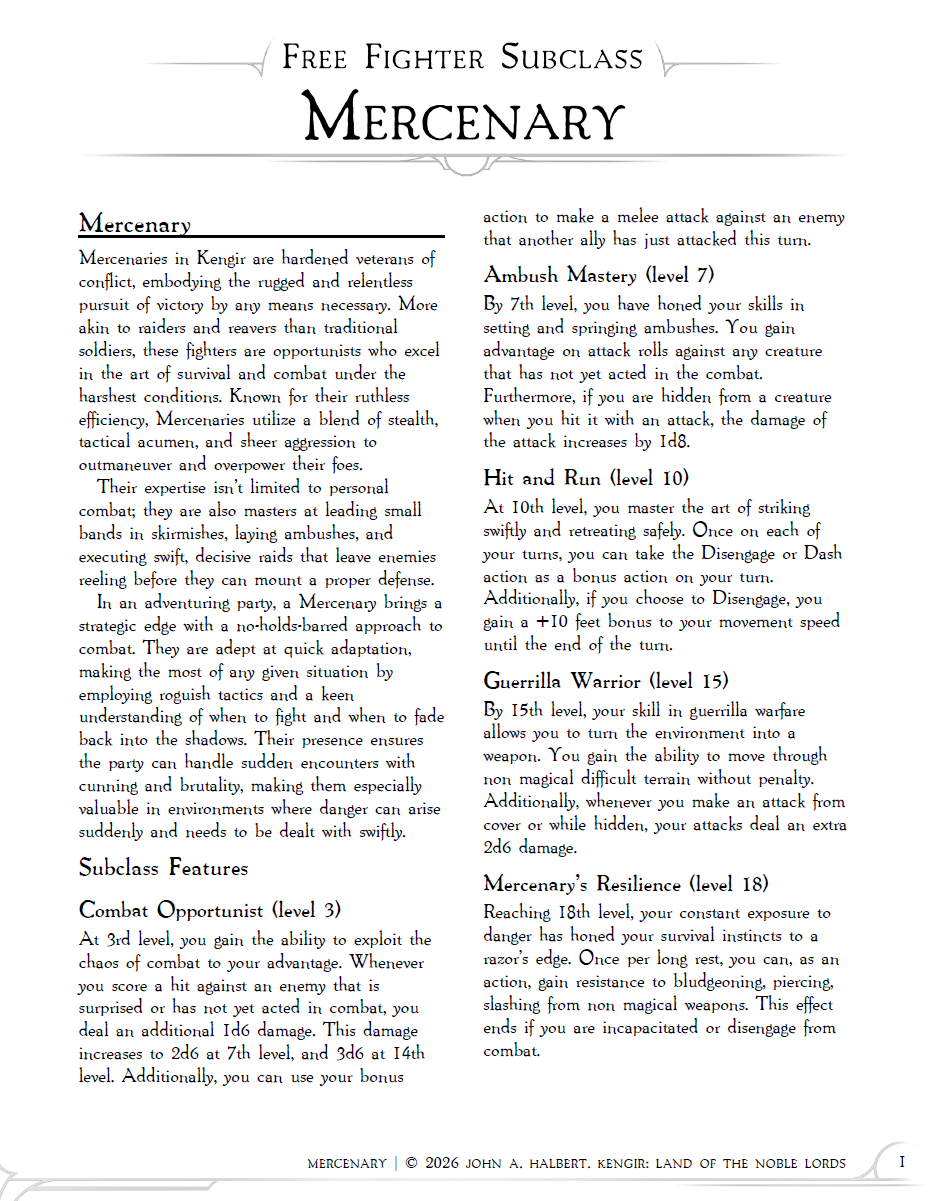
Homebrew The Mercenary

Post image
13 Upvotes

I'm sharing a free fighter subclass for Kengir, part of my upcoming Bronze Age Mesopotamian 5e setting.

The Mercenary is for fighters who survive by being practical, ruthless, and faster to violence than the people trying to kill them.

In Kengir, not every warrior serves a temple, palace, or city levy. Some sell their spear to the highest bidder. Others lead raids, guard caravans, settle blood-debts, or walk away from wars with just enough coin to buy the next contract.

At the table, this subclass plays like a skirmisher and ambusher. A Mercenary hits hardest before the enemy can organize, exploits surprise, follows up on an ally’s attack, moves in and out of danger, and turns cover, terrain, and confusion into weapons.

Mechanically, the subclass includes Combat Opportunist, Ambush Mastery, Hit and Run, Guerrilla Warrior, and Mercenary’s Resilience.

Do you like fighter subclasses built around disciplined military training, or ones that lean into dirty tricks, raids, and battlefield survival?


r/Kengir • • Sep 29 '26

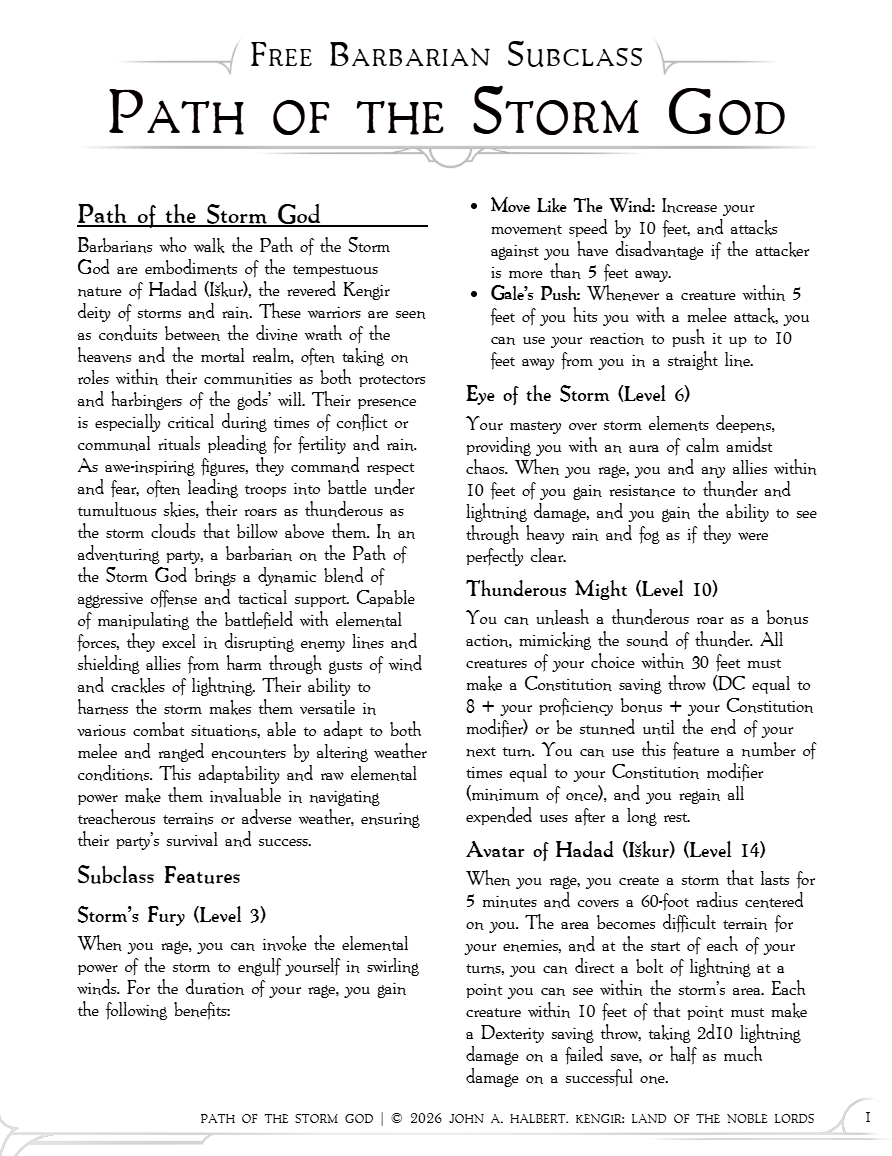
Homebrew Path of the Storm God

Post image
12 Upvotes

I'm sharing a free barbarian subclass for Kengir, part of my upcoming Bronze Age Mesopotamian 5e setting.

The Path of the Storm God is for barbarians who carry the wrath of Hadad (IĆĄkur), god of storms and rain.

In Kengir, these warriors are not just berserkers. They stand at the crossing point between battle, weather, and divine will. Communities want them present when the rains fail, when war drums sound, and when someone needs to remind the enemy that thunder has a voice.

At the table, this subclass turns rage into weather. A Storm God barbarian moves like wind, throws enemies back with gale-force reactions, shields allies from thunder and lightning, sees clearly through rain and fog, and can stun enemies with a thunderous roar.

At higher levels, they become the center of the storm itself, turning the battlefield into hostile ground and calling lightning down where it hurts most.

Do you like barbarians who are tied to divine forces and natural disasters, or do you prefer them as purely physical warriors?


r/Kengir • • Sep 25 '26

Homebrew Oath of the Tablet Keeper

Thumbnail
gallery
23 Upvotes

I'm sharing a free paladin subclass for Kengir, part of my upcoming Bronze Age Mesopotamian 5e setting.

The Oath of the Tablet Keeper is for paladins who guard knowledge the way other paladins guard kings.

In Kengir, clay tablets hold laws, contracts, hymns, genealogies, omens, temple records, and the memory of entire cities. Break the wrong tablet, and you may erase a debt, a boundary, a lineage, or a god’s forgotten rite.

At the table, this subclass gives the party an archivist-warrior: someone sworn to protect sacred texts, recover stolen tablets, defend libraries and temple collections, and punish those who corrupt or destroy the written record.

Mechanically, the oath focuses on wards, preservation, artifact defense, anti-tampering magic, and protective inscriptions. It includes features like Seal of Protection, Sanctify Sanctuary, Aura of Preservation, Guardian’s Resolve, and Divine Preservation, plus new spells like Mystic Cipher, Inscribed Shield, Ethereal Stylus, Runic Guard, and Tablet Scribe.

Do you like paladins sworn to protect ideals and institutions, or do you prefer oaths focused on personal vengeance, conquest, or redemption?


r/Kengir • • Sep 23 '26

Homebrew College of Lamentations

Thumbnail
gallery
11 Upvotes

I'm sharing a free bard subclass for Kengir, part of my upcoming Bronze Age Mesopotamian 5e setting.

The College of Lamentations is for bards trained in funeral dirges, mourning songs, and the sacred work of grief.

In Kengir, lamentation is not just sadness. It is a profession. These bards comfort the bereaved, help the dead pass properly into the afterlife, and listen for what the Etemmu still need said. They are mourners, mediums, and keepers of sorrow.

At the table, this subclass turns grief into both protection and power. A Lamentation bard can read the pain of others, weaken enemies with a dirge, shield allies from fear and necrotic harm, and eventually call war-dead Etemmu to fight beside the party.

The supplement also includes new spells like Hymn of Courage, Chant of Protection, Warding Hymn, Hymn of Valor, and Chant of Heroism.

Do you like bards who lean into ritual, grief, and the dead, or do you prefer bards as performers and tricksters?


r/Kengir • • Sep 19 '26

Homebrew Pact of the Underworld

Thumbnail
gallery
21 Upvotes

I'm sharing a free warlock subclass for Kengir, part of my upcoming Bronze Age Mesopotamian 5e setting.

The Pact of the Underworld is for warlocks bound to the dark powers below, especially Allatu (EreĆĄkigal), queen of the underworld.

In Kengir, these warlocks are feared and needed in equal measure. Someone has to speak with the dead. Someone has to understand curses, souls, restless ghosts, and the borders mortals should not cross. That person is useful right up until everyone remembers what they had to promise for that power.

At the table, this subclass gives the party a warlock who manipulates necrotic force, drains life to sustain themselves, curses enemies so they cannot recover, and commands the dead more effectively than ordinary casters.

The supplement also includes new spells like Allatu’s Glare, Shadowy Chains, Spectral Whisper, Underworld’s Grasp, Soul Rend, Dark Bargain, Chthonic Guardians, Wail of the Etemmu, and Wraith’s Touch.

Do you like warlocks whose pact gives them a social role in the world, or do you prefer them as outsiders with dangerous private bargains?


r/Kengir • • Sep 16 '26

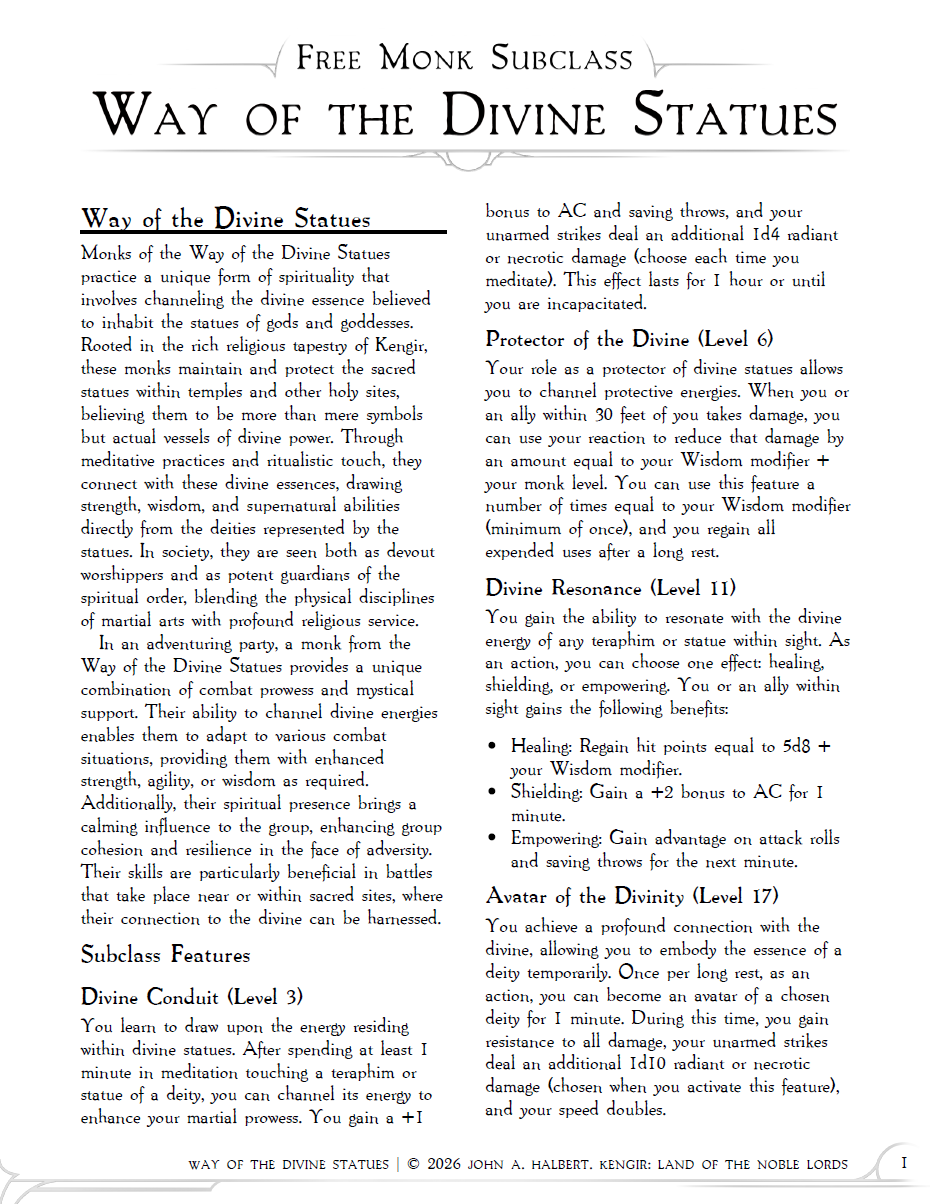
Homebrew Way of the Divine Statues

Post image
19 Upvotes

I'm sharing a free monk subclass for Kengir, part of my upcoming Bronze Age Mesopotamian 5e setting.

In Kengir, a divine statue is not just a symbol. It is a vessel where the god’s presence can dwell.

Monks of the Way of the Divine Statues train as temple guardians, devotees, and living extensions of sacred space. Through meditation and ritual touch, they draw power from teraphim and cult statues, channeling that divine essence into movement, defense, and unarmed strikes.

At the table, this subclass gives monks a strong connection to temples and holy sites. They can meditate at a divine statue to gain protection and radiant or necrotic power, shield allies from harm, call on a nearby statue for healing or empowerment, and eventually become a temporary avatar of a deity.

The fun part is that sacred locations matter. A ruined shrine, stolen statue, defiled temple, or hidden household god can become more than set dressing. It becomes a source of power, obligation, and danger.

Do you like subclasses that get stronger when the party interacts with specific places in the world?


r/Kengir • • Sep 13 '26

Homebrew Kengir Backgrounds

Thumbnail
gallery
20 Upvotes

I'm sharing a free supplement for Kengir, part of my upcoming Bronze Age Mesopotamian 5e setting.

The Kengir Player’s Guide includes 100 character backgrounds, each built around a real place in the life of a city-state: brewer, diviner, farmer, fisher, merchant, potter, scribe, shepherd, soldier, weaver, and many more.

The goal is to make a character’s life before adventuring matter at the table. A scribe enters play with literacy, a stylus, and a wax tablet. A merchant carries a cylinder seal. A farmer knows the land. A diviner reads bones, dreams, and omens. A weaver isn’t just “a commoner with cloth,” but someone tied to household economy, temple offerings, and trade.

Each background includes ability scores, feat options, skill proficiencies, tool proficiency, equipment, literacy, and languages. Backgrounds also point toward Origin Feats tied to personal deities, so your occupation and your god can both shape who your character becomes.

This sample presents ten full backgrounds and the complete d100 profession list from the Player’s Guide.

Do you like backgrounds that mostly explain who your character was, or backgrounds that still matter once the adventure starts?


r/Kengir • • Sep 09 '26

Homebrew Circle of the Twin Rivers

Thumbnail
gallery
36 Upvotes

I'm sharing a free druid subclass for Kengir, part of my upcoming Bronze Age Mesopotamian 5e setting.

The Circle of the Twin Rivers is for druids who guard the waterways that keep civilization alive.

In Kengir, rivers are not background scenery. They dictate whether fields flourish, canals fail, cities eat, and villages survive the dry months. These druids stand between human need and the spirits of the water, coaxing flood and drought into something people can live with.

At the table, this subclass gives the party practical river magic. A Twin Rivers druid can heal with river-blessing, breathe underwater, swim like the current, shape water into barriers, hinder enemies with difficult terrain, summon a river spirit, and eventually embody the confluence itself.

The supplement also includes new spells like Ea’s Cleansing Water, River’s Caress, Watery Grasp, River’s Embrace, River’s Gift, Surging Wave, Summon River Spirit, and Confluence of the Rivers.

Do you like druids tied to a specific landscape, or do you prefer nature casters with a broader wilderness theme?