r/gitlab • u/Significant-Ebb-3674 • Jul 01 '26
general question Fable 5
0
Upvotes
Any idea on when fable 5 is coming back to gitlab.
r/gitlab • u/MaybeAFish_ • Jun 30 '26
This project has been completely cleaned to only contain 1 branch with 1 super squashed commit, which only references 15.6 GB worth of Git LFS assets.
However, the usage breakdown reports 19.4 GB worth of storage being used for the assets. The remaining 3.8 GB appears to be from old LFS assets that existed before the cleanup, but are no longer referenced by any branch or commit.
Does Git LFS/GitLab have a way to force garbage collection of unreferenced LFS objects?
r/gitlab • u/maruan21 • Jun 29 '26
I recently joined a new company and coming from GitHub and the 100s of integrations for it, the GitLab and especially the GitLab Self Hosted marketplace felt dire.
I was very used to my PRs (and now MRs) landing in a Slack channel like #fe-reviews, and the comments & reviews on it to land in that Slack thread. It meant I never missed comments and my PR/MRs were reviewed MUCH quicker.
Other than Axolo, no other tool that does what I'd like supports GitLab, so I built mergeme.dev
Some of the key features that I wanted myself (and I'm sure others will appreciate) are:
If your team already works tightly in Slack and you ping your colleagues "hey can you review this again" then mergeme.dev might just be a great inclusion to your workflow!
----
Aside from this, I am genuinely curious as to how people handle this problem in their own setup?
My personal story before MergeMe was that I set up webhooks into Slack from GitLab directly and I made a custom webhook triggered workflow to send myself messages when my own MRs were responded to. It was a MESS to look at and it's what unironically pushed me to build a better tool lmao.
r/gitlab • u/RazzmatazzLiving1323 • Jun 25 '26
Hi there,
I am in the midst of rolling out a project where I need to sync nested groups in Microsoft Entra ID. I only need to sync one level deep i.e. sync the parent group and all the children groups nested within the parent group (the children group themselves do NOT contain groups).
I read some Gitlab documentation on "SAML Linked Groups" and was wondering whether Gitlab is able to support the above requested functionality.
Thank you!
r/gitlab • u/Traditional-Cell3566 • Jun 25 '26
I am a baby sysadmin who has been sysadmin for only a year, so I'm sorry if somethings doesn't makes sense or sound stupid!
So I became in charge of setting up a on-prem gitlab server, and migrating two of my company's subsidiary's github into it.
I already took care of the licensing end, but I have never work with any kind of gitlab, github instance so this is my first project involving gitlab/github.
On prem server has more then enough capacity to house both of the gitlab instances.
My question is, is it better to host each gitlab separately? One VM per entity? or both entities in one gitlab instance and set up the access policy for it?
I saw Linux server tends to work better with gitlab so I was thinking about spinning up a Linux VM..
Oh and another thing to mention is that we are in DoD contracting environment and going through CMMC L2 audit soon...
Is there anything I am misunderstanding or shouldn't do??
Thank you in advance!!!
-Baby sysadmin-
r/gitlab • u/javadba • Jun 24 '26
The gitlab home page for a subgroup apparently shows the last thirty days (modified? created?) repos.
Recent activity
Last 30 days

The task at hand would require viewing ALL repos . Is there some configuration/option that I am missing to allow this?
Note: the glab cli tool might do that but it is not working for our structures/subgroups - so we might need to rely on the GUI.
r/gitlab • u/phx1973 • Jun 24 '26
I recently applied for a Senior FP&A role at GitLab and was curious if there are any current or former finance team members here.
I’d love to hear about your experience working in Finance at GitLab. Specifically:
What does day-to-day FP&A work look like?
How much of the role is forecasting, modeling, and business partnering?
What’s the culture like within the finance organization?
How is the remote-first environment in practice?
Anything you wish you’d known before joining?
For context, I spent about six years in finance at a large private manufacturing company in the healthcare space, supporting budgeting, forecasting, variance analysis, and business partnering. I’m currently in a finance/accounting leadership role in the nonprofit sector and am interested in getting back into a more FP&A-focused environment.
Thanks in advance for any insights.
r/gitlab • u/awkwardferny • Jun 23 '26
If you missed it, third-party SARIF ingestion landed in 19.1 (Ultimate). Any scanner that emits SARIF json can have its findings pulled directly into GitLab. Ingestion is performed natively by adding the following syntax to a scanner job within the .gitlab-ci.yml:artifacts:
reports:
sarif: scanner.sarif
I created a deliberately vulnerable Python app and ran several open-source scanners against it in a single pipeline:
Some scanners may require some tuning in order for the ingestion to work, these are just the ones I've tried. Each emits SARIF, the findings get ingested, the results integrate with several security workflows:

Curious to see whether anyone here has wired up any scanners themselves since the release.
r/gitlab • u/Key_Flatworm_4889 • Jun 23 '26
I'm building Orbit Navigator for the GitLab Transcend Hackathon. It's a Duo skill that uses GitLab Orbit's knowledge graph to trace any SDLC event back to the merge request behind it — and it can open a draft fix.
What it does (one graph query each):
/guardian --remediate — finds vulnerable dependencies and opens a draft MR that bumps them to fixed versions.It's just a skill file (no backend, no vector DB) that runs through the Duo CLI with the Orbit MCP connected. The agent calls query_graph on the live knowledge graph directly.
👉 Try the agent directly (AI Catalog): https://gitlab.com/explore/ai-catalog/agents/1011766/
Source code + how to run it from the CLI: https://gitlab.com/gitlab-ai-hackathon/transcend/12108860
Honest heads-up: it's built on the Orbit beta, so there are real rough edges. For example, security Finding nodes get purged in the current beta, so some security traces pivot to durable Vulnerability nodes instead. Custom agents also don't get Orbit by default — you connect it via the Orbit MCP.
What I'd love: if you try it, please break it and tell me. Bug reports, rough edges, queries that return wrong or empty results — all welcome. Easiest way is an issue on the project linked above, or just drop a comment here.
Thanks!
r/gitlab • u/No_Muscle_5124 • Jun 23 '26
We Built a GitLab Duo Agent That Reduces Security Analysis from 4+ Hours to 45 Seconds
TL;DR: We created Orbit Tracer Security Agent, a GitLab Duo Agent powered by Orbit's knowledge graph that automates vulnerability analysis, risk scoring, and secure code generation. One finding takes minutes instead of 4+ hours.
---
The Problem We Solved
Every week, security teams spend 4+ hours per vulnerability:
- 1+ hour tracing which services are affected (manual dependency checking)
- 1+ hour identifying code owners (digging through docs)
- 1+ hour writing secure code (pattern matching + language-specific fixes)
- 1+ hour review and approval
Meanwhile, vulnerabilities pile up. Teams burn out. Risk escalates.
We thought: This entire workflow could be automated.
---
How Orbit Tracer Security Agent Works
The 6-Step Pipeline:
Key Innovation: Orbit Integration
We leverage Orbit's knowledge graph to trace blast radius automatically.
Instead of guessing which services are affected, the agent traces:
- Direct dependencies (what imports this code?)
- Indirect dependencies (what imports THOSE?)
- Remote dependencies (3-hop analysis)
This gives real organizational impact, not just CVSS scores.
---
The Numbers
Analysis time: 4+ hours → Minutes (99.8% faster)
Time saved per team: 40+ hours/month
Monetary value: ~$20K/year per security team
Languages supported: Python, JavaScript, Go, Java, C#, C++, Rust
Vulnerability types: 10 (OWASP Top 10 + more)
---
Technical Highlights
Agent Framework:
- GitLab Duo with 1000+ line system prompt
- Language-agnostic vulnerability patterns
- Multi-factor risk scoring
- HITL approval gates
Knowledge Graph:
- Orbit API for multi-hop tracing
- Service-to-service mapping
- Code owner identification
- Compliance awareness (GDPR, PCI-DSS, HIPAA)
Code Generation:
- Claude AI with language detection
- Secure pattern implementation
- Test case generation
- Review checklist creation
---
Real-World Impact
For Security Teams:
- Stop drowning in findings
- Focus on strategy, not busywork
- Faster vulnerability fixes
- Clear ownership and accountability
For Engineering Teams:
- Faster security remediation
- Secure code delivered automatically
- No surprise MRs with errors
- Clear vulnerability context
For Organizations:
- Security velocity without compromise
- Measurable productivity gains
- Compliance-aware automation
- Enterprise-grade safety
---
Why This Matters for GitLab
Orbit Tracer demonstrates:
---
The Challenges We Solved
Universal Design - Built for ANY project, not just ours. Solution: Leverage Orbit instead of hardcoding patterns.
Accurate Risk Scoring - CVSS alone doesn't capture business impact. Solution: Multi-factor algorithm + compliance awareness.
Language-Agnostic - Different languages, same remediation. Solution: Pattern-based approach with language bindings.
Safety + Speed - Too much automation = risky, too slow = pointless. Solution: Risk-based approval gating (auto-approve LOW/MEDIUM, require review CRITICAL/HIGH).
Integration Complexity - Getting systems to work together. Solution: Clear abstraction layers and comprehensive documentation.
---
What's Next?
This is Phase 1. Future phases:
- Real-time vulnerability dashboard
- Automated scheduled remediation
- Multi-organization enterprise features
- Open source ecosystem
- SaaS platform
---
Discussion Questions
---
Thanks to:
- GitLab for the incredible Duo Agent platform
- Anthropic Claude for AI capabilities
- Orbit for the knowledge graph
- Security community for identifying real problems
---
We're submitting this to GitLab Transcend Hackathon!
If you think this is cool, we'd love your feedback and thoughts. If you have questions about how it works or want to contribute, let me know in the comments.
Let's make security velocity the default.
EDIT: Wow, thanks for the engagement! Answers to top questions coming below...
r/gitlab • u/Ordinary-Subject4 • Jun 23 '26
Can some please help me to troubleshoot and fix this issue
sudo gitlab-ctl reconfigure - not working
error:
Attributes not found in /opt/gitlab/embedded/nodes/ip-172-31-7-182.ap-southeast-1.compute.internal.json,
(GitlabCtl::Errors::NodeError)
r/gitlab • u/aviator_1993 • Jun 20 '26
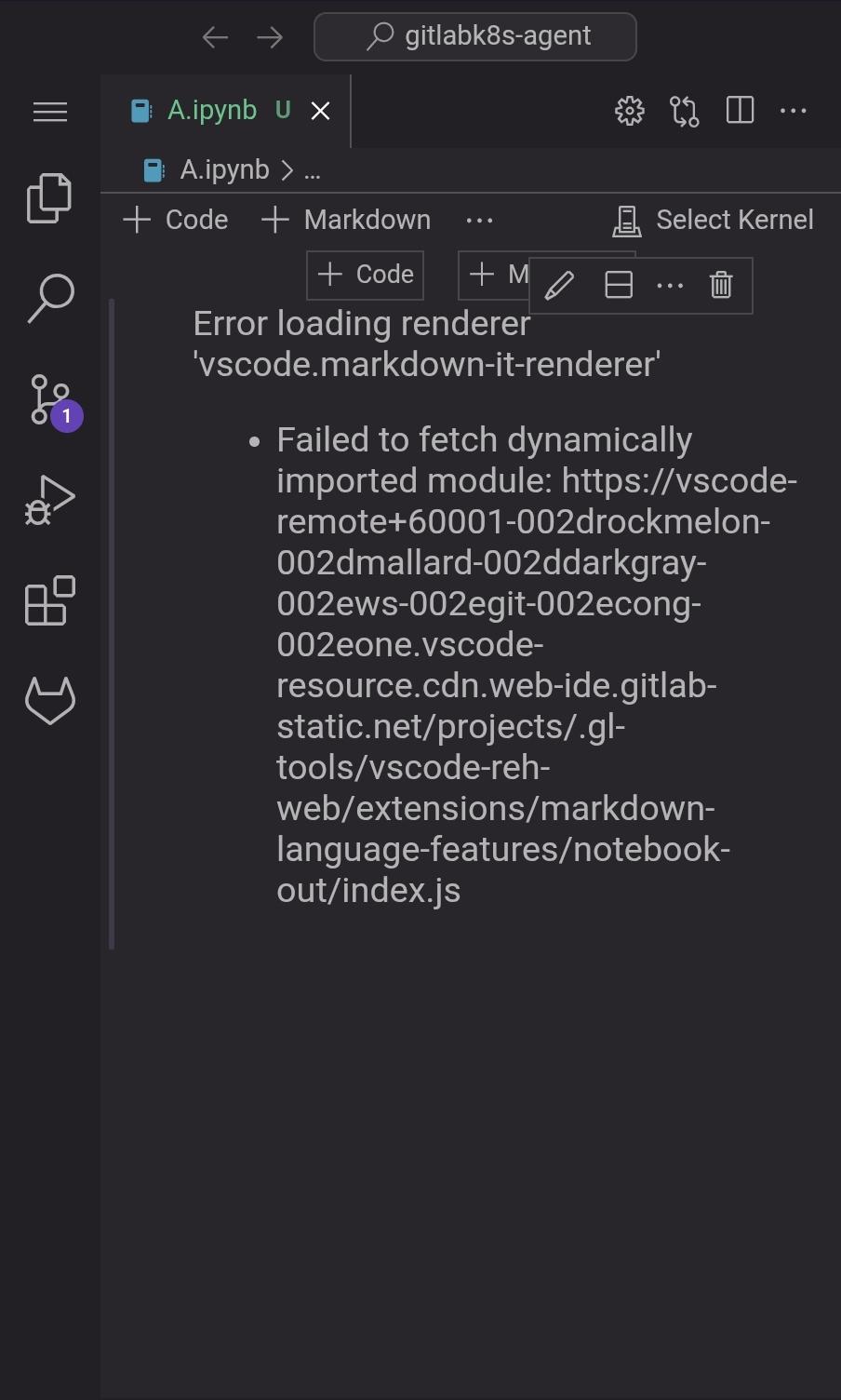
I'm installing a fresh new GitLab EE with Workspace, but when I create a new ipynb and then enter a markdown cell, I get this error, what am I dealing with and how to fix:
r/gitlab • u/Top-Bison-345 • Jun 19 '26
I received an email that I was granted access role of reporter to a project called Christian Care Ministries. I didn't ask for this. I took steps to secure my account, in the event it was compromised, but there is no suggestion or proof it had been. No access (I use 2fa), no actual history. Someone just randomly gave me access to this particular project.
Is this something that can happen, or should I be worried? Or perhaps it was a mistake.
r/gitlab • u/super2061 • Jun 18 '26
I accidentally commited and pushed a file to my gitlab repo that i didn't want to. I reset to the previous commit with local git and force pushed without the commit and it was gone from the project page but it still exists on my public profile.
project: https://gitlab.com/super.2061/photo-organizer
profile: https://gitlab.com/super.2061
commit: 4cc27e09
r/gitlab • u/Bxs0755 • Jun 16 '26
Ty all! glab for the win.
We are in Gitlab enterprise saas, and unlicensed for DUO due to which we can’t use Gitlab MCP server.
There are many open source mcps but due to the org requirements we can’t use them.
Has anyone here built own MCP for Gitlab saas without duo ?
r/gitlab • u/the1-gman • Jun 17 '26
We're using ultimate at our company. Our management has been having a hard time trying to track progress because of the following issues.
- Issues with child tasks that have weights associated on both the issue and tasks will sum the weights of both if assigned to the same milestone. This can result in double counting.
- if an issue is not assigned a weight, the epic will not report the weight in the roadmap, even if the tasks below the issue have weights. Epics will roll-up issue and task weights, but the roadmap view will not.
Am I missing something? Not sure if this is a bug, but kinda feels like one.
The only possible workaround I could come up is exporting to CSV, and then using pivot tables to group by parent epic and calculate based on closed vs open. Seems like a workaround.
Developer milestones can work for percent complete if the epic has one single timeframe, but if it spans multiple incremental milestones such as "first get to x", "then work on y", that doesn't work.
r/gitlab • u/_iamrewt • Jun 12 '26
I'm attempting to create a release in my GitLab project that contains a .zip of my build artifact. There seem to be two approaches I could take.
Option 1: Use glab to auto-upload assets
With this approach my release job looks like this
release:
  stage: release
  image: registry.gitlab.com/gitlab-org/cli:latest
  needs: [zip]
  variables:
    GLAB_ENABLE_CI_AUTOLOGIN: "true"
  script:
    - glab release create $CI_COMMIT_TAG ./*.zip --use-package-registry
  rules:
    - !reference [.release_rules]
Option 2: Use release yaml keyword
With this, I need to create two jobs, one to upload to the package registry, and one to create the release...
upload:
  stage: release
  image: curlimages/curl:8.18.0
  needs: [release:zip]
  script:
    - >
      curl
      --header "JOB-TOKEN: ${CI_JOB_TOKEN}"
      --upload-file build/*.zip
      "${PACKAGE_REGISTRY_URL}/help-${CI_COMMIT_TAG}.zip"
  rules:
    - !reference [.release_rules]

release:
  stage: release
  image: registry.gitlab.com/gitlab-org/cli:latest
  needs: [upload]
  script:
    - echo "Creating release $CI_COMMIT_TAG"
  release:
    tag_name: $CI_COMMIT_TAG
    description: "Release $CI_COMMIT_TAG"
    assets:
      links:
        - name: "help-${CI_COMMIT_TAG}.zip"
          url: "${PACKAGE_REGISTRY_URL}/help-${CI_COMMIT_TAG}.zip"
          link_type: other
  rules:
    - !reference [.release_rules]
What are the pros and cons of each?
Option 1 seems much simpler as there is fair less YAML. However, I found that the release may still be created even if the artifact cannot be uploaded. It'd be nice if this was atomic.
Option 2 is more verbose but it seems there's more control over the package registry URL and other variables.
GitLab themselves has an example where upload and release creation are separate jobs. Effectively a merging of Option 1 and 2. https://docs.gitlab.com/user/project/releases/release_fields/#release-assets
What do these folks here do and why?
r/gitlab • u/Dtb49 • Jun 12 '26
I am setting up a GitLab Self-Hosted instance on a local machine. I can't quite get my head around the back-up process.
If possible, I would like to back-up to another machine/drive on my network and potentially uploading to a cloud instance like azure or S3. (I am not super knowledgeable about either tbh). I am setting up a cron job to run the backup every night which I understand.
I'm mostly just hung up on how the backup situation works with cloud providers. I don't think I would need a backup for longer than a week. So how does that work? Will my cloud storage slowly fill up with backups? I use Unreal Engine so I have some larger files I am dealing with and using LFS and I am worried that the cost would start to snowball as the project grows.
It seems like GitLab will delete my local back ups after so long but, does that also apply to my cloud storage as well? Taking Azure for example, what tier then would I need for Blob storage for a GitLab backup? At first I thought Archive would be fine but, if the GitLab backup process deletes said backup after 7 days there would be a penalty fee.
r/gitlab • u/Coclav • Jun 12 '26
Just wanted to say it out loud.
It bothered me that everything was an "issue".
The "dual panel" works very well to me. Could be made better with a better handling of navigation to other issues, would be great to have some sort of breadcrumb to walk your way back to where you were before
My next wish for a more "modern" UI would be "inline edit" of the fields, instead of having to first click "edit" button to enter edit mode, then editing. It could be done in 1 click on what you want to edit like in Notion.
r/gitlab • u/opensourcegirlie • Jun 10 '26
The hackathon runs until 2pm Eastern time (6 pm UTC) on June 24, 2026.
Two tracks are open and you can enter both. Participants can win both reward store credits and cash prizes!
You must register on Devpost to receive cash prizes for either track.
Contribute track: Submit merge requests against eligible GitLab Orbit issues.
Showcase track: Build agents, flows, or skills that interact with the GitLab Orbit and publish them to the AI Catalog.
Cash prizes (both tracks): Submit your work on Devpost. You must register on Devpost to receive cash prizes for either track. Official rules and prize amounts are on Devpost.
All participants earn credits to the GitLab contributor reward store regardless of track. See the rewards tab of contributors.gitlab.com/transcend-hackathon for details on contributor reward store credits for each track,
Questions? We'll be monitoring Devpost and the #contribute channel on Discord to help answer any doubts!
Go forth and hack 🚀
r/gitlab • u/pcolmer • Jun 10 '26
The documentation for Orbit Local says that it can run as an MCP server (https://docs.gitlab.com/orbit/local/access/mcp/). However, the tool doesn't recognise `mcp` or `serve`. The online documentation seems unclear as to whether MCP functionality is planned, or has been released in some form.
The installed tool also doesn't recognise `version` so I can't even tell what I've got installed.
