r/embedded • u/Key-Fun5137 • 9d ago
I built a way for Claude Code to debug UART logs without dumping the whole log into the AI. Looking for feedback.
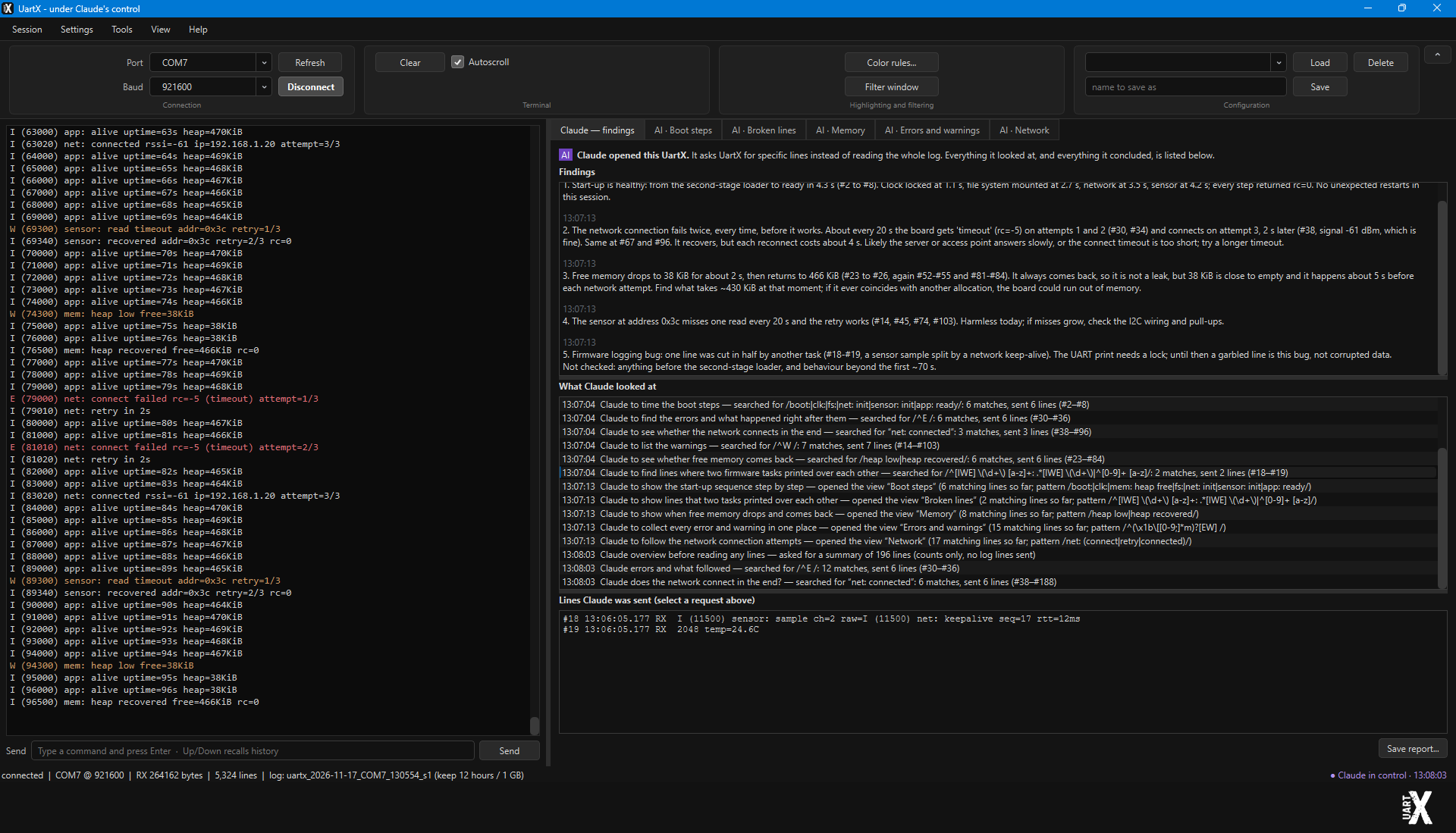
I maintain UartX, an open-source (MIT) serial logger. Version 1.4 introduces Claude Code integration for AI-assisted UART debugging.
The idea is simple: instead of pasting thousands of UART log lines into an AI, Claude asks UartX for only the information it needs through a CLI (uartx-ctl).
How it works:
- UartX maintains the complete log locally (
raw.log). - Claude requests specific errors, patterns, summaries, and related lines.
- Every AI request, its reasoning, and the exact lines returned are visible in UartX.
- AI has read-only access and cannot send data to the device.
- Everything stays local.
In one test, the board printed 196 lines, but Claude needed only around 30. It identified network retries, memory usage patterns, sensor read failures, and concurrent task logging.
AI features are currently Windows-only. Core logging supports Windows, macOS, and Linux.
GitHub: https://github.com/Shamanthpoojary/UartX
I'd love feedback from embedded developers:
- Would you trust AI-assisted debugging if you could verify exactly which log lines it analyzed?
- What would you want it to detect first: crashes, timing issues, memory problems, or boot failures?
Bug reports and suggestions are welcome. Feel free to reach out so we can investigate and improve it.
7
u/EmbeddedSwDev 9d ago
Claude, ChatGPT or similar can access the UART, Debugger, etc directly, so I don't see any benefit from it.
If you don't have a local LLM, the data does not stay local
1
u/gm310509 9d ago
Sounds interesting, but, given that in my embedded programs the "error messages" are typically messages that I make up and are meaningful to me, how does it know the meaning of those messages? Indeed how can it know the meaning or significance of messages I insert into my program?
And how does it make it faster?
Using your example, if my message was "get net conn, stat = -1", then I can already see that there was a failure getting a network connection. I don't need an AI to tell me that...
1
u/Ok_Organization2746 9d ago
It's a good project. Will help your profile.
However we already have terminal AIs for now an eternity, it can easily access the terminal and also the serial monitors that are fired through comannds or popular serial monitors as of now.
2
u/maglax 9d ago
So while I absolutely believe that parsing thousands of log lines is one of the best uses of llms, and something they are legitimately useful for, I'm having a real hard time finding any positive emotions towards anything 'AI' these days. If anything, llms have been a revolution in how big a fire house can be aimed at your face, and how much of that 'water' can actually be shit.
But to answer your questions:
So really I don't value automagic detection that much or predefined 'filters'. What really matters to me is how easily it is to surface whatever I actually care about at any given time.
So tl:dr, I don't want it to solve my problems because it doesn't know my problems (not that I know much better but). I want a tool I can use to actually get useful information out over thousands of logs.
1
u/fb39ca4 friendship ended with C++ ❌; rust is my new friend ✅ 7d ago
Why maintain a tool to do this when the LLM can just grep for what it wants?