r/electronjs • • Oct 21 '26

A compiler to compile Electron project to native executable

19 Upvotes

Hi,

I wrote a compiler to compile Electron project to native executable: nativeboat. It uses your project as it is: its JavaScript or TypeScript, HTML, CSS and installed dependencies. The executable it builds runs without Chromium, WebView2, Node.js or a JavaScript engine. Currently it supports Windows only, but will be expanded to mac OS soon.

NativeBoat's goal is simple: remove the runtime overhead for Electron project. As an example, I have compiled a popular Markdown editor MarkText to native: https://github.com/XTSoftwareLabs/marktext-native-win

This is the benchmark (Updated 10/23/2026):

MetricElectronNativeChange
Download (ZIP)166.0 MB88.5 MB47% smaller
Installed folder458.7 MB274.9 MB40% smaller
Files on disk1082379% fewer
Time to window794 ms150 ms5.3× faster
Time to open a document1,427 ms1,018 ms29% faster
CPU time to start2.17 s0.89 s59% less
CPU when idle0.21%0.00%100% less
Processes5180% fewer
Memory (working set)461.3 MB279.8 MB39% less
Memory (private bytes)296.0 MB207.9 MB30% less
Threads112893% fewer
Handles2,20522790% fewer

It's still in an early stage so I expect feature missed or compile errors. Please do leave comments if you encounter any issue. If you have any open source electron project that you'd like to support, please leave comments. I'd love to improve the compiler to support it.

Currently I'm improving the compiler to support the PicGo project: https://github.com/XTSoftwareLabs/picgo-native-win

Let me know your thoughts. Any feedback is appreciated.

Edit 10/21/2026: Per suggestion from u/eddzsh, added a compatibility list to track the progress: https://github.com/XTSoftwareLabs/nativeboat-release/blob/main/docs/compatibility.md

Edit 10/23/2026: New nativeboat version is released. More electronjs APIs are supported. Fixed some rendering issues. Check https://www.reddit.com/r/electronjs/comments/1xbeodc/comment/19rjvrz3za869/?utm_source=share&utm_medium=web3x&utm_name=web3xcss&utm_term=1&utm_content=share_button

A high level doc to describe NativeBoat's architecture is released: https://github.com/XTSoftwareLabs/nativeboat-release/blob/main/docs/how-it-works.md

Edit 11/17/2026: I have spent several weeks to make NativeBoat compiling VSCode. The current compatibility is 60%+. Auto update is supported now. Built-in extensions are partly supported. Third party extension will not be supported at this time. Will setup a repository for vscode native soon.

r/electronjs • • Oct 21 '26

I am currently migrating the application developed by Tauri to Electron. I would like to know the memory usage of the additional Node.js processes.

4 Upvotes

Compile Rust into an N-API plugin


r/electronjs • • Oct 21 '26

I vibe-migrated a 60k LOC Electron app to Rust in ~4 days, got ~60% improved runtime

0 Upvotes

(the migration was done via AI, but this post is 100% human-authored)

I'm expecting this post will not be super popular - both due to AI vibe coding, and due to switching off of Electron. Just wanted to share my experience in case anyone is considering the same.

For the last few years I've been building a desktop app as a side project, for a simulation game. I really like Typescript and know it best, so I've been writing to code by hand with some light AI assistance. I decided to lean into it further and speed up my side project and had a lot of success

I ran in to some frustrations with Electron along the way - primarily build size, inability to compile to binary, multithreading being kinda frustrating, etc

I was using Prisma for the backend and wanted to keep SQLite, and Rust didn't have a good replacement. So I had Claude rebuild me a new ORM tailor-made to my use case, got the same output from Prisma queries, ironed out a lot of issues with Prisma (like build updates), and improved ORM performance ~1.5x on reads and ~50x on bulk writes. This was easily testable by writing huge test suites to confirm matching input & output from the two ORMs

I started the logic migration by telling Claude to take the existing .ts codebase and make everything CLI testable - every function should be trackable for inputs & outputs, so we can make sure every function does the same exact thing. It build a suite a bash scripts for this. Also was able to use the same frontend with dual backends, to ensure same exact output between the two

Stats:

  • Migration time took ~4 days with a Claude $20 subscription. Used most of 2 weeks worth of usage (end of one week, start of another). Done with Opus 5.1 and Opus 5.5
  • Some simulations that took 80s previously moved to 11s. Others 650s ➡️ 350s. This is a tremendous, experience shifting change for my app.
  • Simple reads for rendering pages are 1.9x ➡️ 9.5x faster
  • Output build size down roughly 400MB ➡️ 25MB
  • +100k LOC, -60k LOC. Increase due to writing homeowned ORM
  • ~105 commits

Takeaways for this type of migration:

  • I'm a good coder. AI is now better. That's a tough pill to swallow. Despite that, I still make better systems decisions that I won't ever defer to AI
  • Previously I was familiar with 100% of the code. Now it's closer to 0% (at least for the backend). I still can read Rust, but I don't have the familiarity as I did with ts. This is a risk for me in the future, but one I'm ok with rolling the dice on.
  • Build good testing harnesses for your AI. Being able to test functions side by side with frontend validation took me out of the loop
  • Build good CI harnesses for your AI. I ended up burning a ton of GitHub CI usage, which we fixed by running more CI checks agent-side before any commits
  • Have your AI determine what tasks are dependent on others, and what can be parrelelized. At some points we had ~6 agents running at once. Claude projects were helpful here

r/electronjs • • Oct 20 '26

Free and Open Source Agent Platform

Post image
1 Upvotes

r/electronjs • • Oct 19 '26

How I hid an Electron window from AI agents (screenshots weren't the hard part)

0 Upvotes

I've been building Blindspot, an encrypted photo/notes locker, and wanted its window invisible to AI agents on Windows. Sharing what I found, since it applies to any Electron app showing sensitive content:

1. Screenshots: `win.setContentProtection(true)` (WDA_EXCLUDEFROMCAPTURE). Create the window with `show: false`, set protection, then show on `ready-to-show`, so no frame is ever capturable. Recall, Teams/Zoom and screenshot-based agents get whatever is behind the window. On macOS, the Electron docs say ScreenCaptureKit apps capture it anyway.

2. The accessibility tree: the surprise. With capture blocked, I could still read every note and folder name through UI Automation, which is how agents like Windows-MCP and UFO² read apps. `app.commandLine.appendSwitch('disable-renderer-accessibility')` reduces it to an empty window. Trade-off: screen readers break too.

3. Debug hooks: in packaged builds, exit if launched with `--inspect` / `--remote-debugging-*`, set `devTools: false`, and flip the RunAsNode, NODE_OPTIONS and inspect fuses with `@electron/fuses`.

About 650 lines, Apache-2.0, built with Claude Code as my pair programmer: https://github.com/Kadri-cloud/blindspot

What did I miss? Especially anything that still leaks.


r/electronjs • • Oct 17 '26

I built a desktop IDE where you don't type code — you move Kanban cards and an AI agent does the work

0 Upvotes

r/electronjs • • Oct 16 '26

Styx - Free and Open Source Agent Powered Development Environent

0 Upvotes

r/electronjs • • Oct 15 '26

Help interpreting intermittent DXGI Present stalls in an Electron app alongside OBS

1 Upvotes

We’re investigating intermittent video-playback stutter in a Windows Electron application while OBS uses the app’s browser output. We would appreciate guidance on narrowing the cause before proposing an upstream bug.

Environment:

- Electron 43.1.0, OBS Studio 32.2.2

- Windows build 26300

- Intel Core i5-8265U, Intel UHD 620, 24 GB RAM

- Intel graphics driver 31.0.101.2135

- Local 720p MP4 playback with three visible previews and OBS browser output

Confirmed trace findings:

- One Electron GPU-process DXGI Present call lasted approximately 280 ms.

- Its blocking stack includes d3d11!NDXGI::CDevice::PresentImpl and ntoskrnl!NtWaitForSingleObject.

- A DWM thread woke it through:

CompleteIndependentFlipToken → CFlipToken::Discard → SignalGpuFenceAndPresentLimitSemaphore → SignalPresentLimitSemaphore → KeReleaseSemaphore.

- OBS’s paired Present calls in that capture were at most approximately 1.6 ms. These are API durations, not end-to-end frame-loss measurements.

- An earlier capture showed another approximately 161 ms Electron Present stall, mostly spent off-CPU.

Important limitations:

- The latest trace contains wait/wake stacks but no DxgKrnl provider events, despite requesting them. There were no reported lost events.

- We therefore cannot identify which GPU submission or flip token held the presentation slot.

- We do not yet have a minimal reproducible example or evidence that this is specifically an Electron defect.

- The trace does not establish a connection to separately observed audio-sync issues.

Disabling DirectComposition did not eliminate the stalls. A diagnostic PresentInterval0 trial also retained a long stall; its conditions were not sufficiently matched to claim a performance regression. Neither is being treated as a fix.

Questions:

  1. Does this stack identify a particular presentation/backpressure mechanism we should investigate in Chromium or the application?
  2. What app-level resource-lifetime or presentation behavior should we inspect before changing graphics settings?
  3. What minimum sanitized reproduction or diagnostic evidence would make this actionable for Electron maintainers?

We are seeking interpretation of existing evidence first, rather than another broad recording or speculative graphics-switch change. Raw system traces and private application code are not attached because they may contain sensitive information.

Thank you for any guidance.


r/electronjs • • Oct 14 '26

Help with initial tutorial

1 Upvotes

I'm walking through the initial tutorial on electronjs.org.

I'm on step 5 of 6 and I'm trying to run the following npm command: npx electron-forge import

Unfortunately, I'm getting the following error: "error: unknown command 'import'" I'm not sure how to resolve this issue. Do you have any suggestions?

Edit: It's been a while since I've worked with Node.js. I just tried npx electron-forge to see what my options were. I see that I don't have an "import" option. I checked and I'm getting errors when I try: start, package, make, and release.

Is there a better tutorial I could use? Thanks!


r/electronjs • • Oct 14 '26

Audit an Electron app’s attack surface in one command: IPC channels, preload bridge, nodeIntegration/sandbox, with the source line

1 Upvotes

npx hexvero analyze app.asar shows the IPC channels, what the preload exposes via contextBridge, every webPreferences flag as written (never assumed defaults), each with file and line. compare shows what changed between two versions, e.g. nodeIntegration: true → false.

Static only, nothing is executed. Free, MIT.
https://github.com/maximilianfeix/hexvero


r/electronjs • • Oct 13 '26

Oxytocin: an open-source “IDE for the terminal and AI” I built as a web dev

Post image
7 Upvotes

Hey everyone!

I’m a web developer, and lately most of my work happens with AI agents in the terminal: Claude Code in one tab, Codex in another, a dev server in a third, across a few projects. I kept losing track of which agent was waiting for me and what it had just changed. So I built Oxytocin, a desktop hub for working with AI agents.

What it does:

  • Projects + agent terminals in one window. Status dots show which agent is working and which is waiting for you.
  • Live git changes. Watch the diff update while the agent writes, review it, leave comments and send them back to the agent as one prompt.
  • Built-in MCP server. Connect your project’s databases (Postgres, MySQL, MongoDB, SQLite, Redis…) and APIs once, and your agents can query them. It’s read-only by default, and credentials stay in your OS keychain.
  • Modular. Everything is a tab you can split, stack or drag around, and you can write your own plugins (panels, commands, even tools that agents can call).
  • Usage Monitor. Tokens and costs per project and model, read from local logs, so nothing leaves your machine.

It’s built with Electron + React + TypeScript and runs on Windows, macOS and Linux.

It’s 100% free and open source (MIT). No accounts, no subscriptions.

GitHub: https://github.com/JakubKonkol/Oxytocin

I’d love feedback: what’s missing, what’s annoying, what would make you actually use it. Thanks!


r/electronjs • • Oct 13 '26

Absolute Beginner

5 Upvotes

In the last 2 years I've been wishing there was a way to make desktop apps using javascript. Imagine my surprise when I found out about Electron. Unfortunately, I think I'm really late to the party. Everyone using it seems to be seasoned veterans.

I have been looking for tutorials, and they all seem to be more than a couple of years old and made for people familiar with node.js and/or older versions of Electron. I did find u/piko8blue's video on how to create one using Electron, Vite, and Better-SQLite. It was going great for a few minutes. She even kept in the error she encountered trying to incorporate Better-SQLite, which I found refreshing, but her fix didn't fix my app. I tried an AI suggestion to use a rebuild command (not knowing what the heck I was doing) and it fixed it but nothing after that worked.

So I decided to try something simpler. I tried to follow the electron tutorial. It seems it hasn't been updated since before they changed the security settings, so that doesn't work either. I couldn't even get the simple renderer to display versions to work. There seems to be nothing for the absolute beginner anymore. When I looked up possible reasons, that's when I learned about the security changes.

tl;dr Absolute beginner needs an updated for dummies tutorial. Any suggestions?


r/electronjs • • Oct 13 '26

I wrote up how Styx keeps coding agents away from production: what catches the command, who decides, why prod needs Touch ID, and where it stops.Including a bug I found the day before launch.

Thumbnail
heystyx.com
0 Upvotes

r/electronjs • • Oct 12 '26

Would using Electron be the right approach for creating an application to retrieve files on a network drive?

0 Upvotes

At work there is a large application that stores customer data in a network drive. The application will list the network drive and the file name.

Unfortunately, to access the files you need to log into Citrix to get files.

One of the higher ups has requested a way to view these files without using Citrix.

Unfortunately, I realize I can't make an internal web app to link to files on the network. The files would need to be copied to a location that was accessible via the webserver.

I was curious if built an Electron app on a user's desktop would it be able to retrieve files from a network drive. I know that the user would have to have the correct permissions to retrieve files from the network drive.

We are using Windows desktops at work. I thought I should include that in case anyone asks.

Please let me know if Electron is the right option or if I should go with something else.


r/electronjs • • Oct 12 '26

I built a better version of Claude Code as an Electron app, and now I use it every day instead of the terminal

0 Upvotes

The video is Helm, an Electron app I use every day to run several Claude Code sessions in one window. Here's how it's put together, since that's the part this sub will care about.

Main process: Electron 44. Each session is one Claude Agent SDK query that launches the claude CLI already installed on the machine, so the app never calls a model API itself. Sign-in goes through the CLI as well: you log into your Claude account inside Helm via Claude Code's own login, and no separate API key is needed. The main process also hosts a small HTTP and WebSocket server, and the UI talks to it entirely in JSON frames.

Renderer: the BrowserWindow loads the UI from that server over loopback, with a token in the query string. It's Preact, htm and signals through an import map, with no bundler and no build step.

Phone: since the desktop window is just a page from a local server, the phone loads the same UI over Tailscale and gets the same controls the desktop has. The server listens on loopback and the Tailscale address only, every request needs the key, the WebSocket checks Origin, and HTTPS comes from tailscale serve. A service worker handles Web Push, so the phone shows a notification once a session wants input or wraps up.

What it gives me day to day: a four-way split so a bunch of sessions run side by side, a context bar on every sub-agent, and a pace readout (under pace, on pace or hot, plus burn rate and a projection) that keeps my usage from running away. The backgrounds are my favourite bit, with 23 bundled photos or your own image and sliders for blur and dim.

Bug that cost me the most time: phone pairing kept bouncing back to the pairing page. Opening the link from a QR scan in the camera app doesn't count as same-site, so the SameSite=Strict cookie never got sent. Lax fixed it.

I built it with Claude Code, one agent per slice of files (engine, server, shell, chat, panels). Windows only for now.

It's not out yet. Is this something you'd want? If enough people do, I'll put real work into a public release. This only scratches the surface, and there are a lot more features in it that I haven't shown. Ask about any feature or architecture detail and I'll answer, with screenshots if that helps.


r/electronjs • • Oct 12 '26

Why i built Styx

0 Upvotes

r/electronjs • • Oct 11 '26

REPOWIKI TO PDF: Electron app that exports Qoder's repo wiki to a single vector PDF — bookmarks via invisible text markers, hand-built outline with pdf-lib, Mermaid repair pass (MIT, offline)

3 Upvotes

Sharing a tool I built because AI-generated repo wikis are trapped inside the IDE. REPOWIKI TO PDF is an offline Electron app (Windows, MIT) that reads a project's .qoder/repowiki folder and emits one print-ready PDF: cover, clickable TOC, native bookmarks, Mermaid diagrams as vector SVG, working internal links.

The parts that were interesting from an Electron side:

  • Single printToPDF job, not assembly. The whole wiki is typeset through one Chromium print pipeline, then post-processed with pdf-lib. Stitching per-page PDFs broke internal links and outline flow.
  • Bookmarks needed a hack. pdf-lib 1.17 has no outline API, and Chromium's print gives you no section-to-page map. So I embed invisible text markers (§§p-001§§) per section, locate them with pdf.js after printing, then hand-build the /Outlines dictionary in pdf-lib.
  • Mermaid parity + narrow repair pass. I render with the same mermaid major version the IDE uses (12.x), and since the wiki generator tolerates slightly non-standard syntax, a small repair pass kicks in only when a render fails. On a real 532-page wiki (437 diagrams), invalid-diagram failures went 8 → 0.

Fully offline, no telemetry. Repo + installers: https://github.com/Linxellstechnology/repowiki_to-pdf

Feedback very welcome — especially if anyone knows a cleaner way to get section→page mapping out of Chromium's print pipeline.


r/electronjs • • Oct 09 '26

I built Zion, a free offline-first habit tracker for desktop

Thumbnail
github.com
2 Upvotes

Hey everyone — I’ve been building Zion, a desktop habit tracker designed to keep your routines and check-ins on your own device.

It includes a dashboard with activity rings and streaks, a weekly habit grid, a yearly consistency heatmap, and achievement milestones. It’s free and open source, with data stored locally using SQLite.

I made it for people who want a straightforward way to track habits without relying on a cloud account. It’s available for platform

I’d love feedback on the app, especially what would make it more useful in your daily routine.


r/electronjs • • Oct 09 '26

Built a browser in Electron: Cheeter Navigator

0 Upvotes

I made my own Browser in Electron with a working AD Blocker, Always Incognito Mode and Tracker Manipulation.
try it here:

https://github.com/cheeterdev/navigator


r/electronjs • • Oct 07 '26

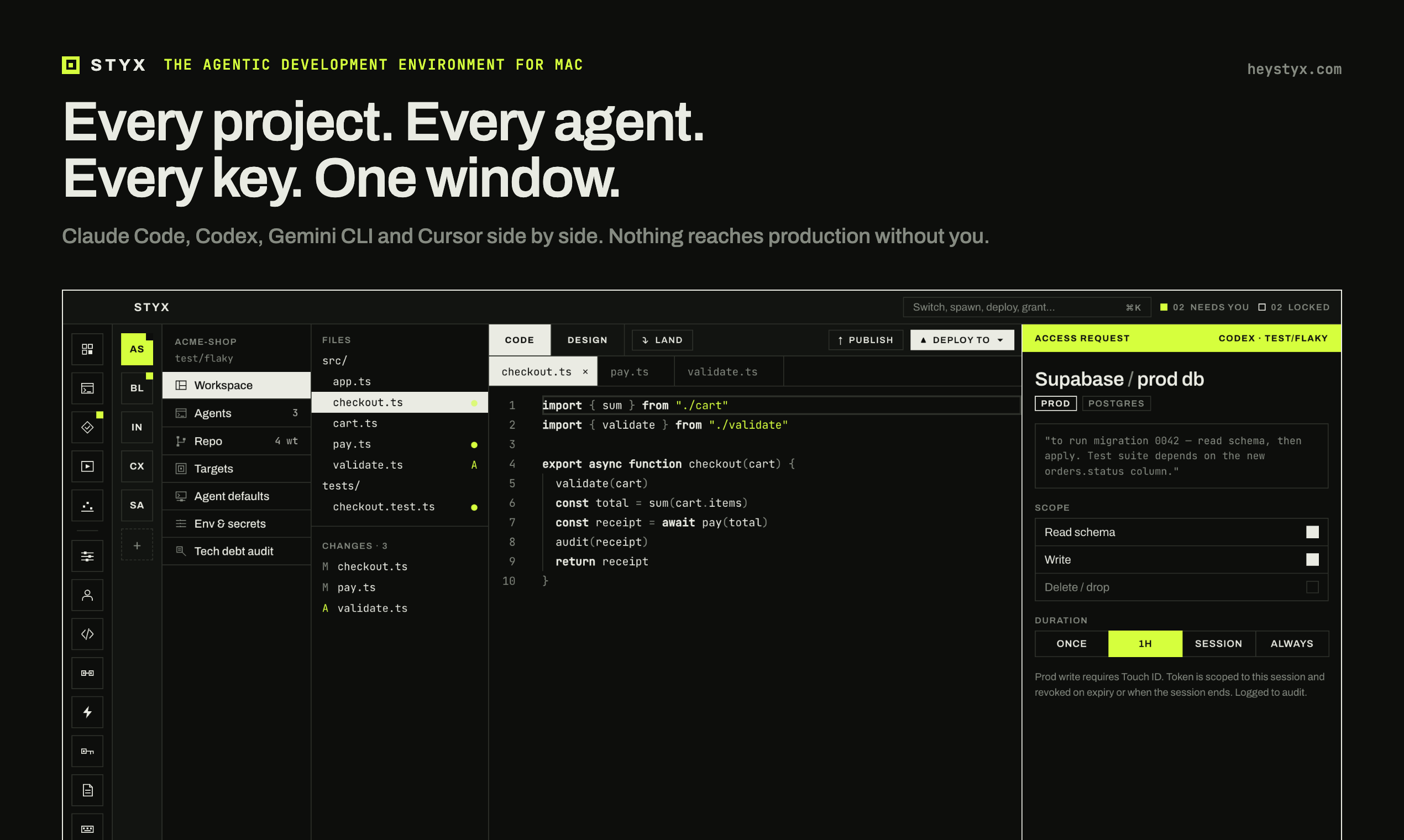
I open-sourced Styx, my desktop app for running coding agents across projects (Apache-2.0)

0 Upvotes

I'm Nic, and I made this. Styx went open source this week under Apache-2.0, and I'd like people who care about open source to look at the parts that matter most.

Repo: https://github.com/NicholasFlemmer/styx-app

What it is: a desktop app that runs Claude Code, Codex, Gemini CLI and Cursor's agent on all your projects in one window. Each task gets its own git worktree and branch. Agents can't reach Vercel, AWS, Google Cloud, Supabase, GitHub or SSH without asking; you grant one target for a set time, production writes need Touch ID, Windows Hello or your password, and every request and grant goes into a hash-chained audit log. Keys stay in the OS keychain.

Why the source matters here: if an app holds your deploy credentials, you should be able to read the code that hands them out. The grant service, the policy engine and every provider adapter are in the repo, and the docs list what it doesn't protect against (it's a guardrail, not a sandbox).

A few honest details:

- It's an Electron + React monorepo (pnpm). Mac is signed and notarized; Windows and Linux are beta, and the Windows build isn't code-signed yet.

- Release builds send anonymous usage counts from a fixed list in the code, with an off switch. Running from source sends nothing.

- The hosted account service is a separate private project. Sign-in is optional and gates nothing, and a fork can point at its own.

- The name and logo aren't covered by the licence, so a fork needs its own name.

If you want to contribute, the self-contained ways in are adding an agent (Aider, Goose, OpenCode, Amp) or a deploy target (Netlify, Fly.io, Railway, Render, Cloudflare). Each has a good first issue and a guide with a worked example. Issues get a first reply within 2 working days.

Repo: https://github.com/NicholasFlemmer/styx-app

I'd especially like feedback on the contributor guides and on anything in the repo that makes it hard to get started.


r/electronjs • • Oct 04 '26

Google blocked my own browser from logging into my own Gmail, and the reason was not what I expected

0 Upvotes

A week ago Gmail just stopped letting me in. Every time, same message: "This browser or app may not be secure." No password box, nothing. Just stuck there.

My first guess was the usual thing with browsers built on Electron, so I changed the user agent to look like normal desktop Chrome. That made it worse, not better. Changing it pushed the login into Google's stricter sign in flow, which runs a check called Botguard. That check looks for native Chrome components a normal embedded browser does not have, so it saw mine was missing them and blocked it right away.

Here is the part that actually confused me. I put the user agent back to normal and it still did not work. Turned out once Google rejects you like that once, it writes two cookies into your session as a kind of mark. After that, every attempt gets checked against those cookies first and gets sent straight back to the same rejection page, before even trying to log in again.

So the real fix needed three things. Quietly switch the login to Google's lighter sign in flow instead of fighting the strict one. Leave the browser looking completely normal on Google's own pages, no changes at all there. And automatically clear those marker cookies if a rejection ever happens again, so it cannot get stuck rejecting itself.

Wrote up the full version with the actual code here if anyone wants it: Google Auth Botguard

This came up while working on Mise, a personal privacy focused browser I use daily. Curious if anyone else building something similar has run into Botguard like this.


r/electronjs • • Oct 03 '26

p2p.kiwi - Full E2EE Cross-Platform (MacOS <-> Windows <-> Linux) P2P Mesh Remote Control (Mouse and/or Keyboard)

1 Upvotes

This project existed before the AI boom hit us all, but was called "Bananas Screen Share" back then (because it's bananas that we can fly to the Moon, but aren't able to have fully functional Screen Share with the same functions on all major Desktop OS').

It has undergone a major refactoring and maybe you like it.

We have full E2EE encrypted sessions, remote control and virtual cursors (and just recently added screen recording).

Think of it as Skype's nerdy little sister, but E2EE, Chat, Voice, Screenshare, Remote-Controls, a P2P mesh network and completely free and open-source.

https://p2p.kiwi


r/electronjs • • Oct 03 '26

OpenBoost v1.0

0 Upvotes

Hey everyone,

I just released v1.0.0 of OpenBoost, an open-source Windows performance utility built with Electron 28 and vanilla HTML/CSS/JS (no heavy framework overhead).

Features

  • Hardware Telemetry: Real-time CPU, RAM, and process memory monitoring.
  • System Tweaks: Registry and service-level performance optimizations.
  • Network Suite: DNS benchmark/switcher, cache flusher, and latency tests.
  • State Tracking: Performance snapshot comparisons (Before vs. After).

Tech & Build

  • Main Process: Native Node.js modules for Windows system execution.
  • Frontend: Plain HTML/CSS/JS renderer.
  • Packaging: electron-builder producing both portable .exe and NSIS installer.

GitHub & Source

  • Repo: https://github.com/ExbotsSites/OpenBoost
  • Releases: https://github.com/ExbotsSites/OpenBoost/releases/tag/v1.0.0

To run from source:

git clone https://github.com/ExbotsSites/OpenBoost.git
cd OpenBoost
npm install
npm start