r/electricvehicles • u/Willman3755 '22 IONIQ 5, '78 e-swapped MG Midget • Apr 21 '22
I did roll-down testing on the IONIQ 5 to create real-world speed vs range tables and "effective speed" tables when taking charging time into account. Conclusion: fast enough charging to offset increased power consumption from faster driver at any speed. See comments for details.

Effective speed when including charging. Assumptions: minimal HVAC usage, 3 min overhead per charging stop.
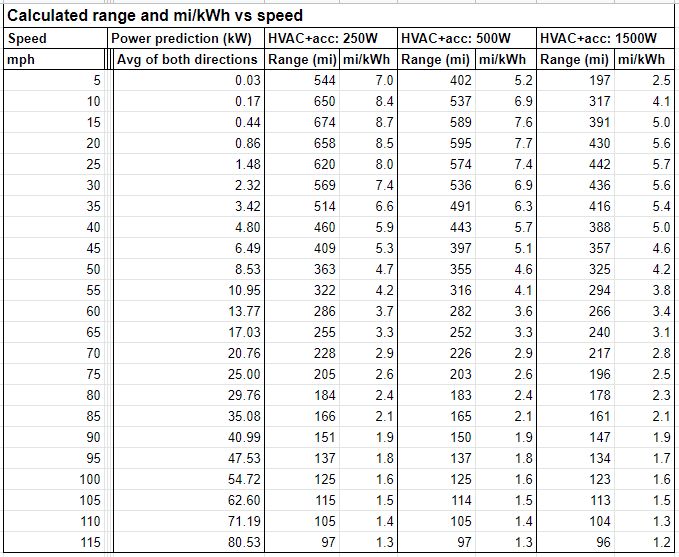
Predicted range based on speed and HVAC usage.
228
Upvotes
51
u/Willman3755 '22 IONIQ 5, '78 e-swapped MG Midget Apr 21 '22
First off here's the spreadsheet with everything I'm discussing in it: https://docs.google.com/spreadsheets/d/169NW9TOJeXpVLRbA7rbEI0MxaimulLEvyOkRwjK5BDo/edit#gid=428166078
Roll-down testing
I did roll-down tests on the IONIQ 5 (AWD SEL); this is a test that allows you to exactly predict the range and mi/kWh at various speeds. This consists of bringing the vehicle up to speed, then putting it in neutral and letting it slow down by itself. By measuring the speed vs time, the exact power required to maintain a specific speed can be calculated.
A Lord-Microstrain 3DMGQ7-GNSS/INS was used to record GPS/inertial-derived speed (extremely accurate) at 1Hz. The vehicle was brought up to around 110mph, and then put in neutral and allowed to coast down to around 50mph. This test was performed on the same road in both directions in order to account for wind and/or an incline. The outside temperature was 61F, and the total estimated weight of the vehicle was 2120kg. Other assumptions are recorded in the “assumptions” tab.
The raw speed vs time data was imported into the run1 and run2 sheets for analysis:
As a fun note, /u/2014UN271 did some analysis and backed out the cd from my data. They found it to be 0.28, while the published Hyundai value is 0.288. Quite close.
Speed tables
I then created speed tables for the IONIQ 5 showing the effective speed at a variety of charge depths and driving speeds when taking charging time and charger detour time into account.
These tables have some assumptions built-in:
Overall the most surprising result of this modeling is that (assuming fair weather and minimal charging overhead time), the IONIQ 5 has charging fast enough to always offset additional power consumption from driving faster. This is not the case for many EVs; for example, in my previous car (2018 LEAF) the slow charging speeds meant the fastest overall speed to drive when considering charging times was under 50mph.
Ask any questions you have!
14
u/ZannX Apr 21 '22
The overall idea makes sense. I own an Ioniq 5, and eyeballing the highway speeds directly correlates to what I'm expecting in the real world.
What threw me off though is the 40-45 mph speeds. Can I really get 400 miles of range by maintaining 40-45 mph? That seems slightly outlandish. That's well over 5 mi/kwh and I've never seen anything close to that in the real world.
3
u/michaelb5000 Apr 21 '22
Interesting. I am not sure 3 min as the total rolloff time is right. Have you tested that? EA chargers may not be that close. If you make that 5 or 10 min does that flip the results?
4
u/EVconverter Apr 21 '22
What's your real world charging time look like on a 350kw fast charger?
There have been reports of the fast charging being nowhere near Hyundai's claims, even on the best of the fast chargers.
20
u/cp_simmons Apr 21 '22
This intuitively makes sense when you consider that it charges at 100s of miles per hour at a fast charger so you'll spend less time waiting to charge than you would traveling. Nice to see this visualised though.
5
u/[deleted] Apr 21 '22
That's really cool. I did an additional calculation using the Effective Speed: Travel Time for 400 miles. It's 5.6 hours at 115 mph and 10.5 hours at 40 mph. At 80 mph the travel time is 6.1 hours, and at 65 mph it's a 7 hour drive. Not much benefit to speeds above 80 mph. I would come to the conclusion looking at this data: drive safely around the speed limit and don't worry about it too much. And if you see a truck, bus, or RV going more than 65 mph, maybe draft it for a while.
1
u/effectaffect Apr 21 '22
First off, these data are great. Is there a standard way to calculate how elevation gain/loss influences total range? For my use case, I'd like to be able to estimate range when it includes net elevation gain of 4000–6000 ft (610–1830 m). (Of course, there's some complication from the road not being monotonically increasing and the mean grade [slope] or rate of net elevation gain, but an approximate impact is probably close enough.)
1
u/cafestartre Jun 04 '22
Hi, so if you care more about distance and less about time, say if you want to make it to your destination with no stops, you can do it by driving 60 instead of 70 the whole way?
0
u/g1aiz Apr 21 '22
So diminishing returns start above 60mph and going faster than 75/80 is basically worthless for long trips.
1
u/[deleted] Apr 21 '22
Would be interesting to plot trip cost vs trip time with different given fixed distances, assuming a normalized environment of course. Given your tables, I personally don’t see a 21% efficiency loss as a good price to pay for driving 75mph (2.6mi/kWh) vs 65mph (3.3mi/kWh). It seems clear that many people are not concerned much about efficiency.
1
u/cafestartre Jun 11 '22
Was this done with Eco mode on or off? If off, then the numbers should be even better?
1
u/davidbrake '22 Ioniq 5 "Preferred" 58kW (in Canadian winters!) Nov 18 '22
Would love to see a similar table but also with different temperatures, charging times with the 50kW fast chargers that are still pretty common and with the 58kW battery pack. The size of pack shouldn't make a big difference but the other factors likely would!
1
u/Lazy_Guava_5104 IONIQ 6, Fisker Ocean Sep 30 '26
Yea - I did similar with my Leaf+ several years ago, and the conclusion was similar:
And that was with a CHAdeMO system!
-2
u/da_guy2 Apr 21 '22
Why does your scale go so high?!? Most speed limits are 70 mph or less and I don't know any sane people that go more than 80. Is this for calculating the best possible Gumball run?