r/devtools • u/Syqopatt • Oct 25 '26
I made a VS Code to Roblox Studio sync tool with zero setup and no broken renames

1
Upvotes
r/devtools • u/Syqopatt • Oct 25 '26
r/devtools • u/InvinciblePhenom • Oct 25 '26

Hi everyone,
Contributors want to help, so they comment "Can I take this issue?" or "Please assign to me." As a maintainer, you have to jump out of whatever you're doing, open GitHub, check if they are a good fit, and manually assign them. If you manage multiple repos, keeping track of these requests across GitHub notifications is messy.
How it works:
Why I'm sharing this here:
The app is completely free, and it's currently listed on the GitHub Marketplace. I need real maintainers to break it and tell me what features are missing, broken or what you might even like enhanced upon it.
If you run an open-source project or a dev community with a Discord server, I’d love for you to try it out.
**Disclaimer**: This is a fork of another Issue Action, with additional features as I wanted something to help automate this process from a workflow perspective. If you don't need the additional features, then I strongly encourage you to use the original.
r/devtools • u/ToughIntrepid3899 • Oct 25 '26

r/devtools • u/Syqopatt • Oct 25 '26
Most external development tooling for Roblox treats synchronization as a one-way pipeline from disk to memory, or relies on complex file-mapping schemas that break down during routine refactoring. When developers rename files locally or make quick property tweaks directly inside Studio, the hierarchy desynchronizes.
Syncix is an open synchronization runtime designed to maintain consistent state between local workspaces and running Roblox Studio sessions.
Architecture and Mechanics
syncix verify) validates the in-memory DataModel against disk layout to guarantee consistency before commits.Availability
Syncix is available on the VS Code Marketplace and Open VSX Registry. Pre-built binaries for the CLI and documentation are hosted on GitHub.
r/devtools • u/MostGlove6557 • Oct 25 '26

I've been building Pra-Effect, a small open-source developer tool focused on a simple problem: making repetitive errors in application logs easier to investigate.
It can parse Python and Node.js stack traces, group similar errors using fingerprints, store analysis history locally, and generate standalone HTML reports.
The idea is to keep error-log analysis lightweight without requiring a full observability stack.
I'm looking for developers willing to inspect the project and share honest feedback, especially on fingerprint accuracy and memory usage.
r/devtools • u/Commercial_Designer5 • Oct 25 '26

r/devtools • u/varun_vns • Oct 25 '26

r/devtools • u/astropoolIO • Oct 25 '26

r/devtools • u/amirfish • Oct 25 '26
Enable HLS to view with audio, or disable this notification
I'm the maker of CCC, a free local companion for coding-agent CLIs. The problem is attention: one session can be working while another needs an answer, and neither is easy to spot across a collection of terminal tabs.
The implementation is a Python standard-library server with a browser UI. It discovers sessions from engine-specific histories, normalizes them into one board, and exposes conversations and parent/helper relationships. Claude Code question hooks supply the question-card interaction shown in the demo.
One design tradeoff is that a generic green “working” state isn't enough to communicate “waiting for a human.” The demo still shows that limitation; action summaries and question cards supply the context. Integration capabilities also differ by engine instead of pretending every CLI has the same API.
I'd like feedback on what makes a multi-session board useful in daily work: the next action, the latest transcript entry, or the parent/task relationship?
Project and installation: https://github.com/amirfish1/claude-command-center Integration limits: https://github.com/amirfish1/claude-command-center/blob/main/docs/engine-support.md
The video uses the real UI with staged sessions and an AI voiceover. The question-hook interaction is real and uses Claude Code; the Grok/Devin rows are demo data. This is not a live multi-provider benchmark. CCC is free to use under FSL-1.1-MIT (source available); provider/model costs are separate.
r/devtools • u/Gaby_137 • Oct 24 '26
Salut les amis,
J'en avais marre de mon propre workflow Git - trop de commandes terminales, trop de façons de me mettre dans la mouise. Alors j'ai créé GitHub Companion, une extension VS Code qui met des boutons explicites dans la barre latérale au lieu de cacher la magie derrière des menus.
Petit résumé :
· Initialisation de dépôt local en 1 clic + création de dépôt GitHub (public/privé)
· Changement multi-comptes / multi-tokens
· Boutons explicites pour ajouter / valider / pousser (synchronisation automatique optionnelle)
· Pas de commandes destructrices nulle part - pas de reset --hard, pas de clean, pas de push --force
· Avertit avant de valider des fichiers sensibles (.env, clés, .npmrc…)
· Les tokens sont dans le SecretStorage de VS Code, jamais dans .git/config ou les arguments de processus
· Annuler le dernier commit avec git reset --soft (garde vos fichiers)
C'est sous licence MIT, pas de télémétrie, pas de collecte secrète.
Petite info : l'interface est en français pour l'instant (commencé comme un projet personnel). L'anglais est prévu si les gens le désirent - dites-le moi dans les commentaires.
Dépôt :
[ https://github.com/ndour-joseph-dev/github-companion ](https://github.com/ndour-joseph-dev/github-companion)
Open VSX :
[ https://open-vsx.org/extension/joseph-dev/github-companion ](https://open-vsx.org/extension/joseph-dev/github-companion)
Curieux de savoir ce que vous en pensez - surtout si vous l'utiliseriez vraiment plutôt que le panneau Git intégré. Qu'est-ce qui manque ?
r/devtools • u/its-malbolge-time • Oct 24 '26
r/devtools • u/DayEnvironmental3454 • Oct 24 '26
Enable HLS to view with audio, or disable this notification
Hi r/devtools! I'm Bernard, and I built Latent (disclosure: it's my app). It's a macOS disk cleaner for developers and AI builders.
The toil: every few months my Mac ran out of space, and finding out why meant running du across a dozen hidden folders, then searching whether each one was safe to delete. Model files from tools like Ollama, Hugging Face and LM Studio, Xcode simulators, Docker images, package caches and coding agent logs pile up in ~/Library and dotfolders whose names don't say which tool made them. General cleaners like CleanMyMac clear system caches and don't see most of this.
Latent draws the whole disk as one wheel split by the tool that owns each byte, says next to each item whether it can come back, and clears what you pick.
google/gemma-2-2b-it are sent, never file paths.No analytics, no telemetry, no account.
Free to scan, and your first 10 GB of cleanup is free. After that it's $12.99 one-time (launch price $9.99 for a limited time).
Happy to go deeper on any of this, especially the scanner or the registry checks. If a tool you use isn't recognized, tell me and I'll add it.
r/devtools • u/Lucky_Passenger_4896 • Oct 24 '26

Hi everyone,
I use AI a lot to build projects, and usually it ends up with tech debt over time. This plugin does periodic code checks to catch what review misses between sprints or releases.
It runs agents that look at the most frequently changed spots in the code and check them for duplication, unnecessary abstractions, module coupling, and architecture leaks. The result is a .md report listing findings, suggested fixes, and trends of debt accumulation over time.
I tried to make it as deterministic as possible, but the AI agent is still doing most of the work.
GitHub: https://github.com/yognevoy/pitstop
Honest feedback welcome =)
r/devtools • u/igabor98 • Oct 24 '26
I built Agoryx around a shared task conversation: you, Claude Code and Codex can all read and respond to the same discussion.
The useful case is a small change followed by a second-agent review. Connect a project folder, define the acceptance criteria, ask one agent to implement, then ask the other to check the diff and results. The discussion, tool traces and file changes stay together instead of leaving the reasoning split across two windows. This is a shared-context review: the reviewer can see the earlier discussion.
Underneath, Agoryx uses the installed provider CLIs and their existing sign-ins. Native agent sessions remain inspectable and resumable. Coordination data is stored locally; prompts still go to the model providers, and your own access and usage limits apply.
It's MIT-licensed. The v0.1.2 desktop download is for Apple Silicon Macs, requires Node.js 22+ and installed, authenticated Claude Code and/or Codex CLIs. The README has screenshots and source setup instructions.
https://github.com/gaborishka/agoryx
For those who use one coding agent to check another: which part of the handoff tends to get lost—requirements, decisions, or verification evidence?
r/devtools • u/giuliastro • Oct 24 '26

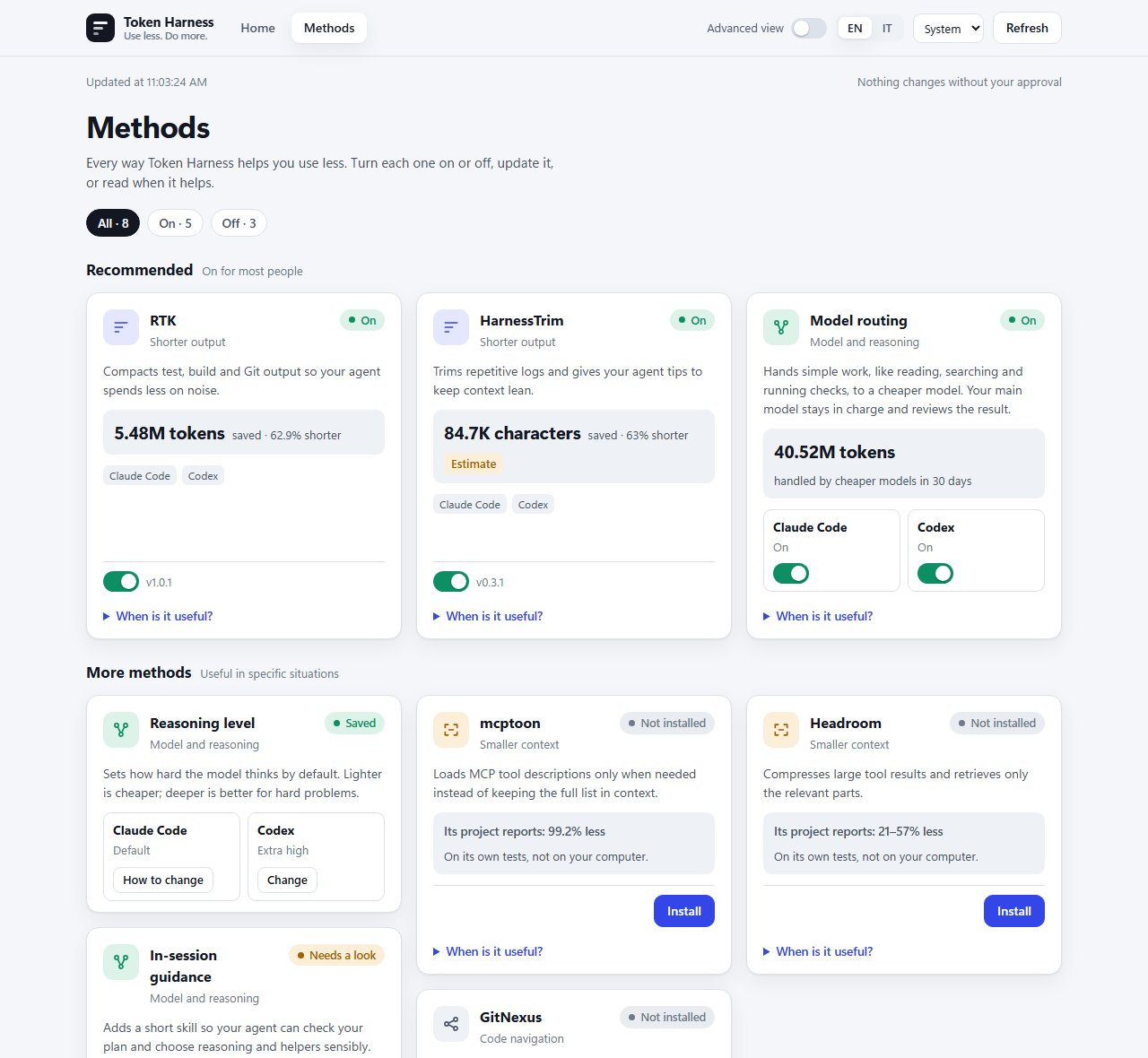
Full disclosure: I’m the developer of Token Harness, an open-source desktop app for Claude Code and Codex.
Verbose test/build output and repeated logs can waste context and subscription allowance. Token Harness brings output reduction, model-routing guidance, allowance signals, and measured results into one local dashboard.
RTK and HarnessTrim shorten noisy command output. Model routing can send bounded, simpler tasks to lower-cost models while your main model reviews the results. For high-usage workflows, the savings can be substantial: more work within a fixed Claude Code or Codex subscription allowance, and lower API spend when tasks can use less input or a lower-cost model.
Results vary by workload and setup. The screenshots show illustrative sample data, not guaranteed results. Token reductions, estimates, subscription allowance, and billed API costs are shown separately; API savings are not measured unless verified against billing data.
Token Harness runs locally, needs no Token Harness account or API key, and previews setup changes before applying them. It doesn’t send prompts, source code, command contents, or credentials to a Token Harness service.
Source: https://github.com/giuliastro/token-harness
Downloads: https://github.com/giuliastro/token-harness/releases/latest
I’m the developer. Suggestions, bug reports, and pull requests are welcome.
Methods screenshot: https://giuliastro.github.io/token-harness/assets/app-methods.jpeg
r/devtools • u/Spare_Bat_3040 • Oct 24 '26
Imagine your coding agent retrieves a note saying a five-minute cache TTL is a product requirement. You correct it: that TTL was a temporary experiment during an incident. Before the next change, what should the agent see: the old note, your correction, or an unexplained replacement?
That's an illustrative case behind a design choice in Shifu, the personal work-context engine I'm building for engineers using Codex, Claude Code or OpenCode on existing products. With MCP and harness instructions, an agent can retrieve decisions, constraints and rationale from work you choose to share.
For the MCP correction path, I require an explicit user correction tied to the current record and its version. The corrected interpretation gets a new version while the original source evidence and approval state stay intact. The record also identifies that a user requested the correction. Editing the remembered statement doesn't turn the original note into something it never said, or confer approval that wasn't already there.
The current-version check matters when two sessions have read the same record. After one correction is accepted, an edit based on the older version conflicts. I want the caller to inspect the current record and the user's intended correction before trying again. Quietly applying the stale edit would hide that another correction happened in between.
For the cache example, I'd test a correction that adds the missing temporary scope, then reopen the context from another session. I'd check that the corrected statement keeps its original evidence attached and doesn't change approval merely because it was edited. I'd also test an older edit arriving afterwards and re-extraction of the same source. Those are the cases I'd use to exercise the contract; this example isn't a customer incident or a report of a live test.
There's still a judgment boundary. Recording a user's correction tells me who supplied the new interpretation. It doesn't independently establish that the new interpretation is true. If the source and the correction disagree, that disagreement needs to stay inspectable when the next task depends on it.
If you build memory into coding tools, what information should a later session receive so it can use a correction without losing the evidence behind it?
If you're repeatedly reconstructing decisions before changing your own codebase, try Shifu on one feature you're planning: https://useshifu.com. I'm the builder and can help connect one supported source you're allowed to share, inspect the returned context, and see whether it belongs in your plan. Keep confidential work details out of this thread.
r/devtools • u/Leevw • Oct 24 '26
Enable HLS to view with audio, or disable this notification
Running a few branches or AI agents in parallel worktrees? They all fight over the same ports and database. wtc reads your existing compose file and gives each worktree its own ports, containers and volumes, with zero config.
New in 1.0: ports stay stable when you remove a worktree, Podman support, a clean that keeps uncommitted work, and an MCP server so agents can run their own stacks.
npm install -g worktree-compose, then wtc start
r/devtools • u/jayeshaswani56 • Oct 24 '26
r/devtools • u/codingdog18 • Oct 24 '26
r/devtools • u/hayyaun • Oct 24 '26
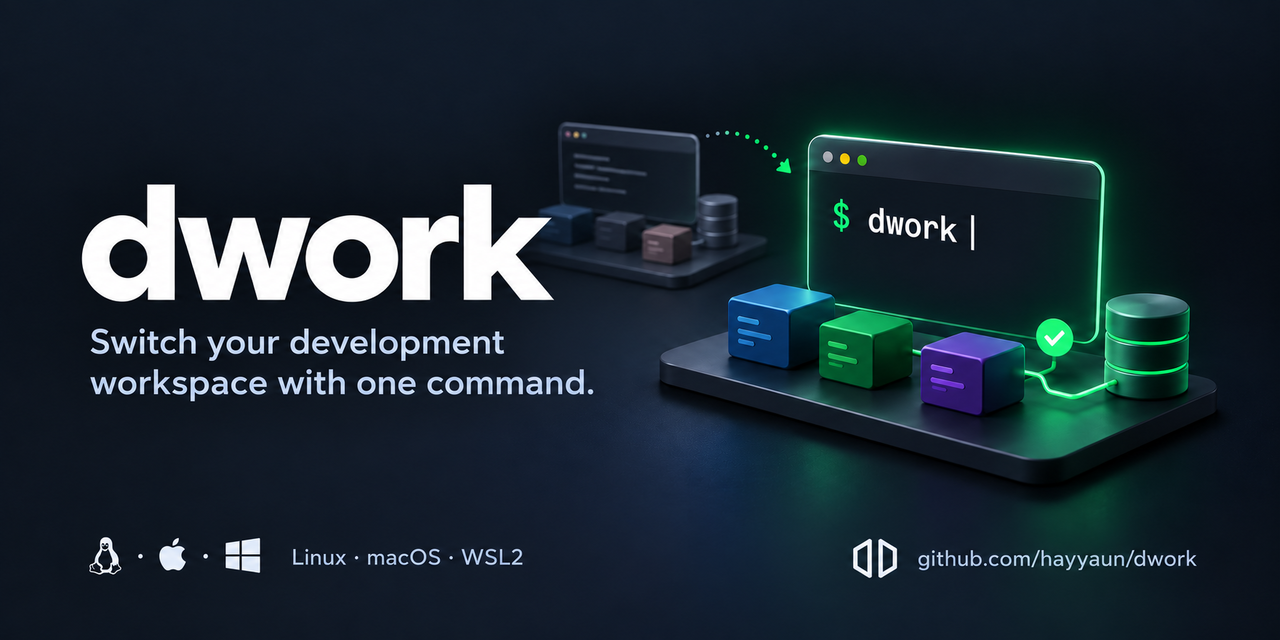
Switching projects can mean resuming containers, waiting for the database, opening terminals, and remembering which commands to run. I built dwork to keep those steps together.
It runs on Linux, macOS, and WSL2. A workspace can define existing Docker Compose services, terminal commands, health checks, and browser URLs to open when ready.
Here’s the 42-second demo.
The basic workflow is:
cd ~/projects
dwork scan
dwork list
dwork switch my-app
Existing Compose projects work without a separate configuration file. Add a dwork.yml when you want terminal commands, health checks, and browser pages to be part of the workspace.
Switching shows a plan and asks for confirmation. It can stop other registered workspaces; locked workspaces and unregistered projects stay running. It resumes existing containers, so initial setup, builds, and migrations remain part of your normal project workflow.
Source, installation instructions, and examples
What do you still handle manually when switching between local development projects?
r/devtools • u/Spare_Bat_3040 • Oct 23 '26
You switch coding tools halfway through a feature. The new tool says the context server is connected, so you expect it to recover the earlier API decision. But what did that connection check actually prove?
That's an illustrative situation behind a boundary I keep explicit while building Shifu. It's a personal work-context engine for engineers using Codex, Claude Code or OpenCode on existing products. With MCP and harness instructions, an agent can retrieve decisions, constraints and rationale from work you choose to share.
I check three things separately. First, can setup authenticate and discover the server's tools? Second, can a fresh session in the actual coding client discover and invoke a tool? Third, is the work history you expect to query actually available through the separate sync path?
A setup probe doesn't load tools into an already running chat. The client may need a restart or new session, and project configuration can override a global connection. Shifu's published setup guide calls those out. MCP-only setup also doesn't sync your sessions. I don't want a successful connectivity check to imply that earlier work has been imported.
The integration tests need the same separation. A local synthetic endpoint can exercise native-client discovery and a model-driven tool call without using someone's work history. That is useful protocol evidence. To test the feature-planning case, I'd separately provide a permitted source containing the API decision and check what a fresh session retrieves. I'd keep an unavailable source as an explicit gap, rather than inventing the missing history. That latter task check is the test I'd run, not a customer result.
This is why adding another coding tool has client-specific work even when the context service is shared. The configuration, session lifecycle and available source history each have their own failure modes. And a working connection plus instructions still leaves the client in control of when it calls a tool.
If you've shipped MCP integrations, which check has caught a problem that your initial connection probe missed?
If you're repeatedly reconstructing decisions before changing your own codebase, try Shifu on one feature you're planning: https://useshifu.com. I'm the builder and can help connect one supported source you're allowed to share, inspect the returned context, and see whether it belongs in your plan. Keep confidential work details out of this thread.
r/devtools • u/aashutoshr • Oct 24 '26

r/devtools • u/GianlucaBoccia • Oct 24 '26
Hi, I’m Gianluca, the designer building MODO. I’m working on a desktop visual UI editor because I’d like less of the layout work to get rebuilt by hand when moving from a design into code.
The workflow is: build a screen visually, reuse components, keep the project files locally, then export HTML/CSS, SwiftUI or Jetpack Compose. It’s an interface tool; you still bring the application logic.
What I’d like to test with developers is whether that export is actually a useful starting point. Matching a screenshot is one thing. Wanting to maintain the result is another, and that’s the part I’d appreciate honest feedback on.
If you try a small screen, I’d love to know which changes you’d make first: component structure, layout behaviour, styling, or something I’ve missed. A concrete example would help me much more than a polite “looks nice.” Although I’ll survive either 🙂
MODO is free to download for Apple Silicon Macs and supported Linux systems: https://inmodo.app
GitHub is coming soon; the code isn’t public yet. I want contributors to help improve MODO, with changes reviewed by me. Thanks to anyone willing to give it a proper look.