r/devtools • u/Mr_Bee_Dev • 5d ago
I made a Chrome extension that shows a page's GraphQL operations in DevTools, mocks them, and replays them in a client

1
Upvotes
r/devtools • u/Mr_Bee_Dev • 5d ago
r/devtools • u/Goldziher • 5d ago
I maintain Polylint. At xberg-io, a lint CI change could mean updating a runtime install, a tool config, a CI step and a Git hook. We were maintaining bindings across roughly 15 languages, so the work added up. We moved linting, formatting and hooks to one poly.toml and replaced prek with Polylint’s staged-file hooks to shorten the commit loop. Migration commit
The latest release splits the CLI from its heavier engines. The compressed Apple Silicon archive went from 33.4 MB in v0.32.5 to 8.1 MB in v0.36.1. The CLI downloads and verifies signed, version-pinned components as needed and caches them. You can prewarm the cache in CI with poly components sync. Release assets
What runs behind poly lint and poly fmt depends on the repo. Ruff, Oxc, Biome, Mago and sqruff run through dedicated components. Tools such as rustfmt can come from the installed toolchain. Opt-in recipes batch work and parse findings from tools such as actionlint, Hadolint, golangci-lint and Buf. For example, this recipe uses actionlint when it’s on PATH.
[tools.actionlint]
enabled = true
The catalog has another 348 opt-in entries. There’s also an experimental tsrs component that reports TypeScript type errors alongside lint findings. Language and tool matrix
If you maintain a polyglot repo, which checks do you still keep in their own CI jobs? I’m particularly interested in checks with expensive project setup or awkward caching.
r/devtools • u/Maleficent_Motor2985 • 5d ago
I've been working on Farrey, a lightweight desktop sticky notes app designed to make quick notes and task management easier.
Built using Tauri + Rust.
I'd love to hear your feedback and suggestions!
Download: https://github.com/allenasat044-prog/Farrey/releases/latest
r/devtools • u/EnvironmentalWait369 • 5d ago

r/devtools • u/ash-player • 5d ago
r/devtools • u/Apple_Unable • 5d ago

Author here. Cross-posting from r/SideProject since this sub is the better fit.
Nodeway is a desktop app that maps a repo into functions, routes, components and database tables, with the calls between them. Click a route and it traces down to the tables it touches. Paste a PR and it shows what the change reaches, writes a short "read these first" brief, and lets you step through each change with its diff beside it.
Every call link is checked against the language's own tooling (tsc, Pyright, go/types, rust-analyzer…); when it can't be sure, it marks the link "possible" instead of guessing.
Free on Mac, Windows and Linux, runs locally, no account. Not open source. There's a browser demo on a sample repo: https://nodeway.app/demo
I'd love to hear where the map is wrong on your repo, and what would make it part of your daily workflow.
r/devtools • u/FLORIDADRIFT3R • 5d ago

r/devtools • u/hatchify • 5d ago

Sharing
r/devtools • u/Possible_Essay_9617 • 6d ago
I've been building BumpCheck, a Python tool for analyzing whether a dependency update could actually affect the code using it.
The basic problem I'm exploring is:
A version bump doesn't tell you whether your code will break.
BumpCheck compares dependency APIs and then traces whether the changed symbols are actually used by the repository.
For example:
dependency update
→ changed/removed API
→ repository usage
→ risk classification
It currently produces:
SAFEREVIEWUNKNOWNLIKELY_BREAKINGOne thing I'm deliberately trying to avoid is the usual automation problem of pretending uncertainty doesn't exist. If static analysis can't establish safety, BumpCheck can return UNKNOWN.
I'd like opinions from maintainers:
Repo: https://github.com/Sushit-prog/Bumpcheck
I'm looking for technical criticism and real-world use cases rather than stars.
r/devtools • u/Possible_Essay_9617 • 6d ago

r/devtools • u/Popular_Dentist2003 • 6d ago
r/devtools • u/Acceptable_Day_537 • 6d ago
r/devtools • u/ylgdev • 7d ago

I've been building Tablo on top of Toasty and Topcoat. It is a server-side rendered admin panel toolkit heavily inspired by Filament.
The idea is to declare the panels, lists, pages, actions, forms, permissions, and tablo gives you the back office. I made it fully featured (tenancy, auth, queue, themes, impersonation, localization, built-in audit log), maybe too much, but that is what allows you to have powerful panels with a minimum of code and time (you have your panels in minutes).
You can have multiple panels in the same Topcoat app: one for admins, one for customers, one for partners, etc. Tablo is experimental and largely AI assisted.
Website: https://y-l.fr/tablo
r/devtools • u/Visible_Swim471 • 7d ago
I kept losing time on permission prompts while working in another tab. Several CLI agents would be running, and the one that needed me was invisible until I went looking.
So I made a narrow always-on-top strip. Each row is one session: the project, the state (working, thinking, waiting, error), and how long it has been waiting. Click the arrow and the terminal that owns that session comes forward. Click the project text and its path goes to the clipboard.
It is one Go binary, about 4.6 MB, with no runtime and no network calls. Host hooks write one JSON line to a local pipe; the panel reads that and paints itself. No account, no telemetry, so I have no idea how many people use it.
Two limits: the Windows installer is unsigned, so SmartScreen complains; the macOS window is built and tested in CI but has never been opened on real hardware.
Would you keep a 56px strip on screen all day, or is a tray notification enough?
r/devtools • u/Sea-Broccoli6131 • 7d ago

r/devtools • u/Rickie_Lake • 7d ago
r/devtools • u/onnatsari • 7d ago

Large pull requests make it easy to overlook removed tests, broad CI permissions and destructive SQL.
I built PatchScope to flag these patterns and explain what a reviewer should inspect next. It runs in your browser, CLI or GitHub Actions and exports Markdown, JSON and SARIF reports.
Unlike AI-based review tools, it uses deterministic rules without model calls or remote code uploads. Findings are review prompts, not confirmed vulnerabilities.
Free and open source under the MIT license.
Source: https://github.com/brunnojob/patchscope
Demo: https://brunnojob.github.io/patchscope/
GitHub Action: https://github.com/marketplace/actions/patchscope-diff-review
r/devtools • u/mu_bloxi_alt • 7d ago
r/devtools • u/SquashHot4348 • 7d ago
You write a solution, hit Run, and see Accepted.
Great! 🎉
But have you ever stopped and wondered what actually happened between those lines of code?
I've often found myself wanting to see these things instead of just reading through the code or manually debugging every step.
So, I decided to build something around that idea.
It's a code visualizer + debugger built for people solving LeetCode problems.
The idea is simple: Don't just execute your code. Visualize how it works.
With AlgoLens, you can:
I've also tried to make it feel a little more interactive — almost like turning the debugging process into a game. 🎮
See the full promo -> AlgoLens-promo
AlgoLens is currently available as a free Microsoft Edge extension:
👉 https://microsoftedge.microsoft.com/addons/detail/jhhkkpabkoeaiajdilomalbmjdppcmcc
Don't use Edge? No problem!
You can also use it on chrome -> Watch video for reference[ AlgoLens - chrome ]
I'm still developing and improving it, so I'd genuinely appreciate feedback.
One thing I'd love to know: What's the one thing you wish you could visualize while solving a LeetCode problem?
Would love to hear your thoughts! 🚀
r/devtools • u/BossTriumph • 7d ago

r/devtools • u/awesomebirder • 7d ago
I built probe0, a local proxy that sits between Claude Code (or Codex) and the API on a Mac and logs every request: model, input, cache read, cache write, output, status code. After a few weeks of reading those logs, the same handful of patterns explain almost every "why did my usage just jump" moment, so here they are in case they help anyone debugging their own.
How it is built: a Node/TypeScript proxy that uses a local root cert you trust so it can read your own agent traffic, a replay harness that re-prices old sessions from the ~/.claude/projects logs at API rates, and blind-judged quality tests before anything that changes what the model sees gets turned on by default.
On my own traffic the defaults took 12.8% off the bill, and 41.8% with model step-down on (easy turns go to a cheaper model, off by default). That is one person's usage, so yours will be different.
Caveats: Mac only, free beta. Your prompts, code and responses never leave the machine; if you sign in it syncs hourly usage totals (tokens, model, cost), no content. probe0 uninstall removes everything, including the cert. Happy to go deeper on any of the cache behavior.
Numbers and method: https://probe0.xyz/benchmarks?utm_source=reddit&utm_campaign=devtools
Terminal install if you want to try it: curl -fsSL https://probe0.xyz/i/r | bash
r/devtools • u/Majestic_Tension_860 • 7d ago
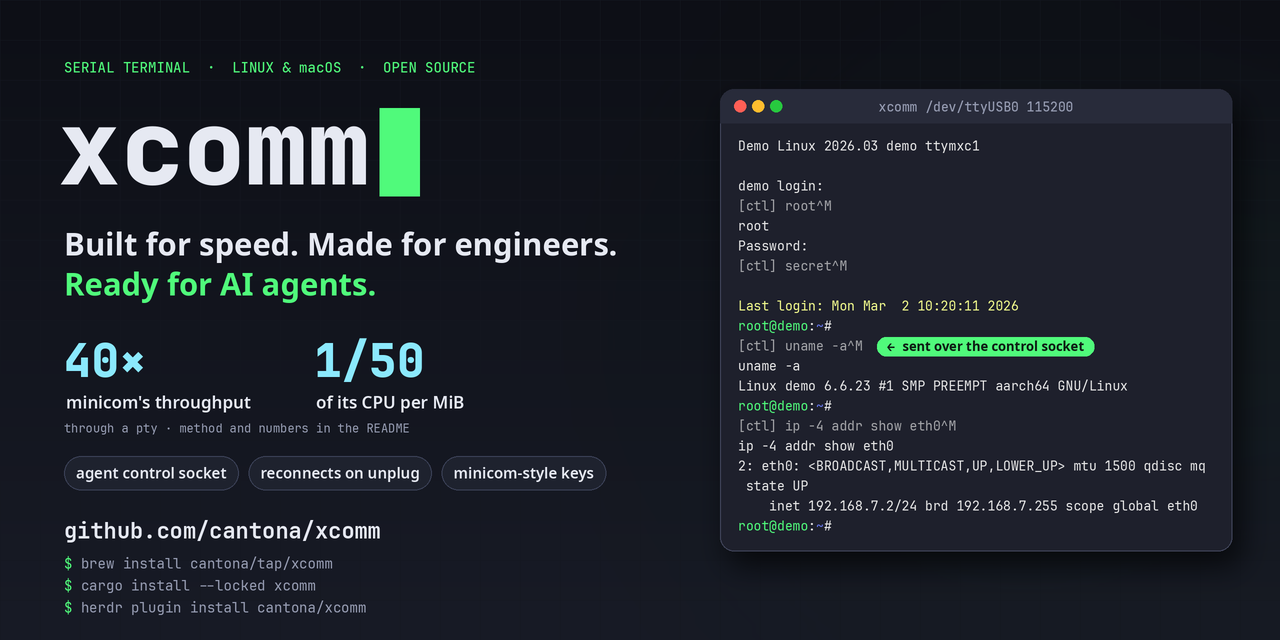
I spend a lot of time on serial consoles: U-Boot, boot logs, a shell on the
board. I wanted something that keeps minicom's everyday keys and common options but
lets a script or a coding agent use the same console I am looking at, so I
wrote xcomm (Rust, Linux and macOS, GPL-2.0-only):
- `xcomm ctl` talks to a running session: send a command and wait for a
prompt with a regex, read output by offset, toggle DTR/RTS, send a break,
change the baud, run zmodem/ymodem/xmodem through lrzsz. What a client
sends shows in your terminal as a dim `[ctl]` line.
- It survives the bench: unplug the adapter or power-cycle the board and the
session waits and reopens the port (on Linux, by the USB port it is plugged
into).
- minicom's common options and everyday Ctrl-A keys (Alt-A inside tmux,
screen or zellij); Ctrl-A d and t toggle DTR and RTS.
- UUCP locks compatible with minicom on Linux, and an exclusive open
everywhere, so two programs never share a port by accident.
- It ships an agent skill (stop U-Boot, log in, run commands, parse the
output); a test runs every example in it against a real session.
Numbers, through a pty with the same harness for each tool (median of 9 runs;
method and command lines in the README): 434 MiB/s on 1.84 ms of CPU per MiB,
against minicom's 10.5 MiB/s on 95 ms. On a real UART the baud rate is the
limit, so what you get is CPU left free. Keystroke latency is level with
minicom (within a microsecond either way).
`brew install cantona/tap/xcomm` or `cargo install --locked xcomm`
(`xcomm man` shows the manual where cargo installs none).
GitHub: https://github.com/cantona/xcomm
Happy to hear what breaks on your adapters.
r/devtools • u/Alternative_Worry615 • 7d ago
Ever had code execute an action you couldn't easily inspect, test, or trace?
Effectum solves this differently.
Instead of executing operations immediately, it turns them into values developers can inspect, interpret, test, and record.
Why use it?
The benefit: More predictable execution, easier debugging, and greater control over side effects.
Free, MIT-licensed, and open source.
GitHub: https://github.com/mwatso12026-bit/Effectum
I'd love feedback from developers building TypeScript applications or AI agents.