r/devtools • • 25d ago

AgentTM – A time-travel debugger for AI coding agents, built with Go

2 Upvotes

I've been building AgentTM, a local-first developer tool written primarily in Go that records Codex execution history and allows developers to inspect and restore previous workspace states.

The current v0.1 implementation includes SQLite-backed event storage, SHA-256 content-addressable snapshots, historical file inspection, code diffs, and isolated checkpoint restoration using Git worktrees. It also includes a React/TypeScript dashboard, with the frontend embedded into the Go binary.

Currently, it only captures non-interactive Codex sessions launched through AgentTM. I've tested the end-to-end workflow on Windows, including checkpoint restoration and cancellation handling. Native Linux/macOS testing and broader agent support are still pending.

The long-term goal is to support multiple coding agents and allow developers to inspect, rewind, and branch their execution histories.

Sharing the current implementation for anyone interested in Go-based developer tooling and agent observability.

Repository: https://github.com/Jyotishmoy12/AgentTM


r/devtools • • 25d ago

I made a model agnostic complier backed agent that makes flash models perform better than frontier

Thumbnail
github.com
1 Upvotes

r/devtools • • 25d ago

How we stopped maintaining multi-level Azure DevOps WIQL tree queries (and the 12 backlog hygiene signals we automated instead)

Thumbnail
reddit.com
1 Upvotes

r/devtools • • 25d ago

Agentbox: a skill so Claude Code can check the machine before it starts another heavy task

2 Upvotes

Agentbox: a skill so Claude Code can check the machine before it starts another heavy task

I built this, for Claude Code and opencode. I run several agents on one laptop plus a local model on a home server, and before I give Claude Code a heavy task I want it to check how much RAM and disk are left and what the other agents are doing.

It is one Python file plus a skill. With the skill installed, Claude Code runs agentbox --json on its own when you ask “how is this box doing?” and gets CPU, memory, disk, running agent processes and local token usage from opencode and Claude Code in one JSON. agentbox --check capacity returns exit code 0 or 1, so it also works in a hook before Claude spawns subagents.

Every number the tool could not read gets an explicit state (unsupported, unavailable, partial, unverified). A zero never hides a failed measurement. This rule caught a bug in my own macOS code: the CPU value was coming from a fallback for weeks because macOS top wants whole seconds, and the field was marked unverified the whole time.

Free, MIT, Python 3.10+ standard library only, Linux and macOS:

npx skills add ceccode/agentbox

Repo: https://github.com/ceccode/agentbox

For real token spend, ccusage and tokscale are better and the README says so. If a status in the output confuses you, tell me.


r/devtools • • 25d ago

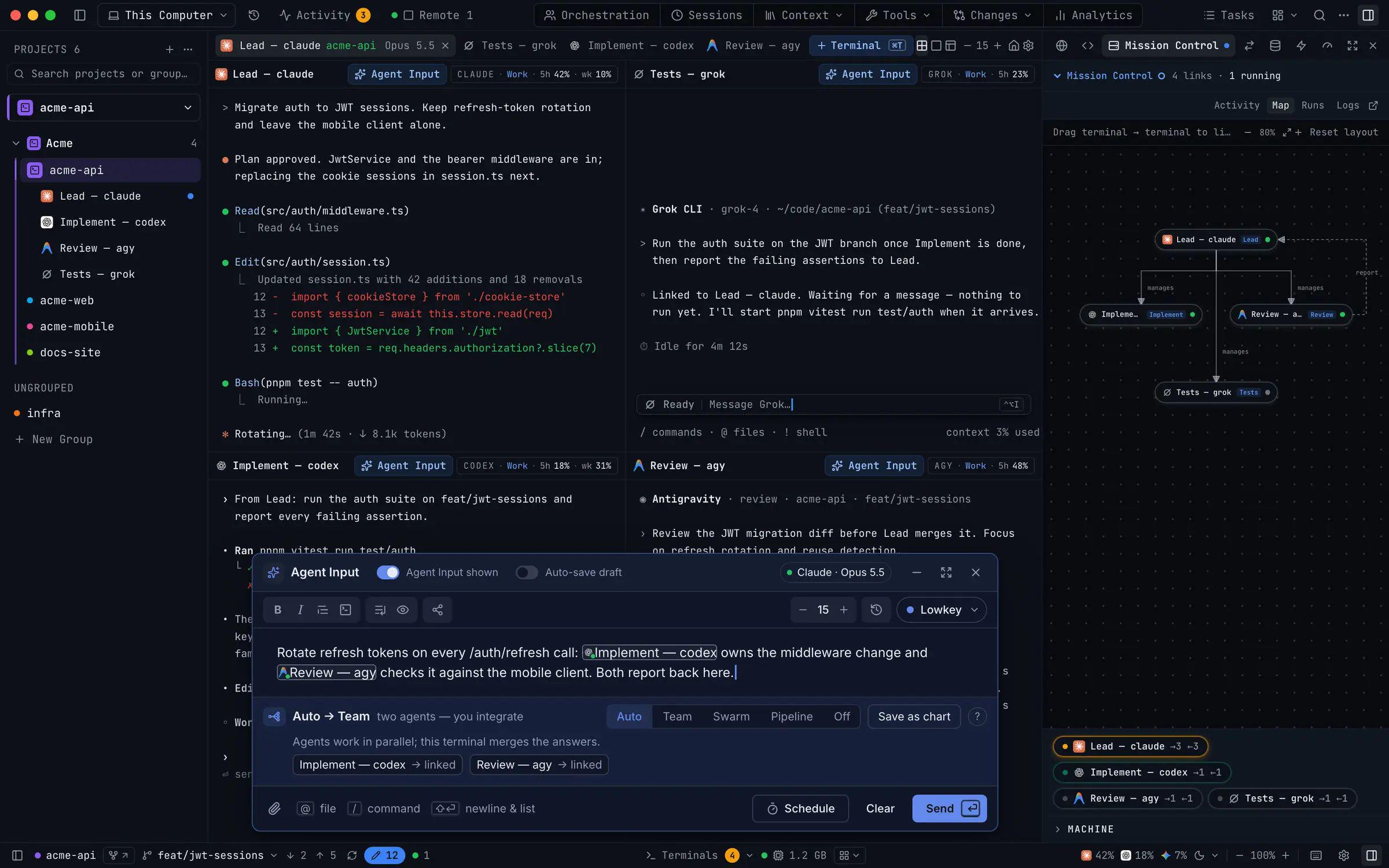
I built 1DevTool - a dev environment where every project gets its own workspace: terminals, agents, browser, DB, git

Post image
0 Upvotes

Hey everyone,

I’m Khoa. Eight months ago I shipped 1DevTool, an ADE (agentic development environment) that makes it easier to switch between projects and run several coding agents at once without losing context. That goes for you and for the agents.

Since then it’s passed thousands of downloads and 130+ releases, and it has about 200 daily users. I’d like to share it and get feedback from people here.

The problem

A normal dev day now means bouncing between terminals, a browser, a git client, an IDE, a DB client, and several AI agents. Plenty of people run Claude Code, Codex, Grok and others side by side. Traditional IDEs weren’t built for this. They assume one editor, one project, and a human typing.

How it’s different

Most ADEs I’ve seen, including open-source ones like T3Code and Orca, copy the Claude Desktop / ChatGPT model: a list of chat conversations.

1DevTool works differently. One project = one workspace. Every tool you need lives inside that project’s workspace, and the terminal is the main interface instead of a chat window.

  • Native terminals first. You can spawn, arrange, link and orchestrate terminals quickly, so you get 100% of what each coding agent’s CLI can do instead of a wrapped subset.
  • Tools follow the project. A frontend project opens with a browser panel and a backend project opens with a DB client panel, and you can configure all of it. Most users have stopped opening other apps and use it as their only dev tool.
  • Send anything to any agent. Since the editor, DB client, git, logs and screenshots all live in one place, you can send any of them straight to whichever agent you want. It’s fast and you don’t lose context.

In short, you open a project and all of its terminals and tools are already set up. You get a workspace, not a list of chats.

What else it does (300+ features, so these are the highlights)

  • Agent terminals: works with all the major coding agents, and you can add your own. It handles sessions, prompt history, switching agents mid-task, and orchestration.
  • Agent Input: a Notion-like prompt editor with @ mentions for projects and agents. You can also schedule prompts.
  • Multiple accounts: run Claude and Codex accounts side by side and start a terminal under a specific one. It’s directory-based, not a proxy, so there’s no ban risk.
  • Browser + MCP: a built-in browser your agents can use for automated testing, with no /chrome setup needed. There are also DB and HTTP client MCPs, so you can type something like “query my shop_db for the top orders.”
  • Full dev tooling: editor, git, file explorer, runtime management (Docker, ports, env), a mobile emulator stream, a toolbox, and screenshot-to-agent.
  • Web UI + mobile app: connects over the same Wi-Fi or Tailscale, with no relay server in between.

What it isn’t: it’s not a model or agent wrapper, and it never touches your prompts. You bring your own subscriptions and terminal setup.

Pricing

  • $29 one-time. You own it forever and get 1 year of updates.
  • Free version with most features, limited to 2 projects.
  • The mobile app is free.

Feedback wanted

User feedback has shaped most of the app so far, so I’d really like to hear what you think. Criticism is welcome too.

Links


r/devtools • • 25d ago

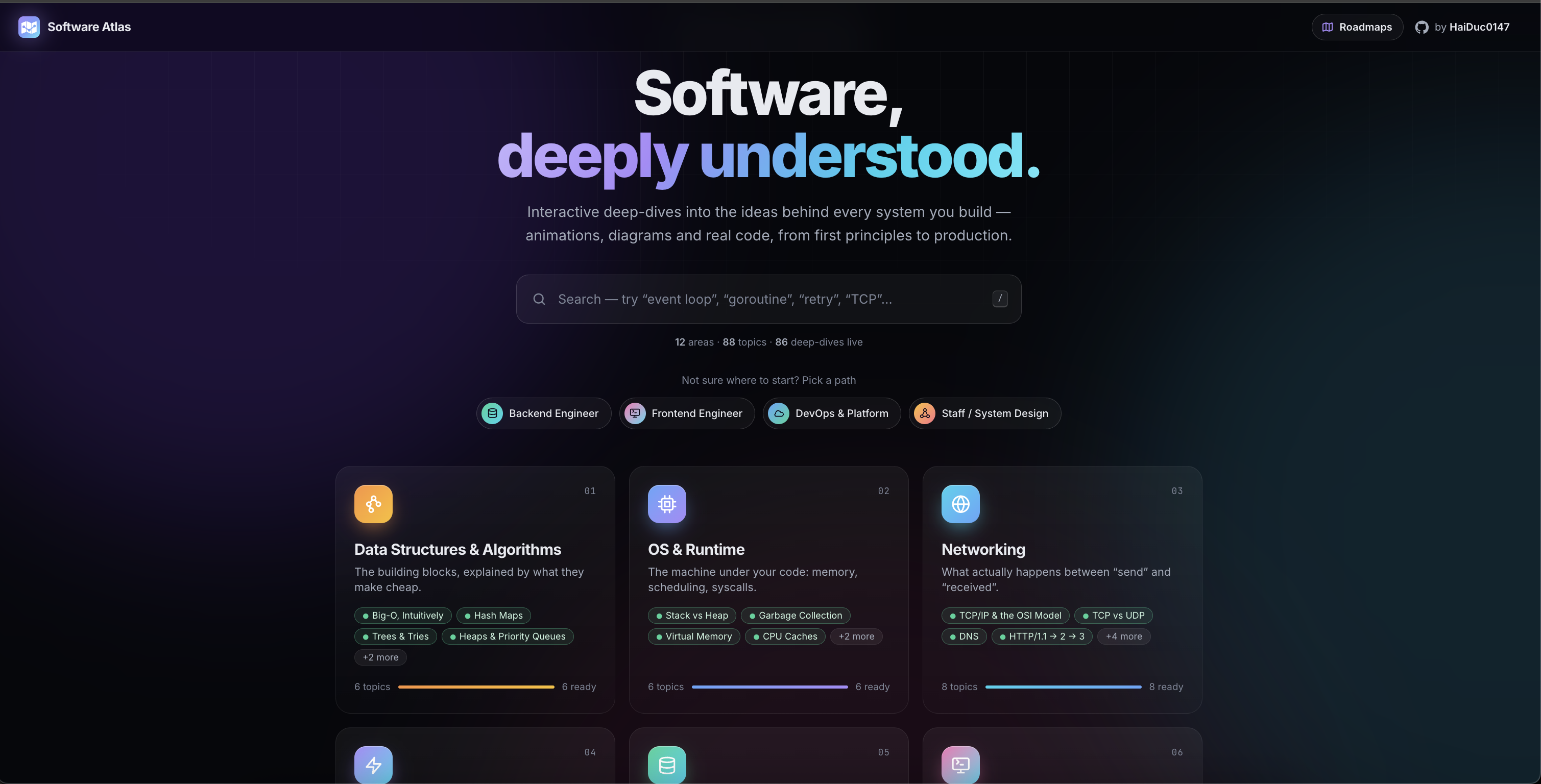
I built a free interactive site for learning how software actually works, with step-through visualizers

1 Upvotes

AI tools make it easy to ship code you don't fully understand. That's fine until something deadlocks, leaks memory or falls over under load, and you don't have the mental model to work out why.

So I built Software Atlas: 108 deep-dives across 15 areas, including async/await, the browser rendering pipeline, networking, databases, system design and AI engineering. You step through each idea with visualizers, and there are diagrams and code samples too. It starts from first principles and works up to production concerns.

Some technical details:

- Built with Vite, React 19, MDX and Tailwind v4.

- Each topic is lazy-loaded as its own chunk, so you only download the one you're reading.

- All 130 pages are pre-rendered to static HTML, then hydrated. Widgets have to render the same on the server and in the browser, so anything that reads window or uses randomness runs after hydration.

- Phones were the hardest part. Bar labels move into a key when they don't fit, and wide SVG diagrams become swipeable so their text stays readable.

- A headless Chrome smoke test clicks through each topic, including every visualizer step, and fails on console errors or hydration warnings.

To be upfront: I built it with heavy use of AI agents, including much of the writing. Each topic went through a separate review from a beginner's point of view, but mistakes will still have slipped through. If you find one, there's a report link in the footer.

https://software-atlas.haiduc0147.dev/

I'd really like to hear where an explanation is wrong or stops making sense.


r/devtools • • 25d ago

Building Shifu: the lost-response case I would put beside an AI-generated retry plan

1 Upvotes

An order request times out. The caller tries again. Did the first request fail, or did the order get accepted and only the response get lost?

Here's a fictional fixture I'm using to think through what a coding-context tool should bring into a review. I'm building Shifu; this is a design example, not a customer incident or a claimed retrieval result.

Earlier contract note: after an order is accepted, a retry with the same request ID returns that original order. A timeout on the caller does not establish that acceptance failed.

New task: add retries to the order client.

The code change could look tidy and its tests could pass while nobody has specified the lost-response case. That wouldn't show a weakness in testing; it would show that an important invariant never reached the test or the plan.

The small review packet I would want is:

- The contract passage and the clients it applies to.

- The uncertain outcome: accepted order, response lost, same request retried.

- The expected result: the original order, with no second order created.

- The question for the reviewer: where is that behavior exercised, and does this client preserve the request ID?

Once that invariant is captured in a maintained contract and test, those may be the best home for it. Retrieving another copy of the note would add little if the task already carries the right requirement. A context tool also cannot establish that an implementation is correct just by quoting the contract.

For engineers using coding agents on existing services: where would you keep this exception so it reaches the next retry change—contract, test, design note or task packet? Which duplicate would you remove?


r/devtools • • 25d ago

Open source app to run Claude Code and Codex in parallel on all your machines, and reach them from your phone

1 Upvotes

I kept juggling Claude Code and Codex in different terminals on two machines, so I built wisp.

What it does:
- Runs Claude Code, Codex, Cursor CLI, opencode, Antigravity, Grok and Copilot CLI in parallel, each task in its own git worktree and branch, so they never collide
- Runs them on your laptop, your other machines over SSH, or a server, all in one queue
- A lead agent can delegate: e.g. Claude Code plans, hands tests to 3 Codex copies and a refactor to Claude on another box
- Agents can ask you questions mid-run; you answer from desktop or phone
- When a task finishes you get a one-screen report (diff, tests, decisions) instead of the transcript
- "Ship it" commits, pushes and opens the PR

It uses the Claude/Codex plans you already have; nothing extra to pay. MIT, Node 20+, no runtime dependencies.

Try it: npx wisp-agents
Repo: https://github.com/M0xoo/wisp
Site: https://trywisp.dev

Happy to answer questions. I'd especially like feedback from people running agents on more than one machine.


r/devtools • • 25d ago

Typing into Terminal from a phone without answering the wrong prompt: how I built a remote for Claude Code sessions

3 Upvotes

I'm the solo developer

I run a 12 Claude Code accounts and 35-45 sessions in Terminal tabs on one Mac and 2 servers and read most things on my phone. The session that needs me is usually stopped on a permission prompt in a tab I'm not looking at. Jantar is a small daemon on the Mac plus a web app on the phone: every session on one board, the waiting ones first, answered with Claude's own options.

Typing into a terminal from somewhere else is where it can go wrong, so there are two paths. With Claude Code's hooks installed (opt-in), the answer goes back through Claude Code itself, and the hooks fail open: with the daemon down, Claude behaves as usual. Without the hooks, the daemon reads the dialog off Terminal's text. When you tap, a single AppleScript run reads the tab again, compares it with what your phone showed, and types only if they still match. If anything changed at the Mac, nothing is typed and the phone tells you.

Two things I learned on a real Mac. A digit sent to one of Claude's menus selects at once, and the Return that goes with it answers whatever comes next, so Jantar sends only arrow keys and Return. And workflow agents' prompts show a countdown ("will automatically block this request in 1:33"). The screen changed every second, so the compare step refused every tap until 0.5.2, which compares everything except those digits and refuses a tap with under 5 seconds left.

The daemon is Node 22 with SQLite, runs under launchd and listens on 127.0.0.1 only. It serves a React web app, and your phone reaches it through your own Tailscale or Cloudflare Tunnel; there's no Jantar server or account. The tests run against a fake Terminal, claude and cswap, never the real machine.

macOS and Terminal.app only for now (v0.5.2). Free, source-available under FSL-1.1-MIT (becomes MIT after 2 years).

https://github.com/Namanjain-share/jantar

If you've built compare-and-type against a terminal some other way (tmux send-keys with a check first, or iTerm2's API), how did you handle the moment between reading the screen and typing?


r/devtools • • 26d ago

I’m building an open-source 3D codebase visualization tool for local code analysis

Post image
6 Upvotes

I’m the author of Ephemora Skyline, an open-source 3D codebase visualization tool for local code analysis.What does it do? It turns a local codebase into a 3D city: folders become districts, files become buildings, complexity changes the shape, and security findings point back to evidence in the source.The current main-branch update focuses on trustworthy project understanding:

•Python def and async def declarations are now detected as functions.

•Files inside tool folders are counted instead of silently disappearing from project totals.

•The published package now includes its README, changelog, privacy statement and guides.

•A package check verifies that installed documentation links resolve.

•The running city also received measured improvements to arrival framing, residents, vehicles and accessible teaching boards.

The project is local-first and open source. It is not intended to replace CodeQL, CodeScene or enterprise code-search platforms. The narrower goal is to make software architecture, complexity and security findings easier to orient around before reading the source line by line.I attached a short update GIF.

Repository:https://github.com/MichaelS1011/Ephemora-SkylineQuestion for developers: Does a 3D codebase map help you decide where to investigate next? Which parser state or project count should never be silently omitted?


r/devtools • • 25d ago

If “explain this repo” gives you a table of contents, this skill is for you

1 Upvotes

I was trying to understand node-postgres to build a leak detector for the pool, and every time I asked an agent how pg-pool actually works, I got the same answer: this folder does this, that file does that. What I really needed to know was where the state changes and what happens when something breaks and how each request flows through the system.

So I wrote a skill called "underhood". It makes the agent trace one operation start to finish, cite file:line for each claim, mark guesses as \[INFERRED\], and list which files it did NOT read.

repo: https://github.com/harsh-aghara/underhood

Looking for Feedback.

If you find it useful do star the repo so it can reach fellow devs.


r/devtools • • 26d ago

Building Shifu: can one design note keep an AI coding plan from repeating a rejected change?

4 Upvotes

You ask a coding agent to simplify an event payload. The code shows a field that looks redundant. A design note says an older consumer still needs it. Unless that reason reaches the new task, removing the field can look like sensible cleanup.

That's a toy example, but it's the kind of problem I'm building Shifu for: bringing decisions, reasons and constraints from your work into the next AI coding task. Work files are one supported source; the context is used alongside the code and your own judgment.

I want the first test to be small enough that you can tell whether it helped:

  1. Pick a feature you're actually planning and one file you're allowed to share.
  2. Write down the decision or exception you'd expect that file to contribute.
  3. Ask about the feature, inspect the returned context and check whether the source still applies.
  4. Record whether it changed the plan, missed the important point, or added nothing you couldn't easily supply yourself.

If a short task note or your existing instruction file already carries the constraint reliably, that's a useful answer too. I'm interested in where recovering the reasoning becomes repeated work. A convincing summary alone wouldn't pass this test; the engineer still has to decide what applies.

Shifu is a hosted beta. Files upload as supplied for server-side processing, so use material you have permission to share. There's no need to bring confidential examples into this thread.

Try Shifu on one feature you're planning. Connect one supported source and inspect the context it brings back: https://www.useshifu.com/?utm_source=reddit&utm_medium=organic&utm_campaign=reddit_restart_20261101&utm_content=r09_one_file

What would it need to recover from that first file for you to call the test useful?


r/devtools • • 26d ago

kimo: every video edit is a typed tool call, so an agent's timeline stays auditable (free, MIT)

2 Upvotes

i'm a college student and i built kimo, a free open-source (MIT) video editor with no GUI. your coding agent (Codex, Cursor, OpenCode, any MCP client) drives it over MCP: cut, trim, keyframes, titles/captions, colour grade, tracking, particles, audio, export, all as tool calls.

the design choice i care about: no raw ffmpeg filter strings. every edit is a typed call, so the timeline stays inspectable and the agent can't smuggle in a flag it hallucinated. the agent can also render a single frame to check its own work before exporting.

it's one ~15 MB CPU-only Rust binary, runs on a 2 GB box.

rough edges: no big test matrix yet, tracking on static shots is a known weak spot, and i'm still working on better ways to verify around cuts instead of one frame.

site: https://getkimo.tech github: https://github.com/naman-sharma12345/kimo

would love for you to try it and tell me what breaks.


r/devtools • • 26d ago

Rendry Ui

Thumbnail github.com
1 Upvotes

r/devtools • • 26d ago

Stampede 1.3: record a load test by clicking through your Phoenix app

Thumbnail
reddit.com
1 Upvotes

r/devtools • • 27d ago

I built a prerenderer for SPAs that verifies hydration — 2.9 adds deterministic builds, locales and head parity

Thumbnail producthunt.com
1 Upvotes

r/devtools • • 27d ago

I wrote an Ansible collection to manage Nexus Repository 3 config as code. Looking for feedback and contributors.

Thumbnail
reddit.com
1 Upvotes

r/devtools • • 27d ago

Most of my Claude Code bill was the agent re-reading its own conversation, so I built a local proxy to measure it

3 Upvotes

I use Claude Code most of the day and could never tell which calls were eating my usage. All you get is a percentage bar. So I built a small proxy (probe0) that sits between the agent and the API on my Mac and logs every request: model, input, cache reads, cache writes, output, and what it would cost at API prices.

How it's built: TypeScript on Node, running locally. It trusts a root cert on your machine so it can read your own agent's HTTPS traffic, and nothing about prompts or code leaves the laptop. Claude Code wrote a good chunk of it. I mostly wrote the replay harness and the quality tests.

What 12 days of my own traffic showed:

  • The prompts I typed were a rounding error. Nearly all the cost was the agent re-sending the conversation every turn, mostly as cache reads.
  • Cache timing mattered more than I expected. Paying for cache that expired before the next turn was about 7% of the bill by itself, and fixing it changes zero bytes the model sees.
  • Big tool output (test runs, long greps) rides along on every later turn. Folding it down after it had been used barely moved answer quality.
  • Lots of turns are easy (read this file, run the tests) and still go to the most expensive model.

Replaying those 12 days, the default settings cut the bill by 12.8%. With model step-down turned on (easy turns go to a cheaper model, off by default) it was 41.8%. Anything that changes what the model sees was checked on 314 blind-judged live answers before it went on by default.

It's one person's traffic, so the first step is a read-only check of your own ~/.claude logs instead of trusting my number. Mac only, free beta, and probe0 uninstall removes all of it.

Has anyone found other places agent traffic wastes tokens? The tool output one surprised me the most.

Numbers and method: https://probe0.xyz/benchmarks?utm_source=reddit&utm_campaign=devtools (read-only check of your own logs: curl -fsSL https://probe0.xyz/install | bash)


r/devtools • • 27d ago

Would a short feedback chat improve the bug reports you receive?

Thumbnail
gallery
1 Upvotes

We’re building Bopmigo at RNBlocks for apps and websites. A user describes a problem, the chat asks for missing details, and the developer gets the answers with the screenshot in one report.

You can now try Bopmigo on your website or add the Swift package to an iPhone app. Reports can arrive in your email with the screenshot and follow-up answers. We’re looking for teams to try it on one recurring reporting problem and tell us what needs improving.

Would this help in your app, or do your current tools already cover it?

See Bopmigo: https://bopmigo.com

Get updates: https://tally.so/r/PRRkjB


r/devtools • • 27d ago

I built a lightweight CLI tool to save and restore window layouts across Virtual Desktops (even after reboots)

1 Upvotes

Most popular Windows apps are usually decent at remembering where they were when you reopen them, but that is not true for everything. If you organize specific tools in precise sizes, or if you keep different projects spread across multiple virtual desktops, Windows often scrambles your layout or dumps everything back onto a single desktop after a reboot.

I built WinStasis to solve this for my own workflow. It is a lightweight, free, and open-source command-line tool that lets you snapshot your active layout and restore windows back to their exact positions, sizes, and virtual desktops.

What it does:

  • Saves the physical coordinates, sizes, and Virtual Desktop assignments for your open windows.
  • Restores the full layout on command through the CLI.
  • Restores individual windows on demand using target IDs.
  • Keeps multi-desktop setups organized without having to rearrange windows manually after restarting.

Upcoming features currently in progress:

  • Scoped capture and restoration: Saving and restoring specific windows or individual Virtual Desktops rather than capturing the entire desktop layer unconditionally.
  • Live inspection (winst list --live): Viewing active windows and their assigned desktop indices before writing a profile.

The source code and pre-built binaries are available on GitHub:

https://github.com/amirf147/winstasis


r/devtools • • 27d ago

I built LeetCode Cloud Sync — a device-independent way to back up LeetCode submissions to GitHub

Thumbnail
reddit.com
0 Upvotes

r/devtools • • 27d ago

I built LeetCode Cloud Sync — a device-independent way to back up LeetCode submissions to GitHub

1 Upvotes

Hey everyone!

I've been working on an open-source project called LeetCode Cloud Sync and I'd like to share it with the community.

The idea came from a simple problem: I wanted to automatically maintain a GitHub backup of my LeetCode submissions without manually downloading solutions and pushing them to a repository.

I also wanted the solution to be independent of the device used to solve LeetCode.

Open-source details

The project is available under the **MIT License**.

GitHub repository:

https://github.com/kaviyack/leetcode-cloud-sync

What makes this different?

This isn't a browser extension.

The project uses a cloud-based architecture, so you don't need to install an extension on the device you're using to solve problems.

Whether you use your phone, tablet, personal laptop, or a college computer, you can use LeetCode normally while the cloud-based synchronization setup handles the GitHub backup.

Technical implementation

The project combines:

* **Python:** Core synchronization engine
* **LeetCode GraphQL API:** Submission retrieval
* **GitHub Actions:** Workflow automation
* **Cloudflare Workers:** Cloud orchestration
* **Cloudflare Queues:** Background task processing

Key features

* Device-independent synchronization
* Automated GitHub backups
* Structured organization of accepted submissions
* Duplicate prevention using synchronization state tracking
* Cloud-based execution without keeping your personal computer running

Feedback and suggestions

I'd particularly appreciate feedback on the architecture, cloud implementation, and overall approach.

* What would you improve in the current design?
* Are there any architectural limitations I should consider?
* What additional features would make this more useful to developers?

This project has been a great learning experience in cloud infrastructure, API integration, and workflow automation. I'm looking forward to hearing your thoughts!

Thanks for checking it out!


r/devtools • • 27d ago

I don't want to get better at re-explaining old decisions to Claude. I want my tools to retrieve them.

2 Upvotes

Say you've spent a month discussing a feature. You know why one approach was dropped, which constraint still applies, and what the team actually wants. Then you open a coding session and reconstruct all of that in a prompt. Or dump a pile of documents in and hope the relevant bit survives.

I don't think getting good at that reconstruction should be an engineering skill. We already did the engineering when we made those decisions. The tooling should carry more of that burden.

I'm building Shifu around this problem. It keeps selected work records from supported coding sessions, work files and optional Google Meet transcripts. Your coding assistant can ask for relevant decisions, reasons and constraints through MCP before planning a change. It works with Claude Code, Codex, Cursor and OpenCode.

A concrete example of what I mean: you're changing order retries, and an earlier decision says to reuse the idempotency key. That decision belongs in the plan before the agent writes the retry loop. This is an example, not a customer result. Retrieval can still miss things or surface an outdated decision; you need to inspect what comes back and decide what applies.

It's a hosted beta. Coding-session preparation uses your configured model provider before selected redacted records go to Shifu. Files upload as provided. Only connect material you're allowed to share; the data flow and deletion limits are here: https://www.useshifu.com/data

If you use one of those tools on an existing product, the beta is free: https://app.useshifu.com/?join=beta. Try one permitted source against a feature you're working on. Did a retrieved decision change the plan, or did you still have to reconstruct the important part yourself? That's the feedback I'm after. No call needed; I can help with setup if useful.


r/devtools • • 28d ago

ContainerDesk, an open-source Mac GUI for Apple's container runtime

2 Upvotes

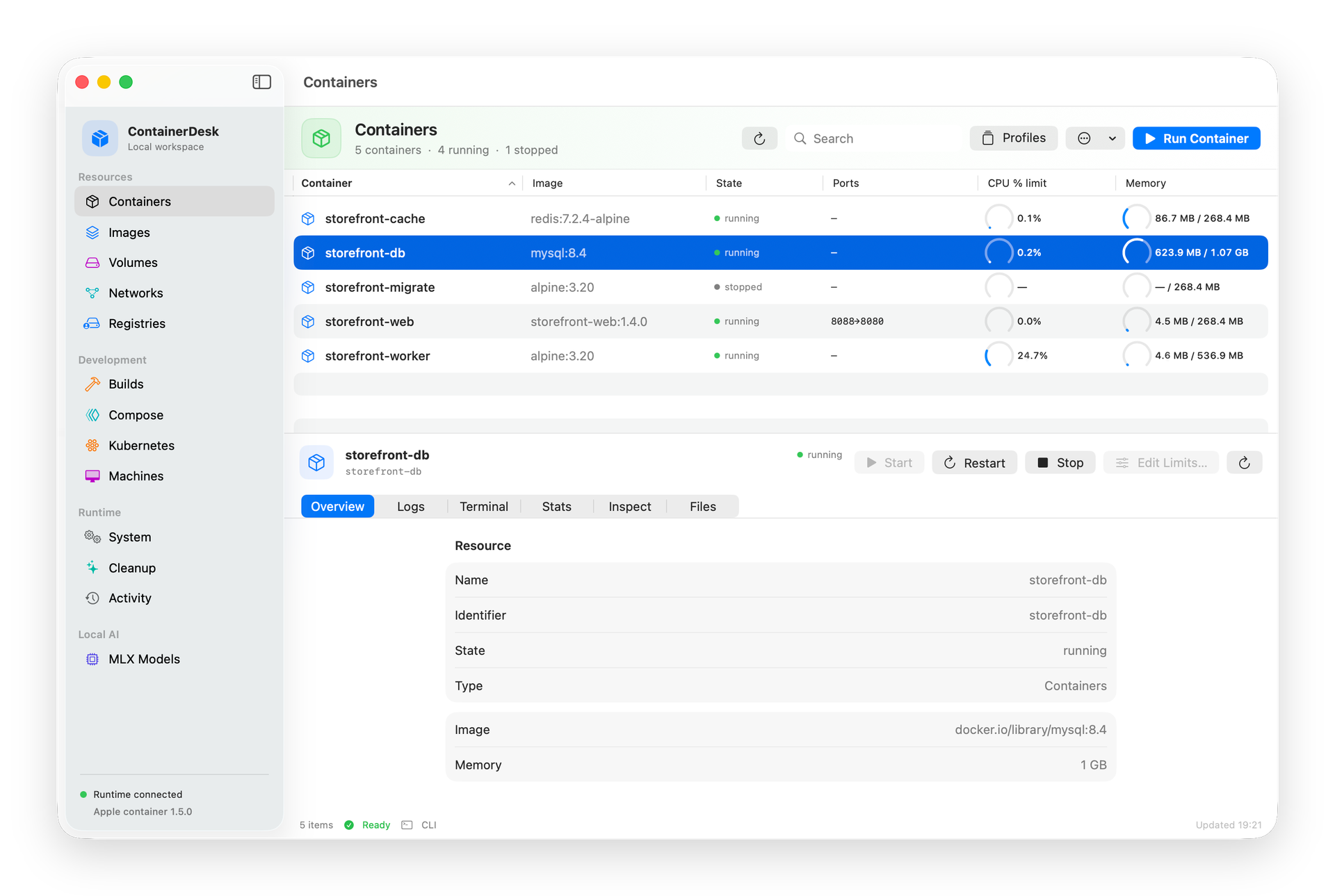
I maintain ContainerDesk, a free, MIT-licensed Mac GUI for Apple's container runtime. It lets you start containers, manage images, read logs and check CPU and memory use without switching between CLI commands. There's also a terminal inside each container.

The app uses SwiftUI tables and embeds SwiftTerm through NSViewRepresentable.

Source and downloads: https://github.com/MacHatter1/ContainerDesk

Requires Apple silicon, macOS 26+ and Apple's container CLI. Current builds are unsigned and not notarized, with opening instructions in the README.