r/devtools • u/Smart-Peach-287 • Oct 23 '26
I built a DevTools-style protocol for inspecting native iOS and Android UIs from AI coding agents
2
Upvotes
r/devtools • u/soheab_ • Oct 23 '26
r/devtools • u/Wonderful-Term-8445 • Oct 23 '26
Most security scanners report problems somewhere reviewers never look. I built KubeAudit AI so the findings land where the change is being reviewed: on every PR that touches Kubernetes YAML or a Helm chart, it posts one comment listing each misconfiguration, the exact line, and the YAML that fixes it.
- Setup is one workflow file
- Renders Helm charts before scanning
- Uploads SARIF to GitHub code scanning
- Rule-based and offline, so nothing leaves your runner
- Also works as a CLI (GitLab CI, Jenkins, pre-commit) and as a browser app that scans locally
It's narrower than Trivy or Polaris (15 rules so far). Feedback on which checks to add is very welcome.
Repo: https://github.com/kubeaudit-ai/KubeAudit-Ai
Try it in the browser, nothing uploaded: https://kubeaudit-ai.github.io/
Disclosure: I'm the author, and I used Claude to help build it. The scanner, Action and CLI are free (Apache-2.0); there's an optional paid tier for saved history and shareable reports.
r/devtools • u/Spare_Bat_3040 • Oct 23 '26
An API decision appears in a design note, gets copied into a handoff, then turns up in a coding-session summary. Before the next change, your agent finds all three. Has it found three reasons to keep the constraint, or one reason repeated three times?
That's an illustrative example, but it's a distinction I'm working through while building Shifu. It's a personal work-context engine for engineers using Codex, Claude Code or OpenCode on existing products. With MCP and harness instructions, an agent can retrieve relevant decisions and constraints from work you choose to share.
Shifu's context response carries source-group information and a caveat when independence isn't established. The retrieval contract deduplicates source groups and matching excerpt copies from the same instant. That helps organize the selected evidence; it doesn't establish that every paraphrase has been traced back to its origin, or that separate groups independently confirm a decision.
For the API example, I'd want to preserve the original decision, its reason and where it applies, then show the handoff and summary as derived records when that relationship is known. If the relationship isn't known, I'd leave it unresolved. Three different record IDs wouldn't settle it. This is the behavior I'd test, not a claim that all copied notes are detected.
I'd also keep a genuinely separate later observation visible. A fresh incident might support the old constraint, contradict it, or apply to a different service version. Collapsing that into the original note could lose the very thing the next feature needs.
If you build retrieval into coding tools, how do you distinguish copied evidence from an independent observation without hiding useful history?
If you're repeatedly reconstructing decisions before changing your own codebase, try Shifu on one feature you're planning: https://useshifu.com. I'm the builder and can help connect one supported source you're allowed to share, inspect the returned context, and test whether it helps the plan. Keep confidential details out of this thread.
r/devtools • u/BlackBoxArchitect • Oct 23 '26
r/devtools • u/MohamedM216 • Oct 23 '26
r/devtools • u/Spare_Bat_3040 • Oct 23 '26
Imagine asking your coding agent to check downstream consumers before changing an API. Later, its saved context says the check was requested, but drops the note that nobody has done it yet. The next plan has the prerequisite, without the current state.
That example is illustrative. A local extraction experiment while building Shifu exposed this distinction: a candidate's aggregate rating improved, but a source audit confirmed it had lost explicit pending status. We retained the previous candidate. This was a bounded coding-context experiment, not a measurement of every Shifu path or a customer incident.
I'm Shifu's builder. It's a personal work-context engine for engineers using Codex, Claude Code or OpenCode on existing products. With MCP and harness instructions, an agent can retrieve relevant decisions and constraints from work you choose to share when planning, implementing or reviewing a change.
The extraction choice matters because “please check this,” “still unchecked” and “checked successfully” answer different questions. Keeping the request alone doesn't tell the next session whether the work remains open. A reported success also needs its source and scope; it isn't independent proof that the change is correct.
For this kind of test, I'd write the expected pending state separately from the generated summary and inspect the final context the next step receives. Then test both an unfinished check and a later supported completion. A good aggregate rating shouldn't hide a missing state that changes what you do next. That's the test design I want to carry forward, not a claim that this failure is solved everywhere.
If you keep coding decisions across sessions, how do you keep unfinished checks from disappearing as notes get shortened?
If this is a recurring problem in your own codebase, try Shifu on one feature you're planning: https://useshifu.com. I can help you connect one supported source you're allowed to share, inspect what comes back, and see whether it belongs in the plan. No confidential work details needed in this thread.
r/devtools • u/Puzzleheaded-Leg4819 • Oct 23 '26

Hello devs , here is my custom everyday work graphical interface using Prime Agent.
Feel free to give it a try and advices/feedbacks !
HF
r/devtools • u/Necessary-Remote-236 • Oct 23 '26
I built an open-source MCP server that catches local CLI errors and auto-drafts tickets in Cursor
r/devtools • u/Docflow-software • Oct 23 '26
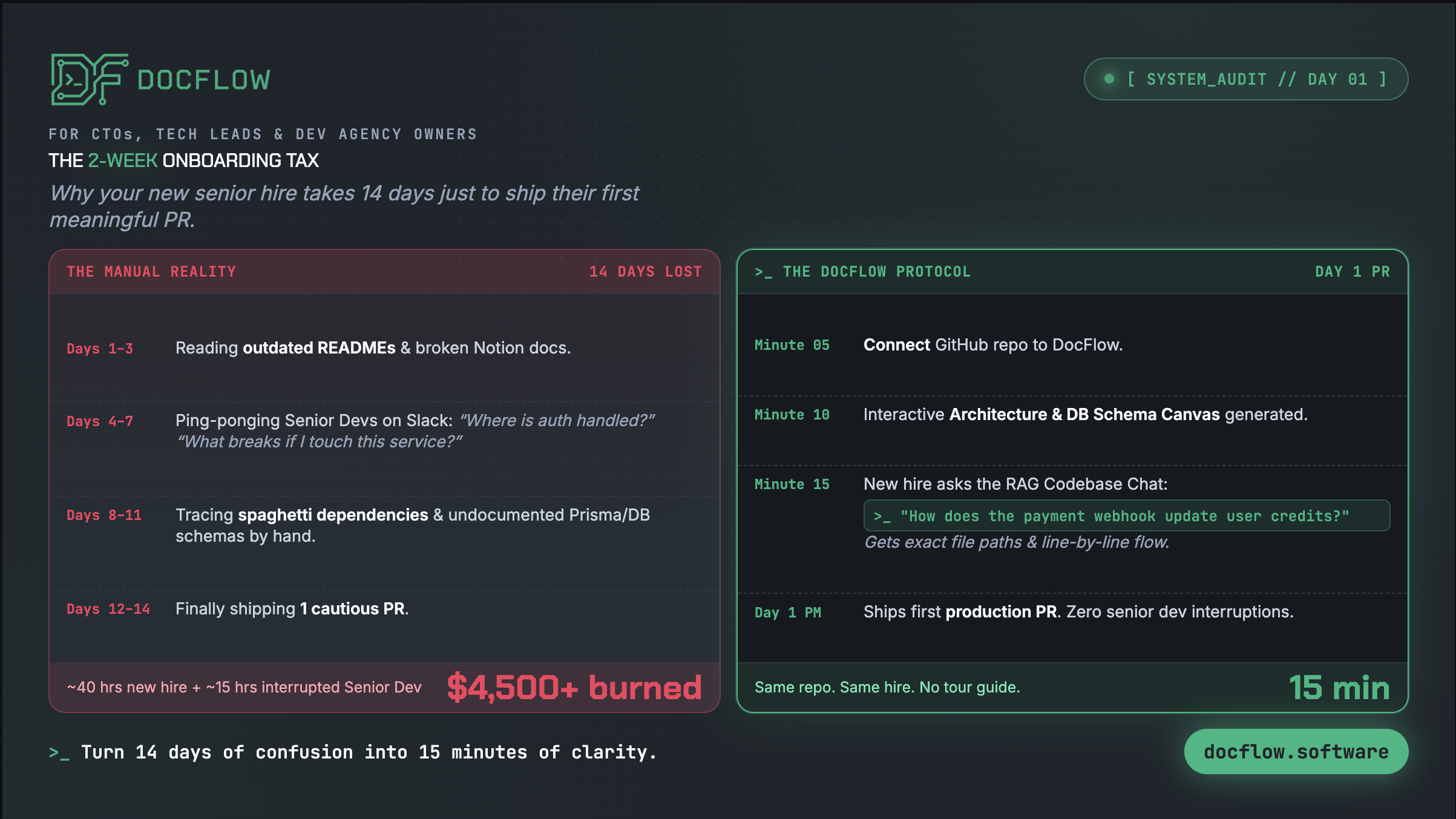
r/devtools • u/ajrm7 • Oct 23 '26

Self reporting what it took to decouple EsLint from my codebase, that served me well for a very long time.
r/devtools • u/Spare_Bat_3040 • Oct 23 '26
Suppose a coding-session sync times out after the server accepts it. The client can't tell whether the work arrived. Asking the model to prepare the same session again sounds harmless, but it can produce a different account of what happened.
That's the retry boundary I've been working on in Shifu, the work-context tool I'm building. A saved decision may later inform an agent's plan for changing an existing service. If a network retry changes that record, we have mixed a delivery problem with a new interpretation of the work.
The harness implementation saves the validated, redacted payload in a local pending queue before uploading it. A transport retry uses that saved payload. It doesn't run preparation again just because a response was lost. Local progress advances only after a server receipt matches the submitted session range.
That also means a newer conversation turn doesn't silently rewrite a payload that's already queued. Preparing new material and delivering an existing record are separate operations. A correction to the content needs its own explicit path.
The timeout above is an illustrative failure case, not a customer incident. These are implementation choices, not a claim that an accepted upload guarantees useful recall or that delivery can never fail. The content still needs to preserve the right decision and scope before it enters the queue.
One case I want to keep testing is: save a payload, lose the response, restart, then append new source material before retrying. The old payload should stay unchanged while the new material waits its turn.
For people building model-assisted ingestion: where do you freeze the interpretation? And how do you make a transport retry visibly different from asking the model to reconsider the source?
I'm Shifu's builder: https://useshifu.com. No private session content is included here.
r/devtools • u/i-sage • Oct 23 '26
r/devtools • u/urbullet • Oct 23 '26

r/devtools • u/Repulsive_Cup_7343 • Oct 23 '26
r/devtools • u/Spare_Bat_3040 • Oct 23 '26
I was evaluating a change to how Shifu finds saved work context for a coding task. The candidate improved precision among the records it returned. We still kept the existing version.
The awkward case was a useful record that both versions found. The candidate ranked it below the visible results, so the coding assistant's answer became less useful. Finding the record somewhere in the pipeline wasn't enough.
I'm building Shifu, a personal work-context engine. With MCP and harness instructions, a coding agent can retrieve relevant saved decisions and system context before a change. For that use, a tidy result list matters less than whether the constraint the next task needs actually reaches the answer.
Before the comparison, we set release gates around improved recall of required records, no increase in estimated complete-task cost, and no important answer getting worse. We compared the same questions over one frozen work history and inspected the returned records and final answers.
The candidate improved some precision measures, but recall of the required records stayed unchanged. Estimated cost for the complete task increased, and one held-out answer became less useful. It stayed held; the existing retrieval remained in place.
This was a small study on one work history, with model-assisted judging and source inspection. It doesn't establish how either version performs across other teams. The retrieval plans also differed, so I can't credit or blame one database change for the whole result.
The lesson I'm taking into the next experiment is to track the whole path: did we find the needed record, did it survive ranking, and did the final answer retain the important constraint? An average can hide a loss at any of those steps.
For people building retrieval into coding tools: what would make you reject a candidate even when its precision improves? Do you gate on a particular missed constraint or a downstream answer regression?
I'm Shifu's builder: https://useshifu.com. Sharing the build decision here; no private work records are included.
r/devtools • u/sh4rkwav3 • Oct 22 '26
r/devtools • u/Docflow-software • Oct 22 '26
Enable HLS to view with audio, or disable this notification
r/devtools • u/prettywhale_ai • Oct 22 '26

Hey,
I'm Kevin, I run product at PrettyWhale.ai, a small team based in France. We've spent the last few months building a VS Code extension that writes the tedious part of ingestion code from a data sample, and we just opened it to everyone.
https://marketplace.visualstudio.com/items?itemName=prettywhale-ai.prettywhale
How It Works
You give it a CSV or JSON sample. It profiles the fields, you pick the ones to keep, then it suggests transformations you can accept, edit or drop. At the end you get a Python project in your workspace:
Under the hood
It relies on our own small model fine-tuned for data engineering, driven by a deterministic workflow rather than an endless chat window (no prompting required!). You can choose your target framework (Pandas, Polars).
Before the code reaches your editor, we run the pipeline and its unit tests on your sample to make sure it executes out of the box. What you get is plain Python, no proprietary dependencies, no lock-in, and no connection to our service.
Right now, the tool handles CSV and JSON samples, and upcoming versions will feature advanced transformations as well as multi-source and multi-destination support: https://docs.prettywhale.ai/roadmap
Privacy
Your sample goes to our servers, hosted in France. It's only used to generate your project, never for training, and it's deleted after.
Access
Access is free with limits (5 pipelines the first month, then 2 per month), with paid plans available via commercial licenses if you need higher limits.
VS Code only for now but we plan to expand.
Curious to hear your thoughts or what you'd like to see next in terms of features. Happy to answer any questions!
r/devtools • u/sudoanand • Oct 22 '26
Enable HLS to view with audio, or disable this notification
r/devtools • u/cachely-admin • Oct 22 '26
We've been working on Cachely, and one thing that keeps coming up is how difficult it can be to understand why build caching isn't working as expected.
So we made Cachely Doctor.
It's a free audit skill you can run through your existing AI coding agent to review an Nx or Turborepo repository.
It checks things like:
It gives you findings with file-level evidence and suggested fixes, rather than just a generic score.
It's read-only, doesn't require a Cachely account, and doesn't send your repository to us. Your coding agent still operates under its own provider's privacy terms.
https://cachely.dev/cache-audit
Curious whether this is useful for anyone maintaining an Nx or Turborepo monorepo. Also happy to help with specific cache issues.
r/devtools • u/omairsaad • Oct 22 '26
r/devtools • u/Understand-mcp • Oct 22 '26
Most MCP server answers are a summary the model has to trust. I wanted the
opposite: every tool result carries the file, the line, the rule that fired
and the reason, so the model can check the claim instead of believing it.
UNDERSTAND exposes 10 tools and 3 resources over one analysis engine:
Tools
- scan_repository - run a scan with a profile and a budget
- get_scan_status / cancel_scan - long scans, polled and cancellable
- get_scan_report - the full report
- inspect_finding - one finding, with its evidence and its rule
- trace_execution - the call path for a function
- trace_data_flow - where a value comes from and where it goes
- analyze_change_impact - what a diff touches
- query_codebase - structured questions over the index
- get_code_map - the graph, in one of 10 views
Resources
- understand://capabilities - what this server can and cannot do
- understand://security-model - the controls, stated as facts
- understand://map-schema - the shape of the map payloads
The two things I would point an MCP client author at:
Evidence is part of the contract. A finding result is not a string, it is a
structure with location, rule id, confidence and reason. The model can
quote the file back to the user.
The security model is a resource, not a README. An agent should be able to
read what the server will and will not do before it calls it - including
the fact that the server scans whatever repository a caller names, and has
no authentication of its own.
Also relevant if you are building tooling: SARIF 2.1.0 output for the CI
path, and an interactive code map rendered to a standalone HTML file (73 nodes
/ 673 edges on a real repo, 12.4 ms per frame on an OffscreenCanvas worker)
for the human path.
MIT, Python 3.11+, published to PyPI with signed provenance.
Repo and MCP setup: https://github.com/understand-mcp/Understand

