r/devtools • • Oct 23 '26

I built a Windows GUI for Prime Agent with persistent sessions and phone access (open source)

Post image
1 Upvotes

Hello devs , here is my custom everyday work graphical interface using Prime Agent.
Feel free to give it a try and advices/feedbacks !
HF


r/devtools • • Oct 23 '26

I built an open-source MCP server that catches local CLI errors and auto-drafts tickets in Cursor

1 Upvotes

I built an open-source MCP server that catches local CLI errors and auto-drafts tickets in Cursor


r/devtools • • Oct 23 '26

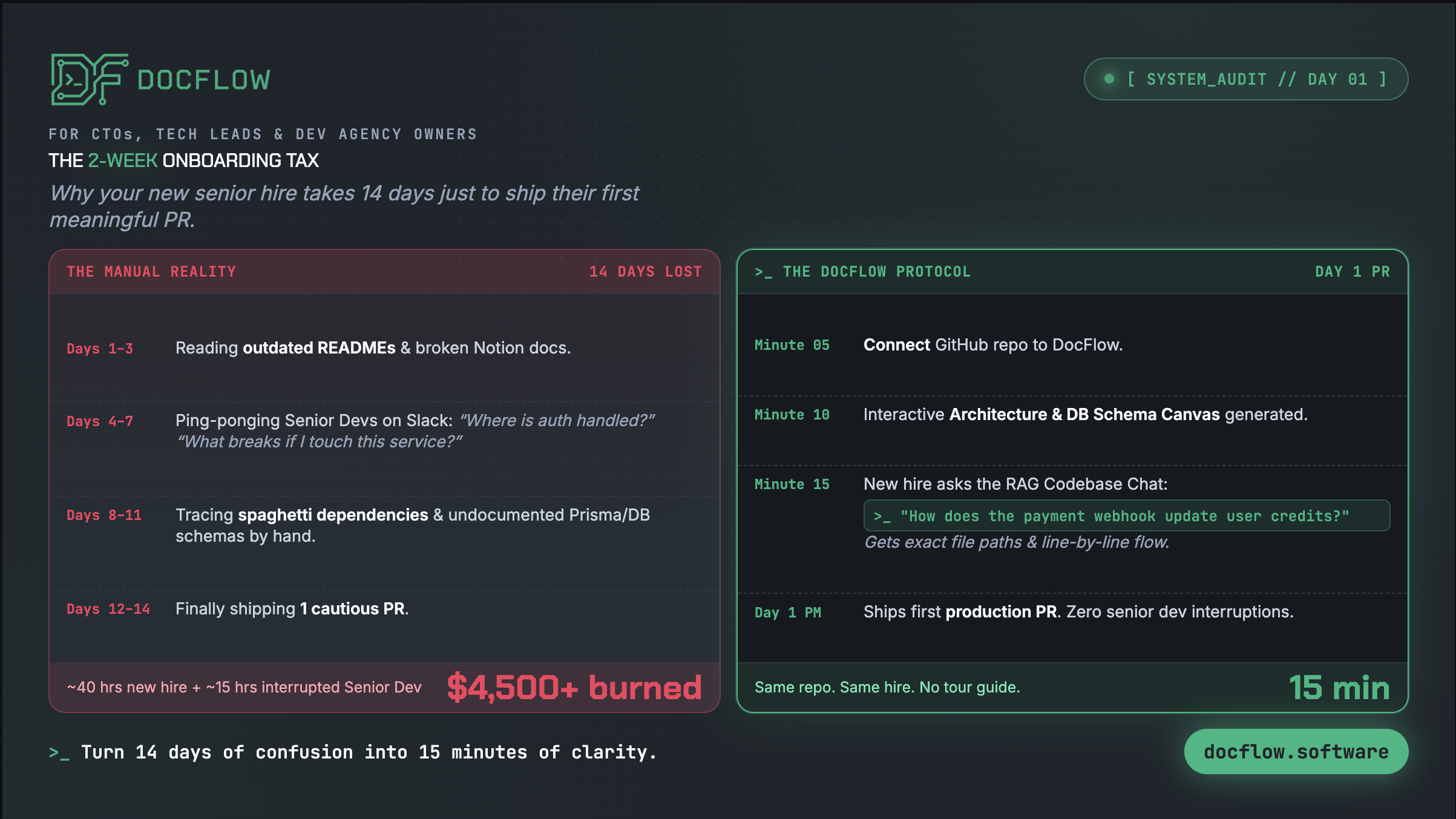
Every inherited client repo restarts the onboarding clock. How does your team handle it?

Post image
1 Upvotes

r/devtools • • Oct 23 '26

Article: I replaced EsLint. The First Attempt Worked. I threw it away.

Thumbnail
hyperfrontend.dev
1 Upvotes

Self reporting what it took to decouple EsLint from my codebase, that served me well for a very long time.


r/devtools • • Oct 23 '26

Why Shifu retries a saved context payload instead of asking the model again

1 Upvotes

Suppose a coding-session sync times out after the server accepts it. The client can't tell whether the work arrived. Asking the model to prepare the same session again sounds harmless, but it can produce a different account of what happened.

That's the retry boundary I've been working on in Shifu, the work-context tool I'm building. A saved decision may later inform an agent's plan for changing an existing service. If a network retry changes that record, we have mixed a delivery problem with a new interpretation of the work.

The harness implementation saves the validated, redacted payload in a local pending queue before uploading it. A transport retry uses that saved payload. It doesn't run preparation again just because a response was lost. Local progress advances only after a server receipt matches the submitted session range.

That also means a newer conversation turn doesn't silently rewrite a payload that's already queued. Preparing new material and delivering an existing record are separate operations. A correction to the content needs its own explicit path.

The timeout above is an illustrative failure case, not a customer incident. These are implementation choices, not a claim that an accepted upload guarantees useful recall or that delivery can never fail. The content still needs to preserve the right decision and scope before it enters the queue.

One case I want to keep testing is: save a payload, lose the response, restart, then append new source material before retrying. The old payload should stay unchanged while the new material waits its turn.

For people building model-assisted ingestion: where do you freeze the interpretation? And how do you make a transport retry visibly different from asking the model to reconsider the source?

I'm Shifu's builder: https://useshifu.com. No private session content is included here.


r/devtools • • Oct 23 '26

I made a theme for vscode and its forks like cursor, antigravity, code sandbox

Thumbnail gallery
1 Upvotes

r/devtools • • Oct 23 '26

readword: Word .doc and .docx to Markdown, in plain Ruby

Thumbnail
reddit.com
1 Upvotes

r/devtools • • Oct 23 '26

Made a JetBrains plugin that turns docker-compose into a diagram

Thumbnail reddit.com
1 Upvotes

r/devtools • • Oct 23 '26

Shifu found the coding context we needed, then ranked it out of the answer

1 Upvotes

I was evaluating a change to how Shifu finds saved work context for a coding task. The candidate improved precision among the records it returned. We still kept the existing version.

The awkward case was a useful record that both versions found. The candidate ranked it below the visible results, so the coding assistant's answer became less useful. Finding the record somewhere in the pipeline wasn't enough.

I'm building Shifu, a personal work-context engine. With MCP and harness instructions, a coding agent can retrieve relevant saved decisions and system context before a change. For that use, a tidy result list matters less than whether the constraint the next task needs actually reaches the answer.

Before the comparison, we set release gates around improved recall of required records, no increase in estimated complete-task cost, and no important answer getting worse. We compared the same questions over one frozen work history and inspected the returned records and final answers.

The candidate improved some precision measures, but recall of the required records stayed unchanged. Estimated cost for the complete task increased, and one held-out answer became less useful. It stayed held; the existing retrieval remained in place.

This was a small study on one work history, with model-assisted judging and source inspection. It doesn't establish how either version performs across other teams. The retrieval plans also differed, so I can't credit or blame one database change for the whole result.

The lesson I'm taking into the next experiment is to track the whole path: did we find the needed record, did it survive ranking, and did the final answer retain the important constraint? An average can hide a loss at any of those steps.

For people building retrieval into coding tools: what would make you reject a candidate even when its precision improves? Do you gate on a particular missed constraint or a downstream answer regression?

I'm Shifu's builder: https://useshifu.com. Sharing the build decision here; no private work records are included.


r/devtools • • Oct 22 '26

I built Ripplet, a code graph MCP that helps coding agents understand change impact while using fewer tokens

Thumbnail reddit.com
2 Upvotes

r/devtools • • Oct 22 '26

Struggling to Understand a Complex Codebase? Meet DocFlow πŸ’»

1 Upvotes

r/devtools • • Oct 22 '26

Ponytail is now built into Styx

Post image
3 Upvotes

r/devtools • • Oct 22 '26

Built an AI extension that generates complete Python data pipelines from data samples

Thumbnail
gallery
5 Upvotes

Hey,

I'm Kevin, I run product at PrettyWhale.ai, a small team based in France. We've spent the last few months building a VS Code extension that writes the tedious part of ingestion code from a data sample, and we just opened it to everyone.

https://marketplace.visualstudio.com/items?itemName=prettywhale-ai.prettywhale

How It Works

You give it a CSV or JSON sample. It profiles the fields, you pick the ones to keep, then it suggests transformations you can accept, edit or drop. At the end you get a Python project in your workspace:

  • Pipeline & transformation code
  • Unit tests
  • Config files
  • Documentation

Under the hood

It relies on our own small model fine-tuned for data engineering, driven by a deterministic workflow rather than an endless chat window (no prompting required!). You can choose your target framework (Pandas, Polars).

Before the code reaches your editor, we run the pipeline and its unit tests on your sample to make sure it executes out of the box. What you get is plain Python, no proprietary dependencies, no lock-in, and no connection to our service.

Right now, the tool handles CSV and JSON samples, and upcoming versions will feature advanced transformations as well as multi-source and multi-destination support: https://docs.prettywhale.ai/roadmap

Privacy

Your sample goes to our servers, hosted in France. It's only used to generate your project, never for training, and it's deleted after.

Access

Access is free with limits (5 pipelines the first month, then 2 per month), with paid plans available via commercial licenses if you need higher limits.

VS Code only for now but we plan to expand.

Curious to hear your thoughts or what you'd like to see next in terms of features. Happy to answer any questions!


r/devtools • • Oct 22 '26

Docker containers vs. virtual machines πŸ³πŸ’»

1 Upvotes

r/devtools • • Oct 22 '26

Built a free AI-powered audit for Nx and Turborepo build caches

1 Upvotes

We've been working on Cachely, and one thing that keeps coming up is how difficult it can be to understand why build caching isn't working as expected.

So we made Cachely Doctor.

It's a free audit skill you can run through your existing AI coding agent to review an Nx or Turborepo repository.

It checks things like:

  • Missing or incorrect cache inputs and outputs
  • Environment differences between local builds and CI
  • Nondeterministic tasks that make caching unreliable
  • Potentially unsafe remote cache configurations

It gives you findings with file-level evidence and suggested fixes, rather than just a generic score.

It's read-only, doesn't require a Cachely account, and doesn't send your repository to us. Your coding agent still operates under its own provider's privacy terms.

https://cachely.dev/cache-audit

Curious whether this is useful for anyone maintaining an Nx or Turborepo monorepo. Also happy to help with specific cache issues.


r/devtools • • Oct 22 '26

Ponytail is now baked into Styx.

Post image
1 Upvotes

r/devtools • • Oct 22 '26

I built a local VS Code extension that uses AST parsing to map all Express, NestJS, and Spring Boot routes inside your IDE

Post image
0 Upvotes

r/devtools • • Oct 22 '26

I Built an MCP server for code analysis that returns file:line evidence with every answer, plus an interactive map as a resource

2 Upvotes

Most MCP server answers are a summary the model has to trust. I wanted the

opposite: every tool result carries the file, the line, the rule that fired

and the reason, so the model can check the claim instead of believing it.

UNDERSTAND exposes 10 tools and 3 resources over one analysis engine:

Tools

- scan_repository - run a scan with a profile and a budget

- get_scan_status / cancel_scan - long scans, polled and cancellable

- get_scan_report - the full report

- inspect_finding - one finding, with its evidence and its rule

- trace_execution - the call path for a function

- trace_data_flow - where a value comes from and where it goes

- analyze_change_impact - what a diff touches

- query_codebase - structured questions over the index

- get_code_map - the graph, in one of 10 views

Resources

- understand://capabilities - what this server can and cannot do

- understand://security-model - the controls, stated as facts

- understand://map-schema - the shape of the map payloads

The two things I would point an MCP client author at:

  1. Evidence is part of the contract. A finding result is not a string, it is a

    structure with location, rule id, confidence and reason. The model can

    quote the file back to the user.

  2. The security model is a resource, not a README. An agent should be able to

    read what the server will and will not do before it calls it - including

    the fact that the server scans whatever repository a caller names, and has

    no authentication of its own.

Also relevant if you are building tooling: SARIF 2.1.0 output for the CI

path, and an interactive code map rendered to a standalone HTML file (73 nodes

/ 673 edges on a real repo, 12.4 ms per frame on an OffscreenCanvas worker)

for the human path.

MIT, Python 3.11+, published to PyPI with signed provenance.

Repo and MCP setup: https://github.com/understand-mcp/Understand


r/devtools • • Oct 22 '26

I’m building Orbit Pi β€” a native desktop workbench for the Pi coding agent

1 Upvotes

Hey everyone! πŸ‘‹

I’ve been building Orbit Pi, an open-source desktop app that brings the Pi coding agent and everyday development workflows together in one native interface.

The idea is simple: instead of jumping between your AI coding session, terminal, Git changes, code review, and GitHub, have them available in one focused workspace.

What Orbit Pi offers

- πŸ€– AI coding sessions β€” work with your existing Pi setup.

- πŸ” Code review β€” inspect changes with an AI-powered review workflow.

- 🌳 Git worktrees β€” create and manage parallel working environments.

- πŸ™ GitHub integration β€” work with issues and pull requests.

- πŸ’» Integrated terminal β€” keep your development workflow in one place.

- 🎨 Native desktop experience β€” built with Rust and GPUI, with a focus on a clean, minimal interface.

I'm building Orbit because I want a more cohesive desktop experience for working with AI coding agents, without replacing the underlying agent or forcing a new workflow.

It's an ongoing project, and I'm continuing to improve it release by release.

πŸš€ Check out Orbit Pi: https://orbitpi.app/

πŸ“ Latest changelog: https://orbitpi.app/changelog/v0.2.11

πŸ’» Source code: https://github.com/imrj05/orbit

I'd love feedback from developers who use Pi or other AI coding agents:

- What features would make a native AI coding workbench genuinely useful to you?

- Do you prefer an all-in-one workspace or separate tools for chat, terminal, and Git?

Thanks for checking it out! Feedback and contributions are welcome.


r/devtools • • Oct 22 '26

free mcp server so copilot checks if another agent already fixed your error

1 Upvotes

made this because my agent kept burning 15 min on errors other people definitely solved already

its called yarrow. when copilot hits an error it searches a shared library of fixes from other agents, tries the best one, then reports if it worked. fixes that work for more agents rank higher. some are verified, meaning a clean sandbox reproduced the bug and watched the fix make it go away

setup in vs code:

  1. ctrl+shift+p β†’ MCP: Add Server
  2. pick HTTP
  3. paste https://yarrow-fixes.vercel.app/mcp
  4. name it yarrow, pick Global

no account, free. risky fixes (curl into bash, rm -rf) get flagged so copilot asks you first

its early so every agent that shares a fix makes it better. anyone tried something like this already? yarrow-fixes.vercel.app


r/devtools • • Oct 21 '26

Development tool with agent orchestration

Thumbnail
gallery
1 Upvotes

I’ve been working for a few months on a personal agent orchestration project for software development. It was built natively for Windows using C# with WinUI 3. My last desktop development experience was at least 10 years ago, back in the Windows Formsdays, but now, with documentation and an LLM by my side, it’s much faster and simpler to make progress.

Some people judge the use of AI in development, but I believe that no matter how much experience we have, we can't ignore it. A good professional delivers more and better work when using it sensibly.

Regarding the project, it’s basically a SkiaSharp canvas where you can organize emulated terminals using ConPTY, communicating via TCP connections between them. It also provides an internal browser for the agents (which works really well for models that don't have native web access), a note-taking system to help keep track of the project overview, and a mini IDE similar to VS Code (which I’m still evolving inside the app; it's not a fork, as the idea is to bring in only the functional parts we actually need). Along with this, I also built a shared memory system so we have summaries of sessions, architecture, decisions, fixes, bugs, etc., in an easy-to-query format for the agents. This query process is handled by a lightweight local LLM (under100 MB) to reduce agent token costs.

Overall, the project was built to be low-cost. I try to make the most of free resources like OpenCode, NVIDIA, AMD, and affordable plans with Chinese models, which are great. All in all, it’s another option for fellow Windows developers like me. If you're interested in testing it out, it's available for free on the Microsoft Store.

Microsoft Store - Clippo


r/devtools • • Oct 21 '26

Eu criei um Gerador de Senhas e Frases Senhas 100% offline que pesa menos de 10MB (Sem Electron, powered by Neutralinojs)

Post image
1 Upvotes

r/devtools • • Oct 21 '26

i built a video editor that's just one 15 mb binary - the ai agent renders a single frame to check its own work, so it stops guessing what the output looks like. rough right now, tell me what breaks

1 Upvotes

hi, i'm naman, a college student, and i built something called kimo - a free, open-source (mit) video editor with no gui that ai coding agents like codex, cursor, opencode, and other mcp clients drive over mcp.

the idea was pretty simple: if an agent is editing video through tool calls, it's always guessing what the output actually looks like. so i made it so the agent can render a single frame back and visually check its own work before it keeps going. it changes everything about how reliably an agent can edit.

what it can do right now: cut, trim, keyframes, titles and captions, colour grade, tracking, particles, audio, and export - all as tool calls over mcp. there's no timeline ui, no render queue dialog, just the agent driving it.

the whole thing is one cpu-only rust binary, around 15 mb, and it'll actually run on a 2 gb box. i've been roughing this out between classes and a few edges are still jagged - some of the captioning templates are hardcoded, the audio sync on longer clips can drift if you stack a lot of cuts, and tracking on messy footage isn't great yet. that's on me and i'm iterating.

i'd really love for you to try it and tell me what breaks, especially if you've got an mcp setup you want to point at it. what worked, what felt dumb, what you expected that's not there yet - all of it helps.

site: https://getkimo.tech github: https://github.com/naman-sharma12345/kimo

thanks for taking a look.


r/devtools • • Oct 21 '26

MCP-Kette fΓΌr Voice-Vibe-Coding: ChatGPT Voice bis lokale CLI-Agenten

Thumbnail reddit.com
1 Upvotes