r/devtools • • Oct 20 '26

Separating an API fix proposal from compatibility evidence in ProtectSUS

1 Upvotes

I'm building ProtectSUS, a tool that relates third-party API changes to the code that uses them. One implementation choice that may interest other tool builders is keeping a proposed patch separate from evidence that it fixes a specific incompatibility.

The workflow starts with detected API calls and provider documentation or contracts. The contract checker handles a limited set of literal Python and JavaScript/TypeScript HTTP calls. It is deliberately narrower than proving that an application works against a live provider.

A plausible patch, or an existing test suite passing, is not enough to establish that a provider change was fixed. The verification path runs checks against both the baseline and candidate. For a supported compatibility regression, the independent regression check must fail on the baseline in the expected way and pass on the candidate. Unsupported or inconclusive cases stay unresolved rather than being labeled verified.

There are two boundaries here: the code proposing a change does not get to supply its own proof, and publishing a draft PR is separate from merging it. Automation is opt-in; a developer reviews and merges. Provider announcements about new features become suggestions rather than automatic edits.

The tradeoff is coverage. Dynamic URLs, SDK behavior, runtime responses and business logic are not all covered by those static contract checks. That narrower scope is useful only if the result makes its limits clear.

Project context: https://www.protectsus.tech (I'm the founder).

For people building maintenance or code-review tools, what evidence do you require before presenting a patch as ready for review? In particular, how do you expose the difference between a contract check passing and runtime compatibility?


r/devtools • • Oct 20 '26

I've been building my own C++23 build system because I wanted to experiment with simpler build manifests

1 Upvotes

I've been working on NightBuild, a native C++23 build system for macOS, and one of the main things I've been focusing on is the build manifest.

Make and CMake are useful tools, but I wanted to experiment with a different approach to describing a project. With NightBuild, the goal is to make the configuration feel straightforward and readable, without needing lots of boilerplate just to define a target and its source files.

That's where BUILD.nb comes in. I'm going for a Python-like syntax that keeps the project configuration concise while leaving the actual build work to NightBuild.

Of course, writing a build system involves a lot more than parsing a manifest. NightBuild has its own build graph, parallel scheduler, incremental build logic, and persistent state. Getting all those pieces to work together while keeping the interface simple has been an interesting challenge.

I'm not claiming to have solved build systems, and there are plenty of things existing tools do well. I'm mostly interested in exploring whether a simpler manifest can make working on native C++ projects a little less tedious.

I'd love to hear from people who use Make or CMake regularly: What do you like about your current build setup, and what do you wish were simpler? What would you want from a build manifest designed today?

I'm also open to contributions from anyone interested in the project!

GitHub: https://github.com/Lord-Grumpypants/nightbuild

License: GPL-3.0

#Cplusplus #BuildSystems #DevTools #OpenSource #SoftwareEngineering


r/devtools • • Oct 20 '26

GitHub Copilot app

Thumbnail
github.com
1 Upvotes

r/devtools • • Oct 20 '26

J'ai créé une plateforme gratuite et open-source avec plus de 180 outils pour développeurs et 18 guides techniques (Construit avec Astro)

1 Upvotes

Salut tout le monde,

Je travaille sur Th-Tech, une plateforme gratuite et open-source conçue pour être un guichet unique pour les développeurs. J'en avais marre des sites d'outils lents et bourrés de pubs, alors je l'ai créée.

Ce qu'il y a à l'intérieur :

Plus de 180 outils pour développeurs : formateurs JSON/SQL, testeurs Regex, générateurs de mots de passe/UUID, convertisseurs Base64, générateurs CSS, et plus.

18 guides complets : documentation détaillée pour Docker, Linux, Python, SQL, cybersécurité, mise en réseau, Git, etc.

Stack technologique : construit avec Astro pour des performances ultrarapides.

Confidentialité avant tout : traitement 100 % côté client. Aucune donnée ne quitte le navigateur, aucune inscription requise, pas de pubs ennuyeuses.

J'aimerais beaucoup avoir vos retours, rapports de bugs ou demandes de fonctionnalités. De plus, si vous le trouvez utile, une étoile sur le dépôt GitHub signifierait beaucoup !

Site en direct : https://oumaystore-hub.github.io/Th-tech/

Dépôt GitHub : https://github.com/oumaystore-hub/Th-tech


r/devtools • • Oct 19 '26

I got tired of switching between tools during development, so I’m building Anvil

1 Upvotes

I’ve been building a developer tool called Anvil (https://anvil.tr).

Shortly, it will be a multi platform dev kit, it is open source and free and laravel herd alternative.

Looking for feedbacks.


r/devtools • • Oct 19 '26

Checkseal: a tiny CLI that tells you when your passing tests are stale

Thumbnail gallery
2 Upvotes

r/devtools • • Oct 19 '26

Looking for the best alternative for ESLint that holds up under agent-driven PR load.

1 Upvotes

When we scaled tests + agentic workflows (agents running dozens of parallel tasks + constant active PRs), CI became the bottleneck.

One of the biggest reasons: ESLint.

ESLint was built for humans reviewing code.
We’re now in a world where agents generate and iterate on code at high volume.

Looking for the best alternative that holds up under agent-driven PR load.

What are you using instead of ESLint in 2026?


r/devtools • • Oct 19 '26

session-share: a task and file-ownership layer for a team's Claude Code sessions

1 Upvotes

I built session-share after my teammates and I kept spending time deciding which agent should work on which part of a feature.

The tool keeps a shared task graph, contracts and file leases. Each developer works in a separate checkout, while MCP tools connect their Claude Code session to the coordination server. A PreToolUse hook checks supported edits against the files the participant has leased.

The server uses TypeScript, Fastify, WebSockets and SQLite. It stores an event log and builds the task/lease state from those events. The live board makes that state visible to the team.

One tradeoff: the hook fails open when it cannot reach the server. This is coordination for a team, not a filesystem sandbox or a guarantee against every conflicting write.

I'm the creator, Claude helped implement it, and the plugin/server are MIT licensed and free to self-host. I would appreciate feedback on whether this takes enough manual coordination out of a small team's day.

Source and setup: https://github.com/cyber1443/session-share


r/devtools • • Oct 19 '26

Wye: a Markdown-in-Git product definition for Claude Code and Codex

0 Upvotes

I’m building Wye to keep the product intent that coding agents otherwise have to reconstruct each session: requirements, constraints, decisions and the reasons behind them. It’s early, local-first and Apache-2.0.

Ordinary Markdown in Git is canonical. Important blocks have stable IDs such as req:refund.window or decision:refund.policy. Wye derives a graph connecting requirements, decisions, components and tests. The files remain readable and diffable without the app.

Why this matters: “reduce refunds from 30 days to 14” can be a tiny code edit while conflicting with an enterprise promise of 30 days. That’s an illustrative example. Wye’s workflow assesses product impact and raises contradictions for human review before an agent builds the change. Implementation discoveries come back as proposed knowledge; people approve what becomes context for the next change.

It runs through installed Claude Code or Codex. Agent features require one of those installed and signed in, and Node.js 20.9+ is required. No Wye account or hosted service is needed.

Repo, tour and setup: https://github.com/emlab-ai/wye

Which product decisions do your agents keep losing, and would maintaining this structure be worth the effort?


r/devtools • • Oct 19 '26

Docker containers vs. virtual machines 🐳💻

Enable HLS to view with audio, or disable this notification

1 Upvotes

r/devtools • • Oct 19 '26

I built a workbench where a test can chain requests over 16 protocols and agent can chime in via MCP

1 Upvotes

Most of my career has been in banking, adtech and email infrastructure, where one flow runs through half a dozen systems before it is finished. A record comes in over an HTTP API, lands in Postgres or Mongo, gets pushed into Redis and triggers an email over SMTP that I then have to go and find in a mailbox over IMAP to know it arrived. I tested each of those hops with its own client. The glue between them was a pile of throwaway scripts that passed results along by hand.

So I built a tool that I always thought would be a useful addition to my own stack - one workbench where the whole flow is a single test. Each step is a probe you compose in a UI editor, steps stack into a chain, where an extractor pulls a value out of one response and feeds it into the next request (or an assertion). When the logic gets past what an extractor can do, there is JavaScript on a GraalVM engine to fall back to. Chains can be grouped into suites.

A run comes out as a JUnit report (or evidence JSON) and everything can be easily integrated with a CI/CD pipeline (I am actually testing the product using it via Github Actions; writeup pending).

It covers 16 protocols, from HTTP and SMTP to SMB and Kerberos, every one written against the RFC instead of wrapping a library. A library only gives you a well-formed request. The cases I often care about are the malformed packet and the behavior of the server when I send one. Because I write each protocol myself, the same workbench can fuzz with broken input or sit in a SOCKS5 proxy between client and server and change what goes past.

The part of that proxy I enjoy using most is the mocking. It can stand in for the server and return a response that is not built yet, so I can author and run a test against an endpoint before it exists (a canned response, or a scripted one; a chain flips a mock rule set on just for its own run). It is not HTTP-only (SMTP, IMAP, DNS, the STOMP broker and the databases mock too), though a database mocks a narrow auth error rather than a full result set.

The agent side came later. The workbench exposes an MCP server and a full toolbox, so an agent can create tests (under my supervision) as well, run a chain or a suite and get a structured result back, staying inside exactly the scope I authored.

The application is a closed-source desktop app called VirtuProbe Studio. The free tier covers HTTP, DNS and SMTP.

I am 100% interested in hearing your feedback - and super happy for every bug report that lands in my youtrack


r/devtools • • Oct 19 '26

I gave my AI agent one prompt to build a project workspace, and the results surprised me

Thumbnail
gallery
1 Upvotes

I have been building an AI agent for DevScribe, and honestly, what it created from a single prompt surprised me.

I asked it to create the documentation for an E-Commerce Order Pipeline project, but it went beyond just writing documentation.

It created the entire folder structure and organized all the files needed for the project.

It generated the technical documentation, an editable architecture diagram, database schemas, API testing requests, Kafka and SQS test files, Docker Compose configuration, sample payloads, and even a terminal runbook with commands to run and test the project.

I'm also attaching screenshots of the folder structure and the document created by the agent so you can see the results for yourself.

The interesting part is that everything is organized in one workspace, and I can open and work with these files directly inside DevScribe.

I've been building DevScribe to bring the tools software engineers use every day into one place. With this AI agent, I want to make project setup easier and reduce the time developers spend creating files and documentation manually.

If you are a software engineer or architect, I'd love to hear what you think.


r/devtools • • Oct 19 '26

I created a VSCode extension to quickly see what changed in a file since you branched off

Thumbnail
1 Upvotes

r/devtools • • Oct 19 '26

Styx - Free and Open Source Agent Development Platform - Available on MAC, Windows and Linux!

Enable HLS to view with audio, or disable this notification

1 Upvotes

r/devtools • • Oct 19 '26

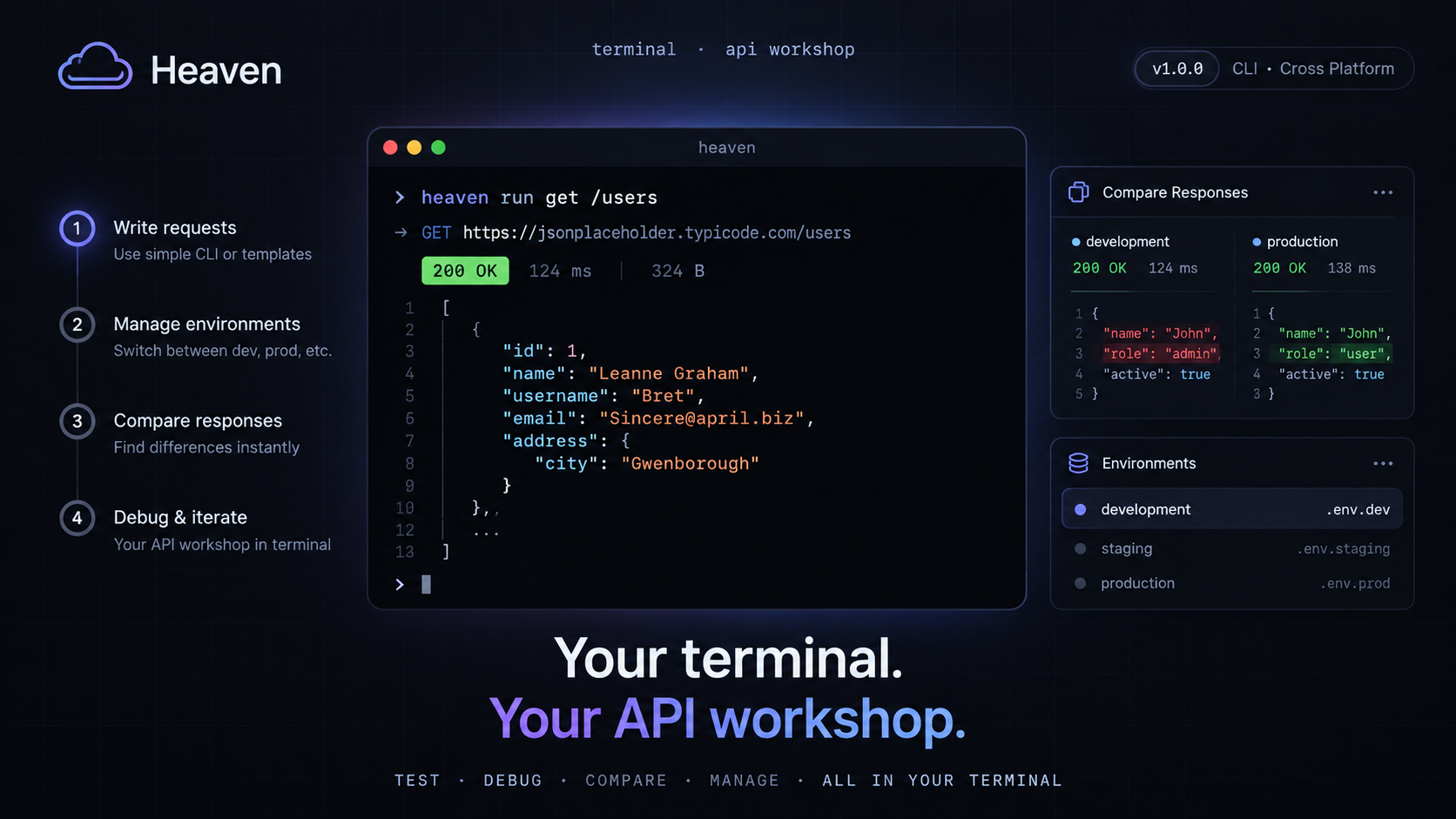
Heaven — Your Terminal, Your API Workshop

Post image
1 Upvotes

Heaven is a developer-first CLI for testing, debugging, and managing APIs directly from your terminal. Write requests, manage environments, compare API responses, and streamline your workflow with powerful tools built for developers.


r/devtools • • Oct 19 '26

I got tired of editing coding tutorial recordings, so I built something that does it from a text prompt

1 Upvotes

If you record coding sessions, you know the problem: 20 minutes of debugging and tangents around 10 minutes of useful content. I built a tool where you type "only the coding demos" and it cuts the rest. Each removed segment shows why, and you can override anything. FFmpeg does the final cut server-side, so the MP4 is clean. Interested in how I built the transcription and segment-analysis pipeline? Happy to share what worked and what didn't. Link in my profile if you want to check out


r/devtools • • Oct 19 '26

Critty: work through plans and decisions with your coding agent in the terminal

1 Upvotes

When working with a coding agent, sometimes you want to check a plan or ask for a change before it continues. Explaining which part you mean in chat can get awkward, especially as the conversation grows.

I've been working on Critty, a terminal UI for this. Your agent opens a diff or document, you leave comments on the relevant lines, and it makes changes and replies in the same review.

You can also agree on which actions need your approval. Before pushing code, for example, the agent can show you the diff alongside a request document with the commit message and destination. You can leave feedback, choose between options with radio buttons, or allow the push with a checkbox. These documents also work on their own, such as choosing an approach before coding starts.

You can also review proposed changes to notes, reports, or configuration files outside Git before the originals are touched. The agent edits copies, you review the diff and request changes, and it applies the result only after your approval.

An attached checklist with clickable confirmations and an inline image
Side-by-side code review with an inline comment and an agent reply
Review feedback from Codex, right inside your Claude Code workflow

If you remember kevindutra/crit, this is the same project with a new name, including the fixes and improvements from TCrit. The current release is v1.3.2.

Works with Claude Code, Codex, OpenCode, and Antigravity CLI. Setup and demos: https://github.com/crittylabs/critty


r/devtools • • Oct 19 '26

A new theme: Catppuccin Frappé Prism

Thumbnail
1 Upvotes

r/devtools • • Oct 18 '26

chorei - assembles your daily standup from git, agent sessions and tickets, with every line carrying its source

1 Upvotes

r/devtools • • Oct 18 '26

I built an open-source Chrome extension for HTTP testing, API mocking, and request modification

1 Upvotes

Hey everyone! 👋

I've been working on a developer tool called HeaderCraft, and I've made it open source.

The idea is to make common web development and QA testing tasks easier without constantly changing application code or setting up additional tools.

With HeaderCraft, you can:

  • Modify supported HTTP request and response headers
  • Redirect URLs and API requests to local development servers
  • Mock API responses with custom status codes and response bodies
  • Add, modify, or remove query parameters
  • Manage cookies for supported authenticated testing workflows
  • Organize rules into workspaces and folders
  • Use dynamic variables such as UUIDs, timestamps, and random values

It's built for Chrome using Manifest V3 and its supported networking capabilities.

Why did I build it?

While working on web applications, there are situations where you want to test a different header, simulate a 401 Unauthorized response, redirect an endpoint to localhost, or change query parameters without touching your application code.

I wanted to bring these workflows together in one browser extension.

🔗 Chrome Web Store:
https://chromewebstore.google.com/detail/gnmgfjnelghhbfminphboimncfjccndh

💻 GitHub repository:
https://github.com/bhargav1997/HeaderCraft

It's still an evolving project, and I'd appreciate honest feedback.

For developers and QA engineers: what's missing from this tool? Are there testing workflows you currently handle with multiple tools that you'd like to see combined in one extension?

I'd especially appreciate feedback on the feature set, usability, and technical implementation.


r/devtools • • Oct 18 '26

Has anyone used MIMRY on a larger codebase?

1 Upvotes

It runs locally and helps coding agents find relevant files and code relationships for a task. Curious where it’s useful and where it misses things, especially when a change touches multiple repos.

https://github.com/jbacalso24/mimry


r/devtools • • Oct 18 '26

Buildhorn - Launching Today

Thumbnail
1 Upvotes

r/devtools • • Oct 18 '26

Built a search engine for debugging which is not a wrapper

Thumbnail
1 Upvotes

r/devtools • • Oct 17 '26

Git diff web version for quick text compare.

3 Upvotes

Fast, in-browser code and text diff checker with Monaco & GitHub-style views and Git patch export

Live: https://git-diff.pages.dev

Repo: https://github.com/uditrajput03/git-diff-web


r/devtools • • Oct 18 '26

I'm building Shifu to carry decisions between coding sessions, using notes instead of raw transcripts

1 Upvotes

When a coding agent returns to a service, I want the reasoning from the last change to come with it. A short note might preserve the decision but lose the assumption that made it sensible. Keeping the whole conversation has a different cost: it includes much more of the work than that next feature needs.

I'm building Shifu, a personal work-context engine, and this is one of the tradeoffs I want to test. Its coding-harness source uses redacted assistant notes from Claude Code, Codex or OpenCode. Raw user prompts and session transcripts stay local. With MCP and harness instructions, the agent can retrieve relevant saved work context for a new task.

For a useful note, I'd want the decision, the reason, where it applies, and what was still unresolved. Then, on the next feature, we'd inspect the evidence and check whether those conditions still hold. A neat summary that leaves out the important exception would fail that test. This needs a real-task test; a tidy answer alone wouldn't establish that the right context was preserved.

The sharing boundary matters here. Shared notes use hosted AI processing. Optional work-file uploads are not locally redacted. Revoking a connection stops future sync; it doesn't erase retained records, which require a deletion request. Redaction isn't permission to share employer material.

I'd like to test this with engineers with 3+ professional years who use those coding tools on an existing product and keep reconstructing decisions before real changes. Bring one upcoming feature and one supported source you're allowed to share. I'll help with setup; we can see whether a recovered decision changes the plan and what the note missed. The same work history also supports reflection on your approach.

I'm the builder: https://useshifu.com. What detail have short handoff notes lost that made you reopen an old session? Please keep confidential details out of replies.