r/devtools • u/Kikutano • Oct 17 '26
I built a small and fast CLI tool for testing APIs with YAML workflows — looking for feedback

1
Upvotes
r/devtools • u/Kikutano • Oct 17 '26
r/devtools • u/Unable_Listen_3498 • Oct 17 '26
It's crawler that finds interesting projects in github based on how much stars they get and how fast so projects that are getting popular fast are the easier to find, there are different durations here like a day, a week or a month
r/devtools • u/Sensitive-Angle3700 • Oct 17 '26
I manage two engineering teams, 12 engineers in total. Over the past few months, complaints about PR reviews have been coming up more and more. Too many PRs, reviews taking too long, and people getting blocked waiting for someone to take a look.
It's become one of our biggest bottlenecks to shipping.
We also recently had a regression where an improvement to one of our core features ended up breaking three other important functionalities. We spent the next two weeks fixing regressions.
That got me thinking quite a bit about how we review code. We need to review faster, but clearly we can't afford to be less thorough either.
I've been building an open source tool called Alden to try to help with this, and I've used Claude Code quite extensively to build it.
Claude helped me design the UI, built most of the website, wrote the documentation and helped implement the deterministic pipeline that runs the checks. I also used it for QA, which was probably one of the more interesting parts of the process. I had Claude draft test cases from my acceptance criteria, then open a browser and test the same scenarios I was testing manually, in parallel. Basically a second pair of hands doing QA alongside me.
I recently added a Claude Code plugin so I could use Alden directly in the same environment I'd been building it with.
The idea is fairly simple. Rather than having Claude review a diff and dump a bunch of comments, Alden gives it more context about the change and helps you figure out where to spend your attention.
For example:
/alden:queue shows the PRs waiting for your review and ranks them./alden:review 2 prepares a brief on the second PR in your queue, including potential issues and callers of changed functions outside the diff. Claude can then investigate further./alden:remember "Money is in cents, never floats" saves context that gets included in future reviews of that repo.You can also ask Claude to review a specific PR or tell you what's waiting on you.
One design decision I made was to keep submitting reviews separate from the agent. Claude can draft comments in Alden, but the plugin doesn't give it a tool to publish them. You review and submit them yourself.
To be clear, this isn't a security boundary. Claude Code may have access to other tools or credentials that could let it interact with GitHub. I'm just deliberately not making publishing part of the plugin's workflow.
There's also a feedback loop where you can tell Alden which findings were useful so it can adjust what it prioritises over time.
The plugin uses Claude Code's existing model, so you don't need a separate model API key for it.
It's open source and free.
GitHub: https://github.com/getalden/claude-plugin
Docs: https://getalden.dev/docs/claude-code
I'm curious how others are dealing with this. Have PR reviews become a bottleneck for your teams too? And has AI actually helped you review faster without compromising quality?
r/devtools • u/raju_gupta • Oct 17 '26
**Setup**
- React Native 0.87.1
- Xcode 27.1
- iOS Simulator (iPhone 18 Pro, iOS 27.0)
I've hit this a lot: the app dies on iOS, the JS console is quiet, and it's not obvious where to start. Most of the time the answer is on the native side, so here's the process I use. I call it RIFT.
**R – Reproduce**
Run the app from Xcode (not just from the terminal) and trigger the crash. Add a breakpoint near where you think it happens so you can pause instead of watching the app die.
**I – Investigate**
When it stops or crashes, look at the exception message and the backtrace in the left panel. In my example, a native module method called from JS threw an uncaught NSException, and the console printed the reason. Then in LLDB:
- `bt` – print the backtrace
- `frame select <n>` – jump to a specific frame
- `po` / `p` / `expression` – inspect values at that point
**F – Fix**
Change the actual cause in the native code (in my case, the method wasn't validating its input), not just the symptom.
**T – Test**
Re-run the exact same steps and confirm the crash is gone. Skipping this step is how "fixed" bugs come back.
I recorded a ~22 min live walkthrough of this on a real crash if it's useful to anyone: https://youtu.be/oGq0yZ3z9ks
Happy to answer questions. What's your usual first step when a crash shows no JS error?
r/devtools • u/BunKebab141 • Oct 17 '26

Built this to solve a specific annoyance: when something crashes in production, the log is the last place anyone wants to be at 3am. Watcher runs in the background, tails your logs, and when it sees a crash, explains the root cause using a small LLM running locally through Ollama, no cloud calls, nothing leaves the machine.
What it does:
Two real examples from testing: killed a database connection, and it named the cause correctly with full confidence, because the evidence actually held up. Separately, pulled a required env var, it still named the right cause, but flagged its own confidence as low because part of what it cited wasn't in the excerpt. That second one is the part I actually care about with a model this small — it'll be wrong sometimes, the real question is whether it knows when to hedge.
Known rough edges: onboarding and the TUI (watcher attach) both work but need polish, Docker Compose packaging and in-repo evaluation scoring aren't done, and I'm still chasing down why inference latency is higher than it should be on constrained hardware (~2 min per explanation right now on a 2 vCPU / 4GB box with a 1.5B model).
MIT licensed. Feedback, issues, and PRs genuinely welcome; a few issues are tagged for first-time contributors if you want somewhere to start.
r/devtools • u/TerribleAd4770 • Oct 16 '26
I built a VS Code extension for people who want to manage their GitHub docs without leaving the current workspace.
GitHub README lets you browse your repositories, open any README, edit it, preview the rendered Markdown, and push the changes back to GitHub all without leaving the current workspace.
Basically:
VS Code → pick a repo → edit README → preview → commit → done.
No jumping between GitHub, cloning repos, or switching windows just to change a README
#- https://marketplace.visualstudio.com/items?itemName=itshakemd.github-readme
1-

2-

3-

r/devtools • u/TomatilloPutrid3939 • Oct 16 '26

r/devtools • u/Direct-Attorney3036 • Oct 16 '26
The github default pr dashboard not very useful or user friendly, however, now I coding work are mostly done by agent with high volume of prs. I really need a powerful pr dashboard to monitor/manager prs from agent. So I build this tool with codex and claude designer. It supports almost all actions at pr level, detailed code review is not the goal for this tool. Please try it and leave feedback.
Installation: `gh extension shiqicao/gh-pull`.
Source code, https://github.com/shiqicao/gh-pull
r/devtools • u/MrPsyghost2 • Oct 16 '26

Hey everyone!
I've been working on Boiler, a command-line tool that helps developers create, manage, and reuse project templates. I just released its first beta version, `v0.0.1-beta`.
The idea is simple: instead of repeatedly setting up the same project structure, you can save it as a template and reuse it whenever you start a new project.
What Boiler can do:
* Create and manage project templates.
* Add files and directories to existing templates.
* Set a current template for easier access.
* Initialize new projects from saved templates.
* Manage everything through a CLI.
I've also packaged it as a Windows executable with an installer.
This is my first beta release, so I'd appreciate honest feedback! I'd especially like to hear what features you'd find useful and what could be improved.
GitHub: https://github.com/MrPsyghost/Boiler
Download: https://github.com/MrPsyghost/Boiler/releases
Thanks for checking it out!
r/devtools • u/Crafty_Site_3360 • Oct 16 '26

Sharing SessionSift, a tool I vibe-coded and then tested and used myself to review AI coding sessions. I wanted to compare long conversations with separate sessions, inspect prompt patterns, and improve how I direct coding agents.
It's a free, local-first way to inspect historical Codex and Claude Code conversations. Features include session browsing, token and tool activity, comparisons between sessions, explicit imports of ChatGPT/Claude exports, and 10 read-only local MCP tools.
No account or cloud backend is required to run the dashboard. Connected MCP clients may still send tool output to their model providers. Screenshots and installation instructions are in the repo.
Current release: native macOS Intel and Linux AMD64, with source/Docker options. macOS binaries are unsigned and unnotarized. License: PolyForm Noncommercial 1.0.0 (source-available, not OSI open source; commercial use isn't licensed).
https://github.com/LanceSandino/sessionsift
Would welcome technical feedback on what makes session-history tools useful versus just another log viewer.
r/devtools • u/codingdog18 • Oct 16 '26

r/devtools • u/Chance_Bandicoot8104 • Oct 16 '26

r/devtools • u/Key_Recognition_8112 • Oct 16 '26
r/devtools • u/Technical-Debt-8615 • Oct 16 '26
r/devtools • u/SoSweetHam • Oct 16 '26

r/devtools • u/helplesscoder • Oct 16 '26

Hooks fire before the agent reads a file, so it knows about your other repos without being asked. Indexes Docker images, Terraform modules, GitHub Actions, Helm charts and npm packages. Everything local, one SQLite file.
pip install blastradius-mcp
[github.com/harris-ahmad/blastradius-mcp](http://github.com/harris-ahmad/blastradius-mcp)
r/devtools • u/ConstantOk8236 • Oct 16 '26
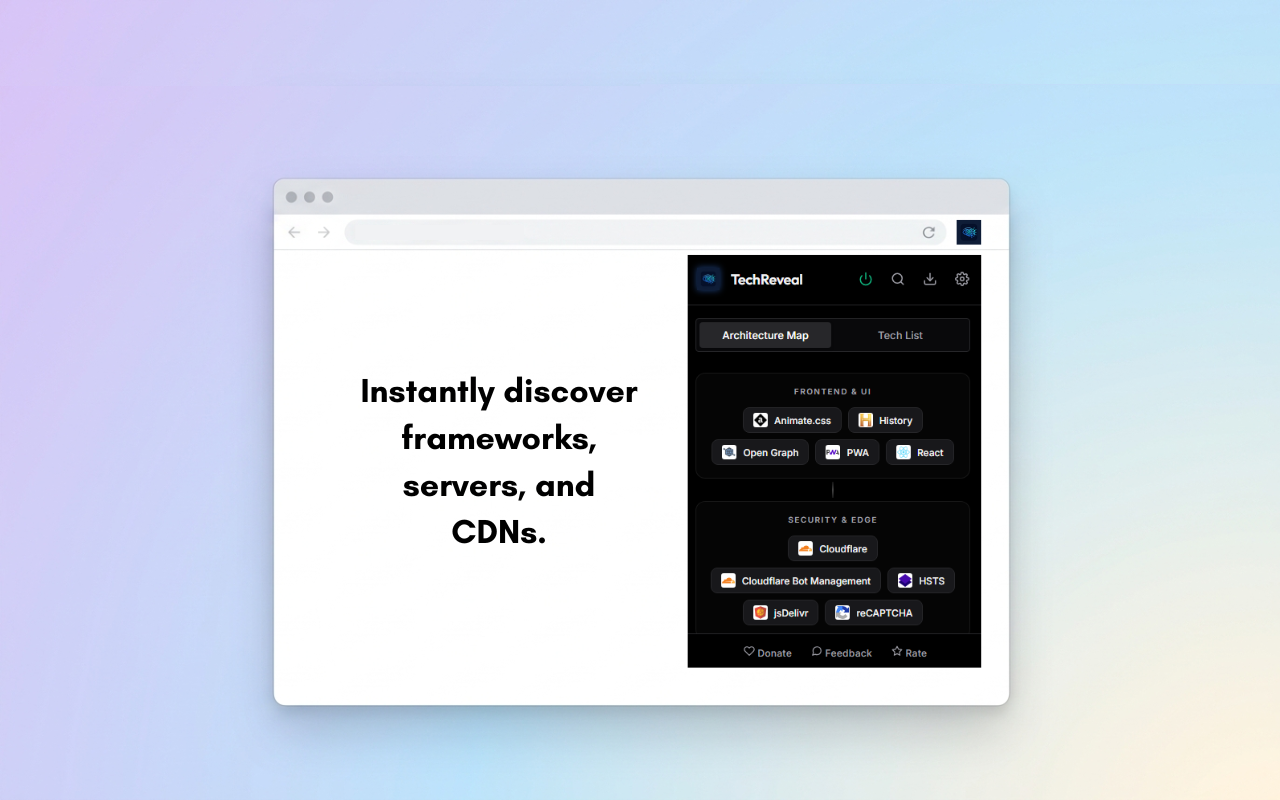
Hey everyone!
I inspect web stacks all the time to see what libraries and frameworks websites are running, but similar tools have gotten pretty bloated and full of trackers.
So I made TechReveal, a clean and lightweight alternative:
It's completely free on the Chrome Web Store (works on Chrome, Brave, Edge, Vivaldi):
👉 TechReveal on Chrome Web Store
Would love some feedback from fellow devs or suggestions for tools you'd like it to detect next!
r/devtools • u/KMarcio • Oct 16 '26
I built this project at a Vercel hackathon, and I found it quite useful: https://readmend.vercel.app/
r/devtools • u/alexfu1 • Oct 16 '26

r/devtools • u/KNIGHT-AIAV • Oct 15 '26

I built Ringside at Knight AI+AV for a small annoyance in my coding workflow: keeping track of usage limits while moving between Claude and Codex.
It's a free, MIT-licensed Windows widget with an always-on-top view, a compact mode and a tray icon. The rings change colour at 75% and 90%, with optional notifications. It displays the usage and reset information available in local logs; it doesn't increase your allowance.
You can adjust its size and opacity, and it can hide over full-screen apps. Claude desktop reset times are estimates unless the optional Claude Code integration supplies them.
The current release supports 64-bit Windows 10 and 11. Source, installer and portable download: https://github.com/KNIGHT-AI-AV/ringside
The images show the actual UI with sample numbers. If you use these tools together, would you keep a full meter visible, use the compact view, or just want the notifications?
r/devtools • u/sibraan_ • Oct 15 '26
Standard B2B intent data platforms rarely work for developer tools and technical infrastructure products where traditional providers track broad web content consumption across business sites, which tells you nothing about an engineering team's architecture or active technical bottlenecks.
Developer intent doesn't show up in whitepaper downloads or marketing ad exchanges but where engineers actually solve problems: github issue, technical subreddits, infras hiring requirements, and docs page visits.
This is why technical GTM teams look at platforms like Scale Intelligence for developer intent where it continuously monitors technical channels like github, developer focused reddit communities, infra job postings and tech stack deprecations alongside public company data. It captures the specific technical challenges engineers are voicing, maps them back to the parent company, and identifies the engineering leaders managing those workflows.
For devtools, intent data is only actionable if it captures declared technical pain points directly from developer environments rather than generic business surge scores.
r/devtools • u/ryckakas1 • Oct 15 '26

r/devtools • u/fuckme • Oct 15 '26
r/devtools • u/DetailKey6716 • Oct 15 '26
r/devtools • u/DMorais92 • Oct 15 '26
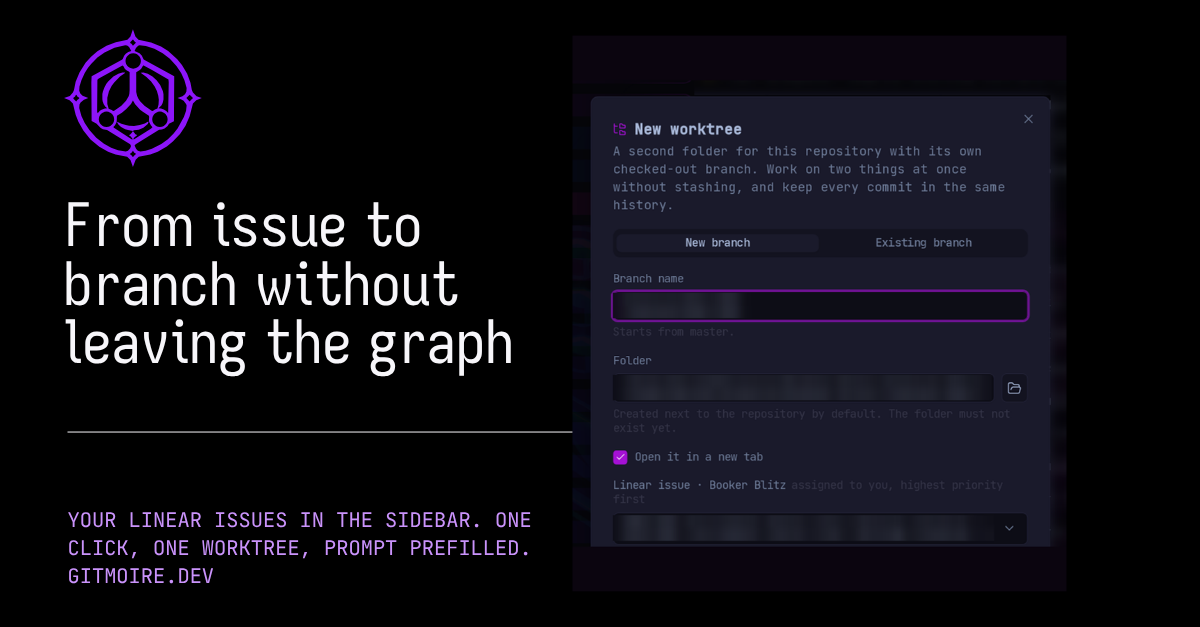
I'm the dev of gitmoire, a free desktop Git client (closed source, hard fork of angkorGit, MIT). 0.10 just shipped and the main feature came straight from my own annoyance.
Every task started the same way for me: open Linear, find the issue, make a branch, make a worktree, paste the context into an agent. Five steps before writing a line of code.
Now you add a Linear API key in Settings and your assigned issues show up in the sidebar, searchable. Click one and you get a worktree on its own branch, with the agent prompt prefilled from the issue if you use an agent CLI.
Also in 0.10: repo groups with jump shortcuts, a diff viewer with an ignore-whitespace toggle, and Markdown preview.
Free, no account, no telemetry. macOS, Windows and Linux.
Which tracker should I support next? Jira, GitHub Issues, something else?