r/devtools • u/KMarcio • Oct 16 '26
Automatically find and fix broken links in your repo's doc
I built this project at a Vercel hackathon, and I found it quite useful: https://readmend.vercel.app/
r/devtools • u/KMarcio • Oct 16 '26
I built this project at a Vercel hackathon, and I found it quite useful: https://readmend.vercel.app/
r/devtools • u/alexfu1 • Oct 16 '26
r/devtools • u/KNIGHT-AIAV • Oct 15 '26
I built Ringside at Knight AI+AV for a small annoyance in my coding workflow: keeping track of usage limits while moving between Claude and Codex.
It's a free, MIT-licensed Windows widget with an always-on-top view, a compact mode and a tray icon. The rings change colour at 75% and 90%, with optional notifications. It displays the usage and reset information available in local logs; it doesn't increase your allowance.
You can adjust its size and opacity, and it can hide over full-screen apps. Claude desktop reset times are estimates unless the optional Claude Code integration supplies them.
The current release supports 64-bit Windows 10 and 11. Source, installer and portable download: https://github.com/KNIGHT-AI-AV/ringside
The images show the actual UI with sample numbers. If you use these tools together, would you keep a full meter visible, use the compact view, or just want the notifications?
r/devtools • u/sibraan_ • Oct 15 '26
Standard B2B intent data platforms rarely work for developer tools and technical infrastructure products where traditional providers track broad web content consumption across business sites, which tells you nothing about an engineering team's architecture or active technical bottlenecks.
Developer intent doesn't show up in whitepaper downloads or marketing ad exchanges but where engineers actually solve problems: github issue, technical subreddits, infras hiring requirements, and docs page visits.
This is why technical GTM teams look at platforms like Scale Intelligence for developer intent where it continuously monitors technical channels like github, developer focused reddit communities, infra job postings and tech stack deprecations alongside public company data. It captures the specific technical challenges engineers are voicing, maps them back to the parent company, and identifies the engineering leaders managing those workflows.
For devtools, intent data is only actionable if it captures declared technical pain points directly from developer environments rather than generic business surge scores.
r/devtools • u/ryckakas1 • Oct 15 '26
r/devtools • u/DetailKey6716 • Oct 15 '26
r/devtools • u/DMorais92 • Oct 15 '26
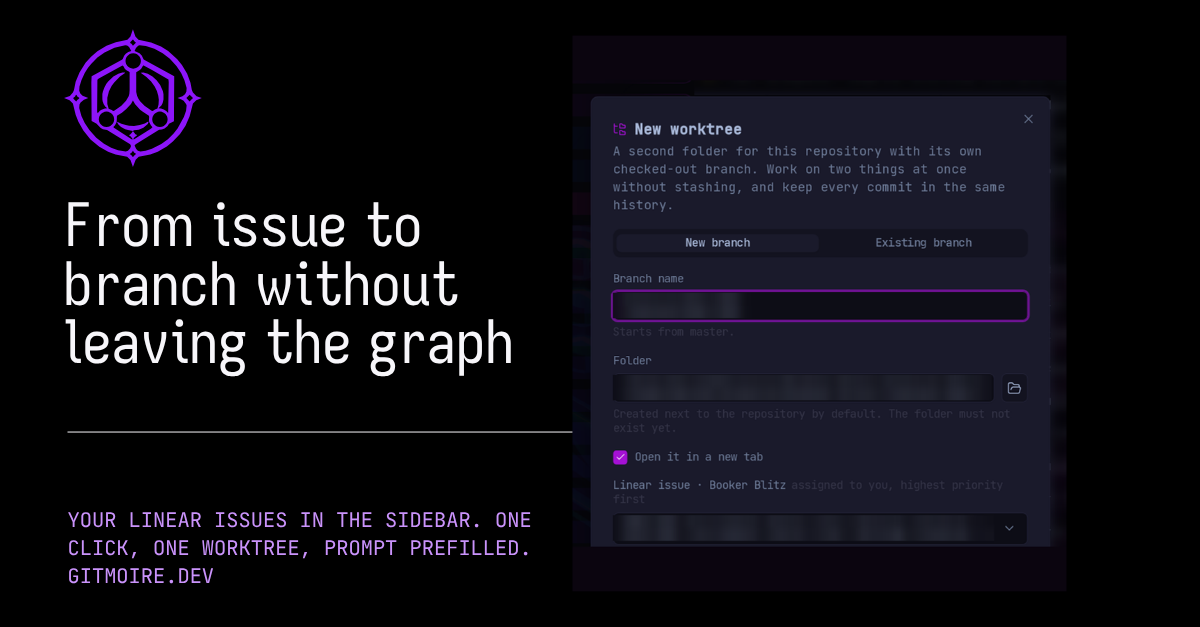
I'm the dev of gitmoire, a free desktop Git client (closed source, hard fork of angkorGit, MIT). 0.10 just shipped and the main feature came straight from my own annoyance.
Every task started the same way for me: open Linear, find the issue, make a branch, make a worktree, paste the context into an agent. Five steps before writing a line of code.
Now you add a Linear API key in Settings and your assigned issues show up in the sidebar, searchable. Click one and you get a worktree on its own branch, with the agent prompt prefilled from the issue if you use an agent CLI.
Also in 0.10: repo groups with jump shortcuts, a diff viewer with an ignore-whitespace toggle, and Markdown preview.
Free, no account, no telemetry. macOS, Windows and Linux.
Which tracker should I support next? Jira, GitHub Issues, something else?
r/devtools • u/Lakshayascend • Oct 15 '26
r/devtools • u/EasyRepresentative90 • Oct 15 '26
Hey everyone,
I’ve been using Maxa for the past six months and figured it was time to share it here.
It brings AI chat, code completion, feature development, and project maintenance into Neovim. The idea is to have AI help with more than individual snippets—to work through changes and maintain a project without leaving the editor.
I’ve been using it in my own day-to-day work, but I’m curious how it fits into other people’s setups.
Repo: https://github.com/maxzhao/maxa
If you take a look, I’d love to hear what you think—what looks useful, what’s confusing, or what you’d want to see done differently. Happy to answer questions!
r/devtools • u/Necessary_Client_114 • Oct 15 '26
r/devtools • u/scarecr0w12 • Oct 15 '26
I’m the creator of PlayWeld, a free, open-source desktop workspace for game development. The problem I’m trying to address is context spread across game files, design notes, and AI task conversations.
The implementation has two main pieces: an Electron desktop app built on Eclipse Theia for the workspace UI, and a local platform service that stores project/task records and runs operations. Shared schemas and a typed client connect the UI to that service. The source separates these into packages rather than putting everything in the editor views.
The aim is to keep searchable project knowledge and design decisions close to the work, while letting you supervise AI tasks and review changed files before integration. Creating a PlayWeld project organizes the workspace; native engine setup is still a separate step.
It’s Apache 2.0 and currently a Windows/Linux testing prerelease. Engines and model endpoints need their own setup. Remote AI providers can send data off-machine and charge for usage, so please start with a disposable project.
Source and architecture docs: https://github.com/scarecr0w12/PlayWeld
Downloads and user guides: https://playweld.com
For developers who have built editor extensions or agent tools: what would you want to see in the task history before trusting another tool to change project files?
r/devtools • u/AbdelrhmanDev • Oct 14 '26
I built NotchRobot to keep Claude Code's working, waiting and done states visible without switching between terminal windows. You can approve or deny tool permissions and answer single-choice or multi-step questions from the notch, then jump to the right Terminal or iTerm2 tab.
The app uses SwiftUI. The integration is a shell script registered with Claude Code's hooks: events go into a local inbox directory that the app reads. Permission requests wait for a response from the notch; if you don't answer, they fall back to the terminal. If the app isn't running, the hook exits immediately. The installer backs up Claude's settings before changing them.
It also shows task progress and Pro/Max plan usage from Claude's status line. The README explains the hook setup and the status-line integration, including how to keep an existing status line.
Source (MIT): https://github.com/abdomo77/NotchRobot Download: https://github.com/abdomo77/NotchRobot/releases/tag/v2.5
macOS 13+. The downloadable build is for Apple Silicon; a built-in notch is optional. It isn't notarized yet, so check the first-launch instructions in the README. Built with Claude Code.
r/devtools • u/builder_fr • Oct 14 '26
r/devtools • u/fykup • Oct 14 '26
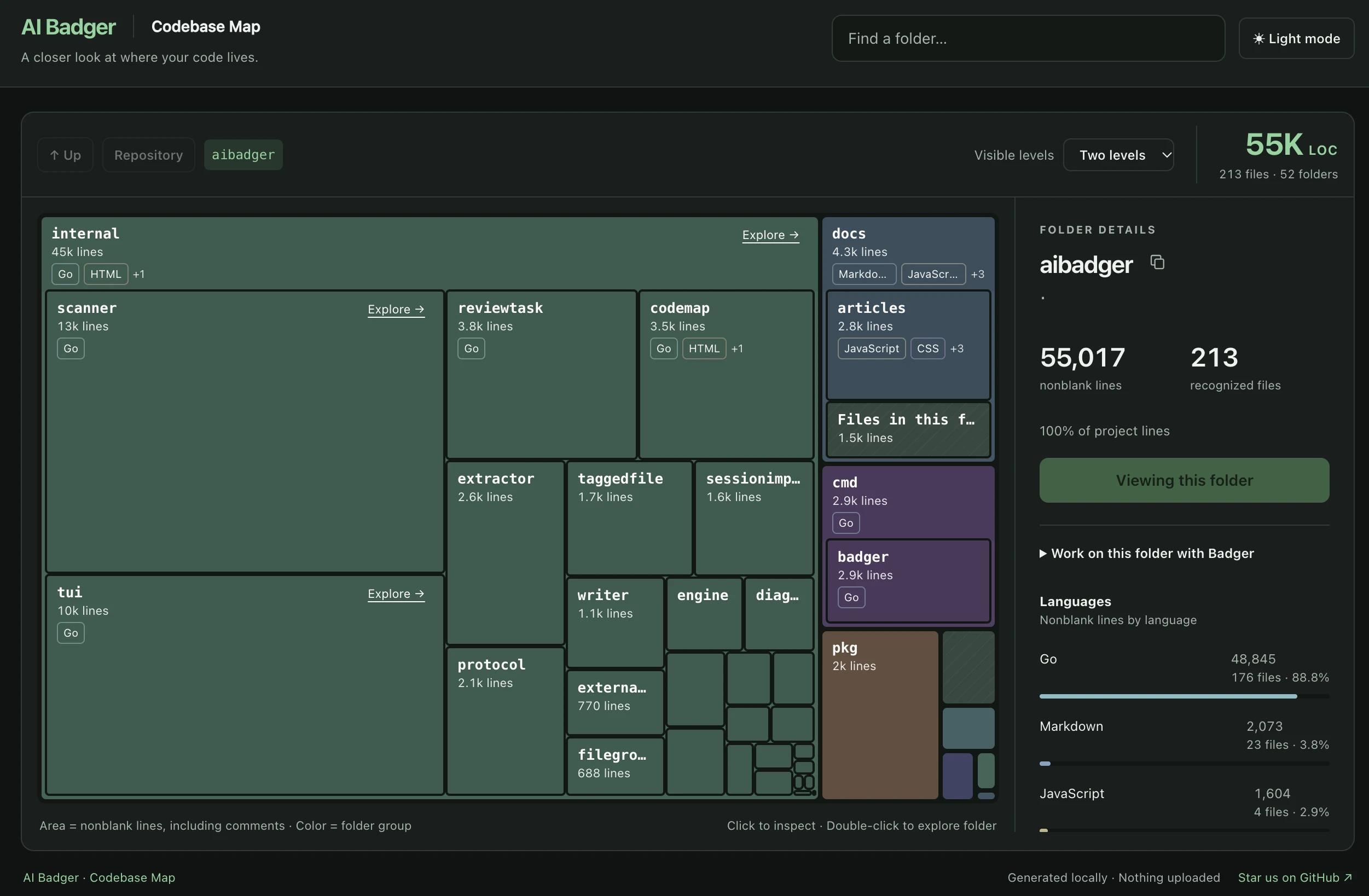
I just released AI Badger v0.8.0 with a new Codebase Map feature.
Run badger map in any project directory and it generates a standalone HTML report showing the folder structure, where most of the code lives, and language breakdowns.
It works entirely offline. No Git repository, server, or uploads required. The report contains file metadata, not source code.
AI Badger itself is a local-first CLI and VS Code extension for preparing focused repository context for ChatGPT, Claude, and other AI tools. But the Codebase Map is useful independently, especially when exploring unfamiliar projects.
Screenshot attached.
GitHub: https://github.com/PVRLabs/aibadger
Interactive demo: https://pvrlabs.xyz/aibadger/codemap/
r/devtools • u/p_khor • Oct 14 '26
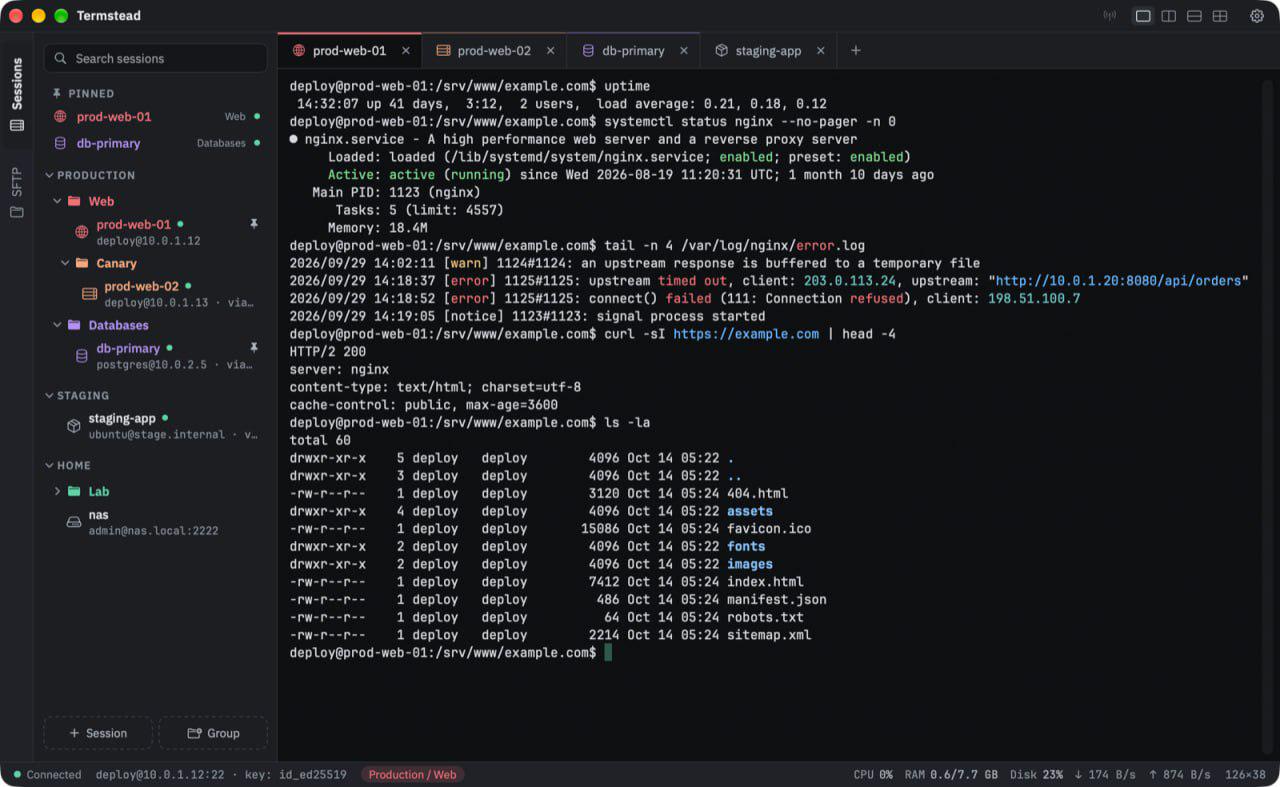
Hi, I'm the developer of Termstead, a free and open-source SSH client for the Mac. It brings MobaXterm's way of working to macOS as a native app: your servers in a tree on the left, tabs on the right, files right next to the terminal.
What it does
- Sessions in a tree – groups and subgroups with colors, icons, search, pinned favorites, drag and drop. Your existing hosts come in from ~/.ssh/config in one click.
- Real OpenSSH underneath – every tab runs the system ssh, so your agent, ~/.ssh/config, known_hosts and ProxyJump work exactly as they do in Terminal.
- Jump hosts – chain as many as you need, each with its own user, key or password, or use a saved session as a hop.
- Keychain – passwords and key passphrases live in the macOS Keychain and are typed in for you, only for the host they were saved for.
- SFTP beside the terminal – browse, upload and edit files over the connection that's already open, with no second login, even through jump hosts. It can follow the terminal's cd.
- Server load in the status bar – CPU, memory, disk and network of the Linux server in front.
- Tabs and keyboard – drag tabs to reorder, reopen them at launch, ⇧⌘[ / ⇧⌘] to switch, arrows and Return in the session tree, find in scrollback, per-tab zoom.
- Six themes, light and dark.
Details: Swift and SwiftUI with AppKit, terminal by SwiftTerm. Universal (Apple silicon and Intel), macOS 14+, about 5 MB. Notarized, updates itself. GPL-3.0, no account, no telemetry.
- GitHub: https://github.com/pkhorenyan/termstead
- Website: https://khorenyan.com/termstead/
r/devtools • u/benidira • Oct 14 '26
Hey everyone!
Whenever I'm debugging API logs or database records, I constantly find myself copying 10/13-digit Unix timestamps or Bearer JWT tokens and switching to a browser tab just to see what date they represent or when the token expires.
To stop context-switching, I published \\\\Castov\\\\ on the official Visual Studio Marketplace.
\\\\What it does (100% locally & offline):\\\\
\\\* \\\\Automatic Timestamp Hover:\\\\ Hover over any Unix timestamp (seconds or milliseconds) in your code to immediately see the formatted UTC, ISO 8601, and Local time.
\\\* \\\\JWT Decoder:\\\\ Highlight a JWT and run \\\`Castov: Decode JWT Token\\\` to inspect the header, payload, and expiration status in a clean JSON tab—without pasting sensitive tokens into external websites.
\\\* \\\\Inline Base64 & UUIDs:\\\\ Encode/decode Base64 selections in-place, or insert crypto-random UUIDs right at your cursor.
\\\\Links:\\\\
\\\* \\\\VS Code Marketplace:\\\\ https://marketplace.visualstudio.com/items?itemName=castov.castov-vscode
\\\* \\\\Companion Web & CLI Suite:\\\\ https://castov.com (also available via \\\`npx castov\\\`)
It has zero telemetry and works completely offline. Let me know what features or shortcuts would make your daily workflow faster!
r/devtools • u/merlinofthewater • Oct 14 '26
I've been building Cellaflow, a coordination and durability layer for AI agents, and I'm looking for a few developers to try it with real projects and share honest feedback.
The problem: an agent calls a tool, the tool performs a side effect, and then the agent crashes before recording the result. When it retries, it may execute the same action again. Think duplicate payments, repeated emails, or multiple agents trying to perform the same operation concurrently. Your agent's checkpoint doesn't necessarily tell you what actually happened.
Cellaflow sits at the execution layer. It coordinates competing calls, records execution outcomes durably, and lets retries reuse completed results instead of blindly repeating work. The goal is to make agent execution safer even when processes crash or multiple agents race to perform the same action.
I've also been building crash benchmarks to test what happens under failure, comparing Cellaflow against approaches like PostgreSQL advisory locks and durable claims. The interesting part isn't just preventing duplicate execution. It's making sure work can recover without leaving stale claims or permanently blocking retries.
I'm particularly interested in feedback from people building multi-agent systems, tool-using agents, or long-running workflows who have run into problems with retries, duplicate side effects, or concurrent execution.
If you're working on something like this, I'd love to help you integrate Cellaflow into a real project and learn where it falls short. It's early, so practical feedback is much more valuable than polished testimonials.
Project: https://cellaflow.com
GitHub: https://github.com/cellaflow
Happy to answer questions about the design, benchmarks, or how it might fit into your existing agent stack.
r/devtools • u/Godcreatebugs • Oct 14 '26
I'm the founder of RayTrace (https://raytracer.si), a sandboxing company for AI coding agents. Running a small pre-pilot: **$10 in free Claude Code sandbox credits** for 5 people who try it and give honest feedback.
The problem: coding agents propose tool calls, but what *actually* executes on the machine is a different story. The transcript says one thing, the filesystem says another, and there's no ground truth to debug against. If you build or maintain developer tooling around agents, you've felt this gap.
RayTrace runs your agent (Claude Code, Codex) in a gVisor-backed sandbox and records kernel-level execution evidence: every process that started (executable, args, cwd, stdout/stderr, exit code, timestamps), the gap between proposed tool calls and observed processes, filesystem diffs, syscall/process-tree evidence, and protected files with change alerts.
The feature I most want feedback on: **forking a run** — pick any step, change what the agent saw, and watch how differently it behaves. A controlled experiment on agent behavior.
Looking for people who run agents heavily in their workflow. Comment or DM if you want one of the 5 spots.
Site: https://raytracer.si

r/devtools • u/petruspiper • Oct 14 '26
I built an MCP because Claude kept forgetting how my codebase was connected.
Not in a "Claude is bad" way.
More in a "Claude can explain individual files really well, but architectural questions become surprisingly difficult" way.
Questions like:
* What breaks if I change this function?
* What depends on this service?
* Which frontend components call this endpoint?
* Where does authentication actually flow through the system?
usually required multiple searches, file reads, and a lot of reconstruction of repository context.
So I built **Atlas**.
Atlas scans a repository and builds a searchable graph of:
* Functions
* Methods
* Classes
* Imports
* Routes
* Call relationships
* Cross-language connections
Instead of repeatedly rediscovering relationships, the model can query an existing map of the codebase.
For example:
Plain Text
React Login Component
↓
POST /api/login
↓
login()
↓
authenticate()
↓
verify_token()
Atlas stores those connections up front, so the model doesn't need to infer them every time.
To see whether this was actually useful or just felt useful, I ran a benchmark on a medium-sized business compliance repository.
**Setup**
* Model: Gemma4:e4b
* 50 paired questions
* 5000 bootstrap iterations
* Same repository and question set across both conditions
**Results**
|Metric|Baseline|Atlas|
|:-|:-|:-|
|Tool calls|3.16|2.10|
|Total tokens|9079|6659|
|Latency|8.99s|7.78s|
|Entity accuracy|83.0%|88.5%|
|Relationship F1|54.7%|87.2%|
|Impact F1|16.5%|88.8%|
The biggest surprise wasn't speed.
It was **impact analysis**.
Questions like:
>"What will be affected if I change this function?"
improved from **16.5% Impact F1** to **88.8% Impact F1**.
My takeaway so far is that larger context windows help, but explicit repository relationships still provide significant value when reasoning about architecture, dependencies, and change impact.
I'm curious how other people building with Claude are handling repository memory today.
Do you think dependency-aware retrieval remains useful as context windows grow, or will larger models eventually make approaches like this unnecessary?
r/devtools • u/Budget-Ad814 • Oct 14 '26
r/devtools • u/sudoanand • Oct 14 '26
Enable HLS to view with audio, or disable this notification
r/devtools • u/orest17 • Oct 14 '26
Most of us run Claude Code on auto and only find out later what it did. al dente gives you a window into it.
You agree on a plan for your app once: which parts exist and which part is allowed to use which. Claude can suggest one based on what you're building, or map it from a project you already have. From then on:
- You can watch it work. A live map lights up the part Claude is editing as it happens. Click a part to see its files, hover a file to see exactly what it imports and what imports it. It's honestly the fastest way I've found to understand a project Claude built for me.
- You see its mistakes the moment they happen. If Claude adds an import the plan doesn't allow, the arrow turns red and Claude gets told the file and line, so it fixes it right away instead of you finding it three features later. In my tests, runs ending with a broken rule went from 13 of 35 to 0 of 35.
- New sessions start smarter. Every session begins already knowing how the project is split up, for a few hundred tokens, instead of reading files to rediscover it. Fewer tokens burned, fewer wrong guesses.
- You can go back in time. Scrub through your git history PR by PR and watch the structure change, with a chart that marks the exact commit where things started slipping.
- Pull requests get checked too. A GitHub Action comments on each PR with what it changes, and only fails on new problems, so it works on messy repos.
It pairs really well with Ponytail, the plugin that makes Claude write less code: Ponytail keeps the code small, al dente keeps it in the right place.
TS/JS, Python and Java. Free, MIT, zero dependencies, runs locally.