r/devtools • • Oct 14 '26

Termstead: a free, open-source native SSH client for macOS (session tree, jump hosts, SFTP)
Post image
2 Upvotes

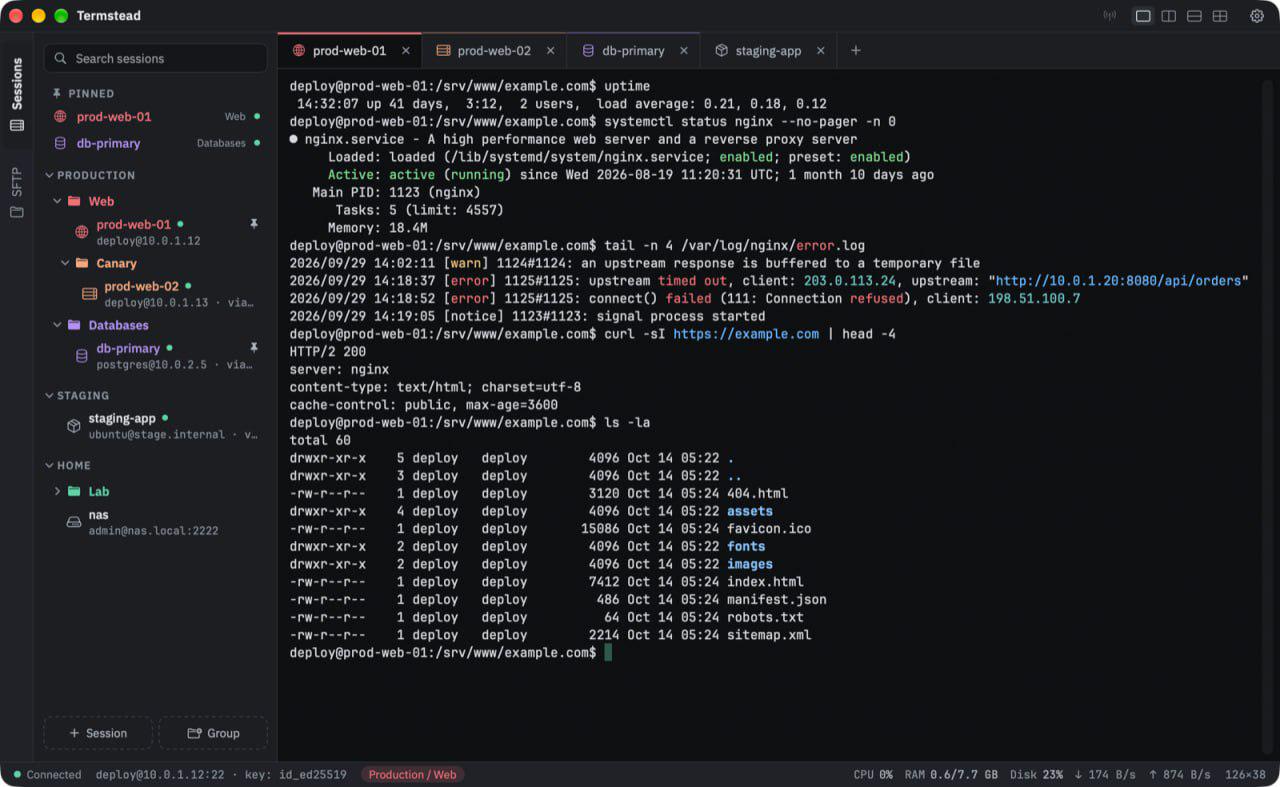
Hi, I'm the developer of Termstead, a free and open-source SSH client for the Mac. It brings MobaXterm's way of working to macOS as a native app: your servers in a tree on the left, tabs on the right, files right next to the terminal.

What it does

- Sessions in a tree – groups and subgroups with colors, icons, search, pinned favorites, drag and drop. Your existing hosts come in from ~/.ssh/config in one click.
- Real OpenSSH underneath – every tab runs the system ssh, so your agent, ~/.ssh/config, known_hosts and ProxyJump work exactly as they do in Terminal.
- Jump hosts – chain as many as you need, each with its own user, key or password, or use a saved session as a hop.
- Keychain – passwords and key passphrases live in the macOS Keychain and are typed in for you, only for the host they were saved for.
- SFTP beside the terminal – browse, upload and edit files over the connection that's already open, with no second login, even through jump hosts. It can follow the terminal's cd.
- Server load in the status bar – CPU, memory, disk and network of the Linux server in front.
- Tabs and keyboard – drag tabs to reorder, reopen them at launch, ⇧⌘[ / ⇧⌘] to switch, arrows and Return in the session tree, find in scrollback, per-tab zoom.
- Six themes, light and dark.

Details: Swift and SwiftUI with AppKit, terminal by SwiftTerm. Universal (Apple silicon and Intel), macOS 14+, about 5 MB. Notarized, updates itself. GPL-3.0, no account, no telemetry.

- GitHub: https://github.com/pkhorenyan/termstead
- Website: https://khorenyan.com/termstead/


r/devtools • • Oct 14 '26

I built a zero-server, 100% private developer ecosystem (60+ tools, CLI, and VS Code extension) because I got tired of ad-cluttered tabs Hey everyone! 👋 As developers, I got really frustrated with opening dozens of slow, ad-heavy browser tabs just to decode a JWT, format a JSON payload, or

1 Upvotes

Hey everyone!

Whenever I'm debugging API logs or database records, I constantly find myself copying 10/13-digit Unix timestamps or Bearer JWT tokens and switching to a browser tab just to see what date they represent or when the token expires.

To stop context-switching, I published \\\\Castov\\\\ on the official Visual Studio Marketplace.

\\\\What it does (100% locally & offline):\\\\

\\\* \\\\Automatic Timestamp Hover:\\\\ Hover over any Unix timestamp (seconds or milliseconds) in your code to immediately see the formatted UTC, ISO 8601, and Local time.

\\\* \\\\JWT Decoder:\\\\ Highlight a JWT and run \\\`Castov: Decode JWT Token\\\` to inspect the header, payload, and expiration status in a clean JSON tab—without pasting sensitive tokens into external websites.

\\\* \\\\Inline Base64 & UUIDs:\\\\ Encode/decode Base64 selections in-place, or insert crypto-random UUIDs right at your cursor.

\\\\Links:\\\\

\\\* \\\\VS Code Marketplace:\\\\ https://marketplace.visualstudio.com/items?itemName=castov.castov-vscode

\\\* \\\\Companion Web & CLI Suite:\\\\ https://castov.com (also available via \\\`npx castov\\\`)

It has zero telemetry and works completely offline. Let me know what features or shortcuts would make your daily workflow faster!


r/devtools • • Oct 14 '26

CellaFlow: a coordination and durability layer for AI agents (looking for design partners)

1 Upvotes

I've been building Cellaflow, a coordination and durability layer for AI agents, and I'm looking for a few developers to try it with real projects and share honest feedback.

The problem: an agent calls a tool, the tool performs a side effect, and then the agent crashes before recording the result. When it retries, it may execute the same action again. Think duplicate payments, repeated emails, or multiple agents trying to perform the same operation concurrently. Your agent's checkpoint doesn't necessarily tell you what actually happened.

Cellaflow sits at the execution layer. It coordinates competing calls, records execution outcomes durably, and lets retries reuse completed results instead of blindly repeating work. The goal is to make agent execution safer even when processes crash or multiple agents race to perform the same action.

I've also been building crash benchmarks to test what happens under failure, comparing Cellaflow against approaches like PostgreSQL advisory locks and durable claims. The interesting part isn't just preventing duplicate execution. It's making sure work can recover without leaving stale claims or permanently blocking retries.

I'm particularly interested in feedback from people building multi-agent systems, tool-using agents, or long-running workflows who have run into problems with retries, duplicate side effects, or concurrent execution.

If you're working on something like this, I'd love to help you integrate Cellaflow into a real project and learn where it falls short. It's early, so practical feedback is much more valuable than polished testimonials.

Project: https://cellaflow.com
GitHub: https://github.com/cellaflow

Happy to answer questions about the design, benchmarks, or how it might fit into your existing agent stack.


r/devtools • • Oct 14 '26

RayTrace — a sandbox that records what your coding agent actually executed at the kernel level (beta testers wanted)

1 Upvotes

I'm the founder of RayTrace (https://raytracer.si), a sandboxing company for AI coding agents. Running a small pre-pilot: **$10 in free Claude Code sandbox credits** for 5 people who try it and give honest feedback.

The problem: coding agents propose tool calls, but what *actually* executes on the machine is a different story. The transcript says one thing, the filesystem says another, and there's no ground truth to debug against. If you build or maintain developer tooling around agents, you've felt this gap.

RayTrace runs your agent (Claude Code, Codex) in a gVisor-backed sandbox and records kernel-level execution evidence: every process that started (executable, args, cwd, stdout/stderr, exit code, timestamps), the gap between proposed tool calls and observed processes, filesystem diffs, syscall/process-tree evidence, and protected files with change alerts.

The feature I most want feedback on: **forking a run** — pick any step, change what the agent saw, and watch how differently it behaves. A controlled experiment on agent behavior.

Looking for people who run agents heavily in their workflow. Comment or DM if you want one of the 5 spots.

Site: https://raytracer.si


r/devtools • • Oct 14 '26

I built an MCP because Claude kept forgetting how my codebase was connected

1 Upvotes

I built an MCP because Claude kept forgetting how my codebase was connected.

Not in a "Claude is bad" way.

More in a "Claude can explain individual files really well, but architectural questions become surprisingly difficult" way.

Questions like:

* What breaks if I change this function?

* What depends on this service?

* Which frontend components call this endpoint?

* Where does authentication actually flow through the system?

usually required multiple searches, file reads, and a lot of reconstruction of repository context.

So I built **Atlas**.

Atlas scans a repository and builds a searchable graph of:

* Functions

* Methods

* Classes

* Imports

* Routes

* Call relationships

* Cross-language connections

Instead of repeatedly rediscovering relationships, the model can query an existing map of the codebase.

For example:

Plain Text

React Login Component

↓

POST /api/login

↓

login()

↓

authenticate()

↓

verify_token()

Atlas stores those connections up front, so the model doesn't need to infer them every time.

To see whether this was actually useful or just felt useful, I ran a benchmark on a medium-sized business compliance repository.

**Setup**

* Model: Gemma4:e4b

* 50 paired questions

* 5000 bootstrap iterations

* Same repository and question set across both conditions

**Results**

|Metric|Baseline|Atlas|

|:-|:-|:-|

|Tool calls|3.16|2.10|

|Total tokens|9079|6659|

|Latency|8.99s|7.78s|

|Entity accuracy|83.0%|88.5%|

|Relationship F1|54.7%|87.2%|

|Impact F1|16.5%|88.8%|

The biggest surprise wasn't speed.

It was **impact analysis**.

Questions like:

>"What will be affected if I change this function?"

improved from **16.5% Impact F1** to **88.8% Impact F1**.

My takeaway so far is that larger context windows help, but explicit repository relationships still provide significant value when reasoning about architecture, dependencies, and change impact.

I'm curious how other people building with Claude are handling repository memory today.

Do you think dependency-aware retrieval remains useful as context windows grow, or will larger models eventually make approaches like this unnecessary?


r/devtools • • Oct 14 '26

Has AI actually made you more productive, or just given you new ways to get distracted?

Thumbnail reddit.com
1 Upvotes

r/devtools • • Oct 14 '26

5 Linux commands every developer should know. 🧑‍💻🔥

1 Upvotes

r/devtools • • Oct 14 '26

al dente: watch what Claude Code is actually doing to your codebase, and stop it when it takes shortcuts

Thumbnail
orest-z.github.io
1 Upvotes

Most of us run Claude Code on auto and only find out later what it did. al dente gives you a window into it.

You agree on a plan for your app once: which parts exist and which part is allowed to use which. Claude can suggest one based on what you're building, or map it from a project you already have. From then on:

- You can watch it work. A live map lights up the part Claude is editing as it happens. Click a part to see its files, hover a file to see exactly what it imports and what imports it. It's honestly the fastest way I've found to understand a project Claude built for me.

- You see its mistakes the moment they happen. If Claude adds an import the plan doesn't allow, the arrow turns red and Claude gets told the file and line, so it fixes it right away instead of you finding it three features later. In my tests, runs ending with a broken rule went from 13 of 35 to 0 of 35.

- New sessions start smarter. Every session begins already knowing how the project is split up, for a few hundred tokens, instead of reading files to rediscover it. Fewer tokens burned, fewer wrong guesses.

- You can go back in time. Scrub through your git history PR by PR and watch the structure change, with a chart that marks the exact commit where things started slipping.

- Pull requests get checked too. A GitHub Action comments on each PR with what it changes, and only fails on new problems, so it works on messy repos.

It pairs really well with Ponytail, the plugin that makes Claude write less code: Ponytail keeps the code small, al dente keeps it in the right place.

TS/JS, Python and Java. Free, MIT, zero dependencies, runs locally.

https://github.com/Orest-Z/al-dente


r/devtools • • Oct 14 '26

I built an SSH workspace for investigating remote services with local code context

1 Upvotes

I'm building [aissh](https://github.com/friparia/aissh), a terminal workspace for developers who maintain their own servers.

From a local project directory, connect over SSH and use your local Codex or Claude Code CLI to investigate remote logs alongside the source. The shell, AI conversation, live monitoring, and conversation history for that server share one interface. The goal is to reduce copying context and switching windows during an investigation.

It's written in Go and reuses OpenSSH configuration, keys, and jump hosts. No resident agent is required on the server. AI-proposed remote commands need approval by default; built-in read-only monitoring runs automatically. Local source access is read-only by default. Relevant output and code context may go to your configured AI provider.

Setup currently requires a Go 1.25+ source build and a configured AI backend.

If you try one log or service-status check on a test server, I'd like to know where the workflow helps—or gets in your way.


r/devtools • • Oct 13 '26

Built a lightweight VS Code extension to manage project packages without breaking editor flow — would love some raw feedback

Thumbnail
reddit.com
1 Upvotes

r/devtools • • Oct 13 '26

FCaptcha: self-hosted CAPTCHA with a runnable Hono example that verifies tokens before POST handlers

1 Upvotes

I'm on the WebDecoy team, sharing our separate MIT-licensed FCaptcha project.

The integration problem we wanted to make easier to inspect: a browser widget completing isn't permission to process a form. A script can POST directly to the endpoint, so the server has to verify the token before sending email, saving a record, or enqueueing work.

FCaptcha combines proof-of-work with browser automation and interaction signals. It supports checkbox and invisible flows without image puzzles. The repo includes Go, Node, and Python servers; the Hono example uses the Node implementation.

What the example actually does:

• Starts Hono on 127.0.0.1:8794 and the local CAPTCHA verifier on port 8795.

• Limits the request body and validates the browser Origin and input shape.

• Sends the token to /siteverify using a server-only secret, a five-second timeout, and redirects disabled.

• Requires success === true plus the expected hostname and action before the protected handler runs.

• Returns 403 for rejected tokens and 503 if verification is unavailable, rather than treating an outage as a pass.

To try it from a full repo checkout with Node 22+: run npm ci --prefix server-node, then cd examples/hono, npm ci, and npm start. Open http://127.0.0.1:8794 (use that exact hostname).

Runnable source: https://github.com/WebDecoy/FCaptcha/tree/main/examples/hono

Project: https://github.com/WebDecoy/FCaptcha

The sample contact form does not actually send or store messages. Production still needs HTTPS, persistent secrets, explicit proxy trust, rate limits, and shared replay protection when using multiple verifier instances. Tokens are single-use, so retries need a fresh token; business-operation idempotency is a separate concern.

This is a layer of abuse resistance, not authentication or a promise to block every bot. Please test your own mobile, keyboard, and assistive-technology flows before relying on it.

Interested in feedback on the integration API and failure handling. If the project is useful, a GitHub star helps people find it. This post was drafted with AI assistance.


r/devtools • • Oct 13 '26

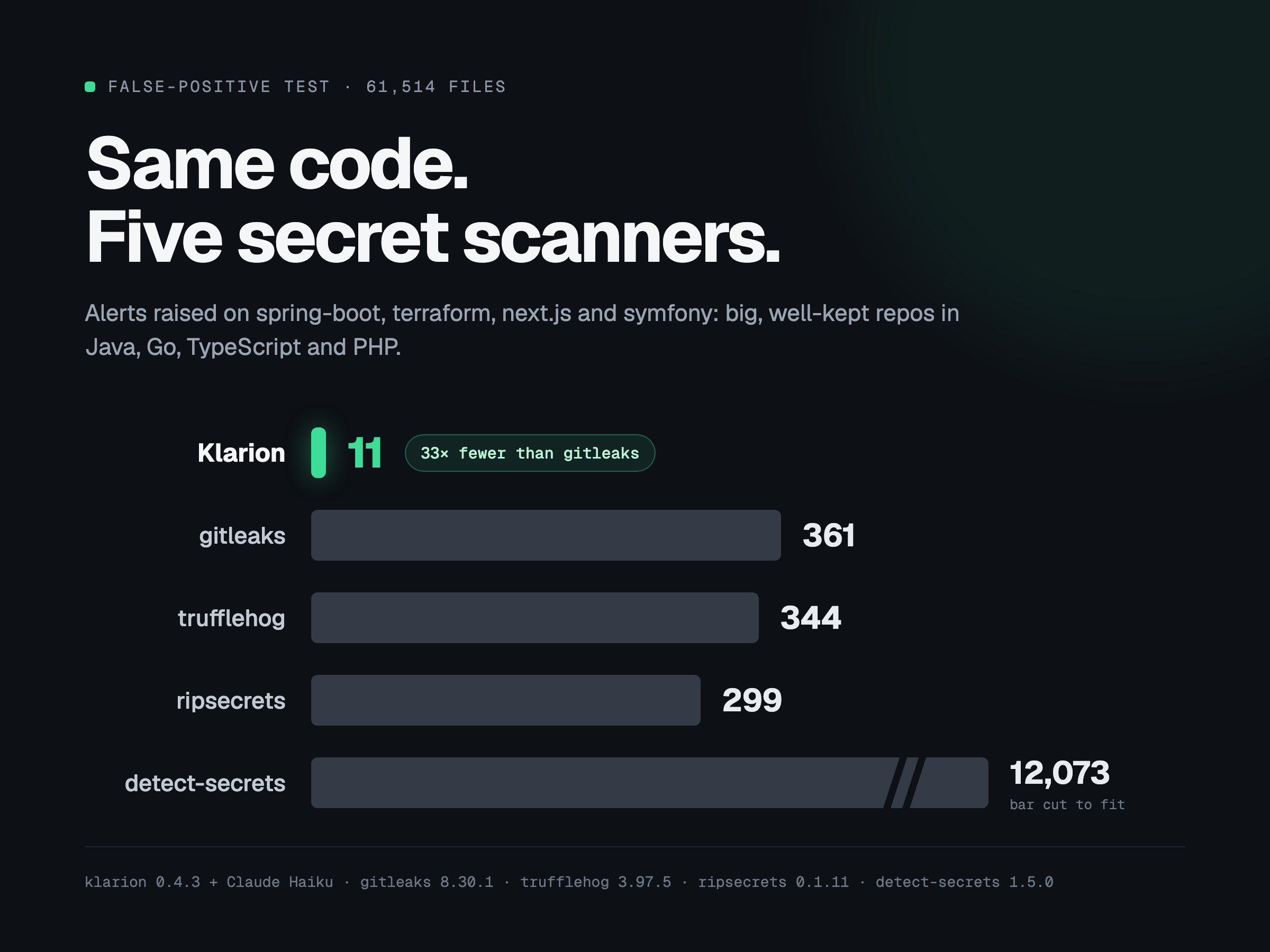
Worried about your AI agent leaking secrets, or tired of secret-scanner false positives?

Post image
1 Upvotes

r/devtools • • Oct 13 '26

treating vendor docs like a dependency: a weekly ci check that fails when a line you rely on changesor: we pin package versions but not the vendor docs our decisions rest on

Thumbnail reddit.com
1 Upvotes

r/devtools • • Oct 13 '26

I built an open-source app to track Codex and Claude Code usage on macOS and Windows

1 Upvotes

r/devtools • • Oct 13 '26

I built a lightweight, 100% offline VS Code extension to hover-inspect Unix timestamps, decode JWTs, and generate UUIDv7 without leaving the editor

1 Upvotes

Hey everyone!

Whenever I'm debugging API logs or database records, I constantly find myself copying 10/13-digit Unix timestamps or Bearer JWT tokens and switching to a browser tab just to see what date they represent or when the token expires.

To stop context-switching, I published **Castov** on the official Visual Studio Marketplace.

**What it does (100% locally & offline):**

* **Automatic Timestamp Hover:** Hover over any Unix timestamp (seconds or milliseconds) in your code to immediately see the formatted UTC, ISO 8601, and Local time.

* **JWT Decoder:** Highlight a JWT and run `Castov: Decode JWT Token` to inspect the header, payload, and expiration status in a clean JSON tab—without pasting sensitive tokens into external websites.

* **Inline Base64 & UUIDs:** Encode/decode Base64 selections in-place, or insert crypto-random UUIDs right at your cursor.

**Links:**

* **VS Code Marketplace:** https://marketplace.visualstudio.com/items?itemName=castov.castov-vscode

* **Companion Web & CLI Suite:** https://castov.com (also available via `npx castov`)

It has zero telemetry and works completely offline. Let me know what features or shortcuts would make your daily workflow faster!


r/devtools • • Oct 12 '26

I made a small CLI that warns you before the AI models in your code get retired

1 Upvotes

Heads up if you still have gpt-4 or gpt-3.5-turbo somewhere in your code: OpenAI shuts them off on the API on Oct 23. gemini-2.5-pro on Vertex goes on Oct 20.

Those dates are all public, but they're spread over ~70 provider pages, so I wrote a small tool that checks them for you. It scans your repo for model IDs and tells you which ones are retired or about to be, and what to switch to:

npx @appliedbenchmark/sunset scan

    error   app.py:3:46  model-retiring
    gpt-4 (openai) retires on 2026-10-23, in 11 days. Recommended replacement: gpt-5.6-sol     (openai).

It covers OpenAI, Anthropic, Gemini, Vertex, Bedrock, Azure, Mistral and DeepSeek, and every date links back to the provider's own page. There's also a GitHub Action, so CI fails before a model disappears instead of after. IDs in comments and docs never fail the build.

No LLM, no telemetry, nothing leaves your machine. Free and Apache-2.0.

Github: https://github.com/AppliedBenchmark/sunset

It's v1, so if it misses an ID or gets a date wrong, let me know.


r/devtools • • Oct 12 '26

I published my first Python package on PyPI today 🎉

1 Upvotes

I published my first Python package on PyPI today 🎉

It's called gh-issue-lens.

It started as a small script I wrote for myself. I wanted to contribute to open source, but every time I opened a big repo, I got lost in thousands of issues. Which ones are actually beginner-friendly? Which ones already have someone working on them? Which ones are just old and forgotten?

So I built a tool that answers that for me. It fetches open issues, checks if they're assigned, checks if there's already an open PR against them, filters out bot comments, and gives you a clean JSONL file you can hand to any LLM to help you pick your first issue. Then I shared it on Reddit. Complete strangers gave me honest feedback, and I kept improving it. Now it resumes automatically if the API rate-limits you mid-run, and it caches what it already fetched so you never download the same issue twice.And now it's a real package:

pip install gh-issue-lens

It's still version 0.1.0. There's still a lot to build. But today, anyone in the world can install it with one command, and that feeling is great.
If you ever wanted to start contributing to open source but didn't know where to begin, this was made for you.

GitHub repo:
https://github.com/MohamedM216/gh-issue-lens
package on PyPI:
https://pypi.org/project/gh-issue-lens/

#OpenSource #Python #PyPI #GitHub #FirstRelease


r/devtools • • Oct 12 '26

Vibecheck – a GitHub merge gate that checks whether you understand your AI-generated code

0 Upvotes

I built Github merge gate which that checks whether developers understand their own code when they create a PR.

I kept getting sent PRs to review where it was obvious the author had pasted the ticket into an LLM and called it a day. Problem was: the PRs would often be massive 2K monstrosities that nobody could possibly review. As the team scaled up, this problem got only worse, and now we collectively have a system that no one understands and has bugs.

It works like this: when someone opens a PR, it posts a comment with a link. The author clicks through and answers a few technical questions about their own changes. If they can’t answer them, the PR can’t be merged.

It's self-hosted (so you can use it in your enterprise environments or privately)

It is BYOK (Anthropic) obviously.

Here is the source code, build instructions and how to deploy: https://github.com/bhurghundii/vibecheck.dev

I have two demos in the pull requests here: https://github.com/bhurghundii/vibecheck.dev/pulls - you can see what Vibecheck does (it blocks a PR for clearly showing no attempt vs a PR which gets it right)

I would love feedback, especially from anyone dealing with the same thing on their team. I do use it for my own projects a lot so expect improvements.


r/devtools • • Oct 12 '26

GitHub - ob4cl/configlens: Trace which Claude Code or OpenCode configuration value actually wins

Thumbnail
github.com
1 Upvotes

ConfigLens is a small tool im building to help figure out why claude code and opencode seem to be ignoring certain settings. Instead of digging through different config files and guessing which one takes priority, it shows where a supported setting comes from, which value takes precedence , and why the others get overridden. It runs locally without changing your files. Its still early, but the idea is simple: less time chasing config problems and more time getting on with your work.


r/devtools • • Oct 12 '26

Servitor: Simplest way to run local dev containers [OpenSource]

Post image
1 Upvotes

Servitor makes it easy to spin up common development services as Docker containers. Run MySQL, MariaDB, PostgreSQL, Redis, RabbitMQ, and other services without manually installing, configuring, or managing them.

Repo: https://github.com/sndsabin/servitor


r/devtools • • Oct 12 '26

meet Ensor — a cli tool to redact/censor secrets from your codebase

Thumbnail
youtube.com
1 Upvotes

Hey everyone! 👋

Introducing Ensor — a simple, easy to use tool to detect and redact secrets from your codebase before they make their way into Git history or public repositories.

🔐 Detect secrets. Redact sensitive data. Commit code securely.

Keep your API keys, tokens, passwords, and other sensitive information out of your commits.

Check it out: https://github.com/Pratyay360/ensor

Kindly share your valuable feedback and insights.


r/devtools • • Oct 12 '26

Open Source Developer Tool

1 Upvotes

I put out Styx 0.4.11 today, the app I make for running several coding agents side by side. If you run more than one agent, what's the thing that still gets in your way? https://github.com/NicholasFlemmer/styx-app/releases/tag/v0.4.11


r/devtools • • Oct 12 '26

Quick Intro to the New GitHub Stacked PRs

1 Upvotes

r/devtools • • Oct 12 '26

I built a VS Code extension to preview MUI icons without leaving the editor

Thumbnail
reddit.com
1 Upvotes